
The Remote Work Relationship Crisis (The Data Is Clear)
Remote work is not just changing how we work — it is fundamentally changing how we build professional relationships. And the data is alarming.
A 2025 Microsoft Work Trend Index study of 31,000 workers found that:
- Remote workers have 50% fewer cross-team connections than in-office workers
- 60% of remote workers report feeling "less connected to their organization" than before the shift to remote
- Remote workers are 30% less likely to receive promotions than hybrid or in-office peers at the same performance level
- The primary reason cited for the promotion gap: "lack of visibility" and "weaker relationships with decision-makers"
The problem is not remote work itself. It is that most professionals have not replaced the relationship-building that used to happen passively. In an office, you build trust through thousands of micro-interactions: bumping into your VP in the coffee line, chatting with a cross-functional partner before a meeting starts, overhearing a conversation that gives you organizational context.
Remote work zeroes out all of these. Every interaction now requires a calendar invite, a Slack message, or a deliberate decision to connect. Professionals who rely on "it will happen naturally" find that nothing happens at all.
The professionals who thrive remotely are the ones who build a deliberate system for relationship maintenance — they do not leave connection to chance.
The Deliberate Networking Framework for Remote Workers
In-office networking happens by default. Remote networking happens by design. Here is the framework:
Principle 1: Structured Serendipity Replace casual encounters with scheduled ones. This sounds contradictory, but it works: schedule 15-minute "virtual coffee" chats with 2-3 colleagues per week. No agenda. Just connection. Over time, these create the same familiarity and trust that hallway conversations used to provide.
Principle 2: Over-Communicate Intentionally In an office, people see you working. Remotely, they see a name on Slack. You must deliberately communicate your work, your thinking, and your contributions. This is not self-promotion — it is visibility. Share your thought process, not just your outputs.
Principle 3: Build Your Digital Body Language In-office trust is built partly through physical cues: eye contact, body language, showing up consistently. Remotely, trust is built through digital behaviors: responding promptly, turning your camera on, following through on commitments, and being reliably present in team channels.
Principle 4: Invest in Cross-Functional Relationships Remote work creates deeper silos than office work because there are no shared physical spaces. Proactively build relationships outside your immediate team — these cross-functional connections are both harder to form and more valuable when working remotely.
Principle 5: Track Everything In an office, repeated physical presence reinforces relationships. Remotely, out of sight means out of mind. If you do not systematically track your professional relationships — who you have connected with recently, who is overdue for a touchpoint, what you discussed last time — your network erodes without you noticing.
| In-Office (Ambient) | Remote (Deliberate) | Why the Remote Version Is Actually Better |
|---|---|---|
| Hallway chats | Scheduled 15-min virtual coffees | More focused, more intentional, more equitable for introverts |
| Overhearing context | Proactive Slack/email information sharing | Creates written record, reaches more people, is searchable |
| Lunch with colleagues | Virtual coworking sessions or group calls | Can include people from different offices/time zones |
| Running into senior leaders | Scheduled 1-on-1s with skip-level managers | More substantive conversations than elevator small talk |
| Reading the room | Stakeholder tracking in Orvo | Documented, reviewable, not dependent on memory |
The Weekly Remote Networking Routine (90 Minutes)
Here is the exact weekly system for building and maintaining professional relationships while working remotely.
Monday: Relationship Dashboard Review (15 min)
- Open your Orvo dashboard: who have you not connected with in 2+ weeks?
- Check for stakeholder relationship health: any key relationships going cold?
- Review the week's calendar: which meetings have important relationship dynamics?
- Set 2-3 outreach intentions for the week
Tuesday-Thursday: Virtual Coffees (30 min total)
- 2 x 15-minute informal conversations with colleagues (mix of team, cross-functional, and senior leaders)
- Rotate through your stakeholder map — do not just talk to the same 5 people
- After each call, spend 60 seconds logging the conversation in Orvo: what you discussed, their current priorities, any follow-up items
Wednesday: Visibility Contribution (15 min)
- Share one insight, update, or helpful resource in a public channel (team Slack, email thread, or company forum)
- This replaces the visibility you would naturally have in an office
- The goal is not self-promotion — it is "I am here, I am thinking, and I am contributing beyond my immediate tasks"
Friday: Relationship Maintenance (30 min)
- Send 3-4 personalized messages: congratulate a colleague on a win, share a relevant article, check in on someone going through a challenging project
- Review and update conversation notes from the week
- Set follow-up reminders for next week's priority relationships
Monthly: Network Audit (30 min)
- Are you connecting with people outside your immediate team?
- Are senior stakeholders aware of your work?
- Are any important relationships deteriorating?
- What new relationships should you proactively build?
The Tool Stack for Remote Professional Relationships
Remote relationship building requires different tools than in-office networking. Here is the complete stack.
| Need | Tool | How It Solves the Remote Relationship Problem |
|---|---|---|
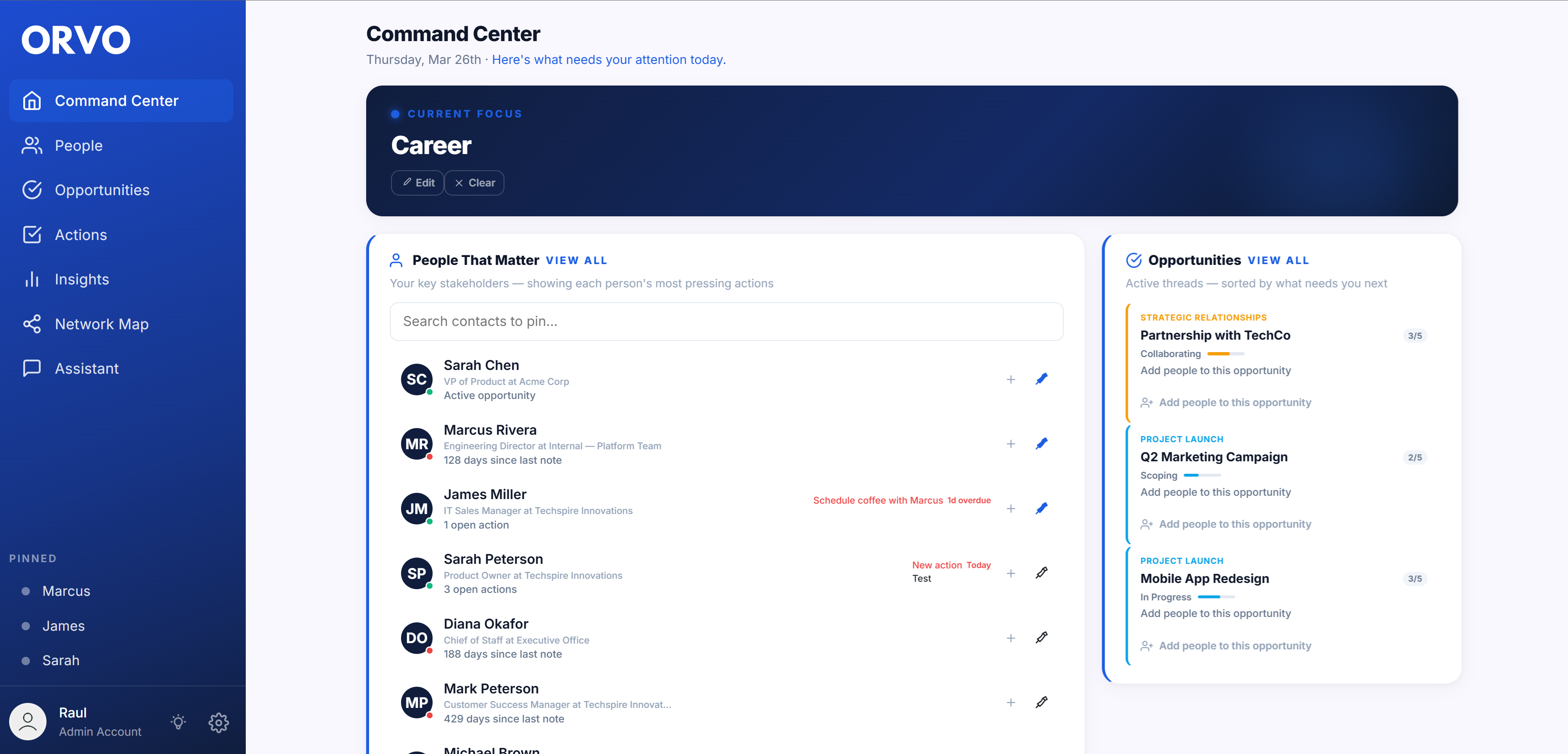
| Relationship tracking | Orvo | Track every professional relationship: conversation history, priorities, follow-up cadences. Replace the ambient awareness you lose when working remotely. |
| Stakeholder health monitoring | Orvo | See which relationships are going cold — remote work makes this invisible without a system |
| Meeting preparation | Orvo AI Assistant | Before any video call, review the person's context: their priorities, your last conversation, open items. Walk in prepared. |
| Virtual coffee scheduling | Calendly + Orvo reminders | Set recurring reminders to schedule virtual coffees; track the rotation through your stakeholder map |
| Async visibility | Slack / Teams / Loom | Share updates, thought process, and contributions publicly. Replace the visibility of physical presence. |
| Network visualization | Orvo Network Map | See who you are connected to vs. who you should be connected to. Identify cross-functional gaps. |
Remote Relationship Building for Specific Scenarios
Scenario: New Remote Employee Your first 90 days remotely are harder than in-office because there are no organic introductions. Proactively schedule 1-on-1s with every team member (20 min each), your cross-functional partners (15 min each), and your skip-level manager (30 min). Log everything in your relationship tracker. Set follow-up cadences from Day 1. You are building the network that took in-office hires months to develop passively.
Scenario: Remote Manager Your direct reports are not bumping into each other — or you — in the hallway. Schedule weekly 1-on-1s (non-negotiable), create virtual team rituals (Monday standup, Friday wins), and track each direct report's engagement and development in your CRM. Set reminders for career conversations, not just project check-ins.
Scenario: Individual Contributor Seeking Promotion The promotion gap for remote workers is real (30% less likely). Counter it by: scheduling monthly 1-on-1s with your skip-level manager, volunteering for cross-functional projects that give you visibility, and ensuring 3-5 senior stakeholders can speak to your impact. Track all of this in Orvo — when promotion time comes, you have documented both your contributions and your relationship-building.
Scenario: Hybrid Worker Use your in-office days strategically: schedule your most important meetings, have relationship-building lunches, and attend optional social events. Reserve remote days for deep work. Track which stakeholders you need to see in person vs. who is fine with virtual interaction.
Scenario: Fully Remote, Company Has No Office You need external relationships even more than in-office workers. Attend 2-3 industry events per year (your conference networking budget just became your most important career investment). Build community through professional Slack groups, online forums, and local meetups. Track all external relationships alongside internal ones in your CRM.
Replace ambient networking with deliberate networking — track relationships, monitor health, and never let a connection go cold. Try Orvo free for 14 days →
Start Free TrialThe Future of Remote Relationship Building
Remote and hybrid work is permanent. The professionals who build systems for deliberate relationship management will have an enduring advantage.
As Sorin Ciornei wrote in *The Future is Now* (thereach.ai), the Curating Economy demands that professionals manage relationships with the same rigor they manage projects. Remote work has made this not optional but essential.
AI is closing the gap between remote and in-office relationship building:
- Relationship health monitoring surfaces which connections are deteriorating before you notice — replacing the ambient awareness of seeing someone's empty desk or shortened hallway greetings
- Stakeholder intelligence provides context before every video call that in-office workers absorb through physical proximity
- Communication analysis helps remote workers understand how they are perceived in written channels — the digital body language that replaces physical cues
- Network gap identification reveals cross-functional blind spots that in-office workers discover through serendipity
The future of professional relationships is not remote vs. in-office. It is deliberate vs. passive. The professionals with the best systems will build the strongest networks — regardless of where they work.
Remote work did not break professional networking. It revealed that most professionals never had a networking system — they had proximity. Now that proximity is gone, the system is everything.
Remote work killed ambient networking. Replace it with a system. Try Orvo free for 14 days →
Get Orvo FreeKey Takeaways
- ✓ Remote workers are 30% less likely to receive promotions — the cause is visibility and relationship gaps, not performance.
- ✓ Replace ambient networking with deliberate networking: scheduled virtual coffees, proactive visibility, systematic tracking.
- ✓ The 90-minute weekly routine: Monday dashboard review, 2 virtual coffees, Wednesday visibility post, Friday relationship maintenance.
- ✓ Track every professional relationship in Orvo — remote work makes "out of sight, out of mind" the default for all connections.
- ✓ Remote workers need 2-3x more proactive effort on cross-functional and senior-level relationships than in-office workers.
- ✓ Remote work did not break networking — it revealed that most people never had a system. Build the system.