
Why your network is your most valuable career asset
There is a reason every career advice article mentions networking. It is because the data is overwhelming: professionals with strong networks earn more, get promoted faster, find jobs quicker, and report higher career satisfaction. A Harvard Business Review study found that people who actively maintain a diverse professional network are 3x more likely to report high career satisfaction and earn significantly more than peers with narrow networks.
But here is the problem with most networking advice: it assumes you already have one. "Leverage your network" is useless advice when your network is your college roommate and your previous manager. "Attend industry events" sounds great until you are standing alone in a conference hall with a name badge and no one to talk to.
This guide is for the people who are starting from zero — or close to it. Whether you are:
- A recent graduate entering the workforce with no professional connections
- A career changer moving into an industry where you know nobody
- An introvert who finds traditional networking draining and inauthentic
- Someone who moved to a new city and left their professional network behind
- A professional who let their network atrophy and needs to rebuild
The approach is the same: build a system, start small, be genuine, and compound over time.
The mindset shift: networking is not what you think it is
Most people picture networking as working a room full of strangers, exchanging business cards, and making awkward small talk. If that image makes you cringe, good — because that is not networking. That is performing.
Real networking is simply building genuine professional relationships over time. It is having a coffee with someone whose work you admire. It is sending a former colleague an article they would find interesting. It is asking a thoughtful question after a talk. It is remembering that someone mentioned they were working on a challenging project and checking in a month later.
The best networkers are not the loudest people in the room. They are the most curious, the most generous, and the most consistent. Research from the Wharton School found that introverts are actually better networkers in the long run because they build deeper, more trust-based relationships — they just build fewer of them, which turns out to be an advantage.
So if you are an introvert, a quiet professional, or someone who hates the word "networking" — you are not at a disadvantage. You just need a system that plays to your strengths: depth over breadth, quality over quantity, consistency over intensity.
The 5 Circles Framework: where to find your network
When you are starting from scratch, the question is not "how do I network" but "who do I network with?" The 5 Circles Framework gives you a systematic way to identify potential connections, starting with the easiest and moving outward.
Circle 1: Existing relationships you have not activated. You probably know more people than you think. Former classmates, previous colleagues, neighbours, people from volunteer work, old clients, professors, family friends in your industry. Make a list of everyone you know professionally, even loosely. This is your starting base.
Circle 2: Online communities. LinkedIn groups, Slack communities, Discord servers, Reddit communities, Twitter/X conversations in your industry. These are places where you can contribute ideas, ask questions, and build recognition before you ever have a 1-on-1 conversation.
Circle 3: Events and gatherings. Industry meetups, conferences, workshops, webinars, local professional associations. The advantage of events is shared context — you are all there for the same reason, which makes starting conversations natural.
Circle 4: Content-based connections. People whose blog posts, podcasts, newsletters, or social media content you engage with. Commenting thoughtfully on someone's work is one of the best warm outreach strategies — it shows you actually pay attention.
Circle 5: Cold outreach. People at target companies, industry leaders, potential mentors you have no connection to. This is the hardest circle, but becomes much easier once you have traction in circles 1-4 because you can reference shared communities or mutual connections.
| Circle | Source | Difficulty | Best For | First Step |
|---|---|---|---|---|
| 1 | Existing contacts | Easy | Everyone | List 20 people you already know professionally |
| 2 | Online communities | Easy-Medium | Introverts, remote workers | Join 2-3 Slack/LinkedIn groups in your field |
| 3 | Events & meetups | Medium | Career changers, new city arrivals | Attend 1 event this month, talk to 2 people |
| 4 | Content engagement | Medium | Subject matter experts, thought leaders | Comment meaningfully on 5 posts this week |
| 5 | Cold outreach | Hard | Targeted connections at specific companies | Send 3 personalised messages referencing their work |
The 8-week startup plan: from zero to a real network
Building a network does not require years. In 8 weeks of consistent, focused effort, you can go from having no professional network to having 30-40 genuine connections. Here is the plan.
Week 1-2: Audit and activate. List every professional contact you have, no matter how loose. Former classmates, previous managers, people you have met at events, LinkedIn connections you have never spoken to. Aim for 20-30 names. Send each one a brief, genuine message: "Hey [name], I have been thinking about people whose work I respect and you came to mind. Would love to catch up — are you free for a 20-minute call or coffee this month?" You will be surprised how many say yes.
Week 3-4: Join and contribute. Identify 2-3 online communities in your industry (Slack groups, LinkedIn groups, subreddits). Do not just lurk — introduce yourself and start contributing. Answer questions, share relevant resources, react to other people's posts. The goal is to become a familiar name before you start reaching out individually.
Week 5-6: Expand through conversations. By now you should have had 5-10 conversations from your existing contacts. At the end of each one, ask: "Who else should I be talking to?" Follow up on every introduction within 48 hours. Attend at least one industry event (virtual or in-person) and aim to have 2-3 real conversations — not to pitch yourself, but to learn.
Week 7-8: Build a system and go deeper. You now have 25-40 people in your network. This is the critical moment where most people drop off — they forget to follow up, lose track of conversations, and let new connections go cold. Set up a tracking system: after every conversation, log what you discussed, any commitments made, and when to follow up. Schedule recurring check-ins with your strongest connections.
The networking tool stack: what you actually need
You do not need a dozen apps to build a great network. You need the right tool for each job. Here is the minimum effective stack.
| Purpose | Tool | Why This One |
|---|---|---|
| Professional profile & discovery | Where professionals live — your public landing page and outreach channel | |
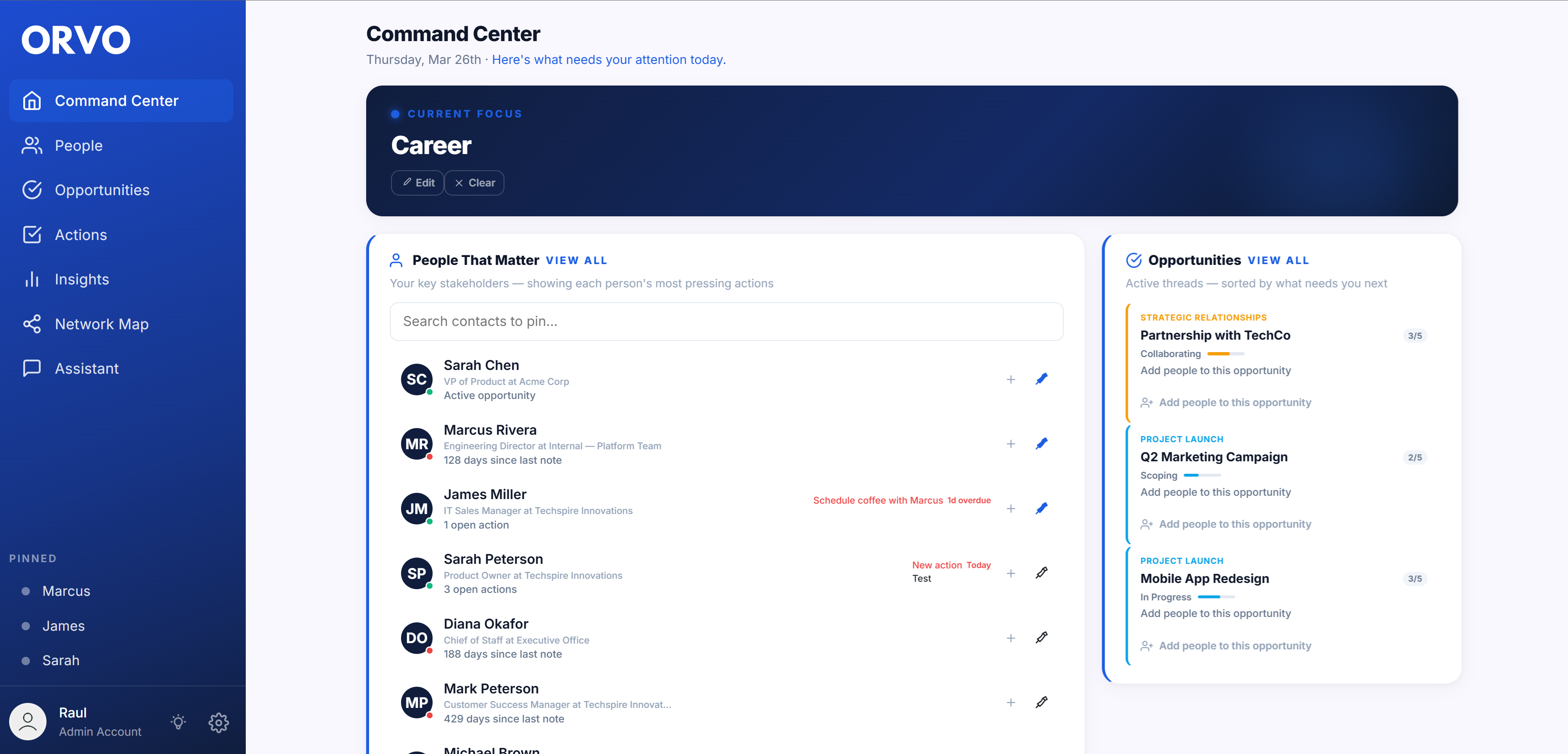
| Relationship tracking & follow-ups | Orvo | Log conversations, set reminders, track relationship history — the system that prevents contacts from going cold |
| Community participation | Slack / Discord / LinkedIn Groups | Build recognition in your industry before doing 1-on-1 outreach |
| Event discovery | Meetup / Eventbrite / Luma | Find relevant industry gatherings near you or online |
| Content creation | LinkedIn + Substack | Share your perspective — even short posts build visibility over time |
Why most networks die (and how a system keeps yours alive)
Building a network is the easy part. Maintaining it is where everyone fails.
The pattern is predictable: you attend a conference, meet 15 interesting people, exchange contact information, maybe send a few follow-up messages. Two weeks later, you are back to your routine and those connections fade. Six months later, you cannot remember half their names.
This is not a character flaw — it is a capacity problem. The human brain can actively maintain about 150 social relationships (Dunbar's number), and most of those slots are taken by family, friends, and immediate colleagues. Your professional network has to compete for the remaining attention, and without a system, it loses.
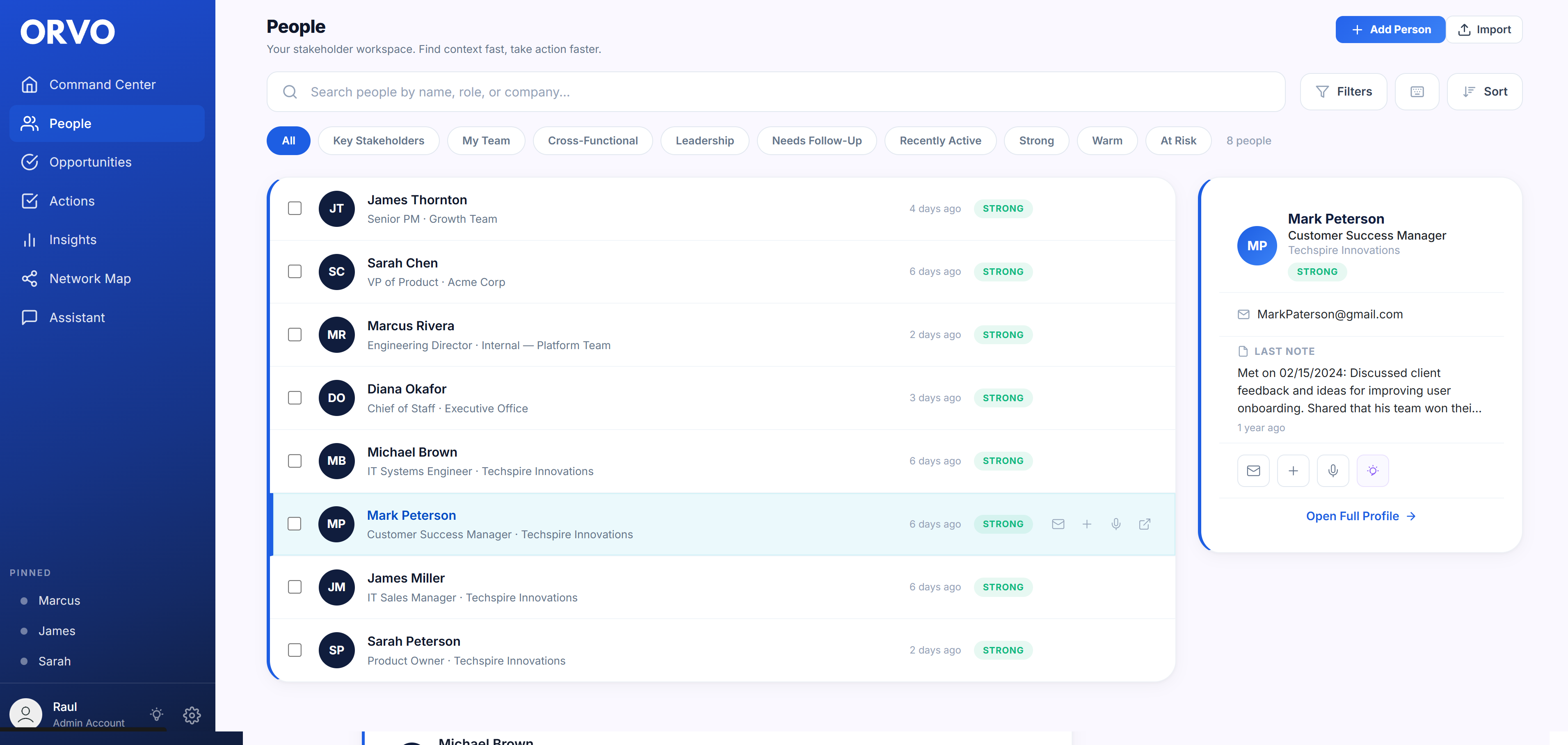
The professionals with the strongest networks all have one thing in common: they track their relationships systematically. After every meaningful conversation, they log what was discussed, what follow-ups are needed, and when to reconnect. Before meetings, they review their notes so they can pick up where they left off. They set reminders to check in with people they have not spoken to recently.
Orvo is built for this. It gives you a single place to manage every professional relationship — conversation notes, follow-up actions, relationship timeline, and AI-powered insights about each person's working style and priorities. Instead of relying on memory to maintain 50+ relationships, you have a system that tells you exactly who needs attention and what to say.
Build a network that actually lasts. Track every relationship in one place.
Start Free TrialNetworking strategies by situation
Different starting points require different approaches. Here are specific tactics based on your situation.
If you are an introvert: Lean into your natural strengths — listening, depth, and thoughtfulness. Skip the large networking events and focus on 1-on-1 conversations. Prepare 3 questions before every interaction so you never feel put on the spot. Follow up in writing (email or message) rather than in person — this plays to your strength of being articulate and thoughtful when you have time to compose your thoughts.
If you are a career changer: You need to build credibility in a new field quickly. Start by consuming and sharing industry content on LinkedIn. Join communities where practitioners hang out, not just job seekers. Frame your outreach around learning: "I am transitioning into [field] and I am trying to understand [specific topic]. Your experience with [specific thing] is exactly what I want to learn about." People love teaching — give them the opportunity.
If you moved to a new city: Local professional groups are your fast track. Search Meetup, Eventbrite, and LinkedIn Events for gatherings in your industry. Attend the same recurring events multiple times — familiarity breeds connection. Also leverage the people you already know: ask them if they know anyone in your new city. A warm introduction to one local contact can cascade into a dozen new connections.
If you are a new graduate: Your alumni network is gold. Most universities have alumni directories, LinkedIn groups, and mentorship programs. Alumni are disproportionately willing to help other graduates. Also leverage professors, internship supervisors, and guest speakers you connected with during your studies. These people are further along in their careers and can introduce you to their networks.
If you let your network atrophy: Reconnection is easier than you think. Send a genuine message: "I have been thinking about people I have worked with and I realise I let us fall out of touch. How have you been?" Most people respond warmly. Do not apologise excessively or make it awkward — just be honest and interested. Then follow up consistently going forward.
The future of professional networking in an AI world
As AI reshapes the professional landscape, your network becomes both more important and more manageable.
More important because AI is automating many of the skills that used to differentiate professionals — writing, analysis, even coding. What AI cannot automate is trust, reputation, and the kind of nuanced judgment that comes from genuine human relationships. As Sorin Ciornei argued in "The Future is Now" (thereach.ai, 2024), we are shifting from a Knowledge Economy to a Curating Economy where the ability to connect, curate, and navigate complex human systems is the primary source of value.
More manageable because AI tools are making it easier than ever to maintain large networks. Relationship intelligence tools like Orvo can surface insights about your connections, remind you when to follow up, and help you prepare for conversations — things that used to require exceptional memory or a personal assistant.
The professionals who will thrive in the next decade are not the ones with the most LinkedIn connections. They are the ones who built genuine, well-maintained networks of people who trust and respect them — and who used systematic tools to keep those relationships alive. The time to start building that network is now.
Stop letting connections go cold. Build a network that compounds.
Get Orvo FreeKey Takeaways
- ✓ You do not need to be extroverted to build a powerful network — you need a system
- ✓ Use the 5 Circles Framework: start with existing contacts, then communities, events, content engagement, and cold outreach
- ✓ Follow the 8-week startup plan to go from zero to 30-40 genuine connections
- ✓ The 48-hour rule: always follow up within 48 hours of meeting someone new
- ✓ Introverts have a natural advantage — depth and trust-based relationships outperform shallow networking
- ✓ Use a relationship tracking tool to maintain your network — memory breaks down past 20-30 active connections
- ✓ In an AI-driven economy, your human relationships are the one thing that cannot be automated