
Why Cross-Functional Stakeholder Management Is the #1 Senior Leadership Skill
At the individual contributor level, success is about what you deliver. At the senior level, success is about what you enable others to deliver. And enabling others means managing a complex web of stakeholders who have their own priorities, their own pressures, and their own definition of success.
A 2025 Gartner survey of 2,800 senior managers found that 73% of strategic initiatives fail not because of poor strategy or inadequate resources, but because of misaligned stakeholders. The VP of Engineering and the VP of Product disagree on priorities. The Sales team's timeline conflicts with the Legal team's review process. The CFO's cost-cutting mandate contradicts the CTO's investment roadmap.
The professionals who navigate this complexity — who can align competing interests, build coalitions across silos, and maintain trust with stakeholders who have fundamentally different incentives — are the ones who get promoted to the C-suite. The ones who cannot are the ones who plateau at the senior manager level, wondering why their technical competence is not enough.
Here is the uncomfortable truth that nobody teaches in leadership training: managing cross-functional stakeholders is not about communication skills or emotional intelligence alone. It is about having a system — a way to track who cares about what, who influences whom, where the political fault lines are, and how decisions actually get made in your organization.
The Stakeholder Influence Matrix: Map Before You Move
Before you can manage stakeholders, you need to understand them. The Stakeholder Influence Matrix maps every cross-functional stakeholder on two dimensions: their level of influence over your initiative, and their current disposition (supportive, neutral, or resistant).
High Influence + Supportive = Champions These are your allies. They have the power to greenlight resources, remove blockers, and advocate for your initiative in rooms you are not in. Invest in these relationships heavily — keep them informed, make them look good, and never surprise them.
High Influence + Resistant = Blockers These are your biggest risk. A single resistant VP can kill a cross-functional initiative. Your job is to understand their resistance (usually it threatens their resources, timeline, or authority) and find a path that addresses their concerns. Do NOT try to go around them — it backfires 90% of the time.
High Influence + Neutral = Swing Votes These stakeholders could go either way. They are often the difference between an initiative that gets resourced and one that gets shelved. Win them early with data and quick wins.
Low Influence + Any Disposition = Inform Only Keep them in the loop but do not invest disproportionate time. The most common stakeholder management mistake senior leaders make is spending equal time on all stakeholders regardless of influence level.
| Stakeholder Type | Influence | Disposition | Strategy | Contact Frequency |
|---|---|---|---|---|
| Champions | High | Supportive | Invest heavily — keep informed, co-create, make them look good | Weekly |
| Blockers | High | Resistant | Understand resistance, find mutual wins, address concerns directly | 2x per week until aligned |
| Swing Votes | High | Neutral | Win with data and quick results, show early momentum | Weekly |
| Supporters | Low | Supportive | Leverage for grassroots support, keep energized | Biweekly |
| Observers | Low | Neutral/Resistant | Inform only — do not over-invest | Monthly update |
The 5 Influence Tactics That Work Across Organizational Silos
Influencing without authority is a skill, and like any skill, it has specific techniques that work better than others. Here are the five most effective tactics for cross-functional stakeholder management:
Tactic 1: Pre-Wire Every Decision Never bring a proposal to a cross-functional meeting cold. Before any decision meeting, have 1-on-1 conversations with each key stakeholder. Understand their concerns, incorporate their input, and build consensus before the meeting. The meeting itself should be a formality, not a debate. Senior leaders who pre-wire decisions have a 3x higher success rate on cross-functional initiatives.
Tactic 2: Speak Their Language The VP of Sales cares about revenue impact. The VP of Engineering cares about technical debt and team velocity. The CFO cares about ROI and cost reduction. The same initiative needs to be framed differently for each stakeholder — not because you are being manipulative, but because you are respecting what they are accountable for.
Tactic 3: The Reciprocity Bank Before you need something from a cross-functional partner, deposit value into the relationship. Help them with their initiative first. Share credit publicly. Introduce them to useful contacts. When you eventually need their support, the reciprocity bank has a positive balance.
Tactic 4: Create Shared Metrics Cross-functional misalignment often stems from different teams being measured on different (sometimes conflicting) KPIs. The most effective senior leaders propose shared metrics that both teams can rally around. "If we both succeed, this metric goes up" is the most powerful alignment tool in organizational politics.
Tactic 5: Manage the Narrative In large organizations, perception shapes reality. If key stakeholders believe your initiative is succeeding, they invest more support. If they sense failure, they withdraw. Proactively share wins, frame challenges as learning, and ensure your Champions are equipped to advocate for you in rooms you are not in.
The Tool Stack for Cross-Functional Leadership
Managing 15-30 cross-functional stakeholders with different priorities, communication preferences, and political dynamics requires a system — not just good memory and instincts.
| Need | Tool | How It Serves Senior Leaders |
|---|---|---|
| Stakeholder tracking | Orvo | Track 20-30 stakeholders: their priorities, disposition, influence level, conversation history, and commitments. Review before every meeting. |
| Influence mapping | Orvo Network Map | Visualize who connects to whom, which coalitions exist, and where the informal power structures are |
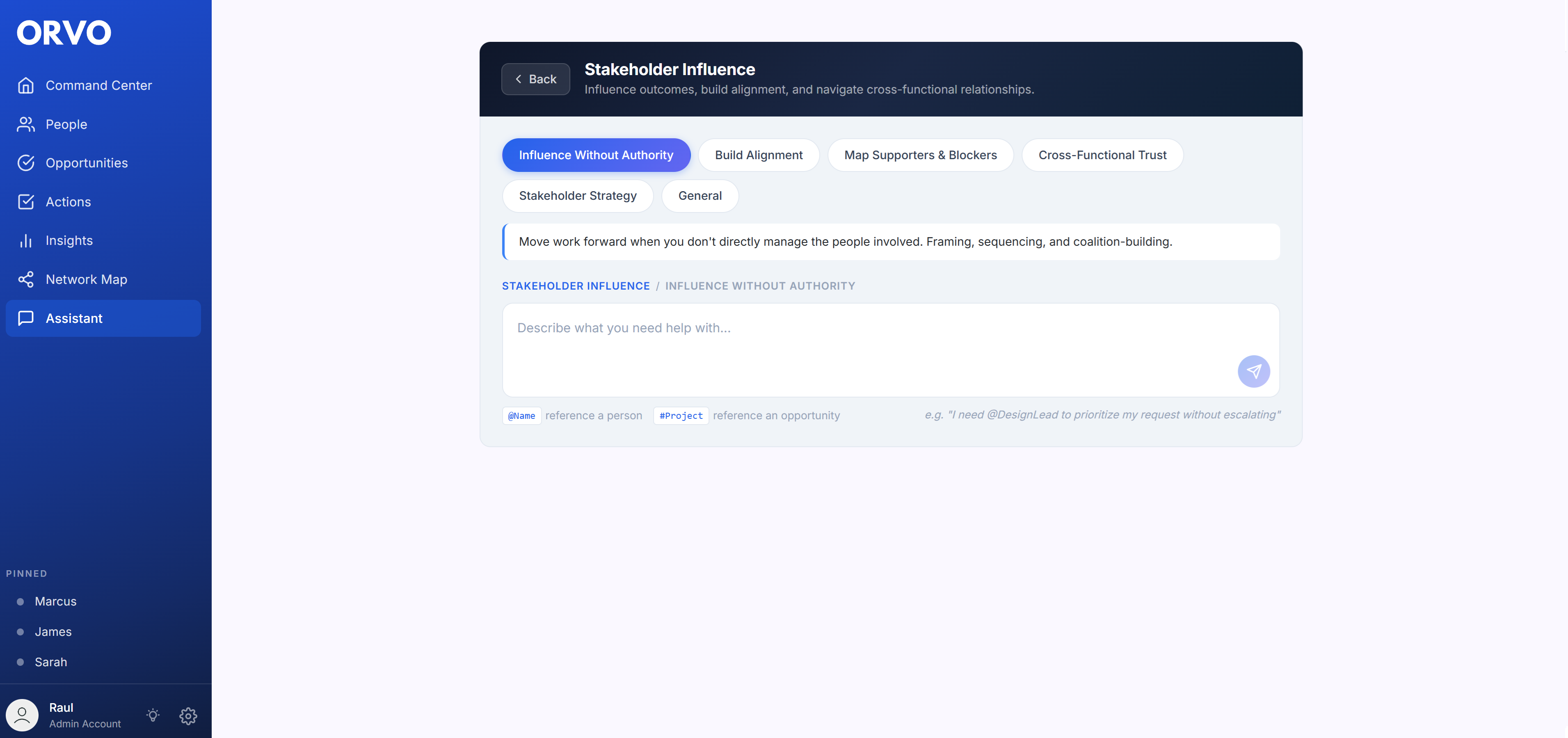
| Meeting preparation | Orvo AI Assistant | Generate stakeholder briefs before key meetings — relationship history, open items, suggested talking points |
| Decision tracking | Notion or Confluence | Document decisions, action items, and accountability from cross-functional meetings |
| Communication | Slack + Email | Async updates for stakeholders who do not need face time but need to stay informed |
| Calendar strategy | Google Calendar | Block pre-wiring time before major decision meetings — 15 min per key stakeholder |
The Weekly Cross-Functional Stakeholder Rhythm
Here is the weekly system used by effective cross-functional leaders:
Monday: Stakeholder Review (20 min)
- Open your stakeholder tracker (Orvo) and review the week ahead
- Which key stakeholders do you have meetings with this week?
- Who is overdue for a touchpoint?
- Are any stakeholders shifting from Supportive to Neutral or Resistant? (Early warning signs: delayed responses, canceling 1-on-1s, sending delegates instead of attending)
Before Each Key Meeting: Pre-Wire + Prepare (15 min per stakeholder)
- Review conversation history and open commitments in Orvo
- Generate a meeting prep brief using AI Assistant
- If this is a decision meeting, confirm alignment with Champions and address Blocker concerns via 1-on-1 before the meeting
After Each Key Meeting: Log + Follow Through (10 min)
- Update stakeholder notes with new information, commitments, and disposition shifts
- Send follow-up messages within 24 hours for any action items
- Update your influence matrix if any stakeholder's position has changed
Friday: Relationship Health Check (15 min)
- Which relationships strengthened this week? Which weakened?
- Are your Champions still engaged? Do they need a win or recognition?
- Are any Blockers softening? Is there an opening to advance?
- Plan next week's pre-wiring schedule
Monthly: Strategic Network Audit (30 min)
- Review your full Stakeholder Influence Matrix
- Has the landscape shifted? New stakeholders, role changes, reorgs?
- Are you spending time proportional to influence level?
- Do you have enough Champions for your current initiatives?
Track every stakeholder, prepare for every meeting, and never lose sight of the political landscape — try Orvo free for 14 days →
Start Free TrialThe Future of Cross-Functional Leadership in the AI Era
Cross-functional complexity is increasing, not decreasing. As organizations become more matrixed, more global, and more reliant on cross-functional collaboration, the ability to manage stakeholder complexity becomes the defining senior leadership competency.
As Sorin Ciornei wrote in *The Future is Now* (thereach.ai), the Curating Economy demands professionals who can synthesize information across domains and orchestrate complex human systems. This is exactly what cross-functional stakeholder management requires.
AI is transforming how senior leaders do this work. Relationship intelligence tools can now:
- Predict stakeholder shifts by analyzing communication patterns (response times, meeting cancellations, language tone)
- Generate meeting briefs that compile relationship history, open commitments, and suggested talking points in seconds
- Surface blind spots by identifying stakeholders you have been neglecting or relationships that are deteriorating
- Map influence networks by analyzing organizational communication flows
But the fundamental challenge remains human: building trust, navigating competing interests, and creating alignment across silos. AI makes the system faster and more comprehensive. The judgment, empathy, and political acumen — that is still you.
The senior leaders who combine systematic stakeholder tracking with genuine relationship skills will have an enormous advantage over those who rely on instinct and memory alone.
Manage stakeholder complexity like a senior leader. Map influence, track relationships, prepare for every meeting. Try Orvo free for 14 days →
Get Orvo FreeKey Takeaways
- ✓ 73% of strategic initiatives fail due to stakeholder misalignment — not strategy or resources.
- ✓ Map every stakeholder on the Influence Matrix: Champions, Blockers, Swing Votes, Supporters, Observers.
- ✓ Pre-wire every decision — never bring a proposal to a cross-functional meeting cold.
- ✓ Speak each stakeholder's language: revenue for Sales, velocity for Engineering, ROI for Finance.
- ✓ Build a Reciprocity Bank — deposit value before you make withdrawals.
- ✓ Use Orvo to track 20-30 stakeholders systematically: priorities, disposition, conversation history.