
Why Introverts Are Actually Better Networkers (The Data)
The networking industry has a dirty secret: the professionals with the most valuable networks are not the ones who attend every happy hour. They are the ones who build fewer, deeper relationships — and that is exactly what introverts do naturally.
A 2024 Wharton study on professional relationship quality found that professionals who maintained 15-25 deep connections generated 2.4x more career opportunities (referrals, job offers, collaborations) than those who maintained 100+ shallow connections. Depth beats breadth, every time.
Adam Grant's research at Wharton confirms this: the most successful networkers are not "schmoozers" — they are people who invest in genuine, reciprocal relationships. They listen more than they talk. They remember details. They follow through on commitments. Sound familiar?
The problem is not that introverts cannot network. The problem is that traditional networking advice forces introverts to act like extroverts — draining their energy on tactics that play to someone else's strengths. The result: introverts either avoid networking entirely (and miss career opportunities) or force themselves through exhausting networking events that yield shallow connections.
There is a better way. A system that leverages your natural strengths — deep listening, thoughtful follow-up, genuine curiosity — while eliminating the energy-draining aspects of traditional networking.
The Introvert Networking Framework: Quality Over Quantity
Forget everything you know about networking. Here is the framework that works for introverts:
Principle 1: One-on-One Over Group Events Group networking events are where introverts go to suffer. One-on-one conversations are where introverts shine. Replace every cocktail hour with two coffee meetings. You will build stronger connections, use less energy, and actually enjoy the process.
Principle 2: Written Over Verbal Introverts often express themselves better in writing than in spontaneous conversation. Use this: send thoughtful follow-up emails, share relevant articles, write LinkedIn posts that demonstrate expertise. These written touchpoints build your reputation while you recharge.
Principle 3: Preparation Over Spontaneity Extroverts thrive on improvisation. Introverts thrive on preparation. Before every meeting, review what you know about the person: their role, interests, recent work. Walking in prepared transforms anxiety into confidence. This is where a relationship tracking system becomes your secret weapon.
Principle 4: Systematic Follow-Up Over Random Outreach Introverts do not enjoy "just reaching out" to people. But a system that tells you exactly who to contact, when, and with what context? That removes the decision fatigue and social anxiety. Instead of "I should probably network today," it becomes "I need to follow up with Sarah about the marketing project she mentioned last month."
| Traditional Advice (Extrovert-Optimized) | Introvert-Optimized Alternative | Why It Works Better |
|---|---|---|
| Attend every networking event | Choose 1 event per month, have 2-3 deep conversations | Better connections, sustainable energy |
| Work the room, meet everyone | Schedule 1-on-1 coffee meetings | Introverts build trust faster in private settings |
| Elevator pitch ready at all times | Prepare thoughtful questions for each person | Asking questions > pitching yourself |
| Follow up with everyone you meet | Follow up deeply with 3-5 key people | Concentrated effort > scattered outreach |
| Be active on all social platforms | Write 1-2 thoughtful LinkedIn posts per month | Quality content > constant presence |
The Tool Stack for Introvert Networking
The right tools transform networking from an energy drain into a manageable system. For introverts, the key is reducing spontaneous social demands and replacing them with prepared, intentional interactions.
The most important tool is relationship tracking. When you know exactly who you should contact, what to talk about, and what your last conversation covered, the anxiety disappears. You are not cold-calling a stranger — you are continuing a conversation with context.
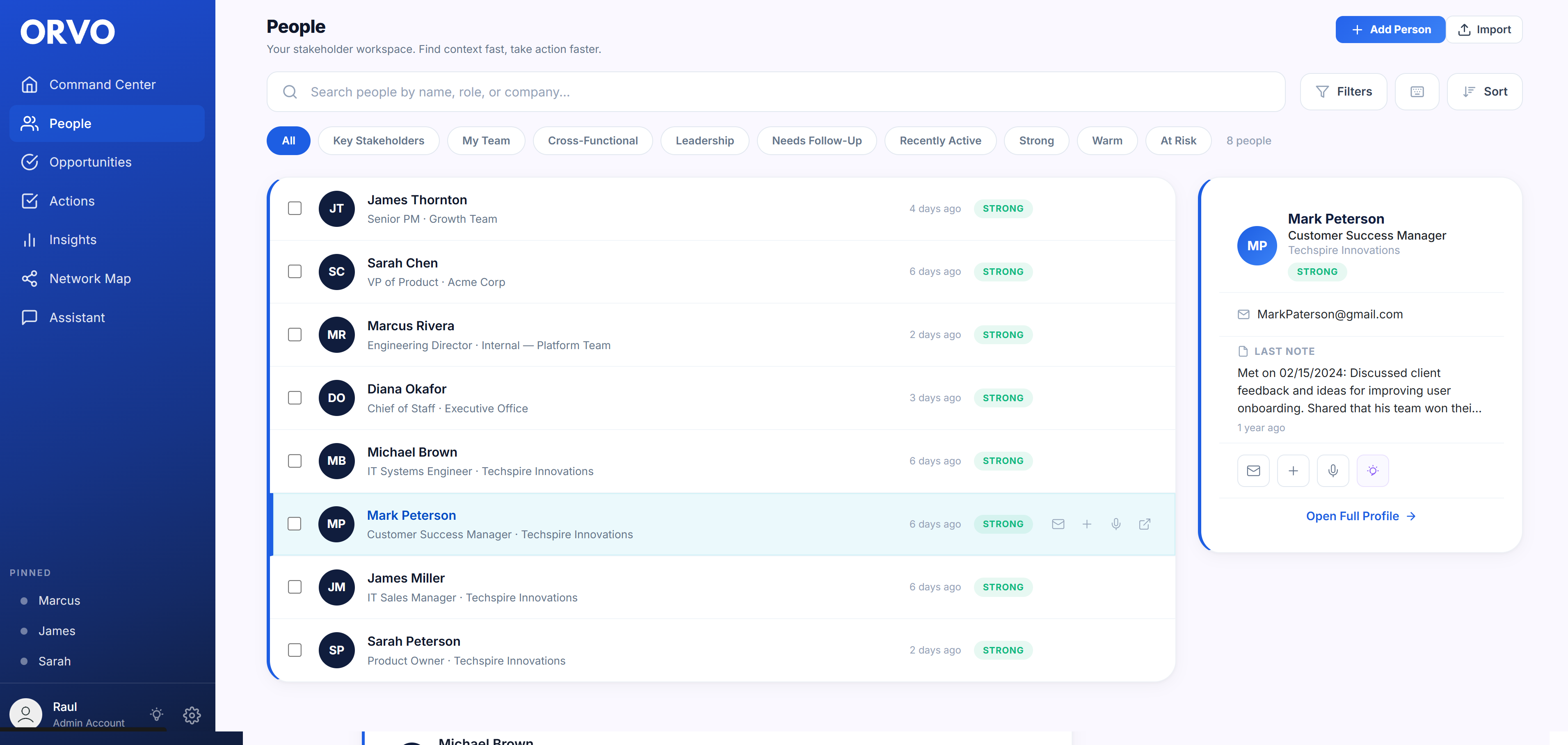
Orvo was built for this: log every conversation, track relationship health, set follow-up reminders, and get AI-prepared meeting briefs. Before a 1-on-1 coffee meeting, pull up everything you know about that person in 10 seconds. That preparation is the introvert's superpower.
| Need | Tool | How It Helps Introverts Specifically |
|---|---|---|
| Relationship tracking | Orvo | Log conversations without relying on memory, get reminded when to follow up, prepare for meetings with full context |
| Async networking | Comment thoughtfully, share content, connect without real-time social pressure | |
| 1-on-1 scheduling | Calendly | Remove the back-and-forth of scheduling — let people book time directly |
| Meeting prep | Orvo AI Assistant | Generate stakeholder briefs before meetings so you walk in confident |
| Energy management | Google Calendar | Block buffer time around networking activities for recharging |
The Introvert's Monthly Networking Routine (2 Hours/Week)
Here is a sustainable networking routine designed for introverts. Total time commitment: 2 hours per week, with zero cocktail hours required.
Week 1: Maintenance (30 min)
- Review your Orvo dashboard: who is overdue for a follow-up?
- Send 2-3 personalized messages to existing contacts (share an article, congratulate a promotion, ask about a project they mentioned)
- Update notes on recent conversations while they are fresh
Week 2: One Deep Conversation (60 min)
- One 1-on-1 meeting (coffee, video call, or lunch) with someone in your network or a new connection
- Prepare using your relationship tracker: review past conversations, set 3 thoughtful questions
- Log the conversation immediately after and set next follow-up date
Week 3: Content Contribution (30 min)
- Write one thoughtful LinkedIn comment on a post by someone in your network
- OR share one insight from your work that could help others
- This builds visibility without requiring real-time social interaction
Week 4: Strategic Outreach (30 min)
- Identify 1-2 new people you would like to connect with
- Send a personalized connection request referencing something specific about their work
- Add them to your relationship tracker with initial context
Monthly Total: ~8 hours of intentional networking — and none of it requires you to "work a room" or make small talk with strangers at a bar.
The compounding effect is powerful: after 6 months, you will have had 24+ deep conversations, maintained 50+ active relationships, and contributed visible expertise to your professional community. That is more effective networking than attending 50 happy hours.
Build your introvert networking system — track relationships, automate follow-ups, prepare for every meeting. Try Orvo free for 14 days →
Start Free TrialAdvanced Strategies for Introverts in Corporate Environments
If you are an introvert in a large company, networking is not optional — it is a promotion requirement. But corporate networking has its own rules, and introverts can hack them.
The Written Authority Play: Most corporate networking happens in meetings where extroverts dominate. Counter this by building your reputation through writing: send concise, insightful recaps after meetings. Write clear project updates. Share analysis that others find useful. Over time, people seek YOU out — which is the introvert dream: inbound networking.
The Strategic 1-on-1: Instead of attending every optional social event, invest in regular 1-on-1s with 10-15 key stakeholders. A monthly 20-minute coffee with your skip-level manager builds more trust than attending 12 happy hours.
The "Helpful Expert" Positioning: Introverts hate self-promotion but are comfortable being helpful. Position yourself as the go-to expert in one area. When people come to you for help, you build relationships without the social overhead of traditional networking.
The Cross-Functional Bridge: Volunteer for cross-functional projects where the collaboration happens through shared work, not social events. Working alongside someone on a deliverable creates natural bonding without the artificiality of "networking."
The Meeting Prep Advantage: Before any meeting with senior stakeholders, review your relationship notes: what do they care about? What did they ask about last time? What commitments were made? Walking in prepared is not just a networking advantage — it signals competence that gets noticed. Use Orvo's AI Assistant to generate meeting briefs that compile your history with each person.
The Future of Networking Favors Introverts
The shift to remote and hybrid work has fundamentally changed networking — and the change favors introverts.
As Sorin Ciornei wrote in *The Future is Now* (thereach.ai), we are moving into the Curating Economy, where the ability to manage information and relationships systematically matters more than social charisma. The professionals who thrive are not the loudest in the room — they are the most prepared, the most thoughtful in their follow-up, and the most systematic in their relationship management.
Remote work has eliminated many of the settings where extroverts had an advantage: office happy hours, conference cocktail receptions, spontaneous hallway conversations. In their place, we have Slack channels, video calls, and asynchronous communication — all formats where introverts perform at least as well as extroverts.
AI tools are amplifying this further. Meeting preparation that used to require extroverted information-gathering (asking around, chatting with colleagues) can now be done through AI-powered relationship analysis. Stakeholder briefs, conversation summaries, and follow-up reminders remove the social overhead that made networking exhausting for introverts.
The future belongs to professionals who build genuine, deep relationships and maintain them systematically. That has always been the introvert's natural mode. The tools have finally caught up.
Network on your own terms. Track relationships, prepare for meetings, and never force small talk again. Try Orvo free for 14 days →
Get Orvo FreeKey Takeaways
- ✓ Introverts with 15-25 deep connections outperform extroverts with 100+ shallow ones.
- ✓ Replace group events with 1-on-1 meetings — introverts build trust faster in private settings.
- ✓ The 2-hour weekly routine: maintenance, one deep conversation, content contribution, strategic outreach.
- ✓ Preparation is the introvert superpower — review relationship notes before every interaction.
- ✓ Use Orvo to automate the parts of networking introverts hate (remembering, scheduling, following up).
- ✓ Remote work and AI tools are shifting networking toward depth and preparation — the introvert advantage.