
The MBA Network Is Your Highest-ROI Asset (The Data)
Harvard Business School published a landmark 20-year longitudinal study in 2024 tracking MBA graduates from the classes of 2000-2004. The findings were striking:
- Graduates who maintained active relationships with 25+ classmates earned 47% more in cumulative career income than those who maintained fewer than 10
- 73% of C-suite executives in the sample attributed at least one critical career opportunity to an MBA classmate
- The most valuable network effects did not manifest until 8-12 years after graduation — when classmates had risen to decision-making positions
The implication is clear: your MBA network is a long-term compounding asset. The relationships you build during the program are seeds. The career opportunities come when those seeds have grown — a decade later, when your classmate is now a VP who needs a trusted hire, or a founder raising a round from your investor classmate, or a board member who recommends you for an advisory role.
But here is the problem: most MBA students treat networking as a 2-year activity. They network intensely during the program, then let 80% of those relationships go dormant within 3 years of graduating. The network they paid $200K to access slowly evaporates because they have no system to maintain it.
The professionals who extract maximum ROI from their MBA network are the ones who build a maintenance system during the program and sustain it for decades after.
The MBA Networking Framework: 4 Circles Strategy
Do not try to be friends with everyone. Strategic MBA networking focuses on four concentric circles:
Circle 1: Your Core Alliance (5-8 people) Your closest MBA relationships — study group members, project partners, people you genuinely connect with. These become lifelong trusted advisors. Invest deeply: regular dinners, honest feedback exchanges, career planning discussions. These are the people who will refer you for C-suite roles in 15 years.
Circle 2: Your Industry Cluster (10-15 people) Classmates heading into your target industry or adjacent ones. These are your industry intelligence network: they will share job openings, warn you about company red flags, and make introductions to people at their companies. Even if you change industries later, they provide bridge connections.
Circle 3: Your Diverse Ties (15-25 people) Classmates in deliberately different industries, geographies, and functions. Research shows that "weak ties" across diverse fields generate more novel career opportunities than strong ties within your immediate circle. The classmate who went into venture capital while you went into consulting may be exactly the connection you need in 10 years.
Circle 4: Your Broader Cohort (all classmates) Maintain awareness of everyone in your cohort through alumni events, LinkedIn, and occasional messages. You do not need deep relationships with all 500 people — you need to be recognizable and accessible. When someone from your cohort needs expertise in your area, you want to be the person they think of.
| Circle | Size | Contact Cadence | Purpose | How to Track |
|---|---|---|---|---|
| Core Alliance | 5-8 | Weekly/biweekly | Trusted advisors, career co-pilots | Orvo: Inner Circle tag + regular check-ins |
| Industry Cluster | 10-15 | Monthly | Industry intelligence, job referrals | Orvo: Industry tag + follow-up reminders |
| Diverse Ties | 15-25 | Quarterly | Novel opportunities, cross-industry bridges | Orvo: Diverse Network tag + quarterly touchpoints |
| Broader Cohort | 100+ | Annual (events/updates) | Visibility, accessibility | LinkedIn + alumni events + annual update email |
During the MBA: Semester-by-Semester Networking Plan
Semester 1: Cast Wide, Log Everything
- Meet as many classmates as possible — attend every social event, join multiple clubs, be present
- After every meaningful conversation, log it: what they are interested in, their career goals, what you connected on
- Identify your emerging Core Alliance (usually forms through study group and early projects)
- Set up your relationship tracking system — Orvo or equivalent — and start logging from Week 1
- The students who start tracking in Semester 1 have a massive advantage by graduation
Semester 2: Deepen and Strategize
- Your circles are forming naturally. Now be intentional: schedule 1-on-1s with people in your target Industry Cluster
- Begin investing in Diverse Ties: have lunch with someone in a completely different career track once a week
- Help your Core Alliance members with their job searches, case prep, or projects — deposits in the reciprocity bank
- Log career conversations: who is going where, who knows whom at target companies
Summer Internship: Stay Connected
- Do NOT go silent during summer. Send 3-4 messages to Core Alliance and Industry Cluster contacts
- Share what you are learning at your internship — this positions you as a resource
- Log new connections made at your internship company — these bridge your MBA and professional networks
Semester 3-4: Activate for Job Search
- Your network is now your job search engine: ask for referrals, introductions to hiring managers, company intelligence
- Track every job-search-related conversation in Orvo: who referred you, what they told you about the company, what you owe them in follow-up
- Continue investing in relationships even with classmates NOT directly useful for your job search — the reciprocity bank pays interest
Graduation: Set the Maintenance System
- Before you leave campus, set follow-up cadences for all four circles in your CRM
- Exchange personal emails/phone numbers (school emails expire)
- Set a recurring annual ritual: send a personal update to your top 30 contacts every December
- Your MBA network maintenance starts the day you graduate — not when you need something
The Tool Stack for MBA Networking
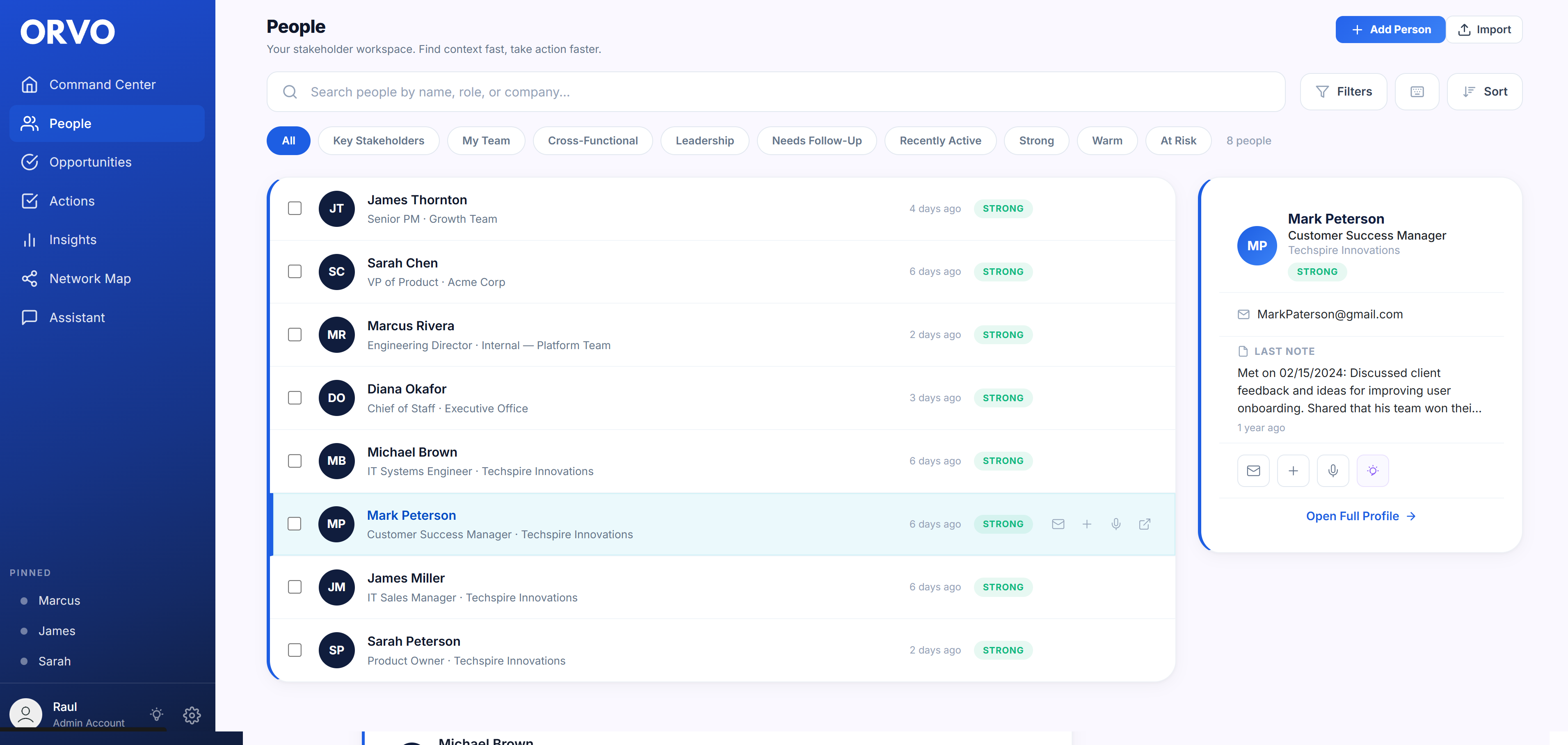
MBA students and alumni need tools that handle volume (400+ contacts), context (years of conversation history), and longevity (decades of maintenance).
| Need | Tool | How It Serves MBA Networking |
|---|---|---|
| Relationship tracking | Orvo | Track 100+ MBA contacts with conversation history, career moves, and follow-up reminders. Tag by circle, industry, and graduation year. |
| Network visualization | Orvo Network Map | Visualize who connects to whom across your MBA network — identify bridge connections for job searches and introductions. |
| Meeting prep | Orvo AI Assistant | Before alumni catch-ups, generate a brief: what they are doing now, your last conversation, their interests. Walk in prepared after years apart. |
| Career tracking | LinkedIn + Orvo | LinkedIn for surface-level career updates; Orvo for deep context (what they told you about their goals, frustrations, plans) |
| Alumni events | School alumni platform | Identify who is attending, review your Orvo notes on them beforehand, log new connections after |
Post-MBA: The 10-Year Network Maintenance System
The MBA network becomes most valuable 8-12 years after graduation. Here is how to maintain it:
Annual Rituals:
- December: Send a personal annual update to your top 30 contacts (not a mass email — personalized notes referencing your last conversation)
- Reunion years: Attend. No excuses. Reunions are where dormant ties get reactivated and new opportunities surface
- Class communications: Stay on alumni email lists, respond to requests from classmates, contribute to alumni publications
Quarterly Maintenance (1 hour per quarter):
- Review your Orvo dashboard: which relationships are going cold? Who has changed jobs or roles?
- Send 5-8 personalized messages to contacts you have not spoken to recently
- Congratulate career milestones: promotions, company launches, publications, board appointments
Ongoing Habits:
- When a classmate crosses your mind — because of an article, a project, or a conversation — message them immediately. The "I was thinking of you because..." message is the most powerful relationship maintenance tool
- When you change jobs, send a personal update to your top 50 MBA contacts (not just a LinkedIn post)
- When classmates reach out for help, say yes whenever possible. The reciprocity bank is always open.
The Compound Effect: After 10 years of consistent maintenance, your MBA network has generated: industry intelligence (you knew about market shifts before they were public), career opportunities (2-3 roles that came through classmate referrals), board positions or advisory roles (from classmates who started companies), and a trusted advisory circle that has seen you through career decisions for a decade. That is the ROI of a maintenance system.
Your MBA network is a \$200K investment. Protect it with a system. Track, maintain, and grow your cohort connections with Orvo — try free for 14 days →
Start Free TrialThe Future of MBA Networking in the AI Era
MBA networking is evolving — and AI tools are creating new advantages for systematic networkers.
As Sorin Ciornei wrote in *The Future is Now* (thereach.ai), the Curating Economy rewards professionals who can manage complex relationship networks across industries and decades. AI amplifies this:
- Relationship intelligence reminds you that a classmate just moved to your target company — 2 weeks before they post the opening publicly
- Meeting preparation generates a brief before an alumni dinner: what each attendee is working on, your last interaction, shared interests
- Network gap analysis identifies holes in your network: "You have strong connections in tech and finance but no one in healthcare — consider reconnecting with classmates who pivoted there"
The MBA students who start building their relationship management system in Year 1 will have the most powerful career networks in their generation. The system is the multiplier that turns a good MBA network into an extraordinary one.
Your MBA network is your highest-ROI career asset. Give it the system it deserves. Try Orvo free for 14 days →
Get Orvo FreeKey Takeaways
- ✓ MBA graduates maintaining 25+ active classmate relationships earn 47% more in cumulative career income.
- ✓ Build 4 circles: Core Alliance (5-8), Industry Cluster (10-15), Diverse Ties (15-25), Broader Cohort (100+).
- ✓ Start tracking relationships in Orvo from MBA Week 1 — by graduation you have 2 years of intelligence.
- ✓ The most valuable MBA network effects manifest 8-12 years post-graduation. Maintenance is everything.
- ✓ Annual rituals: personalized December updates, attend reunions, respond to classmate requests.
- ✓ AI-powered relationship intelligence makes MBA network maintenance scalable for decades.