
The 12 Moves That Will Define Your Career in 2026
Twelve specific, executable moves for European corporate professionals — built around the two compounding levers of visibility and AI fluency.
This piece is the tactical companion to The European Career Outlook Report 2026, Orvo's flagship analysis of the four structural forces reshaping European white-collar work. Read the report for the data and the framework. Read this piece for what to do about it.
There is a particular type of paralysis that comes from reading a strong macro analysis. You finish it, you agree with the diagnosis, and then you sit at your desk on Monday morning trying to figure out what any of it means for the work you're actually doing this week. The forces are too large. The decisions feel too far away. The translation from macro to individual gets lost somewhere between the news and the inbox.
This piece exists to do that translation. Twelve moves. Each one specific. Each one something you can begin this week. Each one calibrated to the European corporate professional in 2026 — someone who is not going to fix EU productivity policy, not going to overhaul their employer's AI strategy, but who can absolutely change how they work, where they work, and what they make visible.
The moves are organised in three groups: four positioning moves (where and for whom you work), four capability moves (what you can do), and four visibility moves (who knows you can do it). All twelve compound on each other. The professionals who navigate this decade well will be doing most of them, deliberately, over the next eighteen months.
Group 1 — Positioning: where and for whom you work
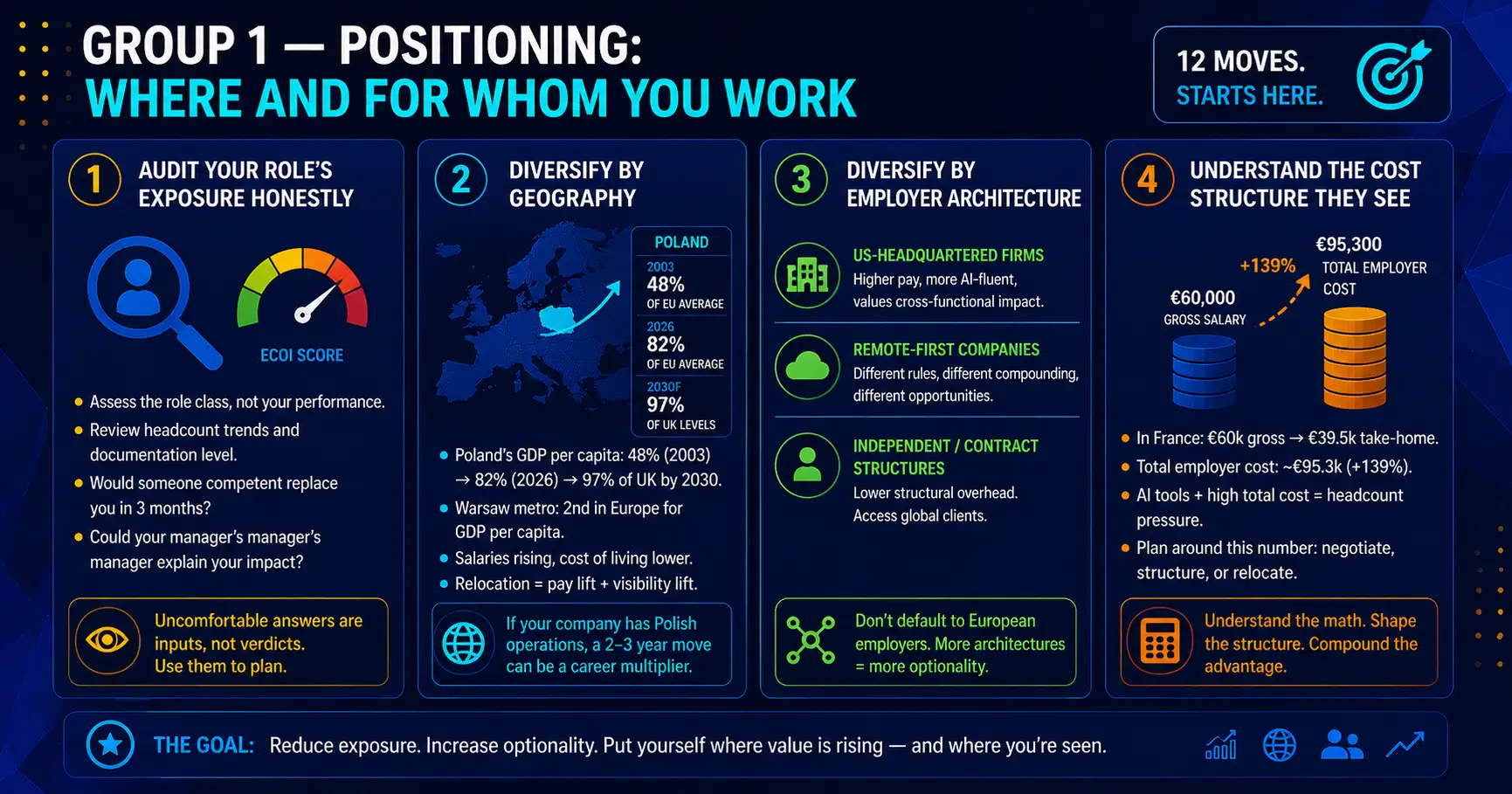
Move 1. Audit your role's exposure honestly
Start with the question you have been avoiding: how exposed is the role I am in today, on the European Career Outlook Index? Not your performance — the role class. The two are different and most professionals confuse them.
Look at your job description. Look at your function's headcount trend over the last two years. Look at whether your work is documented enough that a moderately competent successor could pick it up in three months. Look at whether your industry is on the most-resilient or most-exposed list. Most importantly, look at whether the people three levels above you could name what you specifically do, and what would change if you left.
If the honest answers come back uncomfortable, that is the planning input. The next eleven moves are how you respond to it.
Move 2. Diversify by geography — the Polish thesis is real
Twenty years ago, Poland's GDP per capita was 48% of the EU average. Today it is 82%, with forecasts suggesting 97% of UK levels by 2030. Warsaw's metropolitan area now ranks second in Europe for GDP per capita, behind only Central London. Several Polish regions are now richer than several British regions. The same trajectory applies, in milder form, to the Baltics, Romania, and increasingly Portugal.
For the globally-mobile European professional, this is the most underused career-planning input available. Salaries for global-grade corporate roles in Polish hubs are now approaching Western European mid-tier, with a fraction of the cost of living. If your industry has Polish operations — and most multinationals do — moving there for a two- to three-year assignment is one of the highest-leverage compensation moves available, with a hidden second benefit: the relocation surfaces you to a different part of the corporate organisation, which is a visibility move in disguise.
Move 3. Diversify by employer architecture
Most European professionals work for European-headquartered companies. This is the default and it is increasingly the wrong default. Three architectural alternatives are now viable for most senior corporate roles:
US-headquartered firms with European operations. These companies pay closer to US norms, run AI-fluent operations more aggressively, and tend to value cross-functional surface area in ways European-headquartered firms often do not. The compensation arbitrage of working a European job for a US employer (US-style pay, EU cost of living) is one of the most reliable ways to multiply real income without changing your daily work.
Remote-first companies whose centre of gravity is outside Europe. Different rules apply — different career compounding, different network effects, different rate of compensation review. Worth considering even if your current role is comfortable.
Independent or contract structures with global clients. The structural cost of European employment relationships (we will return to this in Move 4) creates an opening for senior professionals to operate as contractors with global clients rather than as employees of European entities. This is not for everyone. For those it suits, the economics are dramatic.
The Job Search Networking Playbook covers the relationship work that supports these moves.
Move 4. Understand the cost structure your employer sees
For a €60,000 gross salary in France, the worker takes home approximately €39,500. The total cost to the employer is approximately €95,300 — an additional 139% on top of net wage. Similar structures apply across Italy, Belgium, Sweden, and to a lesser extent Germany and Spain.
This number is critical because it explains why your employer is making the decisions they are making. When AI tooling can produce two professionals' worth of output for a fixed €95,000 cost, the math becomes simple from the employer's side. Understanding it from your side is the foundation of negotiating effectively, structuring contracts intelligently, and choosing employers and geographies that favour your economic position rather than working against it.
The professionals who plan around this number — by working for employers in lower-burden jurisdictions, by structuring as contractors where appropriate, by negotiating total-cost packages explicitly — accumulate compensation advantages over years that pure salary negotiation cannot match.
Group 2 — Capability: what you can actually do
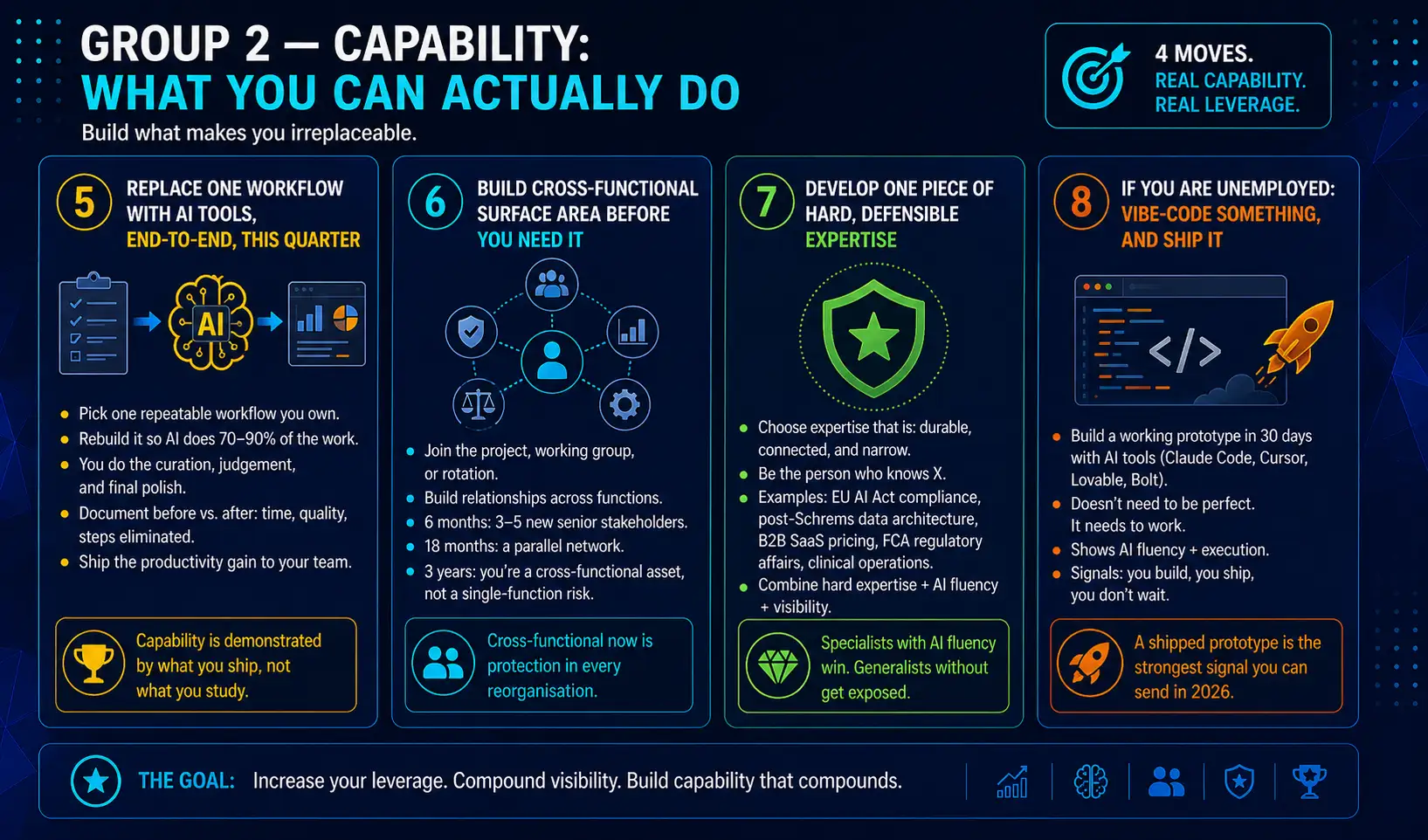
Move 5. Replace one workflow you currently own with AI tools, end-to-end, this quarter
This is the single highest-leverage capability move available to most professionals. Not "use ChatGPT to draft an email." Not "write better prompts." Replace a workflow. Pick one repeatable thing you currently do — running a report, producing a deck, processing inputs into a deliverable, conducting research — and rebuild it so that AI tools do 70–90% of the work and you do the curation, the judgement, and the final-stage polish.
Document what changed. Time saved. Quality difference. Process steps that disappeared. The artefact you produce — a before-and-after comparison of one workflow — is the single most credible signal of AI fluency you can carry into your next promotion conversation, your next employer interview, or your next negotiation. It also produces a measurable productivity gain you can ship to your team this month.
The reason this matters more than learning prompt engineering or taking an AI course: capability is demonstrated by what you can ship, not by what you have studied. Workflow replacement is the demonstration.
Move 6. Build cross-functional surface area before you need it
Volunteer for a project that crosses your function's boundary. Join the regulatory or compliance working group. Take the executive support rotation. Lead the cross-team initiative your manager keeps mentioning but no one wants to own. Pick the one that gives you natural surface area with people you don't currently know.
The work itself matters less than the relationship-building it produces. After six months on a cross-functional initiative, you will have working relationships with three to five new senior stakeholders who can name what you contributed. After eighteen months, you have a parallel network across functions that protects you in any reorganisation that targets your home function. After three years, you are no longer the property of a single function — you are a known cross-functional asset, which is one of the most resilient corporate identities available.
This is not a side activity. It is structural career insurance.
Move 7. Develop one piece of hard, defensible expertise
Generalists with AI fluency are one strong career profile in 2026. Specialists with hard expertise are another. The position you do not want is generalist without hard expertise and without distinctive AI fluency — the most common European corporate profile, and the one most exposed to the legibility trap.
Pick one area of genuine expertise to develop seriously over the next twelve to twenty-four months. The right area is one that combines three properties: it is durable (not eaten by the next AI capability cycle), it is connected to your existing role rather than parallel to it, and it is narrow enough that "the person who knows X" becomes an identity inside your organisation. Examples: EU AI Act compliance, post-Schrems data architecture, B2B SaaS pricing, FCA regulatory affairs, biopharmaceutical clinical operations, supply-chain ESG reporting. Generic expertise (project management, "leadership," "strategy") does not qualify because it does not differentiate.
The combination — hard expertise plus AI fluency plus visibility — is the highest-leverage profile in 2026 European corporate work.
Move 8. If you are unemployed: vibe-code something, and ship it
The single best signal you can send to a hiring market in 2026 is a working artefact shipped in 30 days. Not a polished product. Not a finished company. A working prototype you built using AI tools — Claude Code, Cursor, Lovable, Bolt — that demonstrates you can move from idea to ship without waiting for an engineering team.
The job market has been screening for this since late 2025 and the bar is rising. A candidate who walks into an interview with a working prototype demonstrates AI fluency more credibly than any course, certificate, or claim. They also signal something else: that they treat unemployment as a window for production rather than as a holding pattern. Both signals are now strongly preferred by hiring managers — particularly at US-headquartered firms operating in Europe.
The Career Pivot Networking guide covers how to convert the artefact into conversations.
Group 3 — Visibility: who knows you can do it
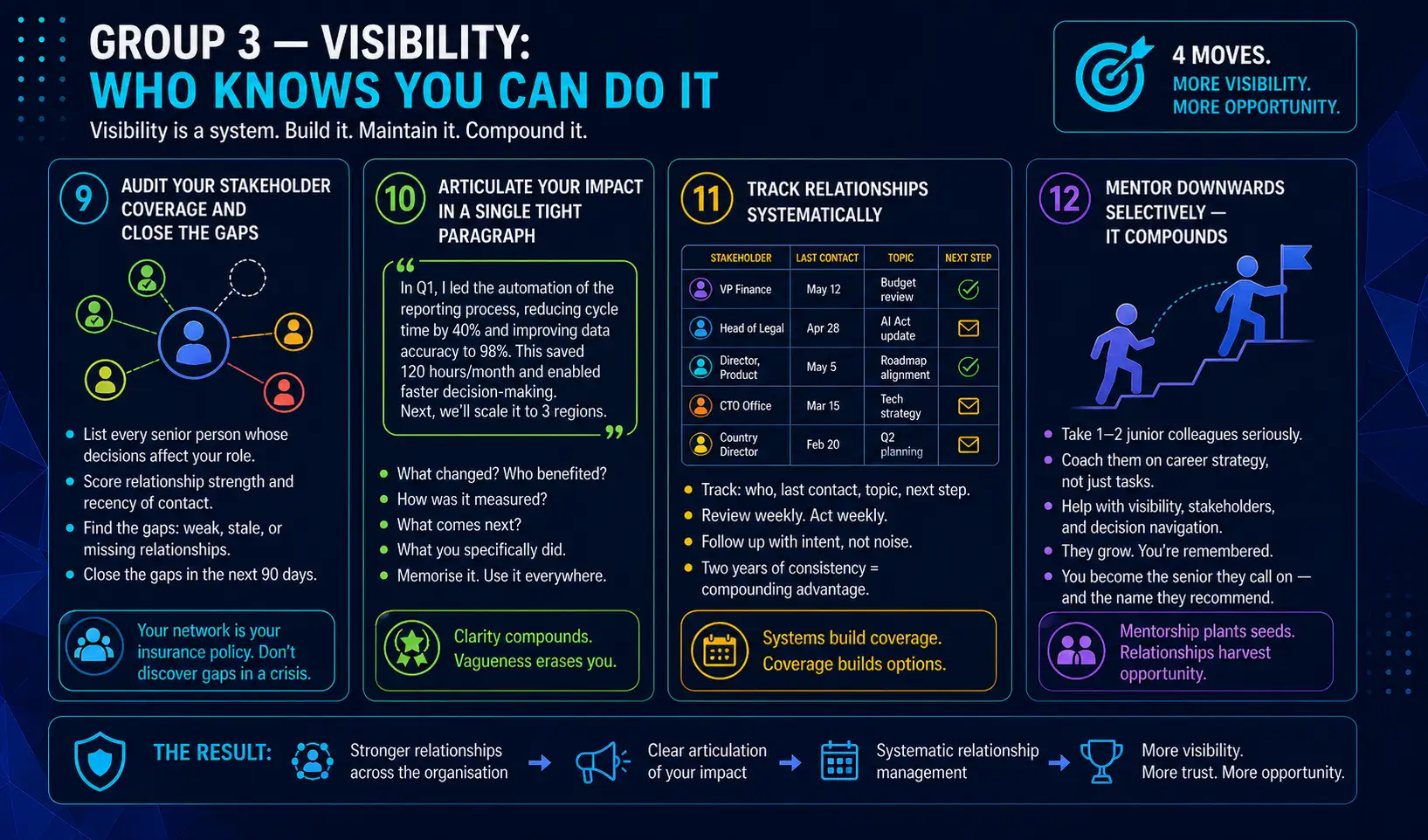
Move 9. Audit your stakeholder coverage and close the gaps
Open a blank document. Write down every senior person whose decisions affect your role — your manager, your manager's manager, the executive sponsor of your function, the leaders of the functions you interface with, the senior people in adjacent organisations who know your work. For each, score the strength of the relationship and the frequency of recent contact.
Most professionals find more gaps than they expected. Senior people they used to know well but haven't spoken to in eight months. Cross-functional leaders whose decisions affect their work but who would not recognise their name. Two-levels-up executives whose offices are forty steps away but whose calendars are blank to them.
The gaps are the planning input. The next 90 days are when you close them. The Career Relationship Audit and Stakeholder Map for Career Growth provide the structure.
Move 10. Articulate your impact in a single tight paragraph
If your manager's manager were asked tomorrow to describe what you do and what you have changed in the organisation in the last quarter, what would they say? If the answer is "I'm not sure they could," you have a visibility problem regardless of how good your work is.
Spend an hour writing a single tight paragraph: what changed because of your work, who benefited, how it was measured, what comes next, and what you specifically did. Five sentences. Memorise it. Use it the next time someone asks you what you have been working on, regardless of who they are.
This is not self-promotion. It is the language equivalent of having your work labelled. The professionals who can produce this paragraph from memory accumulate visibility every time they are asked. The ones who answer with vague generalities — "oh, the usual, lots of projects" — lose visibility at every interaction. The articulation gap is the visibility gap, and AI tools make it easier than ever to close.
Move 11. Track relationships systematically
Career-resilient professionals do not rely on memory for the relationships that determine their next opportunity. They run a system. Whether that system is a notebook, a spreadsheet, or Orvo — the discipline matters more than the tool, but a tool designed for this beats the alternatives.
The minimum viable system: a list of every senior stakeholder who matters to your role, the date of your last meaningful contact, a one-line note on what you discussed, and a flag for who you owe an outreach to. Reviewed weekly. Acted on weekly. The professionals who do this consistently for two years build relationship coverage that is structurally impossible to replicate from a standing start during a job search.
We built Orvo because the discipline was hard to maintain without one. The relationship-tracking workflow is the most mechanical part of career resilience and the easiest to abandon under work pressure. A purpose-built system removes the friction.
Move 12. Mentor downwards selectively — it compounds
The professionals with the highest staying power in any organisation are the ones whose departure would create succession problems. There are two ways to acquire that profile: be irreplaceable through expertise (Move 7), or be irreplaceable through relationships (Moves 6, 9, 11). Mentoring downwards builds the second kind.
Take one or two junior colleagues seriously. Coach them on actual career strategy, not surface-level advice. Get involved in their visibility work. Help them navigate the senior stakeholders you already know. Over two to three years, the people you have mentored become senior themselves — and you are the senior figure they call on for advice, the person whose name they mention to their own networks, the person who has accumulated relationship capital across an entire generational layer of your industry.
This is the longest-cycle move in this piece. It is also the one with the highest compounding rate.
How to sequence the twelve
Twelve moves is too many to do simultaneously. The right sequence depends on where you are starting:
If you are currently employed and your role is on the exposed list: start with Moves 5 (workflow replacement), 9 (stakeholder audit), and 10 (impact articulation). These are the highest-velocity visibility and capability moves. Within 60 days, add Move 6 (cross-functional surface area). Move 1 (role audit) was implicit in your starting position.
If you are currently employed and your role is on the resilient list: start with Move 5 (don't get complacent on AI fluency), Move 6 (build cross-functional coverage now while you have time), and Move 12 (mentor downwards). These compound your existing position rather than recovering from a deficit one.
If you are unemployed: Move 8 (vibe-code and ship), Move 9 (stakeholder audit, especially of dormant relationships), and Move 10 (articulation) are the immediate three. The geographic and architectural moves (2, 3) follow once the immediate-employment question is settled.
If you are in the European pharma, defence, or top-tier professional services sectors: your starting position is structurally favourable. Use it. Moves 5, 6, 7, and 12 compound fastest in these contexts.
Whatever your starting point, the order of work matters less than the discipline of doing it consistently over twelve to twenty-four months. The professionals who navigate this decade well will not be the ones who got the start position right. They will be the ones who put in the deliberate work, in their own way, before everyone else around them did the same.
A final note on patience
None of these moves produce visible results in the first 30 days. Most do not produce visible results in the first 90. The compounding kicks in at six to twelve months and then accelerates.
This is the hardest part of the playbook to internalise. European corporate culture, like most corporate cultures, rewards visible short-term wins and undervalues long-cycle compounding investments. The professionals who navigate this decade well are the ones who, against that pressure, treat their own visibility, AI fluency, and relationship capital as portfolio assets — invested in deliberately, monitored quarterly, allowed to compound without panic.
Twelve moves. Eighteen months. The macro will not improve on that timeline. Your position inside it can.
This playbook is part of The European Career Outlook Report 2026 by Orvo, the career intelligence platform for ambitious professionals. To receive the full PDF — pillar plus all five companion analyses — join our newsletter.
Republication permitted with attribution to Orvo and a link back to this article (Creative Commons Attribution 4.0).