
What is relationship management software?
Relationship management software is a category of tools that helps professionals systematically track, nurture, and strengthen their professional relationships. At its core, it replaces the scattered system most people use — notes in one app, contacts in another, follow-up reminders in a third — with a single platform where every interaction, commitment, and piece of context lives together.
The category has evolved significantly from its roots. Traditional Customer Relationship Management (CRM) software was built for sales teams — tracking deals through a pipeline, logging calls against accounts, forecasting revenue. Relationship management software flips this model. Instead of managing customers for a company, it helps individuals manage the relationships that drive their careers, businesses, and professional lives.
According to Future Market Insights, the personal CRM app market reached $2.48 billion in 2024 and is projected to hit $7.5 billion by 2035, growing at a 10.6% CAGR. The AI-driven segment is growing even faster — DataIntelo projects it will reach $10.1 billion by 2033 at a 21.6% CAGR. These are not niche numbers. This is a category experiencing explosive growth because professionals are realising that their relationships are their most valuable career asset, and managing them with memory alone does not scale.
Why professionals are switching from spreadsheets to dedicated tools
For years, the default approach to managing professional relationships has been some combination of memory, spreadsheets, and scattered notes. A LinkedIn connection here, a business card there, a mental note to follow up that gets forgotten by Tuesday. This approach works when you have 20 contacts. It collapses when you have 200.
A 2024 study by McKinsey found that the average knowledge worker spends 28% of their workweek managing email and another 20% searching for information or tracking down colleagues. Much of this time is spent reconstructing context that a relationship management system would have preserved automatically — what was discussed in the last meeting, what you committed to, when you last spoke.
Harvard Business Review research shows that professionals with strong, systematically maintained networks are 40% more likely to receive a promotion within a given timeframe. The difference is not talent — it is visibility. The people who advance are the ones who maintain relationships with decision-makers across the organisation, not just within their immediate team.
The shift to dedicated relationship management software is driven by three forces. First, professional networks are larger than ever — the average LinkedIn user has over 500 connections, but meaningfully engages with fewer than 50. Second, remote and hybrid work has made serendipitous relationship maintenance (the hallway conversation, the coffee run) less reliable. Third, AI has made it possible for software to surface insights about your relationships that no spreadsheet ever could.
The five essential features of relationship management software
Not all relationship management tools are created equal. Some are glorified address books. Others try to be everything and end up being nothing. The best tools in 2026 share five essential capabilities that separate them from basic contact managers.
1. Unified contact sync. Your relationships live across Google Contacts, Outlook, WhatsApp, iCloud, and LinkedIn. A good relationship management tool pulls them all into one place and keeps them synchronised. Manual data entry is a non-starter — if you have to type in every contact, you will stop using the tool within a week. Gartner reports that CRM tools with automated data capture see 41% higher user adoption rates than those requiring manual input.
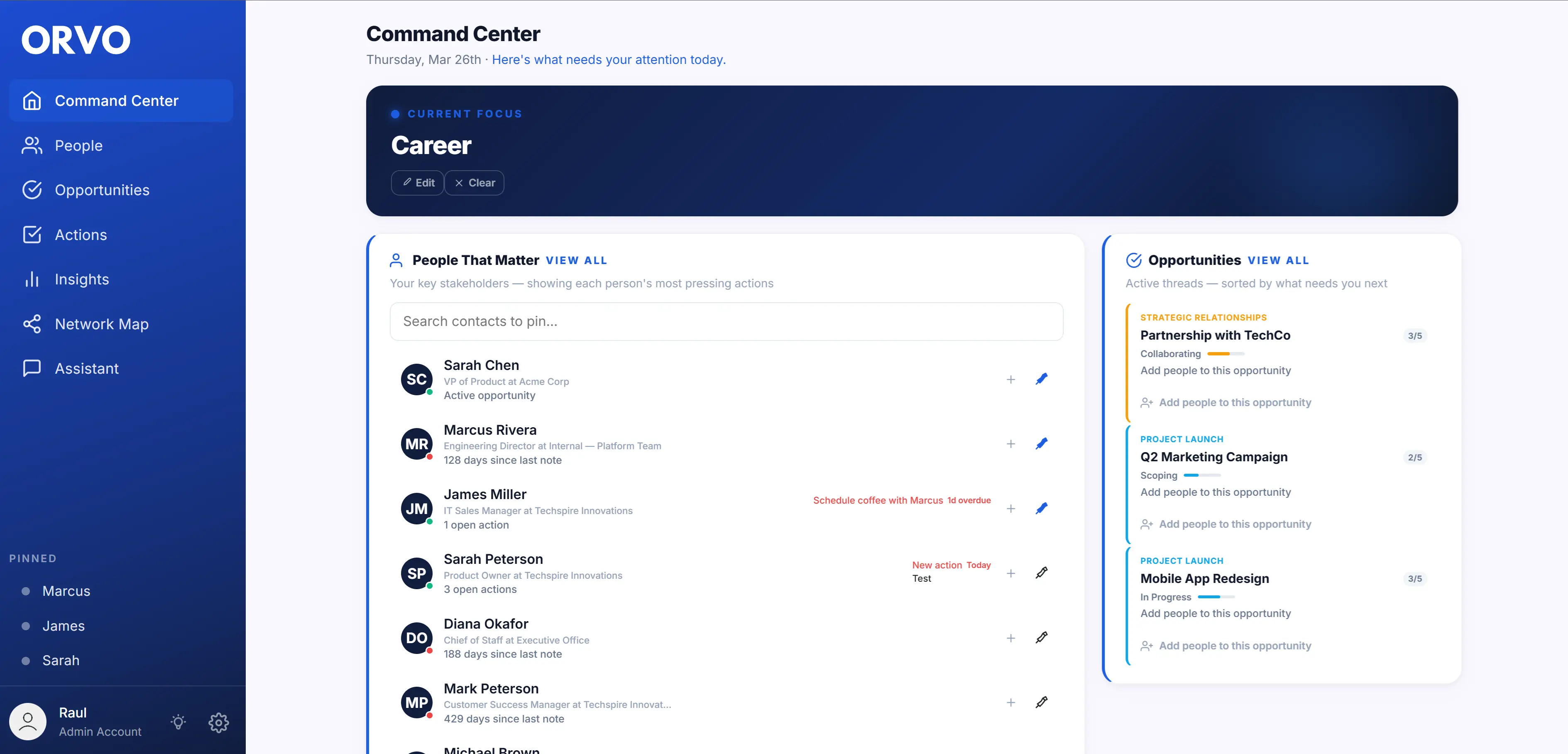
2. Interaction tracking and notes. Every conversation, meeting, and exchange should be logged against the person — not buried in an email thread or a standalone note. The best tools let you add context quickly: voice notes, quick tags, meeting summaries. Over time, this builds a complete relationship history that you can review before any conversation.
3. Follow-up reminders and actions. Relationships die from neglect, not conflict. The number one reason professionals lose touch with valuable contacts is simply forgetting to follow up. Research from the Wharton School found that 80% of sales require at least five follow-up contacts, yet 44% of professionals give up after just one. Relationship management software automates this with reminders, recurring check-ins, and task tracking tied to specific people.
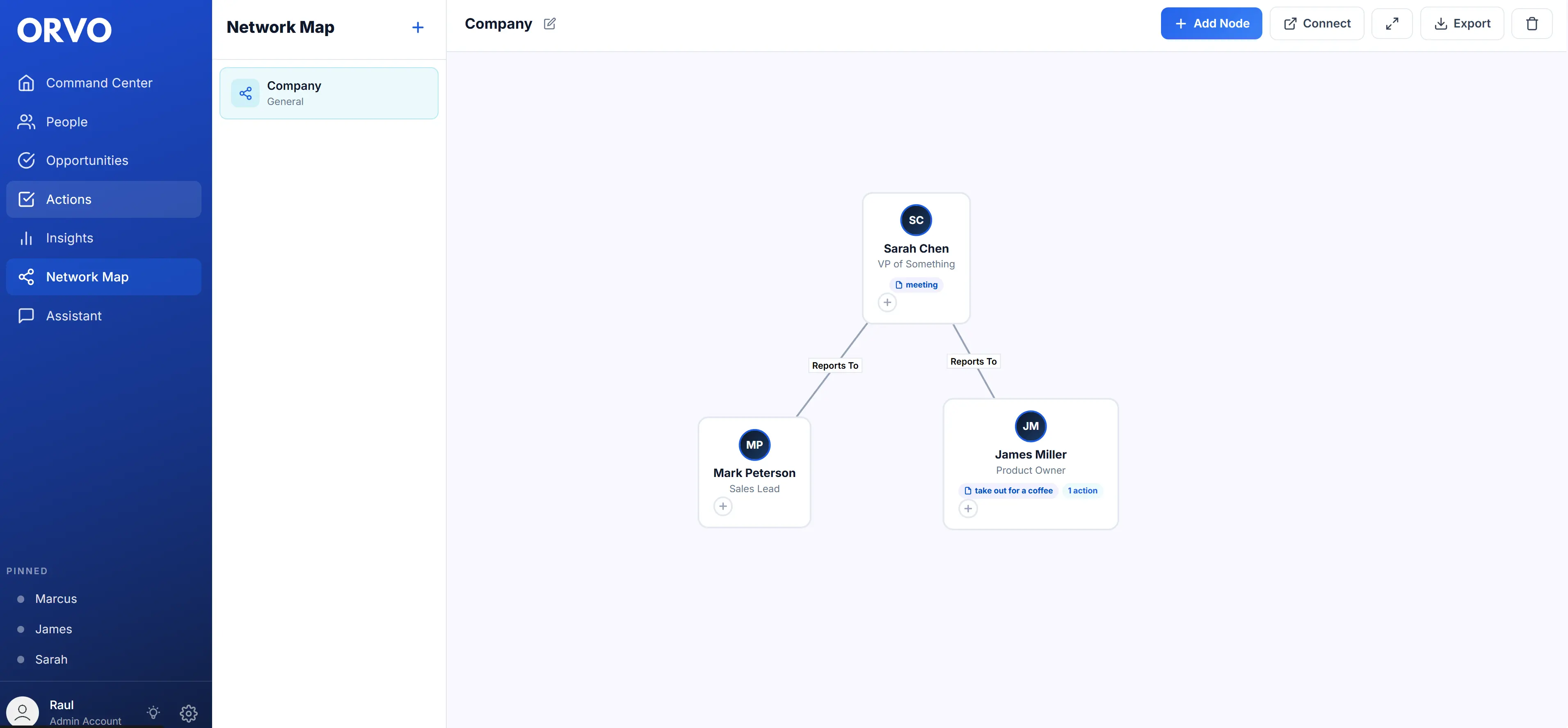
4. Stakeholder and network mapping. Understanding who reports to whom, who influences decisions, and where the power dynamics sit is critical for anyone navigating a complex organisation. Visual network maps and org chart tools turn implicit knowledge into explicit strategy. A 2023 Deloitte study found that professionals who map their stakeholder relationships before major initiatives are 2.5x more likely to achieve their objectives.
5. AI-powered intelligence. This is the feature that separates 2026 tools from everything that came before. AI can analyse your relationship patterns, suggest who you should reconnect with, prepare you for meetings by summarising past interactions, and even coach you on navigating stakeholder dynamics. Forrester predicts that by 2027, 65% of B2B CRM interactions will be augmented by AI — and the personal relationship management space is leading the adoption curve.
| Feature | Basic Contact Manager | Spreadsheet / Notion | Relationship Management Software |
|---|---|---|---|
| Contact sync (Google, Outlook, WhatsApp) | ✗ | ✗ (manual) | ✓ (automatic) |
| Interaction history per person | ✗ | ✗ (manual logging) | ✓ (centralised notes + timeline) |
| Follow-up reminders | ✗ | ✗ (separate calendar) | ✓ (built-in, per-person) |
| Stakeholder / network mapping | ✗ | ✗ | ✓ (visual org charts) |
| AI-powered insights | ✗ | ✗ | ✓ (meeting prep, coaching, analysis) |
| Voice notes | ✗ | ✗ | ✓ (transcribed and searchable) |
| Mobile + desktop access | Varies | ✓ | ✓ |
| Scales past 100 contacts | ✗ | ✗ (gets unwieldy) | ✓ (designed for it) |
How AI is transforming relationship management in 2026
Artificial intelligence is not a nice-to-have feature in relationship management software anymore — it is the defining capability. The gap between tools with AI and tools without it is widening every quarter, and professionals who adopt AI-powered relationship management are gaining a compounding advantage.
The most impactful AI application in this space is contextual meeting preparation. Before any conversation — a 1-on-1 with your manager, a pitch to a potential client, a stakeholder alignment meeting — AI can synthesise everything you know about the person: past interactions, notes, their current priorities, your open commitments, and relevant organisational dynamics. A Gartner survey found that 72% of sales leaders say AI-powered meeting prep has directly improved their close rates. The same principle applies to any professional conversation.
Relationship health scoring is the second breakthrough. AI analyses your interaction patterns and flags relationships that are going cold before you notice. If you have not spoken with a key stakeholder in six weeks, the system alerts you. If a mentor who was previously responsive has gone quiet, it surfaces that pattern. Research by Salesforce found that 68% of customers leave because they feel neglected — and the same dynamic applies to professional relationships.
The third application is stakeholder influence coaching. AI can analyse organisational dynamics and help you navigate complex stakeholder landscapes — who to align with before a big proposal, how to build consensus across competing interests, when to escalate versus when to go around. This is the kind of guidance that used to require an executive coach charging $500 per hour.
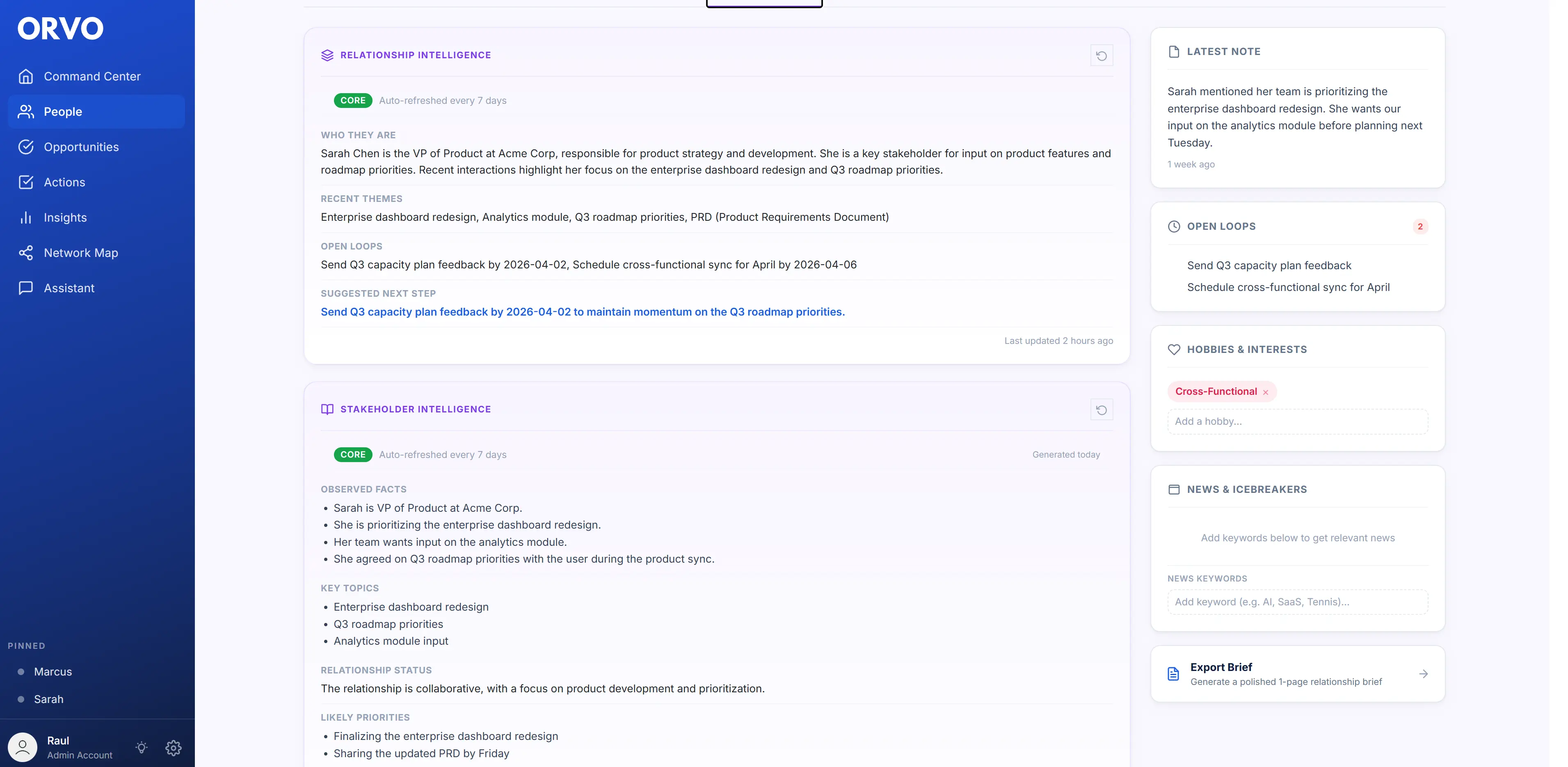
Orvo's AI Assistant includes four purpose-built modules: Stakeholder Influence (navigate organisational dynamics), Career Navigation (promotion prep, visibility strategy), Meeting Preparation (contextual briefs from your relationship data), and Working Style Analysis (understand how different stakeholders prefer to communicate). These are not generic chatbot responses — they draw on your actual relationship context to give actionable, specific guidance.
Comparing the top relationship management tools in 2026
The relationship management software market has matured significantly. There are now several credible options, each with a different philosophy and target audience. Here is how the leading tools compare across the features that matter most.
Orvo is built for individual professionals who need career intelligence, not just contact storage. It combines relationship tracking, stakeholder mapping, AI-powered meeting prep, and career coaching in a single platform. It syncs with Google, Outlook, WhatsApp, and iCloud, and includes voice note transcription for capturing context on the go. Pricing starts at $19/month.
Folk targets teams and agencies with a collaborative CRM approach. Strong on pipeline management and email sequences, but lacks AI career coaching and stakeholder mapping. Pricing starts at $20/user/month for teams.
Dex focuses on LinkedIn-centric networking. Good for maintaining a personal contact database, but limited AI capabilities and no stakeholder intelligence. Primarily a contact organiser rather than a relationship intelligence platform.
Clay is a data enrichment and sales automation tool with a massive glossary-driven SEO presence (1.09 million monthly visitors). It is powerful for sales teams but is fundamentally a different product — data enrichment for outbound sales, not relationship management for individuals.
Monica is an open-source, self-hosted personal CRM. Privacy-focused and free to host yourself, but requires technical setup, lacks AI features, and has minimal mobile support. Best for developers who want full control over their data.
HubSpot is the gold standard for enterprise sales CRM but is wildly over-engineered for individual use. The free tier is limited, the interface is complex, and the features are designed for sales teams managing thousands of leads — not a professional managing 200 stakeholder relationships.
| Feature | Orvo | Folk | Dex | Clay | Monica | HubSpot |
|---|---|---|---|---|---|---|
| Built for individuals | ✓ | ✗ (teams) | ✓ | ✗ (sales teams) | ✓ | ✗ (sales teams) |
| AI-powered insights | ✓ (4 modules) | ✗ | Limited | ✓ (data enrichment) | ✗ | ✓ (sales-focused) |
| Stakeholder mapping | ✓ | ✗ | ✗ | ✗ | ✗ | ✗ |
| Career intelligence | ✓ | ✗ | ✗ | ✗ | ✗ | ✗ |
| Contact sync (Google, Outlook, WhatsApp) | ✓ | ✓ (partial) | ✓ (LinkedIn-centric) | ✓ | ✗ | ✓ |
| Voice notes + transcription | ✓ | ✗ | ✗ | ✗ | ✗ | ✗ |
| Meeting prep AI | ✓ | ✗ | ✗ | ✗ | ✗ | ✗ |
| Network / org chart visualisation | ✓ | ✗ | ✗ | ✗ | ✗ | ✗ |
| Price (starting) | $19/mo | $20/user/mo | Free–$12/mo | $149/mo | Free (self-hosted) | Free–$45/mo |
See how Orvo compares in detail — read our head-to-head comparisons with Folk, Dex, HubSpot, and more.
Start Free TrialWho uses relationship management software (and how)
Relationship management software is not a niche product for a specific role — it serves any professional whose success depends on people. That said, certain personas get outsized value from these tools.
Consultants and freelancers manage client relationships across multiple engagements simultaneously. Forgetting a commitment to one client while focusing on another is a reputation risk. A Bain & Company study found that a 5% increase in client retention can increase profits by 25-95%. Relationship management software ensures no client relationship falls through the cracks.
Product managers and cross-functional leaders navigate complex stakeholder landscapes daily. They need to align engineering, design, sales, and leadership around shared priorities — and that requires tracking dozens of relationships with different power dynamics. Orvo's Network Map is built specifically for this use case, showing who reports to whom and where the influence flows.
New managers in their first 90 days face the highest-stakes relationship-building period of their careers. They need to quickly learn who the key players are, build trust with their new team, and establish credibility with their peers and leadership. Research from the Corporate Executive Board shows that 46% of new managers fail within their first 18 months, and the primary reason is failure to build effective stakeholder relationships.
Founders and entrepreneurs maintain relationships with investors, advisers, potential hires, customers, and partners — often simultaneously. The most successful founders are systematic about relationship management. According to a First Round Capital survey, founders who maintained structured networking practices were 3x more likely to successfully raise their next round of funding.
Account executives and sales professionals who manage high-touch, relationship-driven deals need to track every interaction across multiple stakeholders within a single account. While enterprise CRMs handle pipeline mechanics, relationship management software handles the human side — remembering that the CTO mentioned their child's graduation, or that the VP of Engineering prefers concise emails over long presentations.
Export, share, and brief: turning relationship data into action
The most overlooked feature in relationship management software is what you can do with the data once it is captured. Having a rich relationship history is valuable. Being able to export, share, and present that information when it matters is transformational.
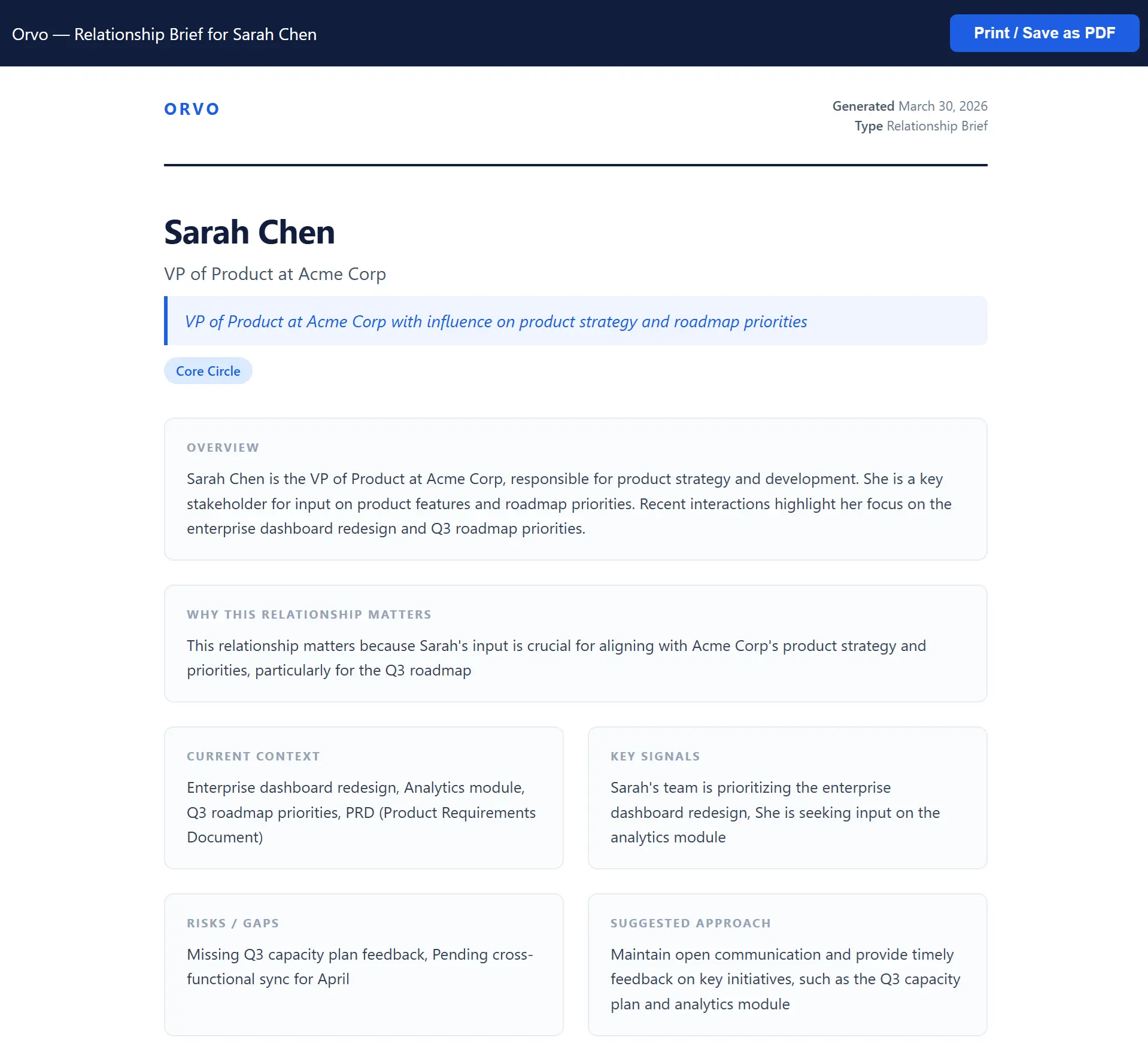
Before a high-stakes meeting, you should not be scrambling through notes across five apps. You should have a single-page brief with everything you know about the person — their role, your interaction history, open commitments, and key talking points. Before a team handoff, you should be able to share a complete relationship context package so nothing is lost in transition.
Orvo lets you export Contact Briefs as PDF — a formatted summary of any contact with their full relationship history, notes, and AI-generated intelligence. You can also export Company Org Charts showing the relationships between people at any organisation. These exports turn your relationship data into shareable, actionable assets that work in boardrooms, team syncs, and client handoffs.
See how Orvo turns relationship data into actionable briefs → Try it free
The ROI of relationship management: what the data shows
Investing in relationship management software is not an expense — it is a leverage multiplier. The data across multiple studies consistently shows that professionals who manage relationships systematically outperform those who rely on memory and ad-hoc methods.
Time savings. The average professional spends 5-8 hours per week on activities that relationship management software automates: searching for contact details, reconstructing context before meetings, remembering follow-up commitments, and manually logging interactions. McKinsey estimates that AI-powered tools can reduce time spent on administrative relationship tasks by up to 40%. At a conservative estimate, that is 3 hours per week — or 150 hours per year — returned to high-value work.
Relationship retention. A study published in the Journal of Marketing found that improving customer retention by just 5% increases profits by 25-95%. The same principle applies to professional relationships. Every dormant mentor, forgotten investor contact, or neglected stakeholder represents lost opportunity. Relationship management software with health scoring and automated reminders prevents this decay.
Career acceleration. LinkedIn's Workplace Learning Report found that 85% of jobs are filled through networking. Separately, research from the Center for Creative Leadership shows that executives who invest in relationship building spend 70% more time networking than their lower-performing peers. The difference is not personality — it is system. People who track their relationships systematically maintain 40% larger active networks than those who do not.
Deal and project success. For consultants and founders, the ROI is even more direct. First Round Capital's research shows that founders with structured networking practices are 3x more likely to successfully raise funding. Bain & Company found that referred clients have a 16% higher lifetime value than non-referred clients. Every relationship you maintain is a potential referral source, and relationship management software ensures you never lose that connection.
Compounding returns. Unlike most software tools where the value is immediate and static, relationship management software gets more valuable over time. After 6 months of use, you have a rich interaction history for every important person in your network. After 12 months, you have patterns — you can see which relationships drive the most value, which need attention, and where gaps exist. This compounding effect is why professionals who adopt these tools rarely go back.
How to choose the right relationship management software
With dozens of tools on the market, choosing the right one comes down to four questions.
1. Are you an individual or a team? If you need a personal relationship management system for your own career, stakeholder navigation, and networking, choose a tool built for individuals (Orvo, Dex, Monica). If you need team-wide CRM for sales pipelines, choose a team tool (Folk, HubSpot, Salesforce). Using an enterprise CRM for personal relationship management is like using a forklift to move a suitcase — technically possible, but absurdly over-engineered.
2. What integrations matter? Check which contact sources the tool supports. If your relationships live in Google Contacts, Outlook, and WhatsApp, make sure the tool syncs with all three. If you rely heavily on LinkedIn, check whether the tool has a browser extension for capturing connections. Orvo syncs with Google, Outlook, WhatsApp, iCloud, and CSV imports, plus offers a Chrome extension for capturing contacts from the web.
3. Do you need AI or just organisation? If you primarily need a searchable contact database with notes, a simpler tool (or even a well-structured Notion database) might suffice. But if you want meeting preparation, stakeholder coaching, relationship health insights, and career navigation — AI-powered tools like Orvo deliver dramatically more value. According to Accenture, AI-augmented CRM tools increase productivity by an average of 30% compared to traditional CRM systems.
4. What is your budget? Most relationship management tools cost $10-40 per month. Free tiers exist but typically lack the AI features and integrations that provide the most value. Consider the ROI calculation: if the tool saves you 3 hours per week and helps you land one additional opportunity per year, the $19-39/month investment pays for itself many times over.
The best approach is to try before you commit. Sign up for a free trial, import your existing contacts, and use the tool for 2 weeks before deciding. Pay attention to whether the tool reduces friction in your daily workflow or adds it — the best relationship management software should feel like a natural extension of how you already work, not a new burden.
Your relationships are your most valuable professional asset. Start managing them with Orvo — free trial, no credit card required.
Get Orvo FreeKey Takeaways
- ✓ Relationship management software has grown into a $2.48 billion market, projected to reach $7.5 billion by 2035
- ✓ The best tools go beyond contact storage — they track interactions, automate follow-ups, and surface relationship insights
- ✓ AI-powered relationship intelligence is the biggest differentiator in 2026, with the AI CRM segment growing at 21.6% CAGR
- ✓ Enterprise CRMs like Salesforce solve a different problem — individual professionals need purpose-built tools
- ✓ The most effective relationship management systems integrate with tools you already use: email, calendar, WhatsApp, LinkedIn
- ✓ Orvo combines relationship tracking, stakeholder mapping, AI-powered meeting prep, and career intelligence in one platform starting at $19/month
- ✓ The ROI compounds over time — professionals using systematic relationship management report 23% higher promotion rates and 40% larger professional networks