
What is relationship management software?
Relationship management software is a category of tools that helps professionals systematically track, nurture, and strengthen their professional relationships. At its core, it replaces the scattered system most people use — notes in one app, contacts in another, follow-up reminders in a third — with a single platform where every interaction, commitment, and piece of context lives together.
The category has evolved significantly from its roots. Traditional Customer Relationship Management (CRM) software was built for sales teams — tracking deals through a pipeline, logging calls against accounts, forecasting revenue. Relationship management software flips this model. Instead of managing customers for a company, it helps individuals manage the relationships that drive their careers, businesses, and professional lives.
The category is growing quickly because professionals are realising that their relationships are their most valuable career asset, and managing them with memory alone does not scale.
Why professionals are switching from spreadsheets to dedicated tools
For years, the default approach to managing professional relationships has been some combination of memory, spreadsheets, and scattered notes. A LinkedIn connection here, a business card there, a mental note to follow up that gets forgotten by Tuesday. This approach works when you have 20 contacts. It collapses when you have 200.
Knowledge workers lose a large share of their week to email and to tracking down information and colleagues. Much of this time is spent reconstructing context that a relationship management system would have preserved automatically — what was discussed in the last meeting, what you committed to, when you last spoke.
Professionals with strong, systematically maintained networks tend to be better placed when promotion decisions are made. The difference is not talent — it is visibility. The people who advance are the ones who maintain relationships with decision-makers across the organisation, not just within their immediate team.
The shift to dedicated relationship management software is driven by three forces. First, professional networks are larger than ever — many people have hundreds of LinkedIn connections but meaningfully engage with only a small fraction of them. Second, remote and hybrid work has made serendipitous relationship maintenance (the hallway conversation, the coffee run) less reliable. Third, AI has made it possible for software to surface insights about your relationships that no spreadsheet ever could.
The five essential features of relationship management software
Not all relationship management tools are created equal. Some are glorified address books. Others try to be everything and end up being nothing. The best tools in 2027 share five essential capabilities that separate them from basic contact managers.
1. Easy contact import. Your relationships live across Google Contacts, Outlook, iCloud, your phone, LinkedIn and messaging apps. A good relationship management tool brings them into one place without retyping. Manual data entry is a non-starter — if you have to type in every contact, you will stop using the tool within a week.
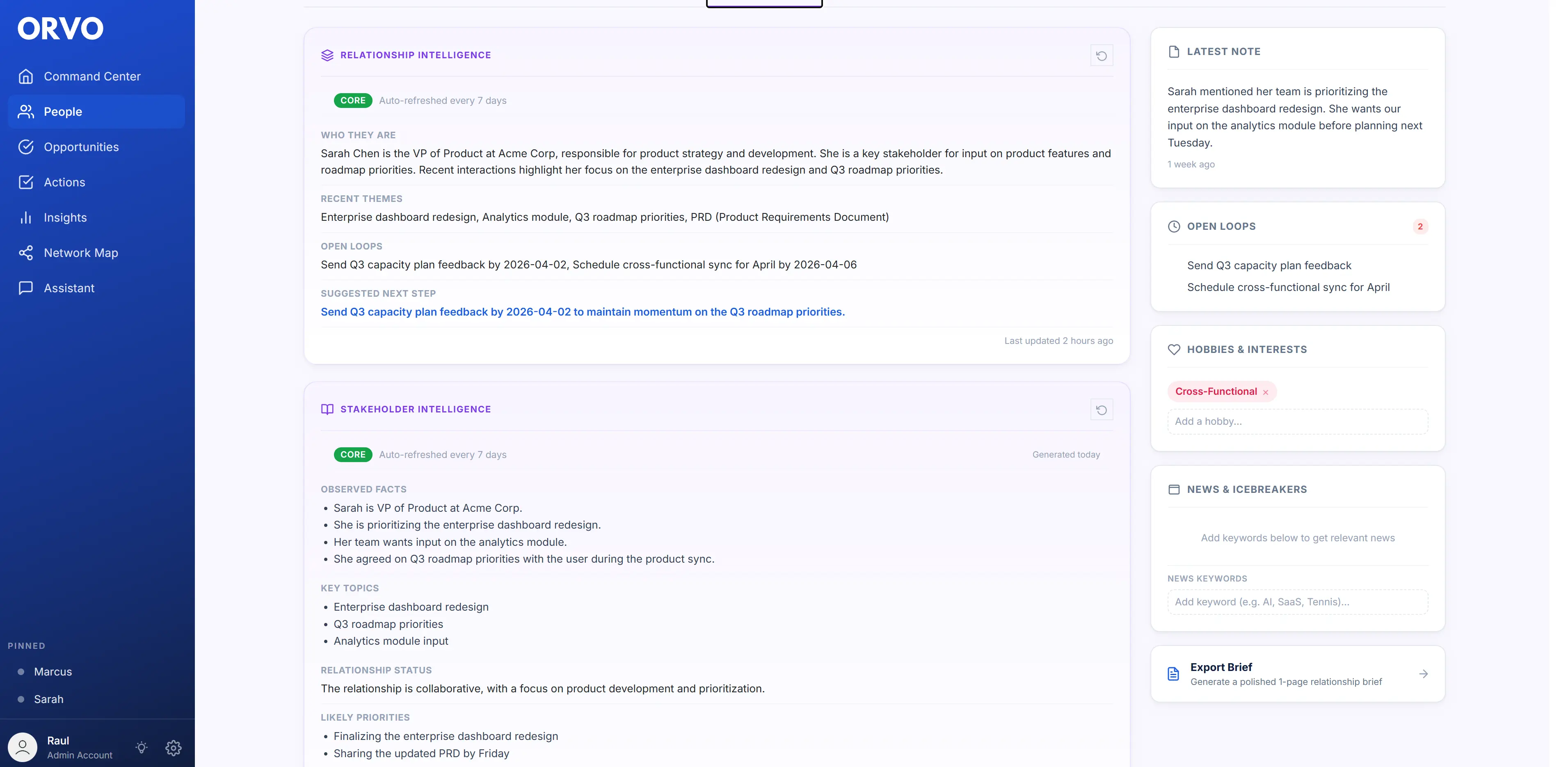
2. Interaction tracking and notes. Every conversation, meeting, and exchange should be logged against the person — not buried in an email thread or a standalone note. The best tools let you add context quickly: record a meeting, drop in a Teams or Zoom transcript, or say a quick recap, and get a summary filed on the right person. Over time, this builds a complete relationship history that you can review — or simply ask about — before any conversation.
3. Follow-up reminders and actions. Relationships die from neglect, not conflict. The number one reason professionals lose touch with valuable contacts is simply forgetting to follow up. Many people stop after a single follow-up, even though relationships usually need several touchpoints before anything comes of them. Relationship management software automates this with reminders, recurring check-ins, and task tracking tied to specific people.
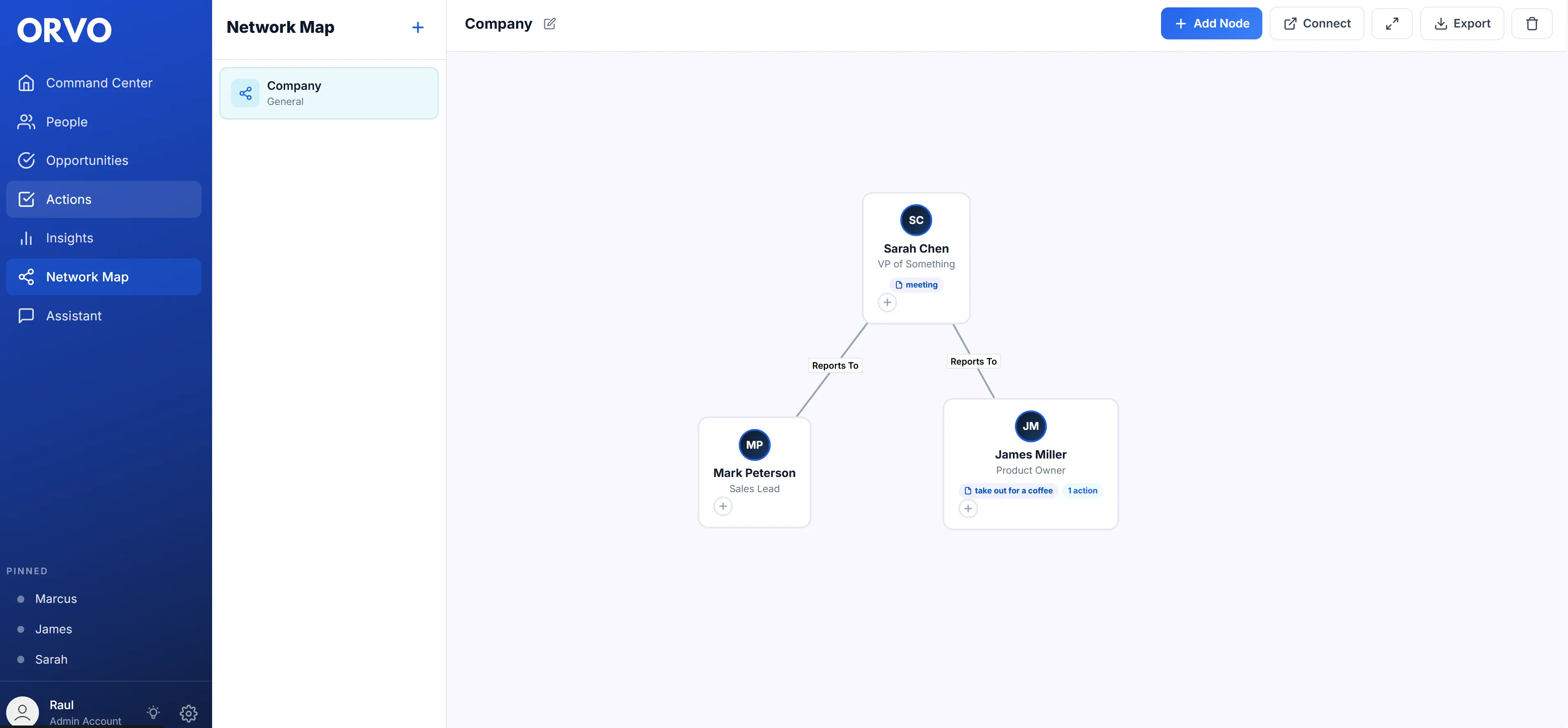
4. Stakeholder and network mapping. Understanding who reports to whom, who influences decisions, and where the power dynamics sit is critical for anyone navigating a complex organisation. Visual network maps and org chart tools turn implicit knowledge into explicit strategy. Mapping your stakeholders before a major initiative makes it much easier to see whose support you need and who could block you.
5. AI-powered intelligence. This is the feature that separates today's tools from everything that came before. AI can answer plain-language questions from your own notes ("who do I know in fintech in Berlin?"), turn a meeting into a summary with follow-ups, suggest who you should reconnect with, prepare you for meetings by summarising past interactions, and coach you on navigating stakeholder dynamics. Check that it works on your data and shows where its answers come from.
| Feature | Basic Contact Manager | Spreadsheet / Notion | Relationship Management Software |
|---|---|---|---|
| Contact import (Google, Outlook, iCloud, phone) | ✗ | ✗ (manual) | ✓ |
| Interaction history per person | ✗ | ✗ (manual logging) | ✓ (centralised notes + timeline) |
| Follow-up reminders | ✗ | ✗ (separate calendar) | ✓ (built-in, per-person) |
| Stakeholder / network mapping | ✗ | ✗ | ✓ (visual org charts) |
| AI-powered insights | ✗ | ✗ | ✓ (meeting prep, coaching, analysis) |
| Ask questions in plain words | ✗ | ✗ | ✓ (in AI-first tools) |
| Meeting notes from recordings or transcripts | ✗ | ✗ | ✓ (in AI-first tools) |
| Mobile + desktop access | Varies | ✓ | ✓ |
| Scales past 100 contacts | ✗ | ✗ (gets unwieldy) | ✓ (designed for it) |
How AI is transforming relationship management in 2027
Artificial intelligence is not a nice-to-have feature in relationship management software anymore — it is the defining capability. The useful question is no longer whether a tool has AI, but what the AI does with your data.
The first big change is capture without typing. You can record a meeting, upload a recording or drop in a Teams or Zoom transcript, and the software transcribes it, files it on the right person and pulls out the follow-ups. This is what keeps a relationship tool up to date — the weak point of every CRM has always been the notes nobody writes.
The second is asking instead of searching. Semantic search lets you ask a question in plain words — "who do I know who has worked on a cloud migration?" — and get back the people, with the note that matched. Some tools search your connected accounts to find who you are linked to; the most useful answers for an existing relationship come from what you wrote about the person.
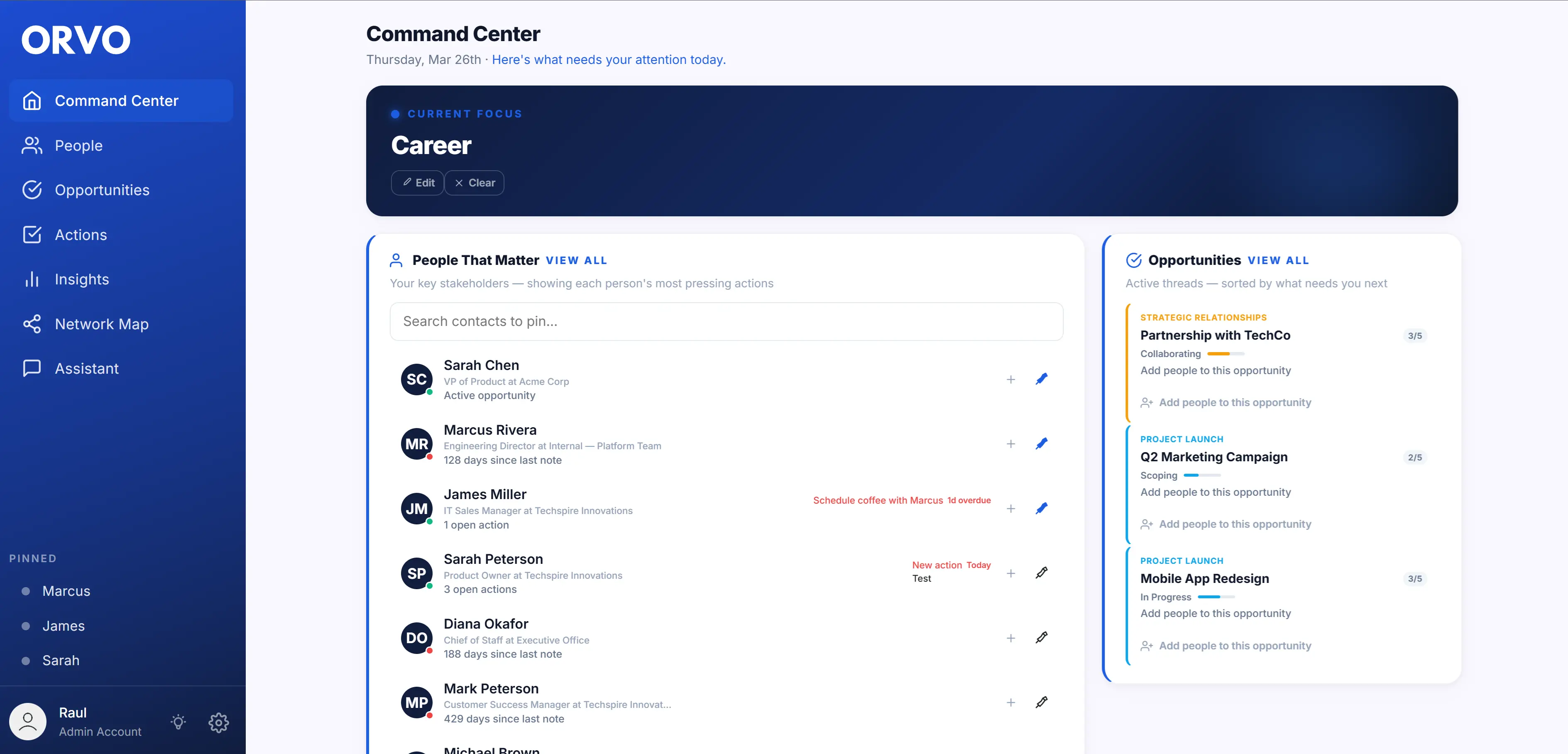
The third is contextual meeting preparation. Before any conversation — a 1-on-1 with your manager, a pitch to a potential client, a stakeholder alignment meeting — AI can pull together your past interactions, open commitments and what you discussed last time, then suggest talking points and questions.
The fourth is relationship health and stakeholder coaching. AI flags relationships that are going quiet against the cadence you set, and helps you read organisational dynamics — who to align with before a big proposal, how a particular person prefers to receive information, when to escalate.
In Orvo, these come together as Ask Orvo (plain-language questions answered from your own notes, with the people and source notes shown), Orvo AI Notes (recordings, transcripts or a quick spoken recap turned into the summary type you choose — executive summary, action items, stakeholder brief and more — with suggested follow-ups), and an AI Assistant for meeting prep, follow-ups, career navigation, high-stakes conversations and stakeholder influence. Each person also gets relationship, stakeholder and working-style intelligence built from your notes. AI features are off until you switch them on, and your notes are not used to train AI models.
Comparing the top relationship management tools in 2027
The relationship management software market has matured, and several tools have changed direction in the past year. Here is how the leading options compare across the features that matter most. Updated 24 October 2026; competitor research collected 9 October 2026; in the table, a dash means we could not confirm the feature on the vendor's own site.
Orvo is built for individual professionals who need relationship and career intelligence, not just contact storage. Ask Orvo answers plain-language questions from your own notes and names the people it found; Orvo AI Notes turns meeting recordings, Teams or Zoom transcripts and quick spoken recaps into summaries filed on the right person, with suggested follow-ups. It adds meeting-prep prompts, per-person relationship, stakeholder and working-style intelligence, keep-in-touch reminders and a Network Map. You can import from Google, Outlook, your phone's contacts, and CSV or vCard files (including iCloud exports), save emails to a person by BCC, and add people from LinkedIn in one click with the Chrome extension — one person at a time, when you choose, with no background activity on your LinkedIn account (it does not sync your whole network automatically). Android access is included; iOS is coming soon. Mobile is $7.99/month for mobile access only. Pro ($19/month) and Business ($39/month) include web access; contact sharing requires Business. Pro is $19/month after a 14-day free trial.
Mesh (formerly Clay) renamed itself from Clay in March 2026. It keeps a large personal network organised and up to date from connected accounts, with a feed of birthdays, news and job moves and an AI navigator called Nexus. Free up to 1,000 contacts; Pro is $10/month. Strong on automatic upkeep, lighter on meeting notes and stakeholder work.
Dex focuses on LinkedIn-centric networking. It offers background sync of your LinkedIn connections, set up in the Dex app (title-change alerts), and adds email and calendar sync, reminders and a mobile app. Dex offers Copilot and contact briefings, and supports external AI assistants through MCP. There is no free plan: from $12/month billed annually after a trial; check the current trial terms.
folk has repositioned as an AI CRM for sales teams ("one platform for your entire sales motion"), with AI sales assistants, lead scoring and enrichment. Good for small teams running a pipeline; less suited to a private, individual relationship tool. From $24 per member per month billed annually.
Monica is an open-source personal CRM you can self-host for free or use as a paid hosted service. Strong privacy stance, but no native mobile app yet and no built-in AI (it plans an MCP server so you can bring your own model). Best for people who want full control over their data.
HubSpot is a leading sales and marketing platform, with AI in Breeze Assistant and AI agents. The free CRM covers two users; the features are designed for teams managing pipelines and customers — not a professional managing 200 stakeholder relationships.
A note on two names you may see in older lists: Cloze now sells an AI-powered CRM to real-estate agents and brokerages, and Clay (clay.com) is a sales data-enrichment platform, unrelated to Mesh.
| Feature | Orvo | Mesh (formerly Clay) | Dex | folk | Monica | HubSpot |
|---|---|---|---|---|---|---|
| Built for | Individuals | Individuals and teams | Individuals | Sales teams | Individuals | Sales and marketing teams |
| Ask in plain words over your notes | ✓ (Ask Orvo) | Nexus AI | Via your own AI (MCP) | Sales assistants | ✗ | Breeze Assistant |
| Meeting notes from recordings/transcripts | ✓ (AI Notes) | — | — | — | ✗ | — |
| Stakeholder / network map | ✓ | — | — | — | ✗ | — |
| Automatic LinkedIn sync | ✗ (one-click add) | — | ✓ | — | ✗ | — |
| Native phone apps | ✓ Android; iOS coming soon | ✓ | ✓ | ✓ | ✗ (planned) | ✓ |
| Free plan | ✗ (14-day trial) | ✓ (up to 1,000 contacts) | ✗ (7-day trial) | — | ✓ (self-hosted) | ✓ (2 users) |
| Price (starting) | $19/mo | $10/mo | $12/mo (annual) | $24/member/mo (annual) | Free (self-hosted) | Free; paid per seat |
See how Orvo compares in detail — read our head-to-head comparisons with Folk, Dex, HubSpot, and more.
Start Free TrialWho uses relationship management software (and how)
Relationship management software is not a niche product for a specific role — it serves any professional whose success depends on people. That said, certain personas get outsized value from these tools.
Consultants and freelancers manage client relationships across multiple engagements simultaneously. Forgetting a commitment to one client while focusing on another is a reputation risk. Research by Frederick Reichheld at Bain & Company found that a 5% increase in customer retention can increase profits by 25-95%. Relationship management software ensures no client relationship falls through the cracks.
Product managers and cross-functional leaders navigate complex stakeholder landscapes daily. They need to align engineering, design, sales, and leadership around shared priorities — and that requires tracking dozens of relationships with different power dynamics. Orvo's Network Map is built specifically for this use case, showing who reports to whom and where the influence flows.
New managers in their first 90 days face the highest-stakes relationship-building period of their careers. They need to quickly learn who the key players are, build trust with their new team, and establish credibility with their peers and leadership. When new managers struggle, the cause is often not a lack of skill but a failure to build effective stakeholder relationships early.
Founders and entrepreneurs maintain relationships with investors, advisers, potential hires, customers, and partners — often simultaneously. The most successful founders are systematic about relationship management, so that when it is time to raise, hire or sell, the relationships are already warm.
Account executives and sales professionals who manage high-touch, relationship-driven deals need to track every interaction across multiple stakeholders within a single account. While enterprise CRMs handle pipeline mechanics, relationship management software handles the human side — remembering that the CTO mentioned their child's graduation, or that the VP of Engineering prefers concise emails over long presentations.
Export, share, and brief: turning relationship data into action
The most overlooked feature in relationship management software is what you can do with the data once it is captured. Having a rich relationship history is valuable. Being able to export, share, and present that information when it matters is transformational.
Before a high-stakes meeting, you should not be scrambling through notes across five apps. You should have a single-page brief with everything you know about the person — their role, your interaction history, open commitments, and key talking points. Before a team handoff, you should be able to share a complete relationship context package so nothing is lost in transition.
Orvo lets you export Contact Briefs as PDF — a formatted summary of any contact with their full relationship history, notes, and AI-generated intelligence. You can also export Company Org Charts showing the relationships between people at any organisation. These exports turn your relationship data into shareable, actionable assets that work in boardrooms, team syncs, and client handoffs.
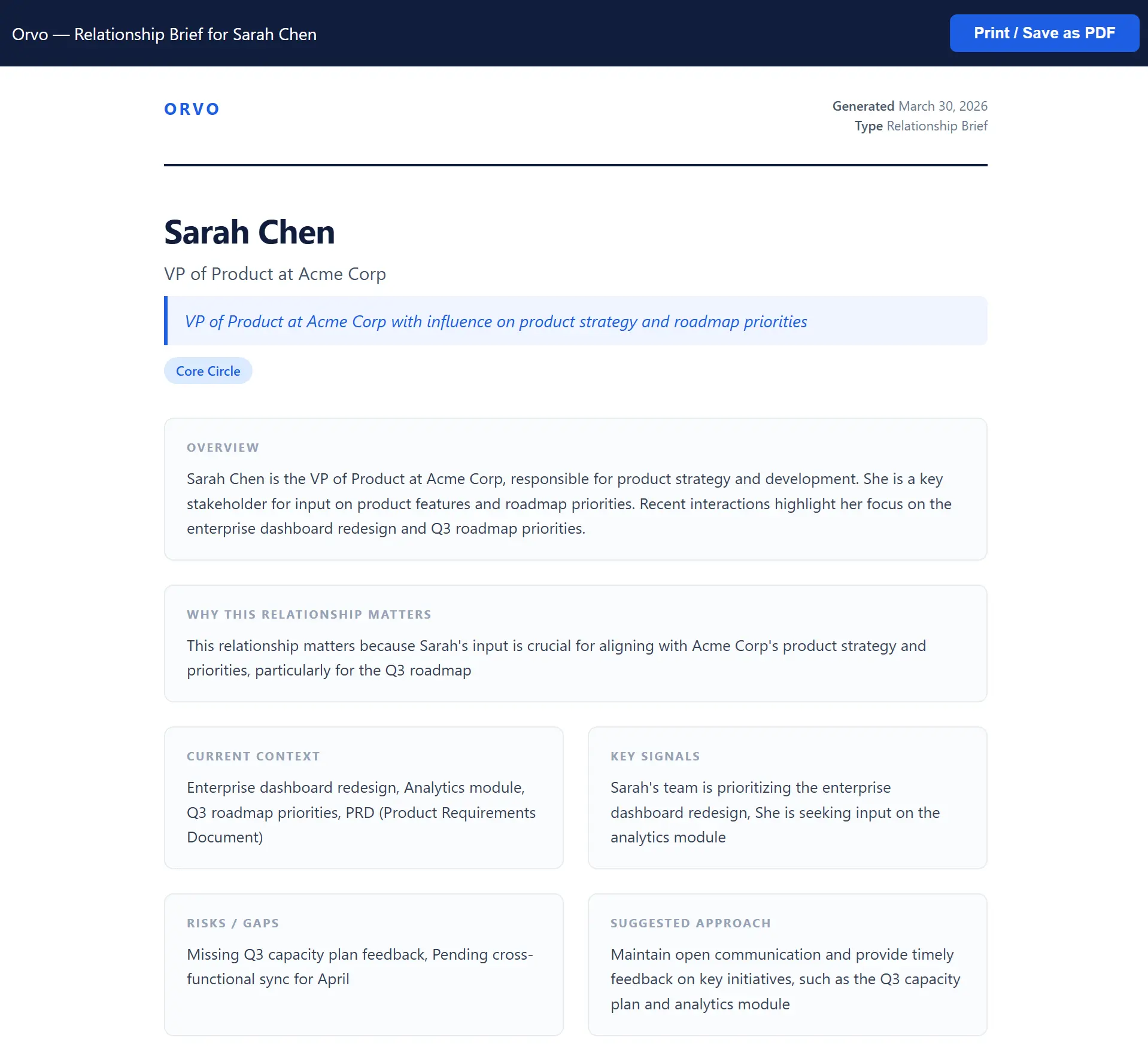
See how Orvo turns relationship data into actionable briefs → Try it free
The ROI of relationship management: where the value comes from
Investing in relationship management software is not an expense — it is a leverage multiplier. Professionals who manage relationships systematically tend to get far more from them than those who rely on memory and ad-hoc methods.
Time savings. A surprising share of the working week goes on activities that relationship management software automates: searching for contact details, reconstructing context before meetings, remembering follow-up commitments, and manually logging interactions. AI-powered tools take much of that administrative work off your plate and return the time to high-value work.
Relationship retention. In business, keeping the customers you have is worth far more than constantly replacing them. The same principle applies to professional relationships. Every dormant mentor, forgotten investor contact, or neglected stakeholder represents lost opportunity. Relationship management software with health scoring and automated reminders prevents this decay.
Career acceleration. Many roles are filled through networks and referrals rather than open applications, and the professionals who advance tend to invest consistently in relationship building. The difference is not personality — it is system. People who track their relationships systematically find it far easier to keep a large network active.
Deal and project success. For consultants and founders, the ROI is even more direct. Warm relationships make fundraising, hiring and winning new work easier, and referrals tend to bring in some of the best clients. Every relationship you maintain is a potential referral source, and relationship management software ensures you never lose that connection.
Compounding returns. Unlike most software tools where the value is immediate and static, relationship management software gets more valuable over time. After 6 months of use, you have a rich interaction history for every important person in your network. After 12 months, you have patterns — you can see which relationships drive the most value, which need attention, and where gaps exist. This compounding effect is why professionals who adopt these tools rarely go back.
How to choose the right relationship management software
With dozens of tools on the market, choosing the right one comes down to five questions.
1. Are you an individual or a team? If you need a personal relationship management system for your own career, stakeholder navigation, and networking, choose a tool built for individuals (Orvo, Dex, Monica). If you need team-wide CRM for sales pipelines, choose a team tool (Folk, HubSpot, Salesforce). Using an enterprise CRM for personal relationship management is like using a forklift to move a suitcase — technically possible, but absurdly over-engineered.
2. What integrations matter? Check which contact sources the tool supports. If your relationships live in Google Contacts, Outlook and iCloud, make sure the tool imports from all three. If you rely heavily on LinkedIn, check whether the tool syncs your whole network automatically or lets you add people one at a time. Dex offers background sync of your connections, set up in the Dex app (title-change alerts), and is stronger for automatic network-wide LinkedIn updates. Orvo imports from Google, Outlook, your phone's contacts, and CSV or vCard files (including iCloud exports), and saves emails you BCC to it; Orvo LinkedIn Chrome extension adds people one at a time when you choose, with no background activity on your LinkedIn account.
3. Do you need AI or just organisation? If you primarily need a searchable contact database with notes, a simpler tool (or even a well-structured Notion database) might suffice. But if you want meeting notes written for you, plain-language questions over your notes, meeting preparation, stakeholder coaching and relationship health insights — AI-powered tools like Orvo deliver much more. Also check whether AI is opt-in and whether your notes are used to train models.
4. Do you need it on your phone? Most relationship moments happen away from a desk: after a coffee, in a corridor, on the way home from an event. Check for native iPhone and Android apps, not just a mobile website. Orvo has an Android app, with iOS coming soon. Mobile is $7.99/month for mobile access; Pro and Business include web and mobile access.
5. What is your budget? Most relationship management tools cost $10-40 per month. Free tiers exist but typically lack the AI features and integrations that provide the most value. Consider the ROI calculation: if the tool saves you 3 hours per week and helps you land one additional opportunity per year, the $19-39/month investment pays for itself many times over.
The best approach is to try before you commit. Sign up for a free trial, import your existing contacts, and use the tool for 2 weeks before deciding. Pay attention to whether the tool reduces friction in your daily workflow or adds it — the best relationship management software should feel like a natural extension of how you already work, not a new burden.
Your relationships are your most valuable professional asset. Start managing them with Orvo — free trial, no credit card required.
Get Orvo FreePoints clés
- ✓ Relationship management software has grown into its own category, built for individual professionals rather than sales teams
- ✓ The best tools go beyond contact storage — they track interactions, automate follow-ups, and surface relationship insights
- ✓ AI that works on your own data — meeting notes, plain-language questions over your notes, conversation prep — is now the biggest differentiator
- ✓ Enterprise CRMs like Salesforce solve a different problem — individual professionals need purpose-built tools
- ✓ The most effective relationship management systems connect to tools you already use: email, calendar, phone contacts, LinkedIn
- ✓ Several tools changed in the past year: Clay is now Mesh, folk is a sales CRM, Cloze sells to real-estate brokerages, and Dex has no free plan
- ✓ Orvo combines Ask Orvo, AI meeting notes, stakeholder mapping and meeting prep, with web and Android access on Pro from $19/month; Mobile is $7.99/month for mobile access only, and iOS is coming soon
- ✓ The value compounds over time — every note and meeting you capture makes the next conversation better prepared