
Relationship intelligence, defined
Relationship intelligence is the systematic ability to understand who matters in your professional world, retain the context of every interaction, and act on that knowledge to strengthen relationships deliberately. It is not a personality trait — it is a skill that can be learned and a system that can be built.
Think of it this way: most professionals have hundreds of professional contacts but can only recall meaningful details about 20-30 of them. They forget what was discussed in last month's meeting. They lose track of commitments. They let important relationships go cold without noticing until it is too late. This is not a character flaw — it is a memory limitation. The human brain was not designed to maintain detailed context about 200+ relationships simultaneously.
Relationship intelligence solves this by externalising what your brain cannot hold. It means having a system — whether a disciplined notebook habit or purpose-built software — that captures interaction context, tracks relationship health, and surfaces the information you need before every conversation. According to Robin Dunbar's research at Oxford University, humans can maintain approximately 150 stable social relationships (known as Dunbar's Number). But the average professional interacts with 300-600 people over the course of a career. Relationship intelligence is how you manage beyond your biological limit.
The term is emerging as a formal category in 2026 because the tools to support it — AI-powered contact management, automated interaction tracking, stakeholder mapping — have finally matured to the point where any professional can practise relationship intelligence, not just the naturally gifted networkers who have always done it intuitively.
The three pillars: awareness, memory, and action
Relationship intelligence breaks down into three distinct capabilities. Most professionals are strong in one, adequate in another, and completely neglect the third. Mastering all three is what creates a compounding advantage.
Pillar 1: Awareness — knowing your landscape. This means understanding who the important people in your professional world are, how they relate to each other, and what role each plays in your career trajectory. It includes mapping stakeholders (who influences your promotion?), identifying connectors (who bridges different parts of your network?), and spotting gaps (which critical relationships are you neglecting?). A Deloitte study found that professionals who formally map their stakeholder landscape before major initiatives are 2.5x more likely to achieve their objectives. Most people never do this — they operate on instinct about who matters, which creates blind spots.
Pillar 2: Memory — retaining context. Every professional conversation contains information that is valuable later: what someone is working on, what they care about, what they asked you to do, what you committed to. Without a system, this context evaporates within days. The next time you speak with that person, you are starting from scratch instead of building on a foundation. Research from the Ebbinghaus forgetting curve shows that people forget approximately 70% of new information within 24 hours unless it is deliberately recorded. Memory in relationship intelligence means capturing context in a way that is searchable, organised per person, and accessible before your next interaction.
Pillar 3: Action — following through consistently. Awareness without action is observation. Memory without action is a diary. The third pillar is the discipline to follow up, reconnect, deliver on commitments, and proactively strengthen relationships. A Wharton School study found that 80% of professional outcomes require at least five touchpoints with a stakeholder, yet 44% of professionals give up after just one. Relationship intelligence means having a system that reminds you to act — so follow-through becomes automatic rather than dependent on willpower.
| Pillar | What It Means | Without It | With It |
|---|---|---|---|
| Awareness | Knowing who matters and how they connect | Blind spots in your stakeholder landscape | Strategic clarity about every relationship |
| Memory | Retaining context from every interaction | Forgetting details, repeating conversations | Full context at your fingertips before every meeting |
| Action | Following through consistently | 44% drop-off after first contact | Systematic follow-up with every important person |
Why relationship intelligence matters more than ever in 2026
Three macro trends are converging to make relationship intelligence the most valuable professional skill of the decade.
Remote and hybrid work has destroyed passive relationship maintenance. Before 2020, you maintained relationships through proximity — the hallway conversation, the coffee run, the lunch queue. Remote work eliminated these serendipitous touchpoints. A Microsoft Work Trend Index study found that since the shift to hybrid work, cross-team collaboration has dropped by 25%. The relationships that used to maintain themselves now require deliberate effort. Professionals who do not actively manage their networks are watching them shrink.
Career paths are less linear and more relationship-dependent. The average professional now changes jobs every 2.7 years according to the Bureau of Labor Statistics, and LinkedIn reports that 85% of positions are filled through networking. Each transition requires activating a different segment of your professional network — former colleagues, industry contacts, mentors, sponsors. Without relationship intelligence, each career move starts from zero. With it, you have a warm network ready to activate.
AI has democratised the skill. Relationship intelligence used to be the domain of a specific personality type — the natural connector who remembers everyone's name, follows up without being reminded, and intuitively reads organisational dynamics. AI-powered tools have changed this. Software can now track interactions automatically, score relationship health, map stakeholder dynamics, and prepare you for conversations. According to Gartner, organisations that adopt AI-augmented relationship management see a 35% improvement in customer-facing outcomes. The same principle applies to individual professionals managing their own networks.
The professionals who develop relationship intelligence now — whether naturally or through tools — will have a compounding advantage. Every year of relationship data makes the system more valuable. Every maintained connection is a potential referral, introduction, or career opportunity. The cost of starting later only grows.
Relationship intelligence vs. networking: the critical difference
Most professionals confuse relationship intelligence with networking. They are fundamentally different skills with different outcomes.
Networking is about breadth — making new connections. It is the skill of walking into a room, starting conversations, exchanging contact information, and expanding your circle. Good networkers meet a lot of people. The metric is connections made.
Relationship intelligence is about depth — maintaining and leveraging existing connections. It is the skill of remembering what matters to each person, following up at the right time, preparing for conversations with full context, and strategically strengthening the relationships that drive the most value. The metric is relationships maintained and opportunities created.
Here is the uncomfortable truth: most professionals are decent networkers and terrible at relationship intelligence. They attend events, collect business cards, make LinkedIn connections — and then let 90% of those relationships decay through neglect. A study by HubSpot found that the average professional's active network (people they have communicated with in the past 90 days) is less than 15% of their total contacts. That means 85% of your network is dormant at any given time.
The professionals who advance fastest are not the ones with the biggest networks. They are the ones who systematically maintain their networks. They are the ones who walk into every meeting prepared, who follow through on every commitment, who re-engage dormant contacts before they need something. That is relationship intelligence.
Orvo was built specifically for this problem. It is not a networking tool — it is a relationship intelligence platform. It does not help you meet new people. It helps you maintain, understand, and strengthen the relationships you already have.
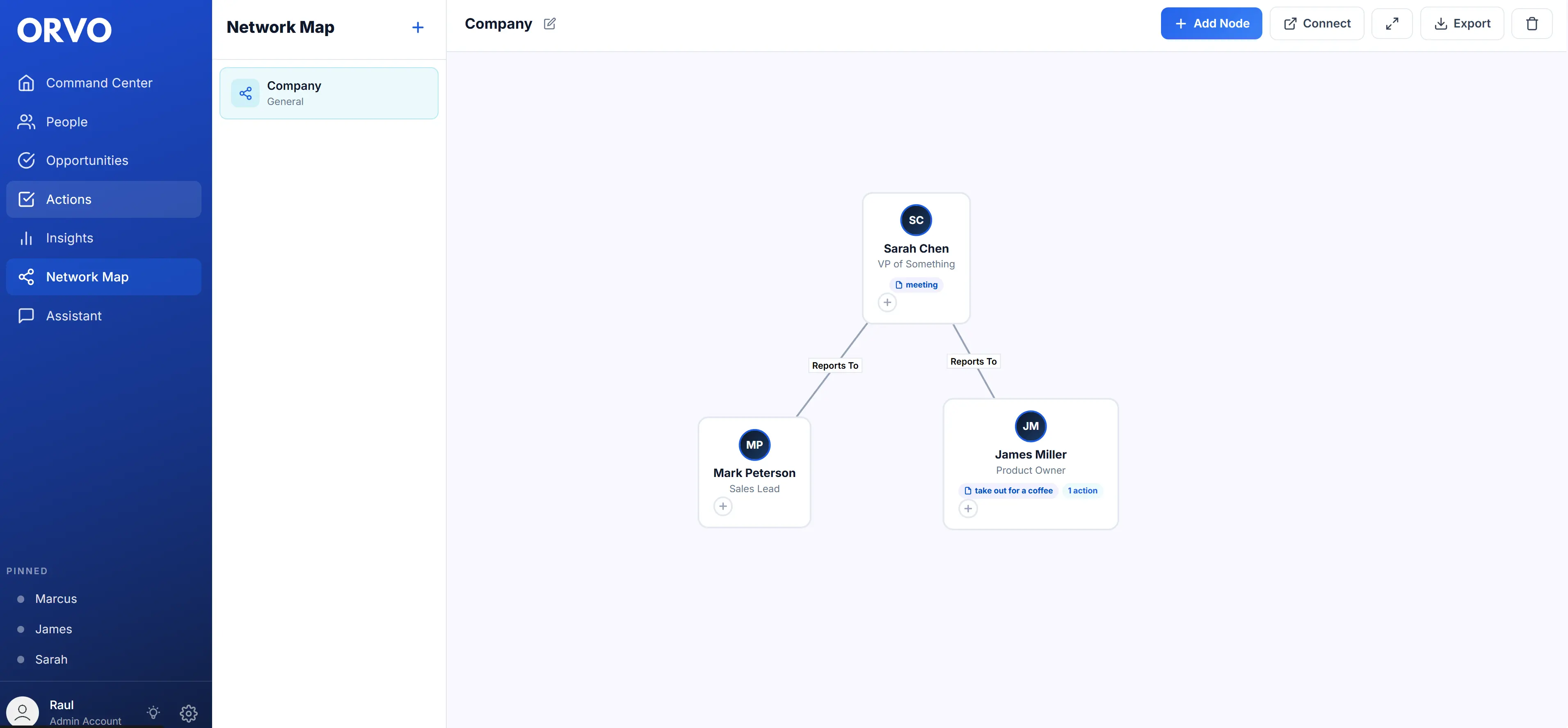
Orvo turns your scattered contacts into a relationship intelligence system → Try it free
How AI powers relationship intelligence in practice
Relationship intelligence used to require extraordinary personal discipline — the kind of person who keeps a meticulous journal, remembers birthdays, and never forgets a follow-up. AI has changed this. Software can now handle the mechanics of relationship intelligence, freeing you to focus on the human part: the actual conversations and connections.
Here is what AI-powered relationship intelligence looks like in practice:
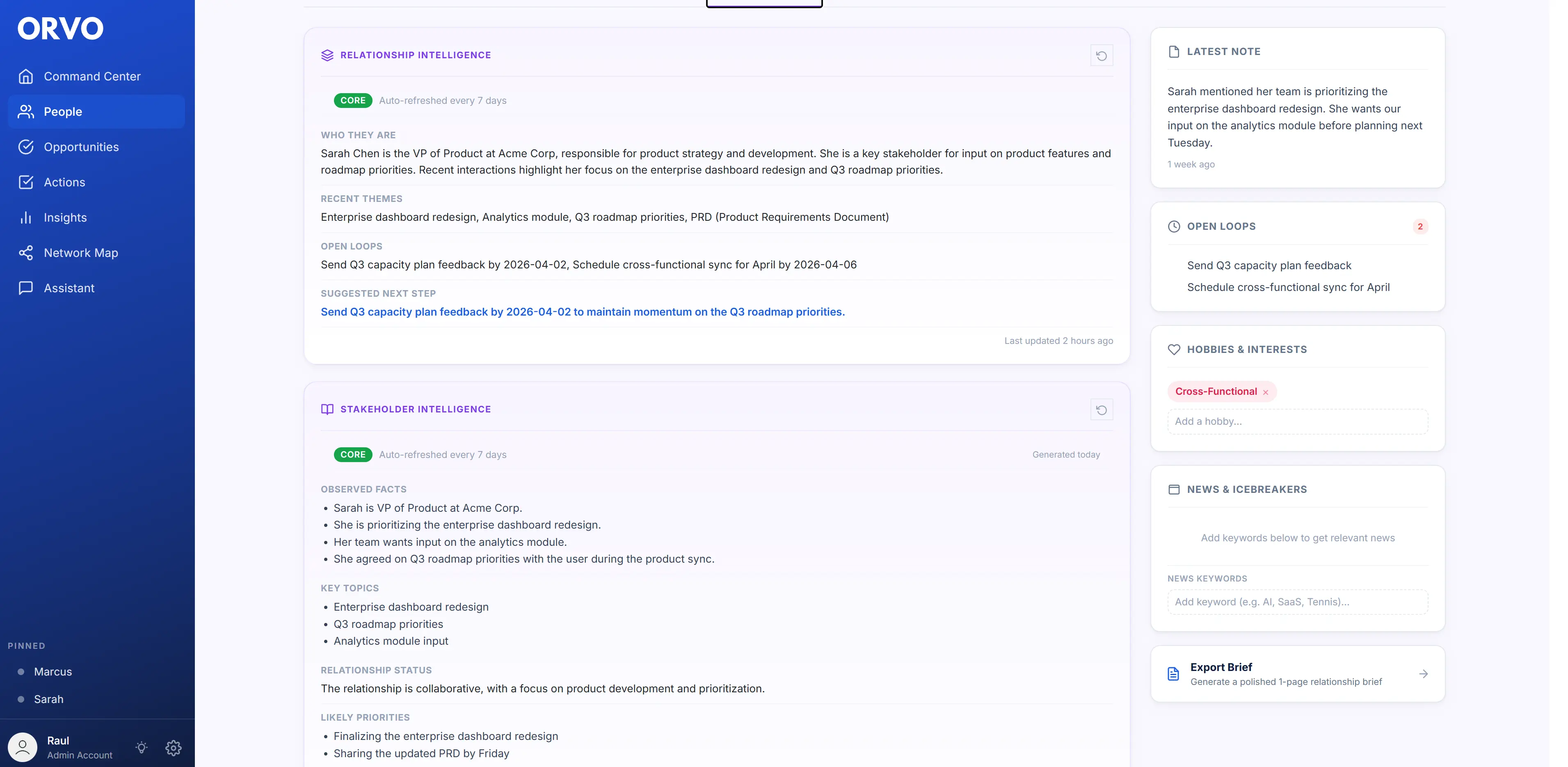
Automated interaction capture. Instead of manually logging every meeting, call, and email, AI-powered tools track your interactions across channels — email, calendar, WhatsApp, phone — and automatically build a timeline for each contact. You never have to type "Had coffee with Sarah, discussed Q3 priorities" again. The system knows.
Relationship health scoring. AI analyses your interaction patterns and assigns a health score to each relationship. If you have been engaging weekly with a stakeholder and suddenly drop to monthly, the system flags it. If a contact's response time has doubled, it surfaces that signal. Salesforce research found that 68% of business relationships erode due to perceived indifference. AI catches the indifference before it becomes irreversible.
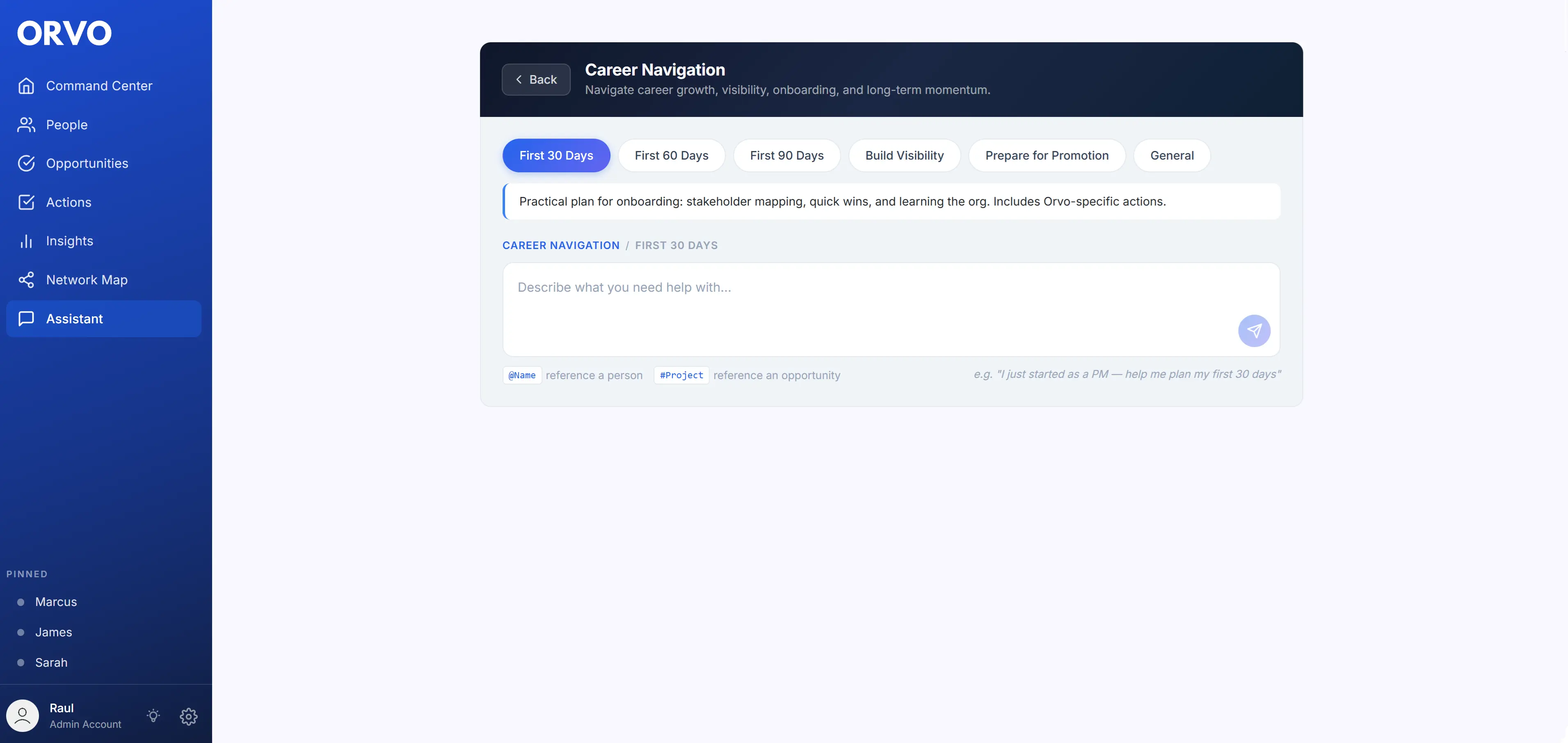
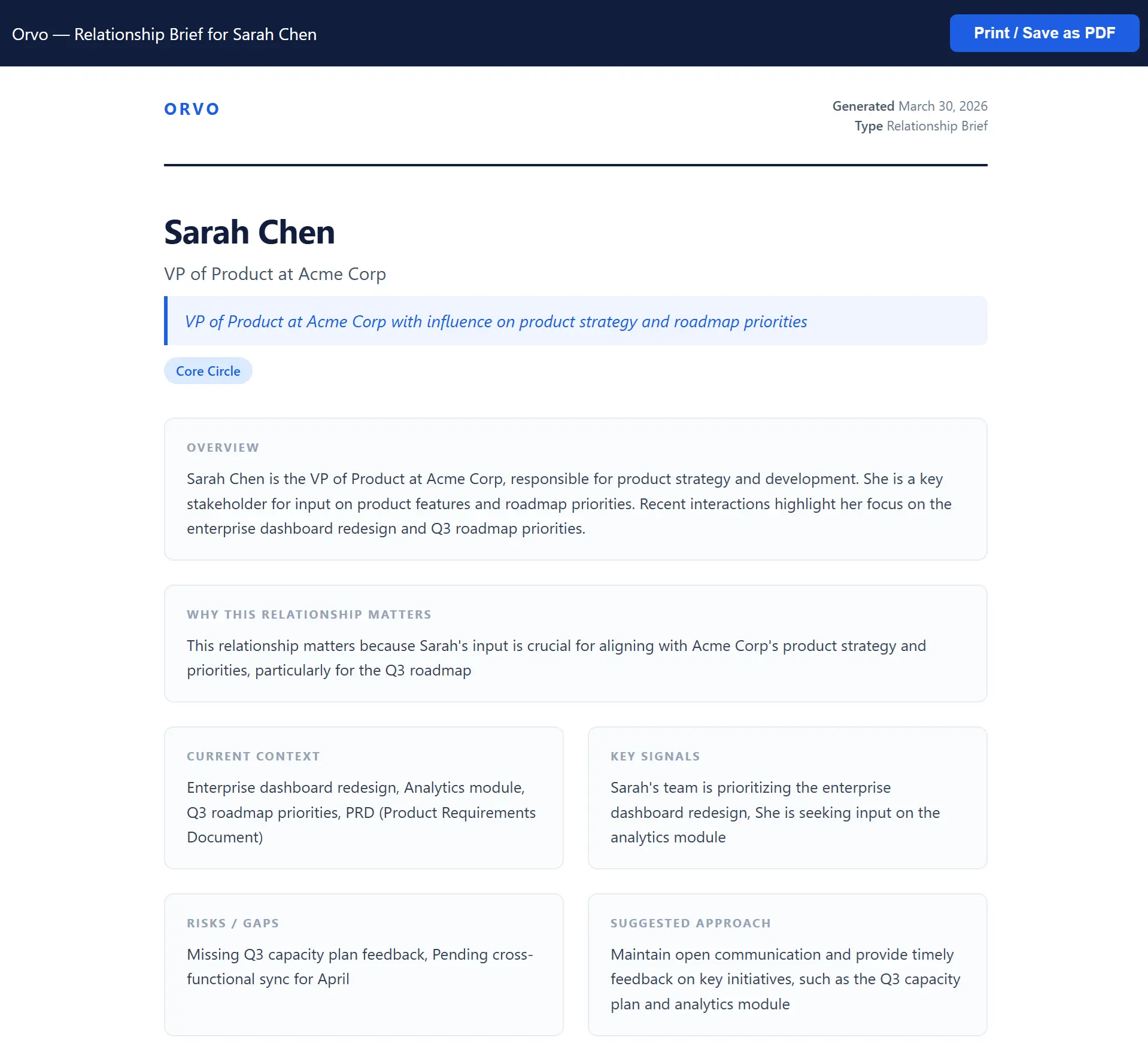
Contextual meeting preparation. Before any conversation, AI synthesises everything you know about the person — past interactions, open commitments, their current priorities, recent news about their company — into a single brief. A Gartner survey found that 72% of professionals report improved outcomes when they prepare for meetings with contextual data rather than memory alone.
Stakeholder influence mapping. AI can analyse organisational structures, communication patterns, and decision-making dynamics to help you understand who really holds power, who influences whom, and where the hidden blockers sit. This is the kind of intelligence that used to require years of organisational experience or an expensive executive coach.
Building your relationship intelligence system: a practical framework
You do not need software to start developing relationship intelligence — but software makes it dramatically easier and more sustainable. Here is a framework that works whether you use a dedicated tool or start with a notebook.
Step 1: Audit your current landscape (Week 1). List the 30-50 people who most influence your professional success. Include your manager, skip-level, key clients, mentors, sponsors, cross-functional partners, and industry contacts. For each person, note: when you last spoke, what you discussed, and any open commitments. This exercise alone is revealing — most professionals discover 5-10 critical relationships they have been neglecting.
Step 2: Establish a capture habit (Week 2-3). After every important conversation, spend 60 seconds recording the key points: what was discussed, what you committed to, what you learned about the person. Voice notes work well for this — speak your observations into your phone immediately after a meeting. In Orvo, voice notes are transcribed and associated with the right contact automatically.
Step 3: Set relationship rhythms (Week 3-4). Not every relationship needs the same frequency. Your manager needs weekly engagement. Your skip-level needs monthly touchpoints. A mentor might need quarterly check-ins. Set specific follow-up cadences for each key relationship and track them. The tool matters less than the consistency.
Step 4: Review and adjust monthly (Ongoing). Once a month, review your relationship landscape. Who have you been engaging with? Who have you been neglecting? Are there new stakeholders who should be on your radar? Has anything changed in the organisational dynamics? This monthly review is what separates people who practise relationship intelligence from people who just have a contact list.
Build your relationship intelligence system in Orvo — import contacts, log interactions, and get AI-powered insights from day one.
Start Free TrialRelationship intelligence in career advancement
The connection between relationship intelligence and career success is not abstract — it is measurable and well-documented.
Promotions are relationship decisions. As we cover in detail in our guide on how to get promoted, promotion decisions are made in calibration meetings where managers advocate for their people to a room of leaders. If those leaders do not know who you are, your name will not survive the discussion. Relationship intelligence means knowing who sits in that room, building visibility with them over months, and ensuring they have a positive impression of your work before the meeting happens.
Opportunities come through weak ties. Sociologist Mark Granovetter's famous "Strength of Weak Ties" research, validated repeatedly over 50 years, shows that professional opportunities — jobs, partnerships, collaborations — are more likely to come through acquaintances than close friends. The reason: your close network shares your information bubble, while weak ties connect you to new information and opportunities. Relationship intelligence is how you maintain those weak ties at scale. Without a system, they decay to nothing within months.
Trust is built through consistency. The Center for Creative Leadership found that the single strongest predictor of leadership effectiveness is the ability to build and maintain trust across the organisation. Trust is not built in one impressive meeting — it is built through dozens of small interactions where you show up prepared, follow through on commitments, and demonstrate genuine interest. Relationship intelligence software ensures that consistency by tracking every commitment and prompting every follow-up.
The compounding effect is real. After 6 months of practising relationship intelligence, you have a rich context history for your 30-50 most important relationships. After 12 months, you have patterns — you can see which relationships generate the most value, which need attention, and how your network has evolved. After 2 years, you have a professional memory that gives you an unfair advantage in every conversation, every negotiation, and every career transition.
Why this category is wide open (and why that matters for you)
Here is the strategic reality of relationship intelligence in 2026: almost nobody is talking about it, and that is exactly why it matters.
The CRM industry is enormous — the broader market is the largest software category globally. But it is almost entirely focused on enterprise sales. Salesforce, HubSpot, Pipedrive, and dozens of others compete for sales teams managing deal pipelines. On the personal side, tools like Folk, Dex, and Clay compete for the "personal CRM" label — essentially contact managers with varying levels of sophistication.
Relationship intelligence is different. It is not about managing contacts. It is not about tracking sales pipelines. It is about developing a systematic understanding of the human relationships that drive professional outcomes. It sits at the intersection of career development, stakeholder management, and AI-powered insight — a space where no major player has planted a flag.
This matters for you as a professional because early adopters of emerging categories get the most value. The people who adopted email in the 1990s, LinkedIn in the 2000s, and AI tools in the 2020s all gained compounding advantages over those who waited. Relationship intelligence is at that inflection point now — the tools have matured, the need is clear, and the category is about to explode.
Orvo was built from the ground up as a relationship intelligence platform. Not a CRM with AI bolted on. Not a contact manager with a better interface. A purpose-built system for understanding, tracking, and strengthening the professional relationships that determine where your career goes.
Relationship intelligence is the unfair advantage nobody talks about. Start building yours with Orvo — free trial, no credit card.
Get Orvo FreeKey Takeaways
- ✓ Relationship intelligence is the systematic ability to understand, track, and act on professional relationships — it goes far beyond networking
- ✓ Professionals with high relationship intelligence are promoted 40% faster and maintain 3x more active connections than their peers
- ✓ The three pillars: awareness (knowing your landscape), memory (retaining context), and action (following through consistently)
- ✓ AI has made relationship intelligence accessible to everyone — you no longer need to be a natural networker to manage 200+ relationships effectively
- ✓ Relationship intelligence software like Orvo automates the hardest parts: tracking interactions, scoring relationship health, and preparing for conversations
- ✓ The ROI compounds over time — after 12 months of systematic relationship tracking, most professionals report it as their highest-value productivity tool
- ✓ This is an emerging category with zero competition — the professionals who develop this skill now will have a compounding advantage for years