
Why "Just Do Good Work" Is Career Suicide
The most dangerous career advice in corporate America is "just focus on doing great work and people will notice." They will not. Research consistently shows that performance accounts for less than half of promotion decisions at the senior level.
A 2024 Stanford GSB study found that political skill — the ability to understand and influence others — predicted career advancement 2.7x better than job performance alone. Professionals with high political skill and average performance were promoted faster than those with exceptional performance and low political skill.
This is not cynicism. This is organizational physics. Decisions in organizations are made by people, and people are influenced by relationships, trust, and perception — not just by spreadsheets and deliverables.
The professionals who understand this are not Machiavellian manipulators. They are the people who know how to:
- Read a room and understand what is really being discussed (not just what is on the agenda)
- Build genuine relationships with people at every level of the organization
- Position their ideas in ways that account for what different stakeholders care about
- Track the informal power structure — not just the org chart
- Make strategic decisions about which meetings to attend, which initiatives to volunteer for, and which relationships to invest in
This is political intelligence. And like any intelligence, it can be systematized.
The Political Landscape Map: Know the Terrain Before You Move
Every organization has two org charts: the official one (who reports to whom) and the real one (who actually influences decisions). The professionals who navigate politics effectively have mapped both.
Power Sources in Organizations:
Positional Power: Comes from title and hierarchy. The CEO has it. Your VP has it. This is the easiest to see but not always the most influential.
Expertise Power: The person everyone turns to for critical knowledge. The architect who understands the legacy system. The regulatory expert whose approval is needed. Often more influential than their title suggests.
Relationship Power: The person who knows everyone and is trusted by key decision-makers. The executive assistant who manages the CEO's calendar. The cross-functional bridge who connects silos. This is the most underestimated power source.
Information Power: The person who knows things early — upcoming changes, strategic shifts, unspoken priorities. They control the narrative because they control the context.
Resource Power: The person who controls budgets, headcount, or access to critical tools. Finance leaders, procurement, and operations often have more influence than their visibility suggests.
Mapping these power sources for every key person in your organization is the foundation of political intelligence. Most people do this intuitively and haphazardly. Top performers do it deliberately and systematically.
| Power Source | Example | How to Identify | How to Work With It |
|---|---|---|---|
| Positional | VP, Director, C-suite | Org chart, reporting lines | Respect hierarchy, pre-wire decisions, manage up |
| Expertise | Senior architect, legal counsel | Who gets consulted on critical decisions? | Seek their input early, give credit publicly |
| Relationship | EA to CEO, cross-functional connector | Who does everyone trust? Who bridges silos? | Build genuine rapport, be helpful, never dismiss |
| Information | Chief of staff, strategy team | Who knows about changes before others? | Exchange information reciprocally, be trustworthy |
| Resource | Finance lead, procurement, ops | Who controls budgets and headcount? | Understand their constraints, make their job easier |
The 7 Rules of Ethical Office Politics
Political savvy does not mean manipulation. Here are the rules that separate strategic professionals from toxic politicians:
Rule 1: Never Surprise Your Boss (or Their Boss) The fastest way to destroy trust is to blindside someone with bad news in a meeting. Always give your manager a heads-up about problems, and give their manager context before escalations. Surprises create enemies.
Rule 2: Build Alliances Before You Need Them The worst time to build a relationship is when you need a favor. Invest in cross-functional relationships during peacetime. Help others with their initiatives. Share credit. When you eventually need support, the relationship is already there.
Rule 3: Understand What People Are Actually Measured On Every stakeholder has a scorecard — the metrics and outcomes their career depends on. When you understand what someone is measured on, you understand their behavior. The VP who blocks your project is not being difficult — they are protecting the metrics their bonus depends on. Address the metric, and you address the resistance.
Rule 4: Control What You Can — Influence What You Cannot You cannot control reorgs, budget cuts, or executive decisions. But you can influence them by building relationships with decision-makers, positioning your contributions as aligned with organizational priorities, and being in the rooms where decisions are discussed.
Rule 5: Make Others Look Good (Especially Upward) The most politically effective move is also the most generous: make the people around you look good. When your manager presents your work to their VP and it shines, your manager becomes your champion. When you publicly credit a cross-functional partner, they become your ally.
Rule 6: Track Everything (Privately) Political intelligence requires data. Track who said what, who committed to what, who changed their position and why. Not for ammunition — for awareness. The professional who walks into a meeting knowing the history of every stakeholder's position has an enormous advantage over the one who is winging it.
Rule 7: Choose Your Battles Strategically Not every political battle is worth fighting. Before investing political capital, ask: Does this advance my long-term goals? Can I win without burning bridges? Will the outcome matter in 12 months? If the answer to any of these is no, save your capital.
The Tool Stack for Political Intelligence
Political savvy requires more than instinct — it requires a system. Here is the tool stack that senior professionals use to navigate organizational politics systematically.
The critical missing piece in most professionals' toolkit is relationship intelligence. You attend 20+ meetings per week with dozens of stakeholders, each with their own priorities, alliances, and agendas. Without a system to track this information, you are relying on memory — and memory is selective, biased, and unreliable.
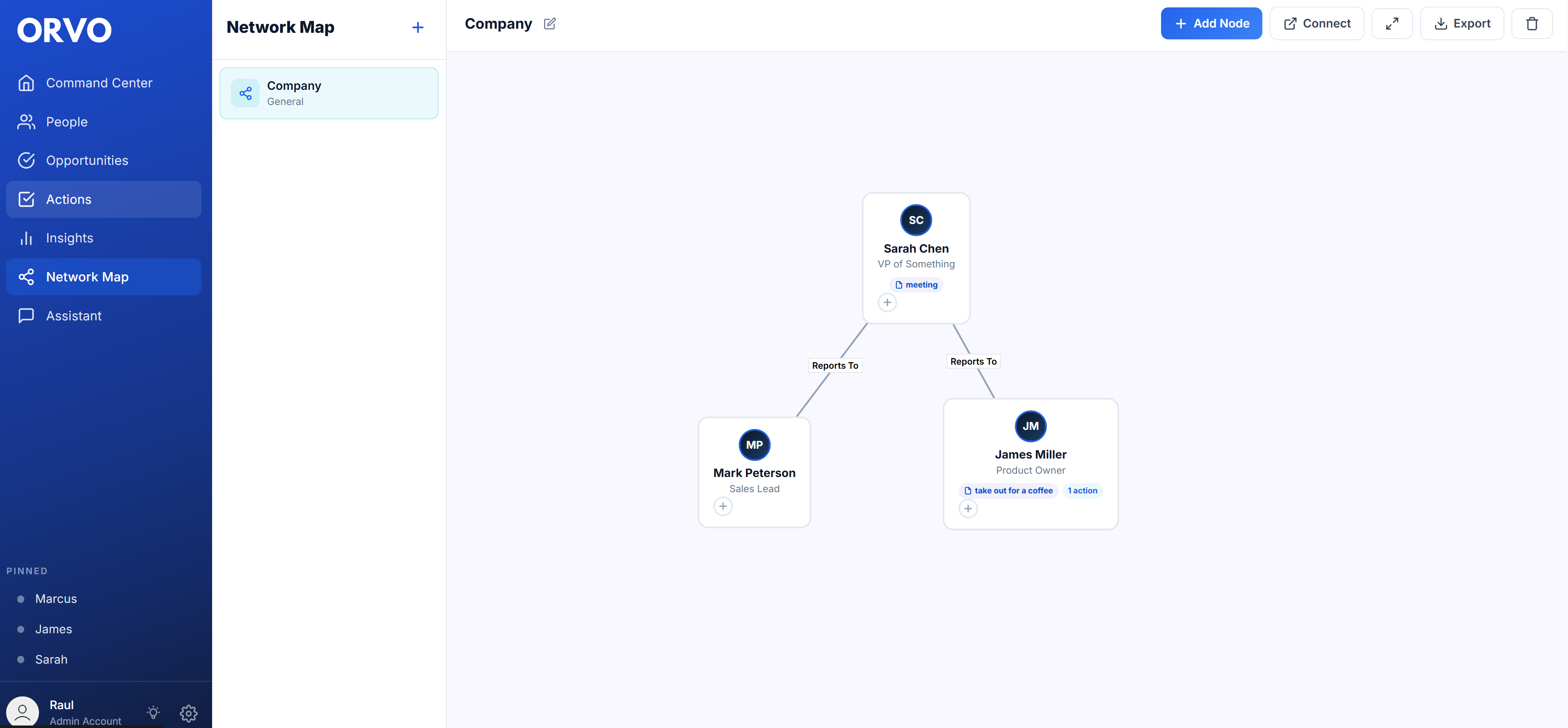
Orvo was built to solve this: log every stakeholder interaction, track relationship dynamics over time, map influence networks, and prepare for meetings with full political context. It is the difference between walking into a meeting blind and walking in with a complete intelligence brief.
| Need | Tool | How It Builds Political Intelligence |
|---|---|---|
| Stakeholder tracking | Orvo | Track every key stakeholder: their priorities, power source, disposition, conversation history. Your political intelligence database. |
| Influence mapping | Orvo Network Map | Visualize alliances, rivalries, and influence pathways. See the real org chart. |
| Meeting preparation | Orvo AI Assistant | Before any political meeting, get a brief: stakeholder history, open commitments, suggested approach |
| Narrative management | Email + Slack | Craft strategic communications that position your work and build allies |
| Visibility tracking | Orvo + LinkedIn | Track which executives are aware of your work and which need more exposure |
Navigating the 5 Most Common Political Landmines
Here is how to handle the political scenarios that derail the most careers:
Landmine 1: The Reorg When a reorg is announced, most people panic and gossip. Politically savvy professionals immediately activate their network: Who made this decision? What is the strategic rationale? Who benefits and who does not? What role would I play in the new structure? Your stakeholder map tells you exactly who to call and what questions to ask.
Landmine 2: The Credit Thief Someone takes credit for your work. The instinct is to confront them publicly — do not. Instead, increase your visibility proactively: send written updates to key stakeholders, present your own work whenever possible, and build a paper trail. Track in your relationship notes which stakeholders know your contributions and which need more exposure.
Landmine 3: The New Boss Your manager leaves and a new one arrives. Your political capital resets to zero. The first 30 days with a new boss are critical: understand their priorities, communication style, and what they are measured on. Log every conversation. Build trust by delivering exactly what they ask for before introducing your own ideas.
Landmine 4: The Cross-Functional Conflict Two departments disagree and you are in the middle. Do not pick a side publicly. Instead, understand both perspectives privately (your stakeholder notes are invaluable here), find the shared interest, and propose a solution that lets both sides claim a win. The person who resolves cross-functional conflict earns political capital from both sides.
Landmine 5: The Toxic Colleague Someone is playing destructive politics — undermining others, spreading rumors, hoarding information. Do not engage at their level. Instead, document the behavior (privately, in your relationship notes), build a coalition of allies who share your concerns, and escalate through the right channels when you have a pattern, not an incident.
Build your political intelligence system — track stakeholders, map influence, prepare for every meeting. Try Orvo free for 14 days →
Start Free TrialThe Future of Office Politics in the AI Era
As organizations become more complex, more matrixed, and more distributed, political intelligence becomes more — not less — important.
As Sorin Ciornei wrote in *The Future is Now* (thereach.ai), the shift to the Curating Economy means that the ability to navigate human systems, build coalitions, and influence without authority is the career skill of the decade.
AI is changing the landscape in two ways:
AI makes technical skills commodities. When AI can code, analyze data, and generate reports, the human differentiator becomes relationship management, political navigation, and stakeholder alignment. The professionals who invest in political intelligence are investing in the skill set that AI cannot replicate.
AI makes political intelligence systematic. Tools like Orvo can now track relationship dynamics over time, surface patterns in stakeholder behavior, generate meeting preparation briefs with full political context, and remind you when key relationships need attention. What used to require exceptional memory and social intuition can now be augmented by intelligent systems.
The combination of human political judgment and AI-powered relationship intelligence is the new competitive advantage. The professionals who embrace it will navigate organizational complexity with a clarity that their peers — relying on instinct and memory alone — simply cannot match.
Navigate office politics with intelligence, not instinct. Map stakeholders, track dynamics, and prepare for every interaction. Try Orvo free for 14 days →
Get Orvo FreeKey Takeaways
- ✓ Political skill predicts career advancement 2.7x better than job performance alone.
- ✓ Map the real org chart: positional, expertise, relationship, information, and resource power.
- ✓ Never surprise your boss. Build alliances before you need them. Make others look good.
- ✓ Track political dynamics systematically — after every meeting, log observations about stakeholder positions.
- ✓ Use Orvo as your political intelligence database: stakeholder priorities, disposition, conversation history.
- ✓ AI makes technical skills commodities — political intelligence is the human differentiator.