
Why the questions you ask matter more than the answers you give
Most new hires spend their first week trying to impress — demonstrating what they know, offering opinions, and jumping into work. This is exactly backwards.
In your first week, nobody expects you to have answers. They expect you to have questions. The quality of your questions signals how you think. A new hire who asks "What does success look like in this role at the 6-month mark?" is perceived as strategic. A new hire who asks "Where is the printer?" is perceived as operational. Both questions are valid, but they create very different first impressions.
More importantly, the right questions surface information that nobody will volunteer. Every organisation has unwritten rules, hidden dynamics, and informal power structures that are invisible in onboarding documents. The only way to discover them is to ask — and to ask the right people.
A 2023 study in the Harvard Business Review found that new employees who asked an average of 7 substantive questions per day in their first week built rapport 40% faster than those who asked fewer than 3. The researchers noted that questions signal humility (I do not assume I know everything), engagement (I care enough to ask), and social intelligence (I value your perspective).
The seven questions below are designed to be asked across your first week — not all on day one. Spread them across different conversations with different people: your manager, your peers, your skip-level (if accessible), and cross-functional partners.
Question 1: "What does success look like in this role at the 6-month mark?"
Ask this to: Your manager, in your first 1-on-1.
This is the single most important question you can ask in your first week. Most job descriptions are vague about what success actually looks like. "Drive growth" or "improve processes" could mean anything. Your manager has a specific picture of what they expect — and if you do not ask, you are guessing.
The answer reveals your manager's priorities, which may differ significantly from the job description. If your JD says "build the analytics function" but your manager says "I need someone who can present data to the C-suite in a way that drives decisions," you now know the real job is communication and stakeholder management, not just data analysis.
How to use the answer: Write down the specific metrics, deliverables, or behaviours your manager describes. These become your personal scorecard. Review them before every 1-on-1 for the next six months. Log them in Orvo alongside your manager's profile — this is the relationship intelligence that shapes every future interaction.
Follow-up question: "What is the biggest risk that could prevent me from achieving that?" This shows you think about obstacles, not just goals — a signal of maturity.
Question 2: "Who are the key people I should build relationships with early on?"
Ask this to: Your manager and one senior peer.
Every role exists within a web of relationships. Your manager knows which relationships are critical for your success — and they are often not obvious from the org chart. The PM who needs the data team's buy-in. The salesperson who needs the product team's trust. The manager who needs the CFO's support for budget requests.
This question does three things. It surfaces the hidden stakeholder map of your role. It signals to your manager that you understand organisations are about relationships, not just tasks. And it gives you a prioritised list of people to reach out to in week 2.
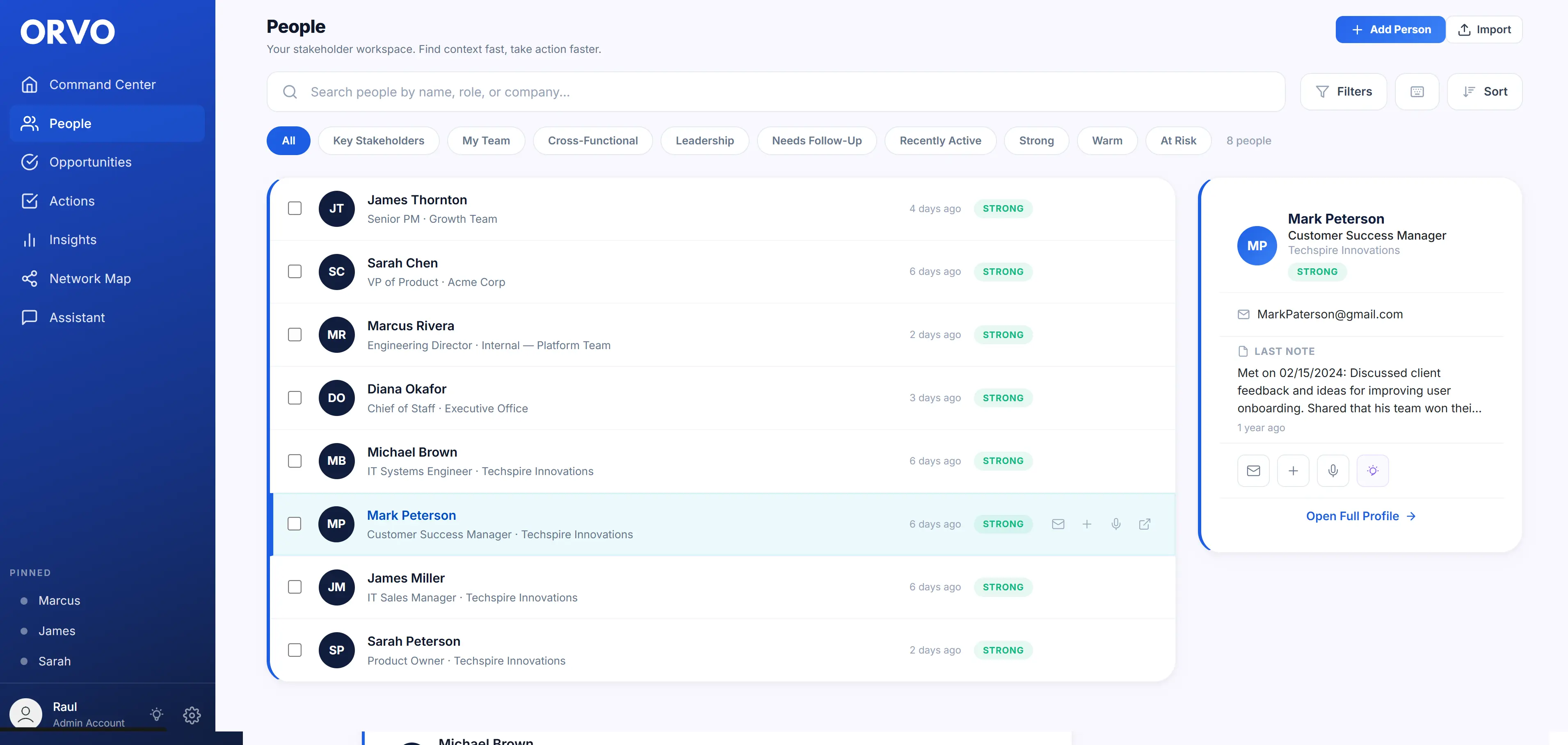
How to use the answer: Create a stakeholder map. For each person your manager names, note their role, why they matter to your work, and what you should discuss when you meet them. Use Orvo to track these relationships from day one — log each initial meeting, note their priorities and communication style, and set follow-up reminders.
Follow-up question: "Is there anyone whose relationship with our team has been difficult or complicated?" This surfaces landmines that you would otherwise step on blindly. Your manager may not volunteer this, but most will answer honestly if asked directly.
Question 3: "What has been tried before that did not work?"
Ask this to: Your peers and senior team members.
Every new hire arrives with ideas. Most of those ideas have already been tried by someone before them. If you propose something that was tried and failed two years ago — without acknowledging the history — you lose credibility with everyone who remembers.
This question is organisational intelligence gold. It tells you what the company has attempted, why it failed, and what the current appetite is for trying again. Sometimes the idea failed because of bad execution, not a bad concept — and knowing that distinction lets you propose a better version. Sometimes the idea failed because of a political dynamic that still exists — and knowing that saves you from walking into the same minefield.
How to use the answer: Create a "lessons learned" list for your role. Before proposing any initiative in your first 90 days, check it against this list. If something similar was tried before, acknowledge it in your proposal: "I know the team tried X in 2024. Here is why I think a modified approach could work now." This shows humility and organisational awareness.
Follow-up question: "If you could change one thing about how the team operates, what would it be?" This surfaces current frustrations and gives you an early opportunity to add value by addressing a real pain point.
How to ask questions without looking clueless (the technique)
Some new hires hesitate to ask questions because they worry about looking uninformed. This fear is understandable but misplaced. There is a technique that makes questions signal intelligence rather than ignorance.
The Context-Question-Value format:
Instead of asking a bare question ("How does the product roadmap work?"), add context and value:
"At my previous company, we used a quarterly roadmap process tied to OKRs. I noticed you use a different cadence here — can you walk me through how the roadmap process works? I want to make sure I align my work with the right priorities from day one."
This format does three things: it shows you have relevant experience (context), it asks a specific question (not a vague one), and it explains why the answer matters (value). The listener perceives you as experienced, curious, and strategic — not clueless.
Questions to avoid in week one:
"Why do you do it this way?" — This sounds like criticism. Instead: "Can you help me understand the thinking behind this approach?"
"That did not work at my last company." — This is not even a question, but new hires say it constantly. Nobody cares what worked at your last company in week one. Listen first, compare later.
"Who is in charge?" — This sounds political. Instead: "Who are the key decision-makers for [specific topic]?"
The 3:1 rule: For every question you ask, share one small, relevant insight from your own experience. This creates a conversation rather than an interrogation, and it gives your new colleagues a reason to enjoy talking with you.
Who to ask: Spread your questions strategically. Ask your manager about expectations, priorities, and success criteria. Ask peers about culture, communication, and team dynamics. Ask cross-functional partners about how teams work together. Ask senior people about strategy, vision, and organisational history. Each person has a different vantage point, and the combination gives you a comprehensive picture.
| Question Type | Ask To | Best Timing | What You Learn |
|---|---|---|---|
| Expectations and success | Your manager | First 1-on-1 (day 1-2) | The real job, priorities, how you will be evaluated |
| Culture and norms | Peers (same level) | Casual conversations (day 2-3) | Unwritten rules, communication style, team dynamics |
| Cross-functional dynamics | Partners in other teams | Introductory meetings (day 3-5) | How teams collaborate, where friction exists |
| Strategy and history | Senior people / skip-level | If accessible (week 1-2) | Big picture, what has been tried, where the org is going |
| Role-specific intelligence | Your predecessor | Whenever possible | What worked, what didn't, key relationships, advice |
Question 4: "How does this team prefer to communicate?"
Ask this to: Your peers and your manager.
Every team has a communication culture that is almost never documented. Some teams live in Slack and consider email formal. Others use email for everything. Some expect quick responses. Others batch communications.
Violating communication norms is one of the fastest ways to create friction. The new hire who sends long emails in a Slack-first team is seen as slow. The one who sends quick Slack messages in an email-first team is seen as casual.
How to use the answer: Match the team's norms immediately. Note each stakeholder's individual preferences — some prefer calls, others written updates.
Follow-up question: "What is the best way to give you updates on my work?" Ask this directly to your manager. Matching your manager's communication preference is one of the highest-ROI relationship investments.
Question 5: "What should I know about this organisation that is not in the onboarding materials?"
Ask this to: A senior peer or someone who has been at the company 2+ years.
This open-ended question gives your conversation partner permission to share unwritten rules, informal power dynamics, and cultural nuances that no onboarding document covers.
The answers are the most valuable intelligence of your first week. "The CEO reads every product update, so always make sure yours is polished." "The VP of Sales and the VP of Product do not get along." "Friday afternoons are sacred — no meetings after 2 PM." "Performance reviews are heavily influenced by your skip-level's opinion."
How to use the answer: Log every insight in Orvo as organisational intelligence. Review before important meetings in your first 90 days.
Follow-up question: "Who are the people everyone goes to for advice or decisions, regardless of their title?" This surfaces the informal influencers — people whose org chart position understates their actual power.
Question 6: "What is the biggest challenge the team is facing right now?"
Ask this to: Your manager and 2-3 peers.
This surfaces a real problem you might help with — giving you an early opportunity to add value. It also tells you where your manager's attention is focused, which helps you prioritise.
If the biggest challenge is a missed deadline, focus on reliability. If it is a cross-functional conflict, focus on relationship building. If it is a skill gap, focus on bringing that skill. Aligning early efforts with the team's biggest challenge makes your contributions visible.
How to use the answer: In your first 30 days, find one small way to contribute. Share a relevant insight, volunteer for an unwanted task, or connect the team with someone in your network.
Follow-up question: "What would make your job easier right now?" This surfaces practical pain points — a missing process, a tool gap, or a communication issue — that you can address quickly.
The first-week daily playbook: what to do each day
Having the right questions is essential. Knowing when to ask them — and what else to do each day — turns a chaotic first week into a structured launch. Here is a day-by-day playbook.
Monday: Orientation and manager alignment. Your first day is mostly administrative — HR paperwork, tech setup, office tour. But carve out time for your first 1-on-1 with your manager. This is where you ask Question 1 (success metrics) and Question 2 (key relationships). Take detailed notes. Before you leave, ask your manager for their preferred communication method and frequency.
End of day: Log your manager's success criteria and communication preferences in Orvo. Write down the names of everyone your manager suggested you meet.
Tuesday: Team immersion. Meet your immediate team members. Ask each one Question 3 (what has been tried before) and Question 4 (communication norms). Eat lunch with the team — this is not optional networking, it is essential context-gathering. The conversations over coffee and lunch reveal more about team culture than any formal meeting.
End of day: Log each team member in Orvo with notes on their role, working style, and anything they shared about team dynamics.
Wednesday: Cross-functional exploration. Start meeting people outside your immediate team — the partners, stakeholders, and counterparts your manager identified. Ask Question 5 (what is not in the onboarding materials) and Question 6 (biggest challenges). These conversations surface the organisational context that your team may take for granted.
End of day: Update your stakeholder map. Note any tensions, political dynamics, or unwritten rules you learned. These are relationship intelligence gold.
Thursday: Deep dives and senior access. If you have access to your skip-level leader or any senior stakeholders, schedule brief introductions. Ask Question 7 (advice for someone starting this role). Senior people often give the most strategically valuable answers because they see the organisation from a higher altitude.
End of day: Review your notes from the week. Identify patterns — what themes keep coming up? What warnings have multiple people given? What relationships do multiple people say are critical?
Friday: Synthesis and planning. Spend Friday morning reviewing everything you have learned. Compile your first-week stakeholder map. Identify your top 3 priorities for week 2. Draft a brief message to your manager: "Here is what I learned this week, here are my priorities for next week, and here are any questions I still have." This message signals competence, initiative, and communication skills.
End of day: Set follow-up reminders in Orvo for everyone you met. A brief message the following week — "Great meeting you on Tuesday, I have been thinking about what you said about X" — deepens every relationship you started.
| Day | Priority | Key Questions to Ask | End-of-Day Action |
|---|---|---|---|
| Monday | Manager alignment | Q1 (success), Q2 (relationships) | Log manager profile + success criteria in Orvo |
| Tuesday | Team immersion | Q3 (what was tried), Q4 (communication) | Log team members with style notes |
| Wednesday | Cross-functional | Q5 (unwritten rules), Q6 (challenges) | Update stakeholder map with org intelligence |
| Thursday | Senior access | Q7 (advice for this role) | Identify patterns and recurring themes |
| Friday | Synthesis | None — review and plan | Complete stakeholder map, message manager with priorities |
Building your first-week stakeholder map (the system)
Asking the right questions generates intelligence. But intelligence without a system becomes scattered notes that you never review. The professionals who ramp up fastest in new roles are those who systematically capture and organise what they learn in their first week.
The first-week stakeholder map:
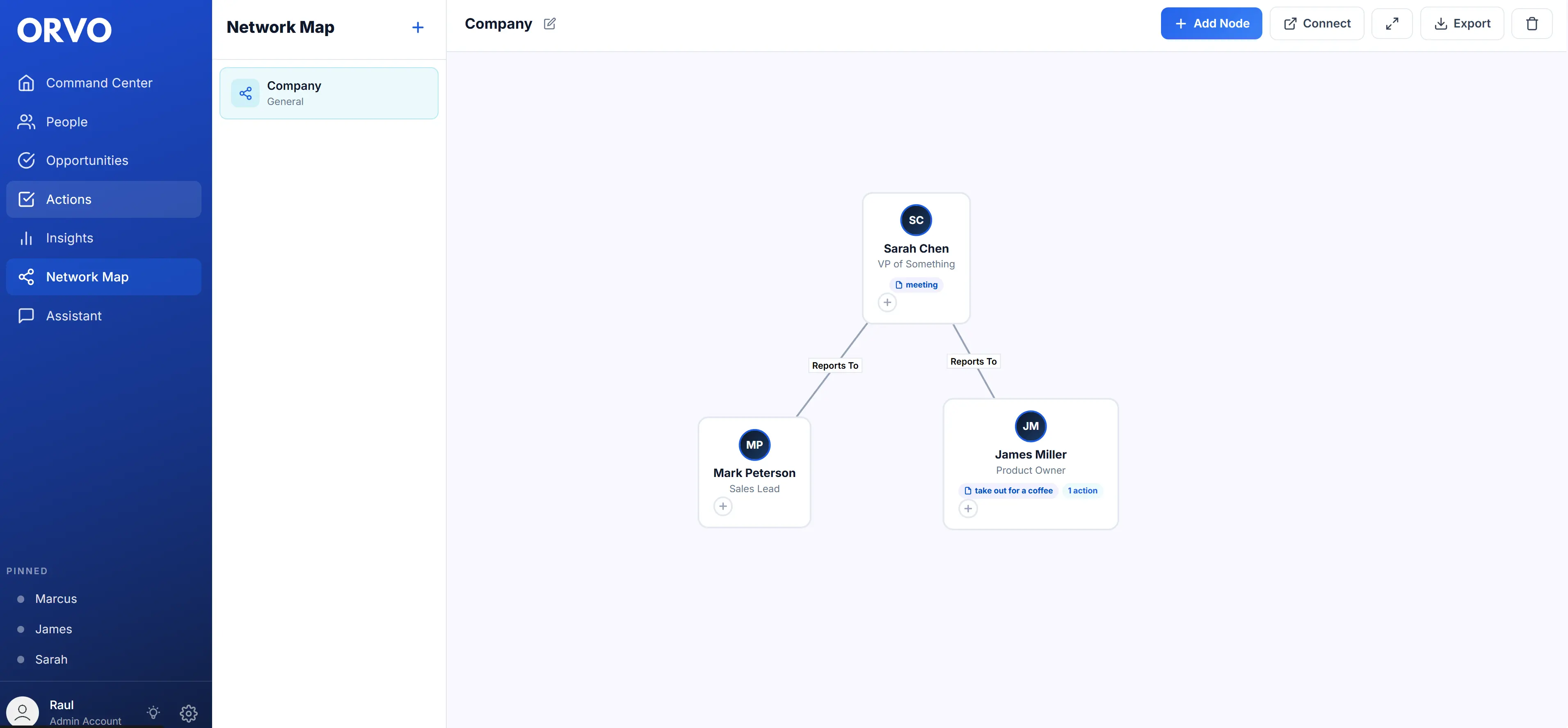
By Friday of your first week, you should have a documented map of the 15-20 people who will most influence your success. For each person, capture:
- Name and role (obvious, but write it down — you will meet 30+ people and forget half of them)
- Why they matter to your role (what is the working relationship between you?)
- First impression notes (communication style, priorities, personality)
- What they told you (any specific advice, warnings, or context they shared)
- Follow-up needed (did you commit to anything? Do you need to schedule a deeper conversation?)
This is exactly what Orvo is designed for. Create a profile for each stakeholder, log your first meeting, note their communication preferences and priorities, and set follow-up reminders. When you review these profiles before your first project meeting three weeks later, you will walk in with context that makes you look like you have been there for months.
The 30-60-90 day review cadence:
Your first-week map is a snapshot. Relationships evolve. At 30 days, review your map: Which relationships are developing well? Which need more investment? Did you miss anyone important? At 60 days, update your understanding of each stakeholder — their priorities may have shifted. At 90 days, you should have a mature stakeholder map that guides your daily work.
What most people do instead: They meet 25 people in their first week, remember 10 names, recall 5 conversations, and follow up with 2. By month three, they are rebuilding relationships they already started because they forgot the context. The systematic approach takes 15 minutes of logging per day in week one. The unsystematic approach costs hours of redundant relationship building over the next six months.
| Day | People to Meet | Questions to Prioritise | Log in Orvo |
|---|---|---|---|
| Monday | Your manager, team members | Q1 (success metrics), Q2 (key relationships) | Manager profile + success criteria, team member profiles |
| Tuesday | Cross-functional partners | Q3 (what has been tried), Q4 (communication norms) | Partner profiles + collaboration notes |
| Wednesday | Senior peers, skip-level (if accessible) | Q5 (unwritten rules), Q6 (biggest challenge) | Org intelligence notes, informal power dynamics |
| Thursday | Stakeholders your manager identified | Q2 follow-ups, Q6 (their challenges) | Stakeholder profiles with priorities and style |
| Friday | Anyone you missed + your predecessor | Q7 (advice for this role) | Complete first-week map, set follow-up reminders |
What NOT to do in your first week (the mistakes that follow you)
The questions you ask build your reputation. The mistakes you make can damage it before it is even established. Here are the first-week mistakes that disproportionately hurt new hires.
Mistake 1: Proposing changes on day one. You see something that could be better. You have experience doing it differently. You want to demonstrate value. But proposing changes before you understand the context is perceived as arrogance, not initiative. The colleague who built the current system is sitting two desks away, and they just heard a new hire tell them their work is wrong. Wait at least 30 days. Ask "what has been tried before" first.
Mistake 2: Name-dropping your previous company. "At Google, we did it this way" is the fastest way to alienate new colleagues. Nobody cares about your previous company in your first week. They care about whether you are curious, respectful, and willing to learn how things work here. Save the comparisons for month three, when you have earned the credibility to offer them.
Mistake 3: Going straight to execution without relationship building. Some new hires dive immediately into tasks to prove their value. They skip introductory conversations, eat lunch at their desk, and focus on output. This is a mistake. Your first week is uniquely suited for relationship building — people expect you to introduce yourself and are more open than they will be in a month. Once the "new hire" window closes, initiating these conversations becomes much harder.
Mistake 4: Oversharing personal information. Your colleagues will become friends over time. In week one, they are strangers. Being warm and personable is good. Sharing details about your divorce, your health issues, or your political opinions is too much, too soon. Build trust gradually.
Mistake 5: Ignoring the admin and support staff. The executive assistant, the office manager, the IT support person — these are the people who make everything work. Many new hires focus exclusively on impressing senior leaders and ignore the operational staff. This is short-sighted and unkind. The EA who likes you will save you from scheduling disasters. The IT person who trusts you will prioritise your requests. These relationships matter.
Mistake 6: Not taking notes. You will forget 80% of what you hear in your first week if you do not write it down. Carry a notebook or keep a notes app open. After every conversation, spend 2 minutes logging the key points. This habit costs almost nothing and prevents the embarrassment of asking the same question twice.
Question 7: "What advice would you give someone starting in this role?"
Ask this to: Everyone. Especially your predecessor (if accessible).
This is the question people love to answer — it invites them to share wisdom. The best version: "If you were starting this role today, knowing what you know now, what would you do differently in the first 90 days?"
How to use the answer: Look for patterns across multiple answers. If three people say "build a relationship with the finance team early," that is a strong signal. If two mention the same cultural pitfall, it is real.
Your predecessor is gold. If you can connect with the person who had your role before you, their perspective is invaluable. Ask what they wish they had known, which relationships mattered most, and what they would do differently.
Log every piece of advice in Orvo alongside the person who gave it. When you follow their advice and it works, tell them. This closes the loop and deepens the relationship.
The compound effect of asking this question to everyone: When you ask 10+ people for their advice, you are doing something subtle but powerful — you are making each of them feel invested in your success. People who give you advice subconsciously root for you to succeed, because your success validates their wisdom. This is not manipulation — it is human nature. The colleague who told you "build a relationship with the data team early" will actively help you do exactly that, because they want their advice to be proven right. By asking for advice, you are building a network of informal sponsors without asking for sponsorship.
A 2024 study from Stanford's Graduate School of Business found that new employees who actively sought advice from colleagues in their first two weeks were rated 31% higher on "team integration" by their managers at the 90-day mark, compared to those who did not seek advice. Asking questions is not just an information-gathering exercise — it is a relationship-building strategy that accelerates how quickly you are perceived as part of the team.
Your first week sets the trajectory for your first year. Orvo helps you track every new relationship, log stakeholder intelligence, and prepare for every conversation — from day one. Start free →
Get Orvo FreeKey Takeaways
- ✓ Your first week is about learning, not proving. The quality of your questions shapes how people perceive you for months.
- ✓ Ask your manager: "What does success look like at 6 months?" — this reveals the real job, not the job description.
- ✓ Map your stakeholders from day one. Ask "Who should I build relationships with?" and start tracking immediately.
- ✓ Ask "What has been tried before?" before proposing anything. Acknowledging history builds credibility.
- ✓ Learn the communication culture — Slack vs email, response times, meeting norms. Match them immediately.
- ✓ Ask "What should I know that is not in onboarding?" — this surfaces hidden rules that determine success.
- ✓ Log every answer and relationship from your first week. This intelligence compounds for the next year.