
The INFP superpower: why organisations need you more than you think
INFPs are the conscience of organisations. You see the human impact of every decision. You sense when a team is struggling before anyone else notices. You create work that has depth and meaning because you refuse to produce anything that feels hollow. These are not soft skills — they are strategic capabilities that organisations chronically undervalue until they are missing.
A 2024 study by Deloitte found that companies with high "empathic leadership" — defined as leaders who understand and respond to employee needs — outperformed their peers by 20% in employee retention and 15% in productivity. INFPs are naturally empathic leaders. The problem is not your capability. It is that you often do not recognise it as leadership.
INFPs excel in roles that require understanding people at depth: coaching, counselling, writing, UX research, HR, organisational development, creative direction, and any role where the question is "what do people actually need?" rather than "what is the most efficient process?" In these roles, INFPs do not just perform — they define the standard.
The INFP career challenge is not lack of ability. It is three specific gaps that this playbook addresses: visibility (your work is excellent but nobody sees it because you do not promote yourself), assertiveness (you avoid conflict and let others take credit or override your ideas), and career navigation (you feel lost because traditional career paths reward behaviours that conflict with your values).
Here is the reframe: you do not need to become someone else to succeed. You need to learn to deploy your natural strengths in a corporate context — and to build the small set of skills that translate your depth into visible impact.
The INFP blind spots that hold you back
Understanding your blind spots is not about fixing who you are. It is about recognising the patterns that prevent your strengths from being seen.
Blind spot 1: Avoiding self-promotion entirely. INFPs find self-promotion inauthentic. But there is a difference between bragging and making your impact visible. When you solve a problem that nobody else could solve — because you understood the human dynamics at play — and you do not tell anyone, the credit goes to whoever was loudest in the room. You are not being modest. You are being invisible.
Blind spot 2: Conflict avoidance that costs you. INFPs avoid conflict because it feels values-violating. But avoiding conflict does not eliminate it — it just means others resolve it without your input. The colleague who disagrees with your approach but never hears your reasoning assumes you do not have one. The manager who overrides your suggestion because you did not push back assumes you did not care. Selective, principled assertiveness is not aggression — it is respect for your own work.
Blind spot 3: Waiting for meaning to find you. INFPs want work that feels meaningful. When it does not, they disengage or assume they are in the wrong role. But meaning is not always inherent — sometimes you create it. The INFP who reframes "I am writing quarterly reports" as "I am helping leadership understand how their decisions affect real people" transforms a boring task into purposeful work without changing jobs.
Blind spot 4: Absorbing others' emotions. INFPs are emotional sponges. A tense meeting can drain you for hours. A colleague's frustration becomes your anxiety. This empathy is a strength in moderation and a career liability at scale. Without boundaries, you burn out — not from workload but from emotional absorption.
Blind spot 5: Perfectionism that delays action. INFPs want their work to be authentic and excellent. This often means holding work back until it meets an internal standard that others do not require. Meanwhile, less thoughtful work from less careful colleagues gets shipped, seen, and rewarded. Done is better than perfect — especially when your version of "done" is already better than most people's "perfect."
| INFP Blind Spot | What You Think | What Others Experience | The Fix |
|---|---|---|---|
| Avoiding self-promotion | "My work speaks for itself" | "I don't know what they contribute" | Share impact in terms of people helped, not self-aggrandisement |
| Conflict avoidance | "I don't want to create tension" | "They don't have strong opinions" | Frame disagreement as caring about the outcome, not attacking people |
| Waiting for meaning | "This work doesn't matter" | "They seem disengaged" | Create meaning by connecting tasks to human impact |
| Absorbing emotions | "I feel what everyone feels" | "They seem overwhelmed" | Set emotional boundaries — empathise without absorbing |
| Perfectionism | "It's not ready yet" | "They're slow to deliver" | Ship at 80% — your 80% is most people's 100% |
The INFP relationship strategy: depth as your superpower
INFPs build the deepest professional relationships of any type. When you connect with someone, it is genuine — you remember what they care about, you ask meaningful questions, and you follow up with thoughtful gestures. This is an extraordinary career asset that INFPs systematically undervalue.
Research from the University of Michigan found that professionals who build "high-quality connections" — relationships characterised by mutual regard, trust, and active engagement — are 3x more likely to receive stretch assignments and 2.5x more likely to be promoted. INFPs naturally build high-quality connections. The gap is not quality — it is quantity and strategy.
The INFP relationship playbook:
1. Build your Inner Circle (3-5 people). These are the people who genuinely understand your work, appreciate your contributions, and will advocate for you. Unlike the ENTJ who builds wide networks, you build deep ones. Lean into this. Your 3-5 person inner circle — a trusted manager, a peer ally, a mentor, a cross-functional partner, and an external confidant — is your career infrastructure.
2. Let depth create breadth. When you build a deep relationship with one person, they connect you to others. Your peer ally introduces you to their skip-level. Your mentor connects you to an opportunity. Your cross-functional partner recommends you for a project. Deep relationships are networking multipliers — one genuine connection creates three more.
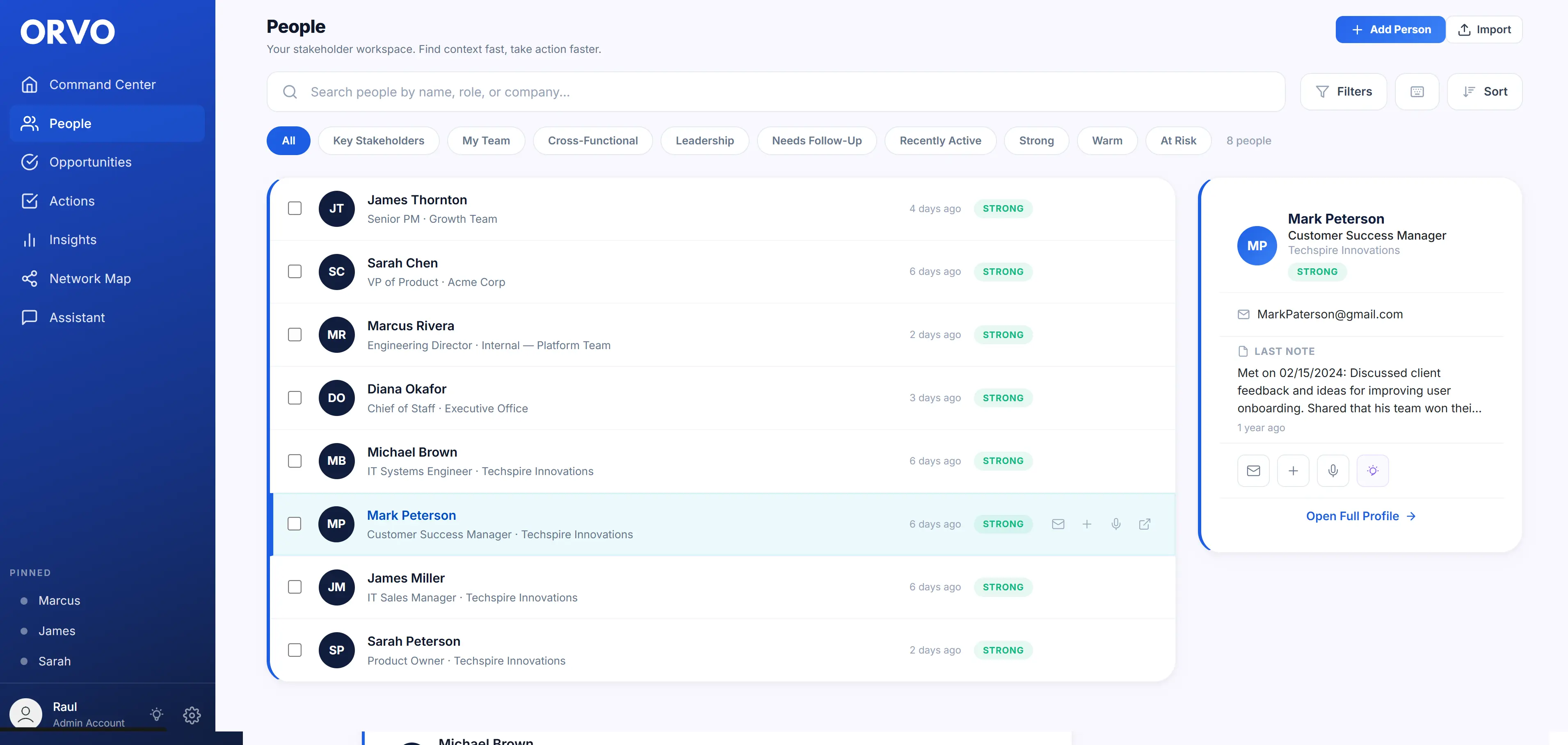
3. Prepare for interactions. INFPs perform best in conversations they have mentally prepared for. Before any important meeting, review the person's context: what do they care about, what did you discuss last time, what is happening in their world? Use Orvo to track this — log every meaningful conversation, note what matters to each person, and review before your next interaction. This turns your natural depth into systematic relationship intelligence.
4. Use written communication as a strength. INFPs often communicate better in writing than in speaking. Use this. Send thoughtful follow-up emails after meetings. Write detailed meeting prep documents. Share reflections via Slack or email. Your written communication conveys the depth and care that your verbal communication sometimes struggles to express in fast-paced group settings.
5. One new relationship per month. INFPs resist networking because it feels forced. The alternative: commit to building one new genuine relationship per month. Not a networking contact — a real person you want to understand. Over a year, that is 12 new relationships. Over five years, 60. For an INFP, that is a powerful, deep network built entirely on authentic connection.
Assertiveness for INFPs: how to push back without betraying your values
Assertiveness is the single highest-leverage skill for INFP career advancement. Not aggression — assertiveness. The ability to state your position clearly, hold your ground when challenged, and advocate for your ideas without apologising for having them.
INFPs avoid assertiveness because it feels confrontational. But here is the reframe: assertiveness is not about winning a fight. It is about ensuring that your perspective — which is often the most human-centred, most thoughtful perspective in the room — actually gets heard. When you stay silent, the decision is made without the input you uniquely can provide. That is not harmony. That is abdication.
The INFP assertiveness toolkit:
1. The values anchor. Before any conversation where you need to assert yourself, connect your position to a value you hold. "I am pushing back on this timeline because I believe rushing will hurt the customer experience" is values-driven assertiveness. It does not feel like aggression because it is not — it is advocacy for something you genuinely care about.
2. The written pre-brief. If speaking up in meetings is hard, send your position in writing before the meeting. "I wanted to share my thinking before tomorrow's discussion" gives people time to absorb your perspective and gives you credit for the idea even if someone else articulates it verbally.
3. The ally system. Find one person in each recurring meeting who shares your perspective and ask them to amplify your points. "I have a thought on this but I know I sometimes struggle to articulate it in the moment — would you be willing to support the point if it comes up?" This is not weakness. It is strategic collaboration.
4. The 48-hour rule. If you leave a meeting feeling that your perspective was not heard, you have 48 hours to follow up. Send an email: "I have been reflecting on our discussion and wanted to share an additional perspective." This gives you the processing time INFPs need while still contributing to the decision.
5. Practise with low stakes first. Do not start asserting yourself in the most political, high-stakes meeting. Start with a safe 1-on-1 with a trusted colleague. Then a small team meeting. Then a cross-functional session. Build the muscle gradually. Each time you assert yourself and the world does not end, the next time becomes easier.
Track each assertion in Orvo — what you said, how it landed, what the outcome was. Over time, you will see a pattern: your assertiveness consistently produces better outcomes for the team, not conflict. This evidence replaces the fear with confidence.
Visibility for INFPs: making your impact seen without self-promotion
INFPs produce some of the most impactful work in any organisation — and are the least likely to make that impact visible. Here is how to close the visibility gap without compromising your authenticity.
The INFP visibility formula: Impact on People.
INFPs hate talking about themselves. But they love talking about how their work helps others. Use this: instead of "I built the new onboarding process" (self-focused), say "The new onboarding process reduced new hire confusion by 40% — we are hearing much better feedback in the first-week surveys" (people-focused). Same achievement. Different framing. The first version feels like bragging. The second feels like sharing something you care about.
The monthly reflection email. At the end of each month, send your manager a brief note: "Reflecting on this month, here is what I am most proud of and what I am thinking about for next month." Frame achievements in terms of people helped, problems solved, and team impact. Your manager uses this in their own reports. You are not self-promoting — you are keeping them informed.
Let your writing speak. INFPs are often the best writers in any organisation. Use this strategically. Write the team retrospective. Draft the project summary. Author the customer case study. These documents carry your name and demonstrate your thinking to audiences beyond your immediate team.
Present through story. When you do need to present, lead with a human story. "Let me tell you about a customer I spoke with last week" is a more powerful opening than any data slide. INFPs are natural storytellers — use this in presentations instead of trying to present like an ENTJ (data-driven, commanding). Your authentic style is compelling precisely because it is different.
Create a visibility ritual. Every Friday, spend 10 minutes reviewing what you accomplished this week and noting one thing worth sharing. Over time, this ritual builds a portfolio of impact stories that you can draw on for performance reviews, interviews, and conversations with leadership. Track these in Orvo alongside your stakeholder notes — when review season comes, you will have months of documented impact instead of a panicked attempt to remember what you did.
The INFP career path: where you flourish and where you wilt
Choosing the right role is more important for INFPs than for any other type. In the right role, INFPs produce extraordinary work and feel energised. In the wrong role, they wither — often blaming themselves for a fit problem that is structural, not personal.
Roles where INFPs flourish: UX research, counselling and coaching, content strategy, creative writing, HR and organisational development, social impact, teaching, non-profit management, design, and any role where understanding human needs is the core skill. INFPs in these roles describe their work as "what I was meant to do."
Roles where INFPs wilt: High-pressure sales (too much rejection), operations management (too transactional), finance and accounting (too impersonal), litigation (too adversarial), and any role that rewards speed over depth. INFPs in these roles often develop chronic stress symptoms and mistake a role-fit problem for a personal failing.
The INFP in corporate environments. Many INFPs end up in corporate roles because of financial necessity or because they did not know alternatives existed. If this is you: corporate environments are not inherently hostile to INFPs. The key is finding a team and manager who value depth, and framing your contributions in the language the organisation speaks.
The INFP marketing manager who says "I think our messaging lacks soul" will be dismissed. The same INFP who says "Our customer research shows that 67% of prospects want to understand our values before buying — our current messaging does not address this, and I have a proposal" will be heard. Same insight, different framing.
The INFP leadership style. INFPs lead through inspiration and individual attention. They create environments where people feel seen, valued, and motivated by purpose. This leadership style produces exceptional team loyalty and creative output. The INFP manager whose team says "I do my best work for them because they genuinely care" is building something no KPI dashboard can measure — but that every executive eventually notices.
Famous INFPs in leadership: Princess Diana, J.R.R. Tolkien, William Shakespeare, and Audrey Hepburn are frequently typed as INFPs. What they share is not corporate ambition — it is the ability to move people through authenticity, depth, and genuine care for others. Your leadership style is not weaker than an ENTJ's — it is different, and in the right context, it is more powerful.
| INFP Career Factor | What Energises You | What Drains You | Career Implication |
|---|---|---|---|
| Work content | Understanding people, creative expression, meaningful impact | Repetitive tasks, bureaucracy, impersonal processes | Choose roles with human insight at the core |
| Work environment | Small teams, trust-based cultures, autonomy | Large meetings, political cultures, micromanagement | Seek managers who value depth over speed |
| Communication | Written expression, 1-on-1 conversations, storytelling | Large group presentations, cold calls, confrontation | Use writing as your primary channel for visibility |
| Growth | Learning that feels personally meaningful | Training that feels corporate or generic | Seek mentors and experiences, not certifications |
| Recognition | Genuine appreciation, impact stories | Public awards, competitive rankings | Track impact in Orvo — your own evidence of meaning |
Emotional boundaries: the INFP survival skill nobody teaches
INFPs absorb emotions like sponges absorb water. A tense meeting leaves you drained for hours. A colleague's frustration becomes your anxiety. A difficult client interaction replays in your mind all evening. This empathy is your greatest strength in moderation and your greatest vulnerability at scale.
Why boundaries matter for career survival: A 2024 study from the American Psychological Association found that empathic professionals without emotional boundaries experience burnout at 2.5x the rate of their peers. The most empathic people burn out fastest — not because they care too much, but because they do not protect their capacity to care.
The INFP boundary toolkit:
1. The emotional airlock. Before entering a stressful meeting, take 60 seconds to set an intention: "I will listen with empathy, but I will not carry this person's emotions with me when I leave." After the meeting, take 60 seconds to mentally close the door: "That was their emotion, not mine. I can be helpful without being affected." This deliberate transition prevents emotional bleed.
2. Energy budgeting. INFPs have a finite emotional energy budget each day. Allocate it intentionally. If you know Wednesday has a difficult client meeting, keep Tuesday evening free. If Thursday has a tense team discussion, do not schedule a high-empathy 1-on-1 right after. Stack restorative activities (solo work, creative tasks, nature breaks) after draining ones.
3. The physical reset. When you absorb a heavy emotion, your body holds it. Walk for 10 minutes. Drink water. Change your physical environment. These simple physical actions interrupt the emotional absorption cycle more effectively than any mental technique.
4. Journaling as release. Spend 5 minutes at the end of each workday writing what you absorbed that was not yours. Name it. Externalise it. "I absorbed Sarah's anxiety about the layoffs. That is her fear, not mine. I can support her without carrying it." This practice reduces evening rumination by creating a deliberate endpoint to the workday's emotional load.
Orvo helps with energy budgeting by letting you see your upcoming stakeholder interactions in advance. If you notice three high-empathy meetings in one day, you can proactively reschedule one or add a buffer between them. Systematic scheduling is an emotional boundary.
5. The empathy audit. Once a month, review your Orvo notes and ask: which relationships are energising me and which are draining me? INFPs often maintain relationships out of obligation long after they have become toxic or one-sided. Giving yourself permission to reduce investment in draining relationships — not cutting them off, but reducing the frequency and depth of engagement — is an act of self-care that protects your capacity to care for the people and projects that matter most.
6. The INFP-specific burnout warning signs. INFPs do not burn out the way ENTJs do (from overwork). INFPs burn out from emotional overload — feeling too much, for too many people, for too long. Warning signs include: cynicism that feels foreign to you ("I used to care about this and now I do not"), creative blocks (you cannot write or think creatively), social withdrawal beyond your normal introversion, and physical symptoms like headaches, insomnia, or chronic fatigue. If you notice these signs, the priority is not productivity — it is recovery. Take time off. Reconnect with activities that restore your sense of meaning. And build the emotional boundaries that prevent the next burnout before it starts.
The INFP at different career stages
The INFP career journey looks different from the traditional corporate ladder — and that is fine. Understanding what each stage requires helps you navigate without losing yourself.
Early career (0-5 years). The biggest challenge: finding your lane. INFPs often try multiple roles before finding work that feels meaningful. This is not floundering — it is exploration. Use this period to discover which types of work energise you and which drain you. Build 2-3 deep relationships with mentors who understand your type. Start using Orvo to track what you learn about yourself and your stakeholders.
Mid-career (5-12 years). You have found a domain that fits. The challenge shifts to visibility and influence. You are producing excellent work but not being recognised proportionally. This is where the visibility formula, monthly reflection emails, and assertiveness toolkit become essential. Build your Inner Circle of 3-5 genuine advocates.
Senior career (12+ years). INFPs who reach senior levels are often described as the "soul of the organisation" — the person who holds the culture together, who people trust with difficult conversations, who sees the human impact of every strategic decision. Your challenge at this stage: ensuring your voice is heard at the table where strategic decisions are made. Partner with a complementary type (ENTJ, ESTJ) who can amplify your perspective in settings where your natural style is less effective.
The INFP career advantage that compounds: While ENTJs and ESTJs advance fast early and sometimes plateau, INFPs often advance slowly early and then accelerate. Your relationships deepen over time. Your reputation for integrity compounds. Your emotional intelligence becomes more valuable as organisations recognise that culture and people strategy are competitive advantages. Many INFPs describe their 40s and 50s as their best career decade — when the depth they invested in finally becomes visible as leadership.
The INFP career mistake to avoid: Do not job-hop every time the meaning fades. Every role has a honeymoon phase where everything feels purposeful, followed by a plateau where routine sets in. INFPs interpret the plateau as "this is not the right fit" and start searching again. But meaning often returns after the plateau — when you have mastered the basics and can start doing deeper, more creative work. Before quitting, ask: "Am I bored because this role has no depth, or am I bored because I have not yet reached the depth?" The answer saves years of unnecessary transitions.
The INFP salary negotiation challenge. INFPs undervalue their contributions because they find salary discussions uncomfortable and believe that financial motivation is less noble than purpose. This is a pattern that costs INFPs significantly over their careers. A 2024 study from Payscale found that professionals who negotiate their salary earn 7.4% more on average — compounding to hundreds of thousands over a career. You deserve fair compensation for the depth and care you bring. Negotiating is not selling out — it is self-advocacy. Use the same values-anchor technique: "I am asking for this salary because it reflects the impact I have on the team and allows me to continue investing fully in this work."
INFPs build the deepest professional relationships of any type. Orvo turns that depth into career intelligence — track what matters to each stakeholder, prepare for every conversation with empathy, and never lose a meaningful connection. Start free →
Get Orvo FreeKey Takeaways
- ✓ INFPs are natural empathic leaders — companies with empathic leadership outperform peers by 20% in retention
- ✓ Five blind spots: invisible contributions, conflict avoidance, waiting for meaning, absorbing others' emotions, and perfectionism that delays action
- ✓ Your relationship depth IS your career strategy. Build an Inner Circle of 3-5 genuine advocates and let depth create breadth.
- ✓ Assertiveness is not aggression — it is ensuring your uniquely human-centred perspective gets heard. Use the values anchor technique.
- ✓ Make impact visible through the people-focused formula: frame achievements in terms of who you helped, not what you did.
- ✓ Emotional boundaries are essential — empathic professionals without them burn out at 2.5x the rate. Budget your emotional energy deliberately.
- ✓ INFPs often accelerate in their 40s and 50s when their depth, integrity, and emotional intelligence become recognisable as leadership.