
1. Orvo — Career Intelligence & Stakeholder Management
Website: getorvo.com
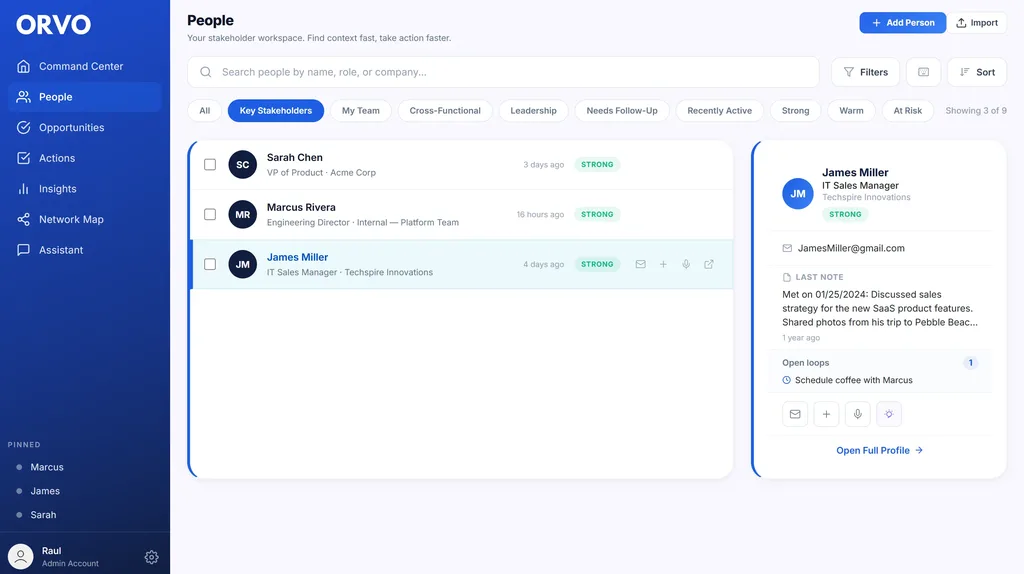
Orvo is a personal CRM built specifically for professionals who manage relationships as part of their career — consultants, business developers, executives, freelancers, and anyone navigating complex stakeholder environments. It goes beyond contact storage and leans hard into career intelligence: who knows who, who influences what, and how to prepare for every meeting.
Orvo's differentiator is its AI layer. Where most personal CRMs track that you spoke to someone, Orvo tries to help you understand what to do next with them.
Strengths:
- AI assistant with four modes — relationship coach, career strategist, stakeholder analyst, and meeting prep advisor
- Network Map — a visual graph of your relationship ecosystem, showing connection strength and gaps
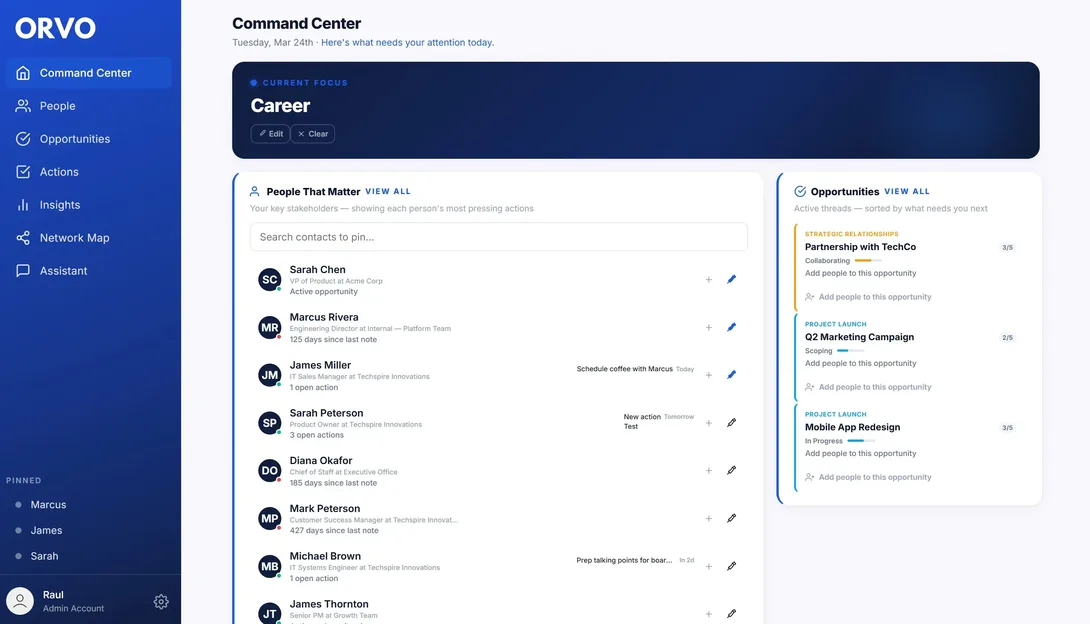
- Command Center — a unified hub for daily priorities, follow-up reminders, and at-a-glance pipeline status
- Meeting prep briefs — auto-generated one-pagers before every important conversation
- Voice transcription — log notes from meetings hands-free
- Opportunities board — a kanban-style pipeline for tracking deals, introductions, or career moves
- PDF export — produce shareable stakeholder maps and briefing documents
Weaknesses — I will be straight here. Orvo is not the right tool if:
- You need deep email integration — Cloze and Streak handle this much better
- You want business card scanning on mobile — Covve is purpose-built for this
- You need a free tier with no limits — Monica (self-hosted) and Notion templates cost nothing
- You are a large team — Orvo is optimised for individual professionals, not sales teams
- You want contact data enrichment — Clay is in a different league for that
Best for: Senior professionals, consultants, business developers, and executives who manage high-value relationships and need to be strategically prepared for every interaction.
Pricing: Pro $19/mo. Business $39/mo. 14-day free trial, no credit card required.
Try Orvo free for 14 days — no credit card required →
Start Free Trial2. Folk — Best General-Purpose Personal CRM
Website: folk.app | Compare: Orvo vs Folk
Folk is arguably the most polished general-purpose personal CRM on the market right now. It launched as a minimal contacts tool and has evolved into a genuinely capable relationship management platform, with strong pipeline views, custom fields, and a clean UI that feels closer to Notion than Salesforce.
Strengths:
- Beautifully designed — one of the best UIs in the category
- Custom properties and flexible views (table, board, list)
- Chrome extension for capturing contacts from LinkedIn
- Team collaboration features — useful for small teams
- Email sequencing (folkX) built in
Weaknesses:
- AI features are less developed than Orvo — no meeting prep or stakeholder mapping
- Gets expensive quickly for power users
- No voice transcription or audio-based note logging
- Less career-intelligence focus — it is a general tool, not built for professional strategy
Best for: Freelancers, small agency owners, and anyone who wants a beautiful, flexible CRM without a steep learning curve.
Pricing: Standard $19/mo. Premium $39/mo.
3. Dex — Simplest Networking CRM
Website: getdex.com | Compare: Orvo vs Dex
Dex is the simplest personal CRM on this list. Its core promise: stay in touch with the people who matter without the overhead of a full CRM. It integrates directly with LinkedIn, your calendar, and your phone contacts, and nudges you when relationships are going cold.
Strengths:
- Extremely easy to set up — under 10 minutes to get started
- LinkedIn integration is one of the best in class
- Birthday and relationship reminders are reliable and well-designed
- Mobile app is genuinely good
- Great for personal networking, not just professional
Weaknesses:
- Very limited AI — no strategic insights, no meeting prep
- No kanban/pipeline view
- Does not scale well for managing complex stakeholder maps
- No team features whatsoever
Best for: Networkers, job seekers, and people who want a lightweight tool to stay in touch with a broad contact list without overthinking it.
Pricing: Basic $12/mo. Pro $24/mo.
4. Cloze — Email-Centric Relationship Management
Website: cloze.com | Compare: Orvo vs Cloze
Cloze is the most email-native personal CRM on this list. It connects to your inbox (Gmail, Outlook), your calendar, LinkedIn, and even social media, and builds a unified relationship timeline automatically. If you live in your email and want your CRM to reflect that, Cloze is worth serious consideration.
Strengths:
- Automatic relationship tracking from email — zero manual logging
- Deep email and calendar integration
- Smart follow-up reminders based on email behaviour
- Solid mobile app
- Long track record — one of the most mature tools in the space
Weaknesses:
- UI feels dated compared to Folk or Orvo
- No AI meeting prep or career strategy layer
- Setup and sync can be slow
- Less visual — no network map or kanban board
Best for: Professionals who manage relationships primarily through email and want a CRM that maintains itself.
Pricing: $17/mo (flat pricing — one of the best value options on the list).
5. Monica — Open-Source / Privacy-First
Website: monicahq.com | Compare: Orvo vs Monica
Monica is an open-source personal CRM with a strong privacy-first philosophy. You can self-host it for free on your own server, or pay for the hosted version. It is deliberately simple — think personal address book on steroids, not enterprise CRM.
Strengths:
- Completely free if you self-host
- Privacy-first — your data stays on your infrastructure
- Thoughtful personal touch features (track gifts, life events, how you met someone)
- Active open-source community
- No lock-in — export everything, always
Weaknesses:
- No AI features whatsoever
- Self-hosting requires technical knowledge
- UI is functional but not beautiful
- No career or professional networking focus
- No integrations with LinkedIn, email, or calendar out of the box
Best for: Privacy-conscious users, developers, and people who want to track personal relationships (friends, family) rather than professional ones.
Pricing: Self-hosted: Free. Hosted: Free to $9/mo.
6. Covve — Mobile / Business Card Scanning
Website: covve.com | Compare: Orvo vs Covve
Covve is built around one killer feature: the best business card scanner in the personal CRM space. If you attend a lot of in-person events and collect physical cards, Covve turns that into a digital contact database faster than anything else here.
Strengths:
- Best-in-class business card scanning (AI-powered, highly accurate)
- Clean mobile-first experience
- Relationship health scores — simple but effective
- Good for professionals who network heavily at conferences and events
Weaknesses:
- Limited desktop experience
- No AI insights beyond basic reminders
- Not designed for complex stakeholder management
- Pipeline and kanban features are basic
Best for: Event-heavy networkers, sales reps, and business professionals who collect large volumes of business cards and need to digitise them fast.
Pricing: Free tier available. Pro: ~$10/mo.
7. HubSpot — Enterprise Free Tier
Website: hubspot.com | Compare: Orvo vs HubSpot
HubSpot is not a personal CRM — it is an enterprise CRM with a free tier generous enough that individuals often use it. If you need serious pipeline management, email sequences, and the ability to scale into a team CRM, HubSpot is the only tool on this list that grows with you.
Strengths:
- Free tier is genuinely feature-rich
- Best-in-class pipeline and deal management
- Email tracking, sequences, and automation
- Massive ecosystem of integrations
- Can scale from one person to a 500-person sales team
Weaknesses:
- Overkill for personal networking — designed for teams, not individuals
- Gets very expensive very fast once you need premium features
- No career intelligence, stakeholder mapping, or personal relationship features
- Steep learning curve compared to personal CRMs
- Your data is in a large commercial system — privacy trade-offs
Best for: Freelancers or solopreneurs who are actually running sales pipelines and want a tool that could become a team CRM later. Not suitable for personal relationship management.
Pricing: Free tier (limited). Paid: Scales from $15/mo to enterprise pricing.
8. Streak — Gmail-Native CRM
Website: streak.com | Compare: Orvo vs Streak
Streak lives entirely inside Gmail. There is no separate app — your CRM is your inbox. It adds pipelines, contact tracking, email templates, and mail merge directly to the Gmail interface. If you have ever thought "I wish I could manage relationships without leaving email," Streak is your answer.
Strengths:
- Zero context switching — works inside Gmail
- Email tracking (open/click) included
- Pipeline views built into Gmail
- Mail merge for outreach campaigns
- Solid free tier for personal use
Weaknesses:
- Completely Gmail-dependent — useless if you do not use Gmail
- No standalone mobile experience
- No AI insights, meeting prep, or relationship intelligence
- UI is constrained by Gmail's interface
- Not suitable for personal (non-email) relationship tracking
Best for: Gmail power users who want CRM functionality without leaving their inbox — consultants, recruiters, and sales professionals who live in email.
Pricing: Free (personal). Pro: $49/mo.
9. Notion — DIY / Free Template
Website: notion.so | Compare: Orvo vs Notion
Notion is not a CRM — it is a productivity platform that people use as a CRM by building their own systems. Free CRM templates exist across the internet, and many professionals swear by the flexibility this gives them.
Strengths:
- Free (Notion itself) plus many free CRM templates
- Infinitely customisable — build exactly what you need
- Great for people who already live in Notion
- Combines notes, tasks, databases, and contacts in one place
Weaknesses:
- No automation — you have to do everything manually
- No contact enrichment, reminders, or email integration out of the box
- Requires significant time to set up and maintain
- Does not scale — becomes unwieldy as your network grows
- No AI relationship intelligence whatsoever
Best for: Self-builders, students, and people who want a free, flexible system they control entirely — and are willing to invest time to maintain it.
Pricing: Free (Notion) plus free templates.
10. Clay — Contact Data Enrichment
Website: clay.com
Clay is in a different category from everything else on this list. It is not really a CRM — it is a contact data enrichment and outreach automation platform. Clay can pull data from 100+ sources (LinkedIn, Apollo, Clearbit, and more) to build deeply enriched contact profiles. Sales teams and growth hackers love it.
Strengths:
- Unmatched contact enrichment — finds emails, job titles, company data, social profiles automatically
- Powerful automation for outreach sequences
- Integrates with almost everything
- Genuinely transformative for sales and recruiting workflows
Weaknesses:
- Very expensive — starts at $149/mo
- Steep learning curve
- Not a relationship management tool — it is a data and outreach tool
- No personal relationship features (birthdays, meeting notes, follow-ups)
- Overkill for personal networking
Best for: Sales teams, recruiters, and growth professionals who need to build and enrich large prospect lists at scale. Individual users are unlikely to need or justify the cost.
Pricing: Starter: $149/mo. Pro: $349/mo.
Full Comparison Table
Here is how all 10 tools compare across the features that matter most for personal CRM users in 2026.
| Feature | Orvo | Folk | Dex | Cloze | Monica | Covve | HubSpot | Streak | Notion | Clay |
|---|---|---|---|---|---|---|---|---|---|---|
| AI assistant | ✓ 4 modes | ~ Basic | ✗ | ✗ | ✗ | ✗ | ~ Basic | ✗ | ✗ | ✗ |
| Meeting prep briefs | ✓ | ✗ | ✗ | ✗ | ✗ | ✗ | ✗ | ✗ | ✗ | ✗ |
| Stakeholder mapping | ✓ | ✗ | ✗ | ✗ | ✗ | ✗ | ✗ | ✗ | ✗ | ✗ |
| Network visualisation | ✓ | ✗ | ✗ | ✗ | ✗ | ✗ | ✗ | ✗ | ✗ | ✗ |
| Voice transcription | ✓ | ✗ | ✗ | ✗ | ✗ | ✗ | ✗ | ✗ | ✗ | ✗ |
| Pipeline / Kanban | ✓ | ✓ | ✗ | ~ | ✗ | ✗ | ✓ | ✓ | ~ DIY | ✗ |
| Email integration | ~ Basic | ✓ | ~ Basic | ✓ Best | ✗ | ✗ | ✓ | ✓ Gmail | ✗ | ✓ |
| LinkedIn integration | ~ | ✓ | ✓ | ~ | ✗ | ✗ | ~ | ✗ | ✗ | ✓ |
| Business card scan | ✗ | ✗ | ✗ | ✗ | ✗ | ✓ Best | ✗ | ✗ | ✗ | ✗ |
| Contact enrichment | ✗ | ~ | ✗ | ~ | ✗ | ✗ | ~ | ✗ | ✗ | ✓ Best |
| Mobile app | ✓ | ✓ | ✓ | ✓ | ~ | ✓ | ✓ | ~ | ✓ | ~ |
| Team features | ✗ | ✓ | ✗ | ~ | ✗ | ✗ | ✓ | ✓ | ✓ | ✓ |
| Privacy / self-host | ✗ | ✗ | ✗ | ✗ | ✓ | ✗ | ✗ | ✗ | ✗ | ✗ |
| PDF export | ✓ | ✗ | ✗ | ✗ | ✗ | ✗ | ~ | ✗ | ~ | ✗ |
| Free tier | ✗ | ✗ | ✗ | ✗ | ✓ | ✓ | ✓ | ✓ | ✓ | ✗ |
| Starting price | $19/mo | $19/mo | $12/mo | $17/mo | Free | Free | Free | Free | Free | $149/mo |
How to Choose: Decision Framework
Skip the feature comparison and answer one question: what is your primary use case?
"I need to manage my professional network strategically — clients, stakeholders, decision-makers." → Orvo. Built specifically for this. The AI meeting prep and stakeholder mapping are worth it alone. See our detailed decision guide.
"I want a beautiful, flexible CRM for general networking with some team features." → Folk. The best-designed general tool on this list. Compare it with Orvo vs Folk before deciding.
"I am a busy professional who hates admin — I want something that mostly runs itself." → Cloze. Its automatic email-based relationship tracking means you barely have to log anything manually. See Orvo vs Cloze.
"I am a lightweight networker who just wants to stay in touch without overthinking it." → Dex. Simple, mobile-friendly, and gets out of your way. Compare at Orvo vs Dex.
"I am privacy-conscious and do not want my data on anyone's servers." → Monica (self-hosted). Free, open-source, and you own everything.
"I go to a lot of events and collect business cards." → Covve. Nothing touches it for card scanning.
"I want free and I am happy to build my own system." → Notion with a free CRM template. Zero cost, infinite flexibility, zero automation.
"I live in Gmail and do not want to open another app." → Streak. If you are not on Gmail, do not bother. If you are, it is excellent.
See if Orvo is right for your career — try free for 14 days, no credit card required →
Start Free TrialWhat Has Changed Since 2025
If you read our previous comparison, here is what has changed at Orvo specifically:
New features shipped since early 2025:
- Command Center — a unified daily dashboard that surfaces your most important relationships, overdue follow-ups, and pipeline activity in one view
- Network Map — visual graph of your contact ecosystem; see relationship strength, connection clusters, and gaps at a glance
- Opportunities Board — full kanban pipeline for tracking deals, partnership conversations, job searches, or any goal-oriented relationship
- Four AI assistant modes — relationship coach, career strategist, stakeholder analyst, and meeting prep advisor; each delivers different types of insight depending on what you need
- Voice transcription — log post-meeting notes hands-free on mobile; transcripts are saved to the relevant contact automatically
- Meeting prep briefs — AI-generated one-pagers that pull together everything you need before a high-stakes conversation
- PDF export — shareable stakeholder maps and briefing documents you can bring to meetings or share with a team
For competitive changes: Folk has significantly improved its email sequencing (folkX) and Clay has introduced lower-cost tiers, though still expensive by personal CRM standards.
Find out why career builders are choosing Orvo. Try free for 14 days →
Get Orvo FreeKey Takeaways
- ✓ Orvo is the strongest tool for professionals who need career intelligence, stakeholder management, and AI-powered meeting prep — but it's not free and isn't built for teams.
- ✓ Folk is the best-designed general-purpose personal CRM if you want flexibility without Orvo's professional focus.
- ✓ Cloze wins for automatic, email-driven relationship tracking — the least manual option.
- ✓ Dex is the easiest entry point for lightweight personal networking.
- ✓ Monica is the only real privacy-first option if self-hosting is viable for you.
- ✓ Clay is transformative for sales and recruiting teams, but wildly expensive for personal use.
- ✓ HubSpot and Streak are strong if you're running actual sales pipelines or living in Gmail — but they're not personal CRMs in the traditional sense.
- ✓ Notion works as a free CRM if you're willing to build and maintain it yourself.