The Most Resilient Careers in Europe in 2026 — And the Ones Most at Risk
A ranked breakdown of 20 corporate roles using the European Career Outlook Index, with the reasoning behind each placement and what to do if you're in either group.
This analysis is drawn from The European Career Outlook Report 2026, Orvo's flagship report on the structural forces reshaping European white-collar work. The full methodology, the four converging forces, and the Visibility Principle that anchors the index are documented there.
Quick answer: the top 5 most resilient careers in Europe (2026)
For readers who want the short version:
- Senior Product Manager, regulated industry — ECOI 84
- Head of Compliance / Regulatory Affairs, multinational — ECOI 82
- Clinical Project Lead, pharmaceutical — ECOI 80
- Cross-functional Programme Manager, enterprise software — ECOI 78
- Senior Strategy / Corporate Development, multinational — ECOI 77
Full top 10, full bottom 10, methodology, and what to do about it follow below.
How we ranked them
In a continent where labour productivity per hour worked is now approximately 82% of the US level and the EU's share of global GDP has fallen from roughly 25% in 1990 to 16% in 2024, career resilience is no longer an abstract concept. It is the structural question of which roles survive a decade of slow growth, accelerating automation, and rolling reorganisations. The European Career Outlook Index (ECOI) was built to answer that question at the role-class level.
The ECOI scores corporate roles on a 0–100 scale, where higher means more resilient. Six variables go into each score: industry layoff trend, geographic concentration exposure, AI displacement exposure, salary growth versus global benchmarks, hiring momentum, and visibility / cross-functional surface area. The first five are macro inputs — they describe the environment a role sits in. The sixth is the individual lever: a role with the same industry exposure as another role can score very differently depending on whether its execution is visible across the organisation or buried inside a single function.
The ECOI is directional, not predictive. It does not forecast whether any individual will keep their job. It estimates the exposure of the role class itself to structural forces. Two professionals in the same role class can have very different outcomes depending on their visibility, their AI fluency, their relationship capital, and their timing.
The safest careers in Europe in 2026 are not the highest-paid. They are the hardest to replace.
The full methodology, including how each variable is weighted and scored, lives in the pillar report.
Top 10 most resilient careers in Europe (2026)
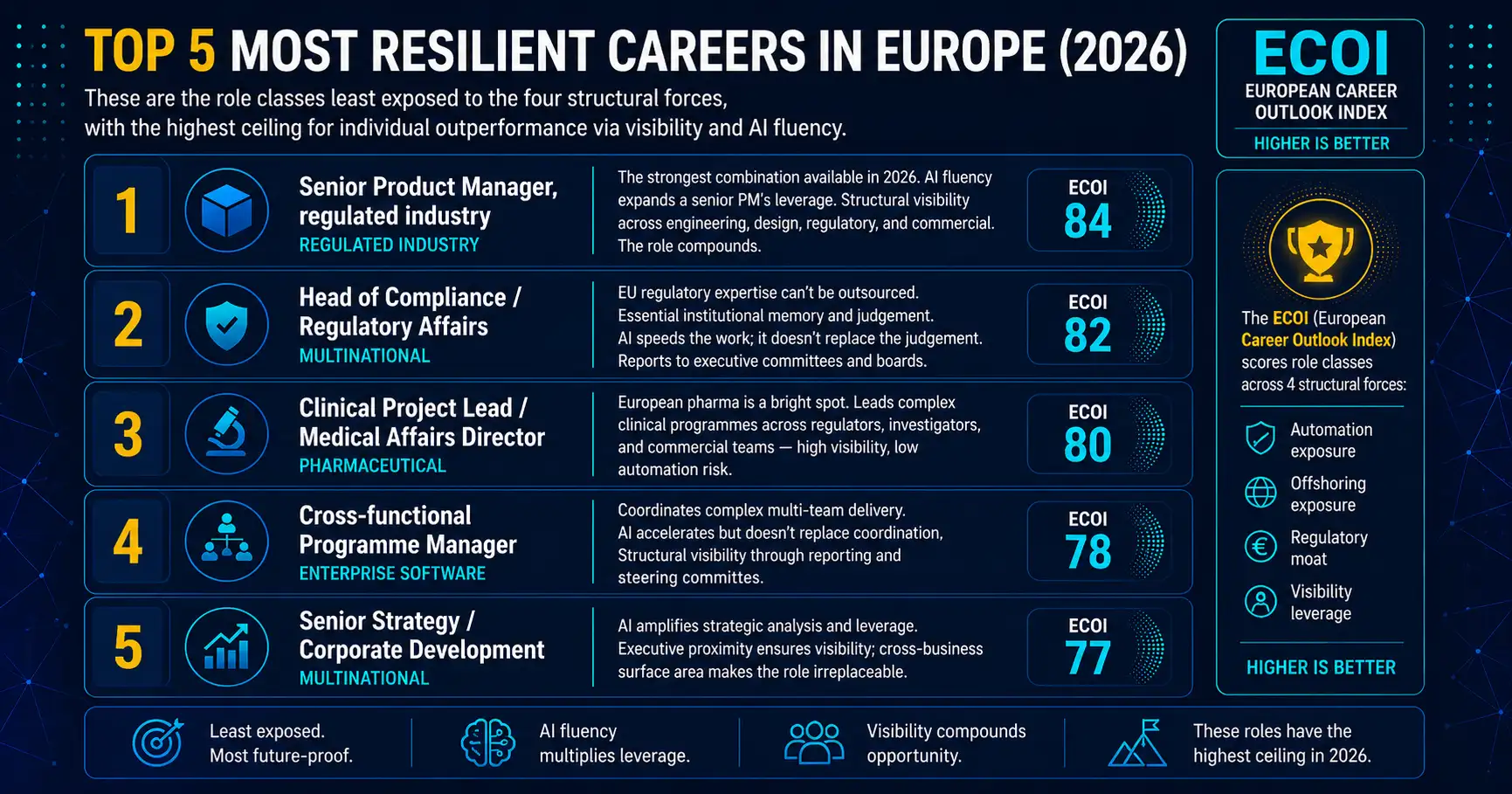
These are the role classes least exposed to the four structural forces, with the highest ceiling for individual outperformance via visibility and AI fluency.
1. Senior Product Manager, regulated industry — ECOI 84
The strongest combination available in 2026. Regulated industries (financial services, healthcare, energy) move slowly enough that AI does not yet automate the core role. Product management itself is being reshaped by AI fluency in ways that expand the senior PM's leverage rather than threaten it — a senior PM who can ship working prototypes during planning conversations is now disproportionately influential. Visibility is structural: senior PMs sit at the intersection of engineering, design, regulatory, and commercial. The role compounds.
2. Head of Compliance / Regulatory Affairs, multinational — ECOI 82
Specific regulatory expertise in EU jurisdictions cannot be outsourced to non-EU teams without losing the function entirely. Compliance leaders are not just experts — they are the institutional memory and judgement that let firms navigate cross-border decisions. AI tools speed up the work; they do not replace the judgement. Visibility is high by definition because compliance reports to executive committees and boards.
3. Clinical Project Lead / Medical Affairs Director, pharmaceutical — ECOI 80
European pharma is the rare bright spot in continental industry. Pfizer, Roche, Novartis, GSK, Sanofi, and AstraZeneca are running large clinical programmes that depend on cross-functional leadership at country and site level. Clinical project leads sit between regulatory bodies, principal investigators, and commercial teams — a profile of stakeholder breadth that scores high on the visibility variable and low on the automation exposure variable.
4. Cross-functional Programme Manager, enterprise software — ECOI 78
Software programme management at firms like SAP, Atlassian, and the European arms of US enterprise vendors. The role exists precisely because complex multi-team delivery requires coordination work that AI accelerates but does not replace. AI fluency multiplies output; visibility is structural through cross-team status reporting and steering committees.
5. Senior Strategy / Corporate Development, multinational — ECOI 77
Strategy work has been one of the fastest beneficiaries of AI: the analytical front-end that used to take a junior consultant a week now takes a senior associate an afternoon with the right prompts. The senior strategists who have absorbed AI tools have become more leveraged, not less needed. Executive proximity guarantees high visibility; cross-business surface area guarantees that the role cannot be reduced to a documentable process.
6. AI / ML Product Manager at US-headquartered tech firm in Europe — ECOI 76
A combination of structurally high demand, US-style compensation paid in European cost-of-living markets, and a role that is by definition AI-fluent. The constraint is geographic: these roles exist almost exclusively in the twelve hub cities, and competition for them is intense. But for those positioned to take them, the compensation arbitrage and the role's own AI-native character produce one of the strongest outcomes in the European white-collar landscape. The path in usually runs through stakeholder relationships at hiring managers rather than cold applications.
7. Defence Technical Programme Manager — ECOI 74
The European defence sector is in a structural up-cycle for the first time in three decades. Helsing in Munich, MBDA across France/UK/Italy, BAE Systems, Rheinmetall, and Saab are all expanding. Programmes are long-cycle, person-dependent, security-cleared (which itself is a moat), and now layering AI capability on top of traditional defence engineering. The role rewards stakeholder navigation across military, civilian, and commercial counterparties.
8. Cybersecurity / GRC Senior Lead — ECOI 73
NIS2, DORA, the EU AI Act, and the post-Schrems data-protection environment have created a structural demand for senior cybersecurity and governance-risk-compliance professionals that exceeds available supply across the continent. AI tools enhance the work substantially. The role is regulatory in character and therefore protected from offshoring. Visibility is high because cyber-incidents now go to the board within hours.
9. Senior Tax Specialist / Senior Auditor at Big Four — ECOI 72
Cross-border tax in Europe is a moving target — pillar two implementation, country-by-country reporting, transfer pricing across diverging regimes — and the senior end of the profession is in structural shortage. AI tools accelerate the mechanical work; they do not replace the judgement, the relationships, or the political navigation. Big Four billing rates and partnership tracks remain among the most reliable senior career paths in European professional services.
10. Senior Communications / Investor Relations Director, listed multinational — ECOI 71
The role survives because of relationships, judgement, and timing — three things AI does not yet do well. The communications director's value is that they know which journalists to call, which messages will land in which markets, and how to navigate executive conversations under time pressure. Visibility is the role; political fluency is the skill; both compound with AI fluency rather than being threatened by it.
Top 10 most exposed careers in Europe (2026)
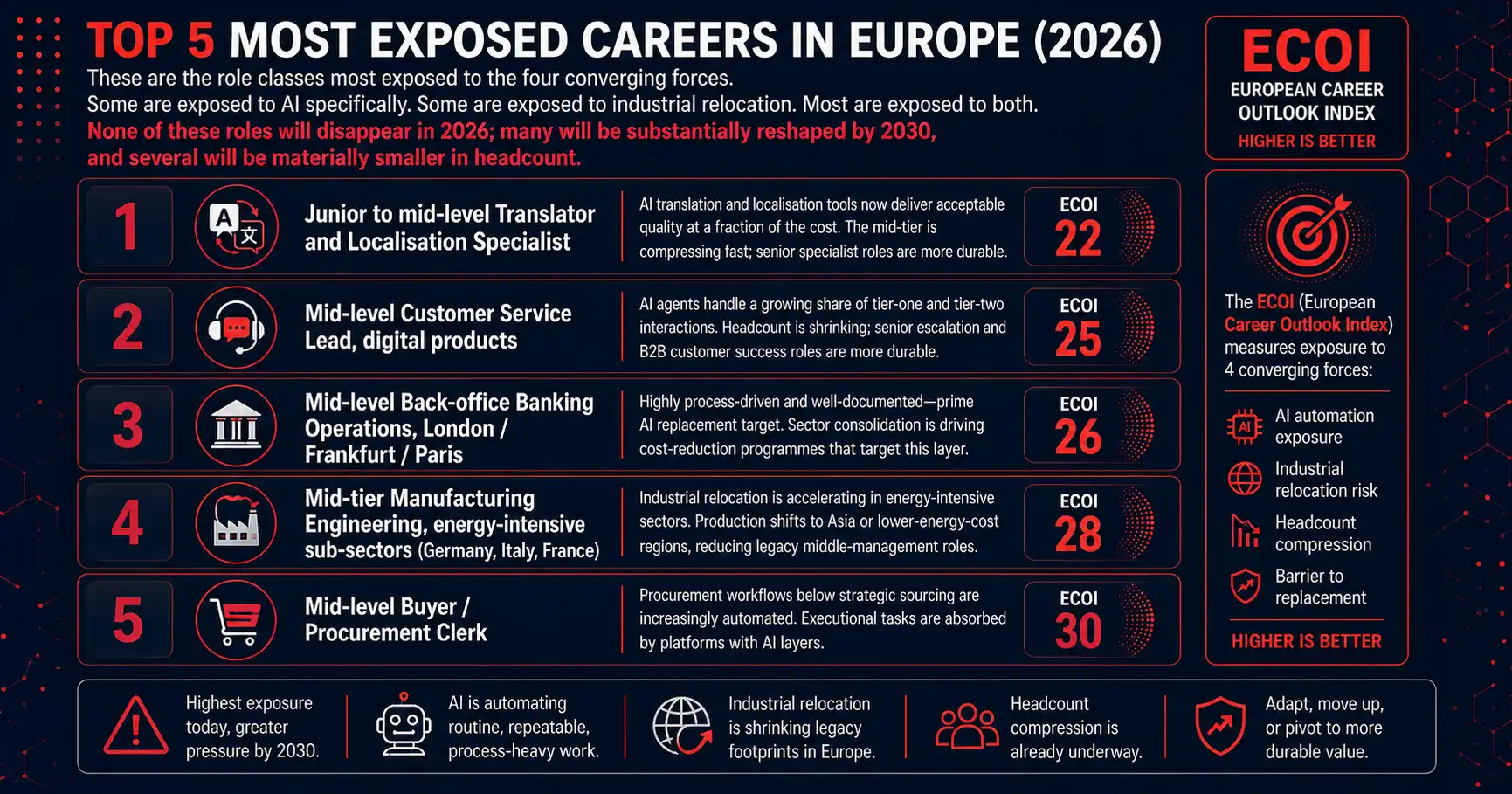
These are the role classes most exposed to the four converging forces. Some are exposed to AI specifically. Some are exposed to industrial relocation. Most are exposed to both. None of these roles will disappear in 2026; many will be substantially reshaped by 2030, and several will be materially smaller in headcount.
1. Junior to mid-level Translator and Localisation Specialist — ECOI 22
The role most directly exposed to current AI capability. Document translation, content localisation, and standard interpretation work are now done at acceptable quality by AI tools at a fraction of the cost. The senior end of the profession (literary translation, legal certified translation, simultaneous interpretation in regulated settings) is more durable. The mid-tier is compressing fast.
2. Mid-level Customer Service Lead, digital products — ECOI 25
AI agents now handle a meaningful share of tier-one and tier-two customer service interactions. The role is not vanishing; it is shrinking. A 100-person customer service organisation in 2026 is doing the work of a 200–300-person organisation in 2022. The senior end (escalation management, customer success leadership, complex B2B) is more durable. The mid-tier is the squeeze.
3. Mid-level Back-office Banking Operations, London / Frankfurt / Paris — ECOI 26
Process-heavy, well-documented, prime AI replacement target. The sector is also consolidating: post-2024 banking consolidation in the eurozone is driving cost-reduction programmes that target exactly this layer. The path forward for professionals in these roles is either upward into client-facing or strategic work (which depends on visibility built over years) or sideways into compliance and risk (where the regulatory moat protects more).
4. Mid-tier Manufacturing Engineering, energy-intensive sub-sectors (Germany, Italy, France) — ECOI 28
Industrial relocation is accelerating in chemicals, metals, automotive components, and energy-intensive specialty manufacturing. The pattern is consistent: production shifts to Asia or to lower-energy-cost regions, and middle-management technical roles concentrated in legacy plants are reduced as part of restructuring. The technical skills transfer to Asian operations, but the geography does not.
5. Mid-level Buyer / Procurement Clerk — ECOI 30
Purchasing workflows below the strategic-sourcing tier are heavily process-driven and increasingly automated. Vendor onboarding, RFQ management, PO processing, and standard contract administration are being absorbed by procurement platforms with AI layers. The strategic sourcing leadership end of procurement remains durable — it requires negotiation, relationships, and judgement — but the mid-tier executional layer is compressing.
6. Junior to mid-level Lawyer at non-specialised firm — ECOI 31
Contract review, due diligence, document discovery, and standard legal research are exactly the workflows AI tools handle at scale. Top-tier specialised firms are protected by client relationships, regulatory work, and the political character of senior advisory. Mid-market generalist legal practices are not. Junior lawyers entering general practice in 2026 are entering a structurally different profession than the one their senior colleagues entered.
7. Generalist HR Business Partner, mid-corporate — ECOI 32
The HRBP role has always sat in tension between being a strategic partner to the business and being a process custodian for HR operations. AI tools are absorbing the process custodian half of the role. The strategic partner half survives only when the HRBP has visibility into commercial decisions and credibility with senior stakeholders — the kind of relationship capital built deliberately over years. The generalist mid-tier — strong in neither direction — is the compressed segment.
8. Mid-tier Insurance Underwriter — ECOI 33
Standard underwriting is among the most automation-exposed white-collar roles in Europe, and the trajectory is clear: actuarial models, claims data, and underwriting decisions are being increasingly automated in retail and SME insurance lines. Specialty underwriting (cyber, marine, large-account commercial) is more durable. The standard mid-tier is not.
9. Junior to mid-level Marketing in advertising-funded industries — ECOI 34
Marketing roles at media companies, ad-funded publishers, and many B2C consumer brands face the double pressure of declining ad budgets and AI-augmented marketing tools that compress headcount needs. A team of ten in 2022 is now a team of four with AI tools. The path forward is to be one of the four — which requires AI fluency invested in early, not retrofitted late.
10. Mid-tier Auto Industry Technical Roles (legacy OEM) — ECOI 36
European legacy automakers are losing the EV race against Chinese manufacturers and are restructuring accordingly. Volkswagen, Stellantis, and to a lesser extent BMW and Mercedes are running headcount-reduction programmes that target mid-tier engineering, planning, and commercial roles. The transition will likely take five to ten years; the trajectory is now visible.
Industry-level summary
| Industry | Average ECOI | Direction |
|---|---|---|
| Pharmaceutical / Healthcare | 71 | Stable to improving |
| Defence and Security | 69 | Improving (AI capacity, geopolitical demand) |
| Professional Services (top tier) | 65 | Stable, AI compresses lower tiers |
| Tech (employed by US-headquartered firms in EU) | 62 | Mixed, depends on parent strategy |
| Public Sector (senior, EU institutions) | 58 | Stable but stagnant |
| Financial Services (universal banks) | 51 | Compressing |
| Tech (EU-headquartered firms) | 48 | High variance, declining median |
| Manufacturing (energy-intensive) | 36 | Declining |
| Media / Advertising | 34 | Declining sharply |
| Retail / Hospitality back-office | 32 | Declining |
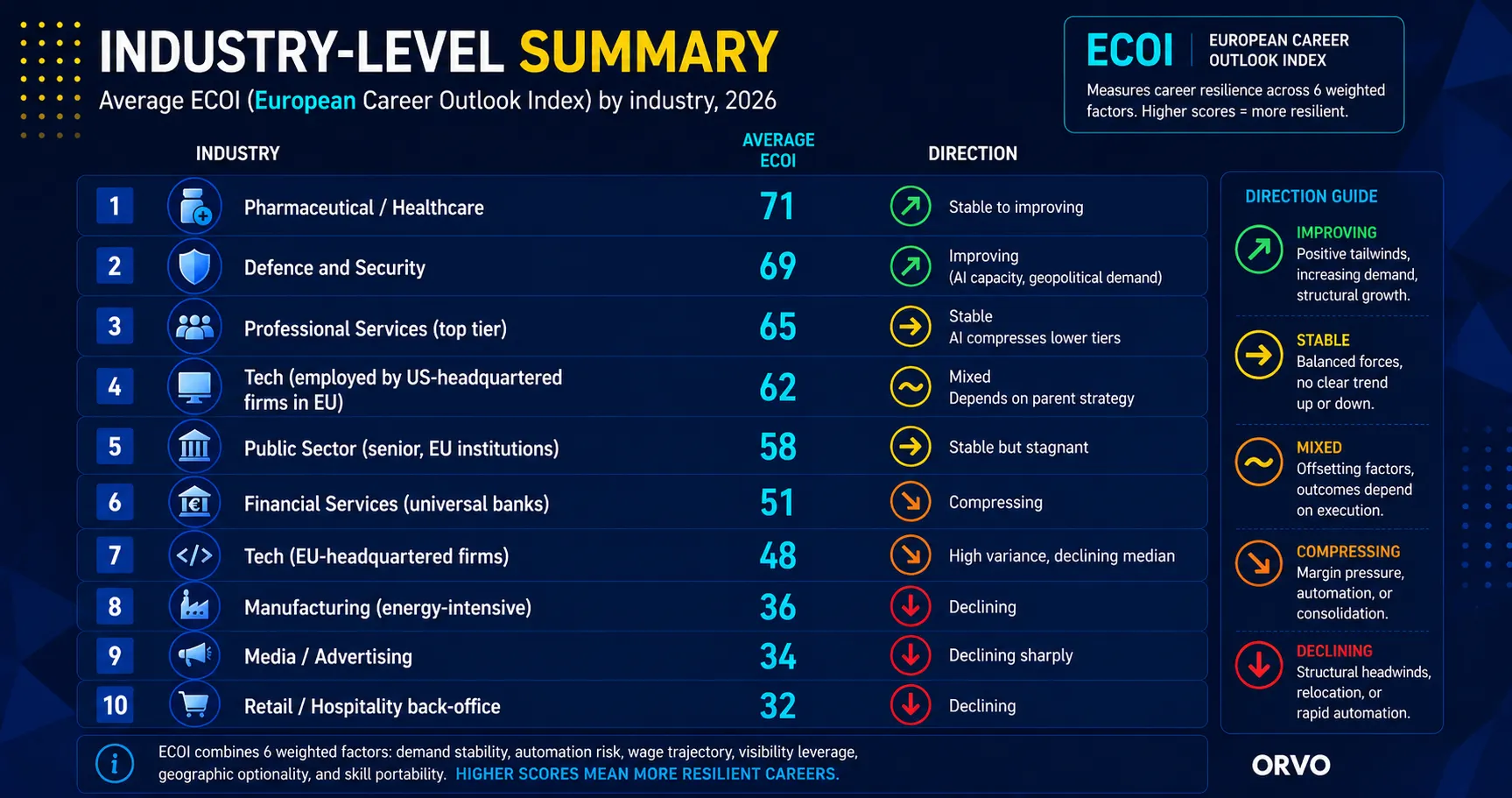
The median ECOI across the 25 corporate roles in our analysis is 53. The spread between the top decile and bottom decile is wider than equivalent US analyses — reflecting the geographic concentration problem documented in the pillar report. Resilience in Europe is increasingly bimodal: high in a few hubs and a few protected sectors, low almost everywhere else.
What this list is not
It is not a forecast that anyone in a high-exposure role will lose their job, nor that anyone in a high-resilience role is safe. The resilience scores describe the role class. Within any role class, individual outcomes vary substantially based on three things: visibility, AI fluency, and relationship capital.
This is the load-bearing point of the Visibility Principle: in structurally stagnant economies, layoffs and outsourcing concentrate not on the lowest performers but on the lowest-visibility roles. A high-performing back-office banker with low visibility is more exposed than a moderately-performing programme manager with high stakeholder coverage. The job description rarely decides who survives a reorganisation; the person filling it does.
For a deeper treatment of why this is true, see Why High Performers Still Get Laid Off (And Who Actually Survives).
What to do if you're in a high-exposure role
You have time, but less of it than you think. The structural pressure on these roles compounds over years, not months — but the earliest movers will absorb the available higher-resilience roles before the rest of the field catches up. Three paths:
Path 1: Move up the value curve within your sector. Mid-tier banking compresses; senior risk and compliance roles in the same banks expand. Generalist HRBPs compress; senior people-strategy roles in the same companies remain. Mid-tier marketing compresses; AI-fluent senior marketing strategists are in shortage. The move is not out — it is upward, into work that is less proceduralised and more person-dependent.
Path 2: Move sideways into adjacent higher-resilience roles. A mid-tier banker can become a regulatory affairs specialist with two years of effort. A generalist HRBP can become a compliance officer with the right certifications. A mid-tier marketer can become a product marketer at a US-headquartered tech firm. The adjacency moves are usually easier than they look — what matters is that you start the move before the broader field starts the same move.
Path 3: AI-augment your way up the curve in place. Some professionals successfully reposition inside their existing role by becoming the AI-fluent person on their team. The mid-tier banker who builds the AI workflow for the whole desk becomes the senior banker; the marketing manager who builds the AI campaign engine becomes the head of marketing operations. This path requires moving fast and being seen — the build executive visibility playbook is directly relevant.
In practice, most successful repositionings combine all three.
What to do if you're in a high-resilience role
The largest mistake high-resilience professionals make is assuming the resilience score protects the individual rather than the role class. It does not. Three priorities:
Compound your AI fluency, don't coast on your role. Resilient roles are still roles; they still get reorganised; the people who keep them are the AI-fluent ones, not the ones with the longest tenure. Senior PMs, compliance leaders, and clinical project leads are all roles where the productivity gap between AI-fluent and AI-non-fluent professionals is now substantial. Closing that gap inside your own role is the highest-leverage thing you can do this quarter.
Build cross-organisational visibility deliberately. Resilient roles often come with concentrated visibility — your team knows you well, but the rest of the organisation may not. In stable times this does not matter. In a reorganisation, visibility outside the home function is what determines whether you are seen as institutional or interchangeable. Use the stakeholder map to audit and plan your coverage.
Mentor downwards selectively. The professionals with the highest staying power in any organisation are the ones whose departure would create succession problems. Build that succession-problem profile by mentoring junior talent in your function and adjacent ones. It compounds your relationship capital and makes your role visibly load-bearing.
For the full individual playbook, see the pillar report's playbook section.
How to use this list
If your current role is on the high-exposure list, this is not a verdict — it is a planning input. The professionals who reposition successfully out of compressing role classes typically start the work eighteen to thirty-six months before the compression hits them personally. The window for action exists; it does not stay open indefinitely.
If your current role is on the high-resilience list, this is not a guarantee — it is a starting position. The compounding advantage of being in a resilient role accrues only to the people who use the time to build visibility, AI fluency, and relationship capital. Time spent comfortable in a resilient role is the most expensive comfort available in 2026.
The professionals who navigate this decade well will not be the ones who started in the right role. They will be the ones who, regardless of starting position, did the visibility work and the AI fluency work earlier than everyone else around them.
Sources and methodology
The ECOI scoring framework, full variable definitions, and source list are documented in The European Career Outlook Report 2026. Primary data sources for this analysis include layoffs.fyi, Hays Salary Guide 2025/2026, Indeed Hiring Lab, the WEF Future of Jobs Report 2025, the OECD AI Occupational Exposure Index, Eurostat sectoral employment data, and the Stanford HAI 2025 AI Index Report. The Visibility Principle and its application at the role-class level are Orvo's analytical framework, developed over two years of operating as a career intelligence platform for ambitious professionals.
This analysis is drawn from The European Career Outlook Report 2026 by Orvo. To receive the full PDF — pillar plus all five companion analyses — join our newsletter.
Republication permitted with attribution to Orvo and a link back to this article (Creative Commons Attribution 4.0).