
What is a personal CRM?
A personal CRM is a tool that helps individuals organise and manage their professional contacts outside of a company-owned system. The term emerged as a counterpoint to enterprise CRMs like Salesforce and HubSpot, which are built for sales teams managing deal pipelines.
Personal CRMs typically offer a contact database, basic notes, tags, and reminders. Some integrate with LinkedIn or Google Contacts to import your network. The core value proposition is simple: stop losing track of people.
Popular personal CRMs include Dex (LinkedIn-focused contact manager), Monica (open-source, self-hosted), and Covve (mobile-first contact app). These tools solve a real problem — most professionals have hundreds of contacts scattered across email, phone, LinkedIn, and messaging apps with no central system.
The personal CRM market reached $2.48 billion in 2024 and is projected to hit $7.5 billion by 2035, growing at a 10.6% CAGR (Future Market Insights). The demand is real. But as the category matures, a gap has opened between tools that store contacts and tools that make your relationships more effective.
What is relationship management software?
Relationship management software is the next evolution of the personal CRM category. It does everything a personal CRM does — contact storage, notes, reminders — but adds layers of intelligence that transform how professionals interact with their network.
The key differences are depth and action. A personal CRM tells you that you last spoke to someone three weeks ago. Relationship management software tells you what you discussed, what you committed to, how that person fits into your stakeholder landscape, and what you should prepare before your next conversation.
Relationship management software typically includes:
- Stakeholder and network mapping — Visualise who reports to whom, who influences decisions, and where you have relationship gaps
- AI-powered meeting preparation — Automated briefs that synthesise your past interactions, open commitments, and stakeholder context before any conversation
- Relationship intelligence — AI analysis of your interaction patterns, relationship health scoring, and suggested actions
- Multi-platform sync — Automatic import from Google, Outlook, WhatsApp, iCloud, and other platforms
- Export and sharing — Contact briefs as PDF, org chart exports, and relationship handoff documents
The AI-driven segment of this market is growing at 21.6% CAGR, nearly double the overall personal CRM growth rate (DataIntelo). Professionals are voting with their wallets — the tools that provide intelligence, not just storage, are winning.
The real differences: personal CRM vs relationship management software
The distinction matters because the tools solve different problems. A personal CRM is a filing cabinet for people. Relationship management software is a strategic system for navigating your professional world.
Here is how they compare across the capabilities that matter most.
| Capability | Personal CRM | Relationship Management Software |
|---|---|---|
| Core purpose | Store and organise contacts | Track, understand, and strengthen relationships |
| Contact database | ✓ | ✓ |
| Notes and tags | ✓ | ✓ |
| Follow-up reminders | ✓ (basic) | ✓ (AI-powered, relationship-aware) |
| Stakeholder mapping | ✗ | ✓ (visual network maps, org charts) |
| AI meeting preparation | ✗ | ✓ (contextual briefs from your data) |
| Relationship intelligence | ✗ | ✓ (health scoring, pattern analysis) |
| Multi-platform sync | Varies (often LinkedIn only) | ✓ (Google, Outlook, WhatsApp, iCloud) |
| Voice notes + transcription | ✗ | ✓ |
| Export contact briefs as PDF | ✗ | ✓ |
| Org chart export | ✗ | ✓ |
| Career / stakeholder coaching | ✗ | ✓ (AI-powered) |
| Best for | Keeping track of contacts | Navigating complex professional relationships |
| Typical price | $0–12/mo | $19–39/mo |
Who should stick with a personal CRM
Personal CRMs are a good fit for professionals with simpler relationship management needs. If any of the following describe you, a lightweight personal CRM may be enough.
You have a small network (under 100 contacts). If you are early in your career and primarily need to keep track of people you meet at events, conferences, and online, a basic contact manager does the job. Dex and Covve are solid options here.
You primarily use LinkedIn. If your professional network lives almost entirely on LinkedIn and you want a tool that enriches and organises your LinkedIn connections, a LinkedIn-centric personal CRM like Dex is purpose-built for this.
You do not manage stakeholders. If you work independently — no cross-functional partners, no internal politics, no complex reporting structures — then stakeholder mapping and relationship intelligence are features you will not use.
You want free or very low cost. Monica (self-hosted, free) and Dex (free tier) offer basic contact management at no cost. The trade-off is manual data entry, limited integrations, and no AI.
Who needs relationship management software
Relationship management software becomes essential when your professional success depends on navigating people — not just remembering them.
Managers and cross-functional leaders. You are managing up, down, and across simultaneously. You need to track who influences promotion decisions, who can block your initiatives, and who needs to be aligned before big meetings. A 2023 Deloitte study found that professionals who map stakeholder relationships before initiatives are 2.5x more likely to succeed.
Consultants managing multiple clients. You are juggling 5-10 client relationships, each with their own stakeholders, priorities, and open items. Losing context between client calls is a reputation risk. Bain & Company found that a 5% increase in client retention can increase profits by 25-95%.
Professionals in their first 90 days. New role, new organisation, dozens of new stakeholders to learn. Research from the Corporate Executive Board shows that 46% of new managers fail within 18 months — primarily from failing to build effective stakeholder relationships.
Founders and entrepreneurs. Investors, advisers, potential hires, customers, and partners — all simultaneously. First Round Capital found that founders with structured relationship practices were 3x more likely to raise their next round.
Anyone whose work involves influence. Product managers, account executives, programme managers, executive assistants — if your effectiveness depends on understanding the people around you, relationship management software gives you a structural advantage.
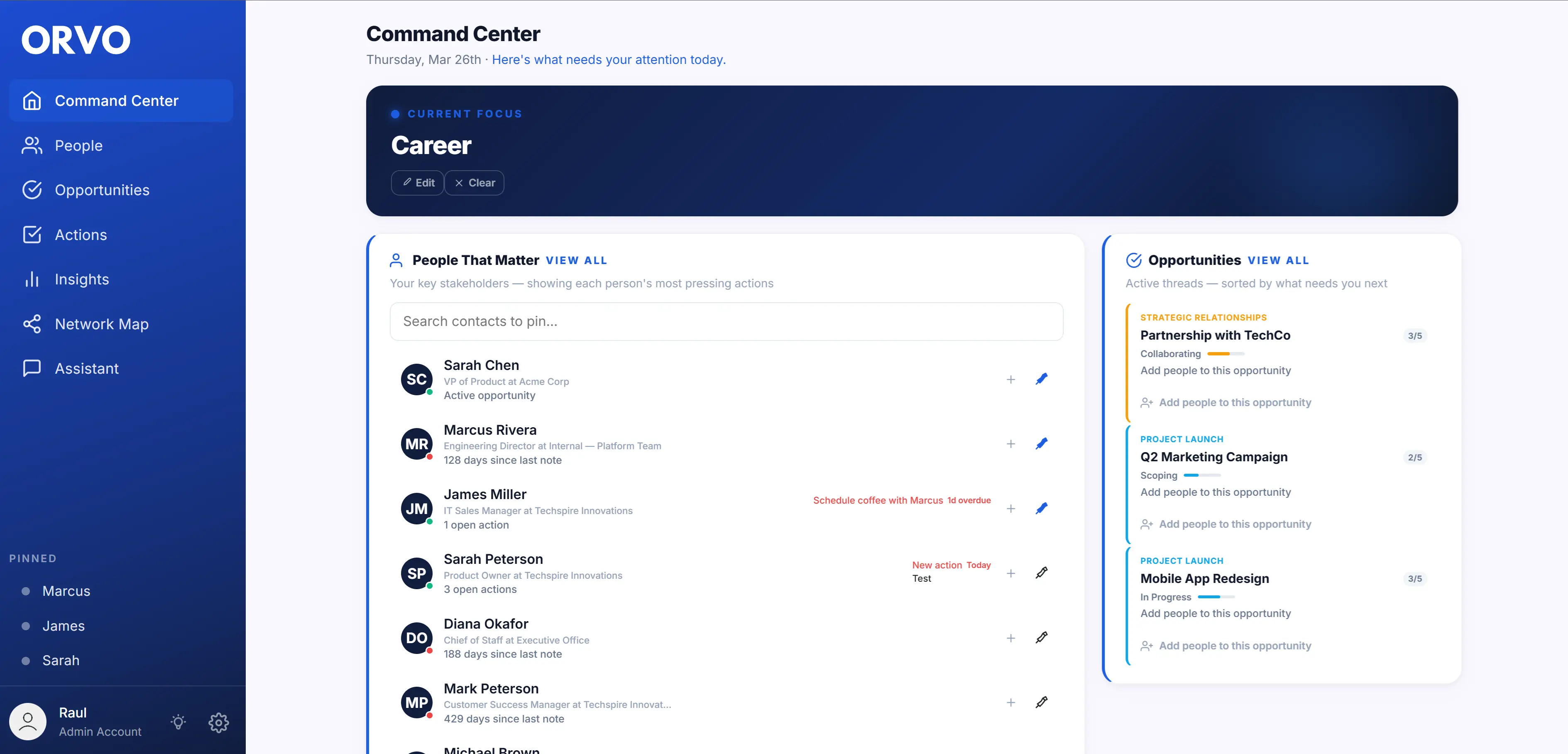
If your career depends on relationships, Orvo gives you the system to manage them. Start your free trial →
Start Free TrialHow Orvo bridges the gap between personal CRM and relationship intelligence
Orvo was built for professionals who outgrew personal CRMs but do not need a sales-team CRM. It combines the simplicity of a personal contact manager with the depth of a relationship intelligence platform.
Everything a personal CRM does, plus more. Contacts sync automatically from Google, Outlook, WhatsApp, and iCloud. Notes, tags, and follow-up reminders work exactly as you would expect. If you are switching from Dex, Monica, or a spreadsheet, the basics feel familiar.
Stakeholder and network mapping. See your professional landscape visually — who reports to whom, who influences what, and where your relationship gaps are. Export org charts for presentations and team alignment.
AI-powered meeting preparation. Before any conversation, Orvo generates a contextual brief from your relationship data: past interactions, open commitments, their priorities, and suggested talking points. No more scrambling through old notes five minutes before a meeting.
Four AI intelligence modules. Stakeholder Influence (navigate organisational dynamics), Career Navigation (promotion prep, visibility strategy), Meeting Preparation (contextual briefs), and Working Style Analysis (understand how stakeholders prefer to communicate).
Voice notes with transcription. Capture context on the go — after a meeting, during a commute, or between client calls. Notes are transcribed and attached to the relevant contact automatically.
Export contact briefs as PDF. Turn any contact into a formatted one-page brief with their full relationship history, notes, and AI-generated intelligence. Use it for meeting prep, team handoffs, or board presentations.
Pricing starts at $19/month (Pro) with unlimited contacts, or $39/month (Business) for team features like shared contacts and assigned tasks. Both include a 14-day free trial with no credit card required.
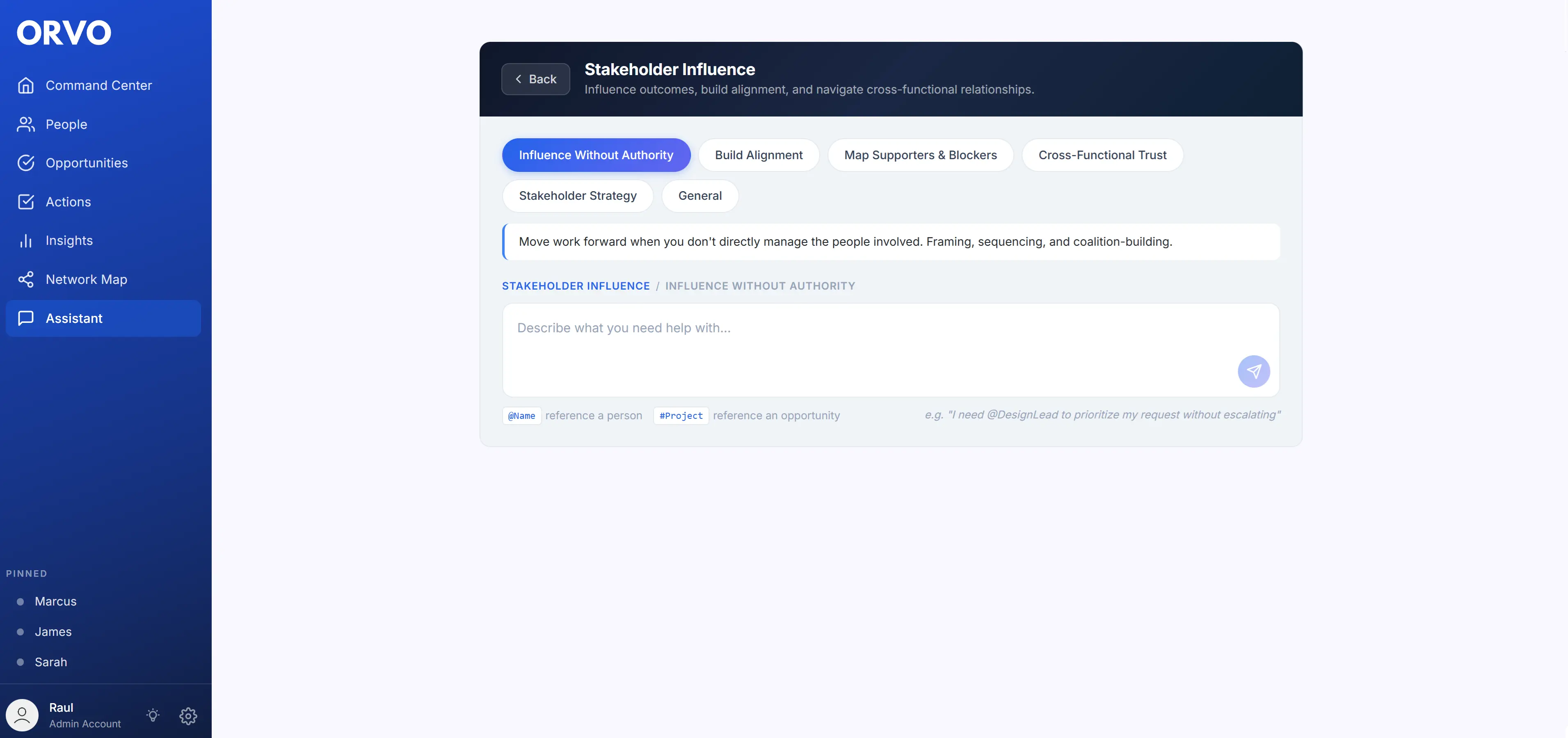
Looking for a personal CRM that goes further? Orvo gives you relationship intelligence, stakeholder mapping, and AI meeting prep — free trial, no credit card required.
Get Orvo FreeWichtige Erkenntnisse
- ✓ Personal CRMs store and organise contacts — relationship management software helps you understand and navigate professional relationships
- ✓ The key differentiators: stakeholder mapping, AI meeting prep, relationship intelligence, and multi-platform sync
- ✓ Personal CRMs work well for small networks (under 100 contacts) with simple needs
- ✓ Relationship management software is essential for managers, consultants, founders, and anyone navigating complex stakeholder landscapes
- ✓ The AI-driven relationship management segment is growing at 21.6% CAGR — double the overall personal CRM growth rate
- ✓ Orvo bridges the gap: personal CRM simplicity with relationship intelligence depth, starting at $19/month