
What is stakeholder management software?
Stakeholder management software is a tool that helps professionals systematically track, understand, and manage the people who have influence over their work. It replaces the scattered approach most people use — notes in one app, contacts in another, follow-up reminders in a third — with a single system where every relationship, interaction, and piece of context lives together.
The term "stakeholder management" originated in project management and corporate governance, but the practice applies to anyone whose success depends on people. Product managers navigating cross-functional teams. Consultants managing multiple client relationships. New managers building trust during their first 90 days. Founders maintaining relationships with investors, advisers, and partners.
According to the Project Management Institute, 80% of project failures are caused by poor stakeholder engagement — not technical problems. A 2023 Deloitte study found that professionals who map their stakeholder relationships before major initiatives are 2.5x more likely to achieve their objectives. Yet most professionals manage their stakeholders with memory alone.
Stakeholder management software closes that gap. The best tools combine contact management, interaction tracking, relationship mapping, follow-up automation, and AI-powered insights into a single platform purpose-built for how professionals actually work.
Why spreadsheets and generic CRMs fail at stakeholder management
Most professionals who try to manage stakeholders systematically start with a spreadsheet or a generic CRM. Both approaches fail within weeks.
Spreadsheets require manual data entry for every interaction. You have to remember to open the spreadsheet, find the right row, type what happened, and update the last-contact date. Nobody does this consistently. Nucleus Research found that DIY CRM solutions like spreadsheets have a 30% abandonment rate within 90 days. The problem is not discipline — it is friction. Any system that requires manual effort for routine operations will be abandoned.
Generic CRMs like HubSpot or Salesforce solve a different problem. They are built around deals and pipelines — tracking a lead from first contact to closed sale. Their data model (Companies → Contacts → Deals) does not map to stakeholder management. There is no concept of "influence level," no way to visualise reporting relationships, no meeting preparation feature. Using Salesforce to manage your internal stakeholders is like using a forklift to carry a briefcase.
Note-taking apps like Notion offer flexibility but no structure. You can build a contact database, but there is no automatic sync, no follow-up reminders, no relationship health tracking, and no AI insights. Every feature must be manually built and maintained. The result is a beautiful system that nobody uses after the first month.
Dedicated stakeholder management software solves these problems by design. Contacts sync automatically from your email and messaging apps. Interactions are logged against the right person. Follow-ups surface when they are due. And AI analyses your relationship patterns to surface insights no spreadsheet could provide.
| Capability | Spreadsheet | Generic CRM (HubSpot/Salesforce) | Stakeholder Management Software |
|---|---|---|---|
| Automatic contact sync | ✗ | ✓ (sales contacts only) | ✓ (Google, Outlook, WhatsApp, iCloud) |
| Interaction history per person | ✗ (manual) | ✓ (sales activities) | ✓ (all interactions) |
| Stakeholder / influence mapping | ✗ | ✗ | ✓ (visual network maps) |
| Follow-up reminders | ✗ | ✓ (deal-focused) | ✓ (relationship-focused) |
| AI meeting preparation | ✗ | ✗ | ✓ |
| Org chart visualisation | ✗ | ✗ | ✓ |
| Built for individuals | ✓ | ✗ (teams/sales) | ✓ |
| Setup time | 30 min+ | 2-4 hours | 5 minutes |
The six features that define great stakeholder management software
Not every stakeholder management tool delivers equal value. The best tools in 2026 share six capabilities that separate them from basic contact managers.
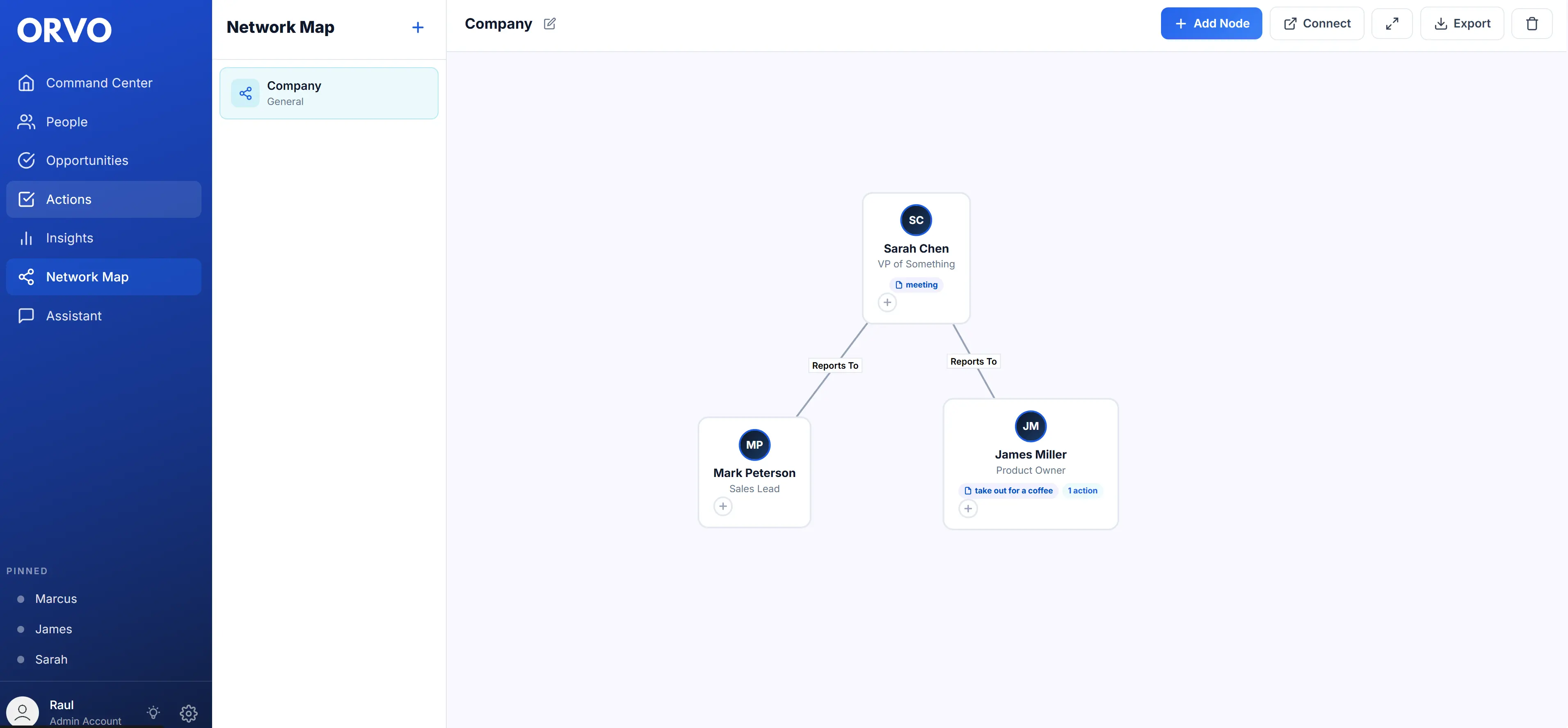
1. Stakeholder and network mapping. This is the defining feature. You need to see who reports to whom, who influences decisions, and where the power dynamics sit in any organisation. Visual network maps turn implicit knowledge into explicit strategy. Without this, you are navigating complex organisations blind.
2. Unified contact sync. Your stakeholders live across Google Contacts, Outlook, WhatsApp, iCloud, and LinkedIn. A stakeholder management tool must pull them all into one place automatically. Manual data entry is a non-starter — if you have to type in every contact, you will stop using the tool within a week.
3. Contextual notes and interaction tracking. Every conversation, meeting, and exchange should be logged against the person — not buried in an email thread. The best tools support quick notes, voice transcription, and tags so you can capture context in seconds and retrieve it before any meeting.
4. Follow-up automation. Stakeholder relationships die from neglect. Research from the Wharton School found that 80% of successful outcomes require at least five follow-up contacts, yet 44% of professionals give up after just one. Good software tracks what you owe, what is overdue, and who you have not engaged recently.
5. AI-powered meeting preparation. Before any stakeholder conversation, AI can synthesise your past interactions, open commitments, their priorities, and relevant organisational context into a preparation brief. This is the feature that separates 2026 tools from everything that came before.
6. Export and sharing. You need to turn your stakeholder intelligence into shareable assets — PDF briefs for meetings, org chart exports for presentations, and relationship handoff documents for team transitions.
Comparing the best stakeholder management tools in 2026
The market for stakeholder management software has matured, but most tools come from adjacent categories — personal CRMs, sales CRMs, or project management platforms. Here is how the leading options compare for individual professionals.
Orvo is the only tool built specifically for individual stakeholder management. It combines relationship tracking, network mapping, AI-powered meeting preparation, and career intelligence in one platform. It syncs with Google, Outlook, WhatsApp, and iCloud, includes voice note transcription, and lets you export stakeholder briefs as PDF. Pricing starts at $19/month with a 14-day free trial.
Folk is a team CRM that handles contact management well but lacks stakeholder mapping and AI meeting prep. It is designed for agencies and teams managing shared pipelines, not individual professionals navigating internal stakeholders. Starts at $20/user/month.
Dex is a personal contact manager focused on LinkedIn integration. Good for maintaining a networking database, but it has no stakeholder mapping, no org chart visualisation, and limited AI. Primarily a contact organiser, not a stakeholder intelligence tool.
Monday.com and Asana offer project management with stakeholder tracking add-ons, but the relationship management is a secondary feature bolted onto task management. You get project timelines with stakeholder labels — not relationship intelligence.
HubSpot is powerful for sales teams but wildly over-engineered for individual stakeholder management. No network mapping, no meeting prep AI, and the learning curve alone takes weeks.
| Feature | Orvo | Folk | Dex | Monday/Asana | HubSpot |
|---|---|---|---|---|---|
| Built for individual professionals | ✓ | ✗ (teams) | ✓ | ✗ (teams) | ✗ (sales teams) |
| Stakeholder / network mapping | ✓ | ✗ | ✗ | Basic | ✗ |
| AI meeting preparation | ✓ | ✗ | ✗ | ✗ | ✗ |
| Contact sync (Google, Outlook, WhatsApp) | ✓ | ✓ (partial) | ✓ (LinkedIn-centric) | ✗ | ✓ |
| Voice notes + transcription | ✓ | ✗ | ✗ | ✗ | ✗ |
| Org chart export | ✓ | ✗ | ✗ | ✗ | ✗ |
| Career / stakeholder intelligence | ✓ | ✗ | ✗ | ✗ | ✗ |
| Price (starting) | $19/mo | $20/user/mo | Free–$12/mo | $8/user/mo | Free–$45/mo |
See how Orvo compares in detail — read our head-to-head comparisons with Folk, Dex, HubSpot, and more.
Start Free TrialWho needs stakeholder management software
Stakeholder management software is not limited to project managers. Any professional whose success depends on navigating people and influence benefits from a systematic approach.
Product managers navigate complex cross-functional landscapes daily. They need to align engineering, design, sales, and leadership around shared priorities — tracking dozens of relationships with different power dynamics. The Network Map feature is built for exactly this use case.
Consultants manage multiple client relationships simultaneously while also navigating internal stakeholder dynamics within each client organisation. A McKinsey study found that consultant effectiveness correlates more strongly with stakeholder management skills than technical expertise.
New managers in their first 90 days face the highest-stakes relationship-building period of their careers. Research from the Corporate Executive Board shows that 46% of new managers fail within their first 18 months, and the primary reason is failure to build effective stakeholder relationships — not lack of technical skill.
Founders and entrepreneurs maintain relationships with investors, advisers, potential hires, customers, and partners simultaneously. The most successful founders are systematic about this. A First Round Capital survey found that founders with structured relationship practices were 3x more likely to successfully raise their next round.
Cross-functional leaders — anyone running a project that spans multiple teams or departments — need to track who has decision-making authority, who needs to be informed, and who might block progress. Stakeholder management software turns this from guesswork into strategy.
How to get started with stakeholder management software
Getting value from stakeholder management software takes less time than most people expect. Here is a practical framework for your first two weeks.
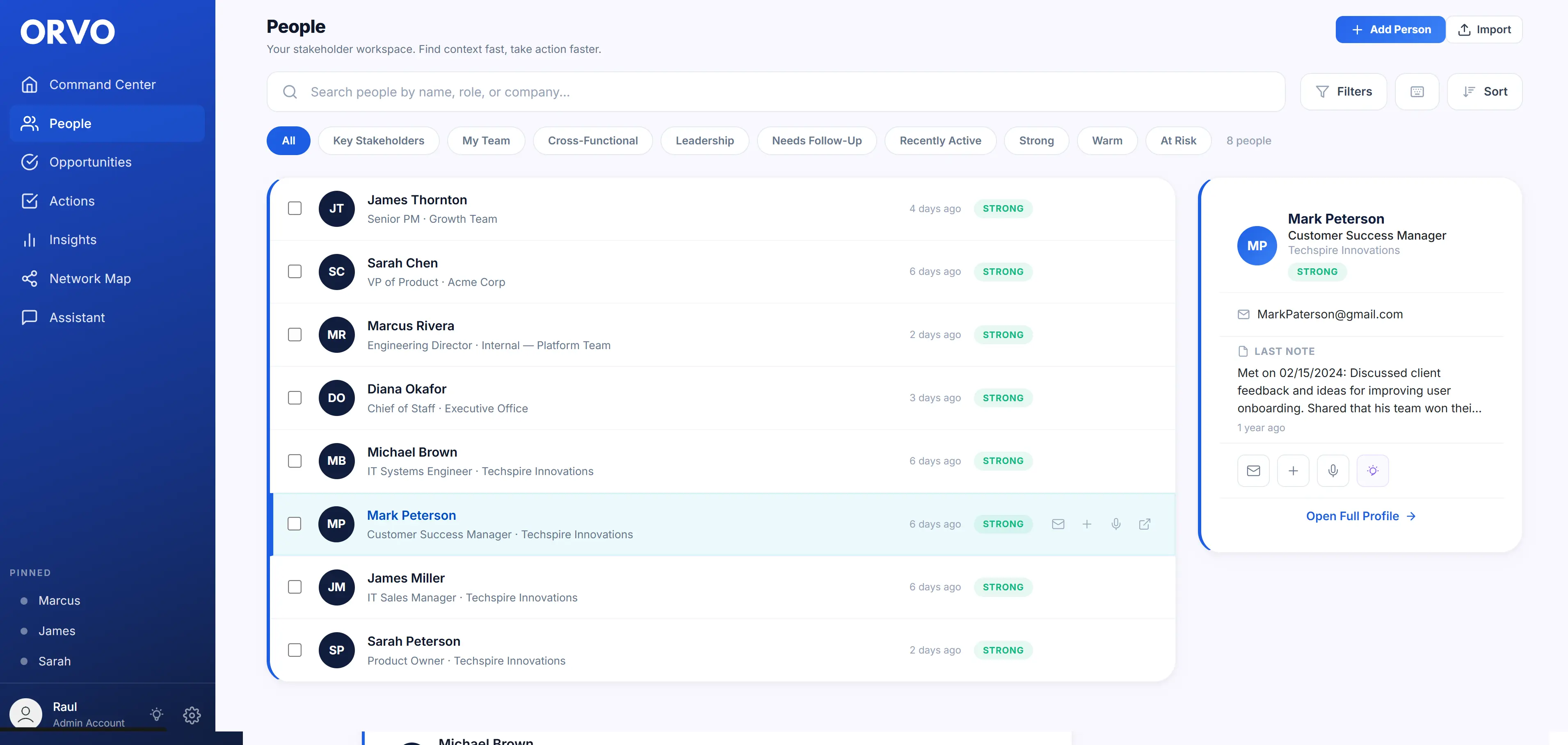
Day 1: Import and sync. Connect your email and contacts (Google, Outlook, or iCloud). Import any existing contacts from WhatsApp or CSV. This gives you a baseline of everyone you already know — most people are surprised to find they have 200-500 professional contacts scattered across platforms.
Days 2-3: Identify your top 20. Tag the 20 people who most influence your current work — your manager, skip-level, key cross-functional partners, clients, and mentors. Add quick notes on each: their priorities, your relationship status, any open commitments.
Days 4-7: Map the landscape. Use the network mapping feature to visualise reporting lines and influence relationships between your top 20. This exercise alone often reveals blind spots — stakeholders you should be engaging but are not, or influence pathways you had not considered.
Week 2: Build the habit. After every meaningful meeting or conversation, spend 30 seconds adding a note to the relevant person. Set follow-up reminders for any commitments. Use the AI meeting prep feature before your next important conversation.
Ongoing: Let it compound. After a month, you will have a rich context history for every important stakeholder. After three months, you will see patterns — which relationships drive the most value, which are going cold, and where to invest your time. This compounding effect is why professionals who adopt stakeholder management software rarely go back to the old way.
Start mapping your stakeholders today. Orvo gives you a 14-day free trial — no credit card required.
Get Orvo FreeWichtige Erkenntnisse
- ✓ Stakeholder management software helps professionals track, map, and manage the people who influence their work
- ✓ 80% of project failures trace back to poor stakeholder engagement — not technical problems (PMI)
- ✓ Spreadsheets, generic CRMs, and Notion all fail at stakeholder management due to friction and missing features
- ✓ The six essential features: network mapping, contact sync, interaction tracking, follow-up automation, AI meeting prep, and export
- ✓ Orvo is the only tool built specifically for individual stakeholder management — starting at $19/month
- ✓ Start with your top 20 stakeholders, map their relationships, and let the system compound over time