
Why nobody tells you what executives expect
There is a fundamental communication gap in most organisations. Executives operate on a completely different information plane than the rest of the company. They think in terms of strategy, resource allocation, and risk. You think in terms of tasks, projects, and team dynamics. Neither is wrong — but the gap creates constant misunderstanding.
A McKinsey study found that 91% of senior executives believe they communicate their expectations clearly. Only 40% of their direct reports agree. That is a 51-point perception gap — and it explains why talented people get passed over for promotion while less skilled but "better aligned" colleagues advance.
The problem compounds at every level. When you are an individual contributor, your manager translates executive expectations into tasks. You deliver the tasks, everyone is happy. But as you move up — to team lead, manager, senior manager — the translation layer disappears. You are expected to understand executive expectations directly, without anyone explaining them.
At Cisco, a recurring piece of advice from VPs was: "Rotate every 2 years and make a big change every 5." This was not about the rotation itself — it was about the underlying expectation that executives value people who seek complexity, not comfort. That expectation was never written in any performance framework. You either figured it out or you did not.
What executives expect at every level
Executive expectations shift dramatically as you move up. What gets you promoted from IC to team lead will not get you promoted from director to VP. Here is the real map.
Individual Contributor (years 0-3): Executives expect you to deliver reliably and learn fast. They do not expect strategic insight. They expect you to finish what you start, ask smart questions, and not need to be managed closely. The differentiator at this level: the ability to see how your work connects to the bigger picture. Most ICs cannot articulate why their project matters to the business. The ones who can get noticed.
Team Lead / Senior IC (years 3-7): Executives expect you to multiply others. It is no longer about your individual output — it is about making the people around you better. Can you onboard a new hire without your manager intervening? Can you run a meeting that produces decisions, not just discussion? Can you flag risks before they become problems? The differentiator: proactive communication upward. Do not wait to be asked for a status update.
Manager (years 5-10): Executives expect you to own outcomes, not activities. They do not care that your team had 47 meetings last quarter. They care what changed as a result. At this level, you are expected to translate strategy into action without detailed instructions. The differentiator: the ability to say no. Executives respect managers who protect their team's focus by pushing back on low-value work — diplomatically.
Senior Manager / Director (years 8-15): Executives expect you to think like them. You should be able to present a business case, understand the P&L impact of your decisions, and navigate cross-functional politics without escalating. The differentiator: building relationships across the org that give you information and influence beyond your direct team. This is where stakeholder management becomes a career-defining skill.
VP and above: Executives expect you to see around corners. Anticipate problems before they materialise. Build the team, not just manage it. Shape the strategy, not just execute it. At this level, your network IS your capability. The executive who knows every key player in the organisation and can align them quickly will always outperform the one who tries to do everything through formal channels.
| Level | What They Expect | The Differentiator | Common Mistake |
|---|---|---|---|
| IC | Reliable delivery, fast learning | Connect your work to the business | Waiting for detailed instructions |
| Team Lead | Multiply others, proactive communication | Flag risks before they escalate | Still doing all the work yourself |
| Manager | Own outcomes, translate strategy to action | Protect team focus by saying no | Reporting activities instead of results |
| Senior Manager / Director | Think like an executive, cross-functional influence | Build org-wide relationships | Staying in your silo |
| VP+ | See around corners, shape strategy | Network IS capability — align stakeholders fast | Relying on formal authority instead of influence |
The three things every executive cares about (regardless of level)
Behind every executive expectation, there are three universal concerns. Learn these and you will never misjudge what your leadership wants.
1. Risk. Executives are paid to manage risk. Every decision they make is weighed against "what could go wrong?" When you bring a proposal, they are not thinking about how clever it is. They are thinking about the downside. The professionals who advance are the ones who address risk proactively: "Here is the plan, here are the two things that could go wrong, and here is how we mitigate each one." This signals maturity.
2. Speed. Executives live in a world of compressed timelines. They do not have time for 30-minute explanations when a 3-minute brief will do. The biggest career accelerator at the manager level and above is the ability to communicate concisely. One framework from corporate leadership training: Keep it simple, make it accessible, state goals and objectives (SMART), share your assessment of the current situation, identify alternatives with pros and cons, answer WIIFM (What\'s In It For Me — from their perspective), and summarise. That is the executive communication formula.
3. Trust. Executives delegate to people they trust. Trust is built through three things: competence (you deliver what you promise), consistency (you deliver every time, not just when it is high-visibility), and candour (you tell them the truth, including bad news, early). The fastest way to lose executive trust: surprise them with bad news in front of their peers. The fastest way to build it: bring them a problem with a proposed solution before anyone else notices.
Every interaction with an executive is an audition for trust. They are always evaluating: can I delegate more to this person? Can I put them in front of the board? Can I rely on them when it matters?
How to adapt to different executive styles
Not all executives operate the same way. Understanding their management style helps you deliver what they need in the way they can receive it.
Management by Direction (the "Red" style). This executive is direct, competitive, and results-oriented. They want you to work independently, respond to their ideas, be candid, prove capability, and emphasise results. Do not waste their time with process — show them outcomes. If you manage up to this type, be organised, purposeful, and decisive. They respect confidence.
Management by Exception (the "Green" style). This executive sets procedures and only intervenes when something deviates from the plan. They want you to be respectful of processes, logical, analytical, and low-risk. Present ideas as careful improvements, not radical changes. Emphasise facts and consistency. They respect thoroughness.
Management by Enablement (the "Blue" style). This executive leads through trust, encouragement, and team development. They want sincerity, team emphasis, demonstrated loyalty, and worthwhile projects. They value the human impact of decisions. When presenting to this type, show how your proposal helps the team grow. They respect relationships.
Management by Participation (the "Hub" style). This executive values consensus, group input, and collaborative decision-making. They want involvement from all stakeholders before moving forward. When working with this type, do not present final decisions — present options and facilitate discussion. They respect inclusion.
The key insight: most professionals present information the way THEY prefer to receive it. The ones who advance present information the way their EXECUTIVE prefers to receive it. This requires knowing your executive — their style, priorities, and pressure points. A relationship management tool like Orvo helps you track these preferences and review them before every interaction.
| Executive Style | What They Value | How to Present to Them | What to Avoid |
|---|---|---|---|
| Direction (Red) | Results, independence, decisiveness | Bottom line first, data second, be direct | Long explanations, indecisiveness, excuses |
| Exception (Green) | Process, logic, consistency | Facts first, low-risk framing, follow procedures | Radical changes, emotional arguments, shortcuts |
| Enablement (Blue) | Trust, team growth, relationships | Team impact first, sincerity, loyalty signals | Cold data without human context, disloyalty |
| Participation (Hub) | Consensus, inclusion, group input | Options not decisions, facilitate discussion | Presenting fait accompli, excluding stakeholders |
The unwritten rules of executive communication
Every corporate environment has unwritten rules about how to communicate with executives. Here are the ones that apply almost universally.
Rule 1: Lead with the answer. Executives do not want to follow your thought process. They want the conclusion first, then the supporting evidence if they ask for it. "We should delay the launch by two weeks because of X and Y" — not a 10-minute story about how you discovered X and Y. The military calls this BLUF: Bottom Line Up Front.
Rule 2: Own the recommendation. Never present a problem without a proposed solution. "We have a budget gap of $50K" is a problem. "We have a budget gap of $50K — I recommend we cut the Q3 contractor spend and reallocate. Here is the impact." That is a solution. Executives promote people who solve problems, not people who identify them.
Rule 3: Know your numbers. At the manager level and above, you are expected to understand the financial impact of your work. Not just "the project will improve efficiency" — but "the project will save 400 hours per quarter, which at a blended rate of $75/hour is $30K in recovered capacity." Executives think in money. Learn to translate your work into their language.
Rule 4: Manage the surprise. Never let your executive be surprised by bad news in a public setting. If something is going wrong, tell them privately first. Give them time to process. Let them decide how to position it. Surprising an executive in front of their peers is a career-limiting move that is almost impossible to recover from.
Rule 5: Close the loop. When an executive gives you direction or asks a question, follow up — even if the answer is "still working on it." Radio silence is interpreted as incompetence. A two-line email saying "Still on track, will have the analysis by Friday" takes 30 seconds and preserves trust.
Building your executive relationship system
Understanding executive expectations is step one. Consistently delivering on them requires a system.
Map your executive stakeholders. Who are the 5-10 executives who influence your career? Your direct manager, their manager (your skip-level), cross-functional leaders you work with, and the decision-makers for your next promotion. For each, note: their management style, what they care about right now, their communication preference, and when you last interacted.
Prepare for every executive interaction. Before any meeting with an executive, review their profile. What are they worried about? What did you commit to last time? What is their preferred communication style? 60 seconds of preparation makes you the most prepared person in the room.
Track commitments religiously. When an executive asks you to do something, it goes into your system immediately. Not your memory, not a mental note — a tracked action with a due date. Executives remember what they asked for. If you do not deliver, they notice. If you deliver without being reminded, they trust you more.
Build visibility strategically. Do not broadcast your achievements randomly. Know which executives matter for your career trajectory and ensure they see your best work. This is not politics — it is strategic communication. A study by the Center for Creative Leadership found that executives who invest in relationship building spend 70% more time networking than their lower-performing peers.
Orvo is built for exactly this: map your executive stakeholders, log their preferences and priorities, track commitments, and prepare for every interaction with AI-generated briefs. It turns executive relationship management from a guessing game into a system.
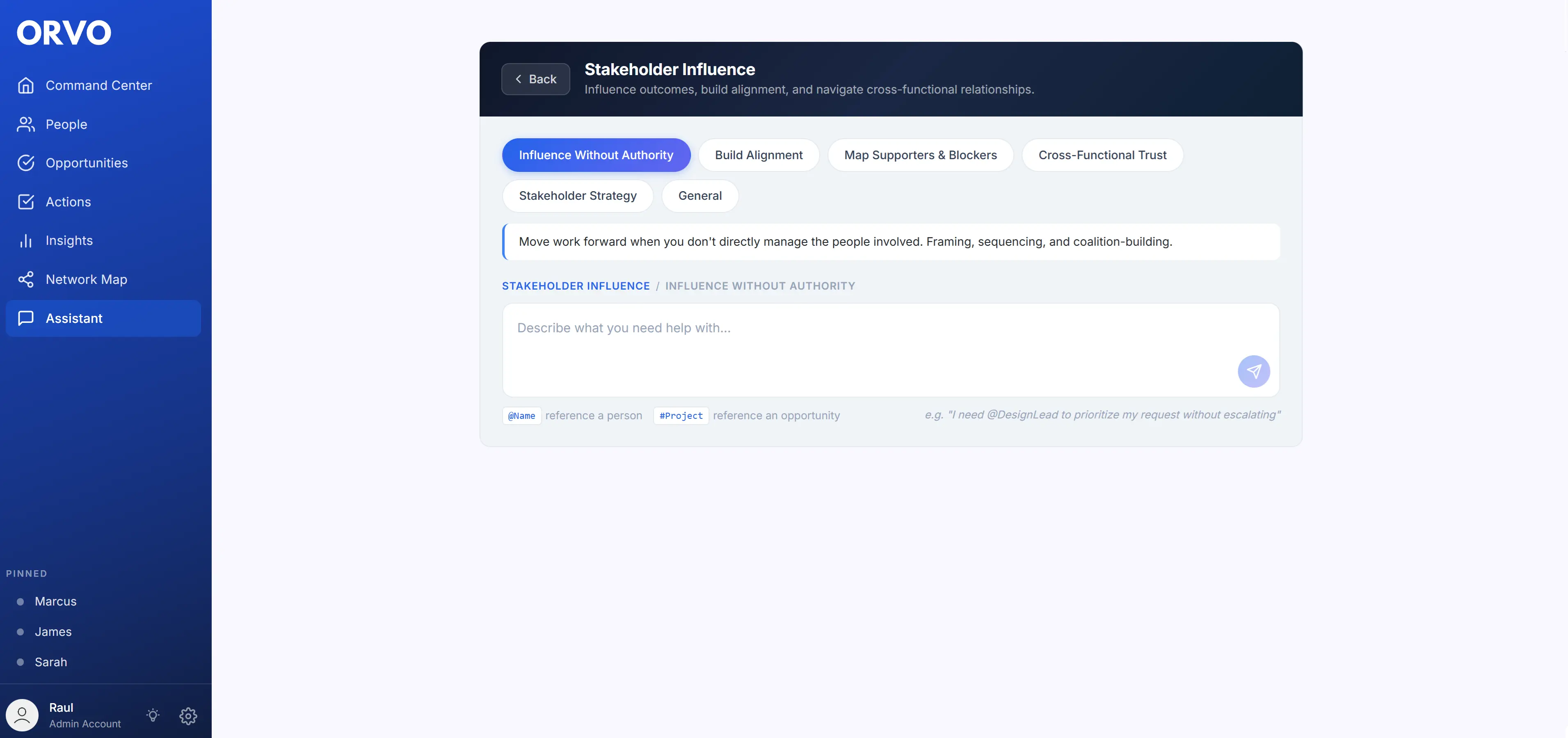
Stop guessing what executives want. Orvo helps you map stakeholders, track commitments, and prepare for every executive interaction — free trial, no credit card.
Get Orvo Free要点まとめ
- ✓ 91% of executives think they communicate expectations clearly — only 40% of their reports agree (McKinsey)
- ✓ What gets you promoted changes at every level: delivery → multiplying others → owning outcomes → cross-functional influence → strategic vision
- ✓ Every executive cares about three things: risk, speed, and trust — address all three in every interaction
- ✓ Adapt your communication to their style: Direction (results first), Exception (process first), Enablement (people first), Participation (consensus first)
- ✓ BLUF — always lead with the answer, not the journey to get there
- ✓ Never surprise an executive with bad news publicly — tell them privately first
- ✓ Build a system: map executive stakeholders, track commitments, prepare for every interaction