
Why Product Management Is the Most Competitive Career Transition in Tech
Product management attracts professionals from every discipline — engineering, design, marketing, consulting, data science — because it sits at the intersection of technology, business, and user experience. The appeal is obvious: high impact, high compensation, and high autonomy.
But the competition is fierce. A 2025 Product School survey found that the average PM role receives 200+ applications, and fewer than 3% of applicants get interviews. The median time from "I want to be a PM" to landing a first PM role is 8-14 months.
Here is what most career-change guides will not tell you: the skills gap is rarely the bottleneck. Most professionals transitioning from engineering, design, or consulting already have 60-70% of the skills they need. What they lack is the right network.
Product management hiring is relationship-driven in a way that engineering hiring is not. PM roles are often filled through internal transfers and referrals before they ever hit job boards. A Hired.com analysis found that 65% of PM hires at top tech companies came through referrals or internal mobility — not cold applications. This means your transition strategy must be a networking strategy.
The PM Skills Stack: What You Actually Need (and What You Can Skip)
Every PM skills framework looks slightly different, but after analyzing job postings from 50+ top tech companies, the core stack breaks down into four layers:
Layer 1: Non-Negotiable (Must Have Before Applying)
- User research and customer empathy — you must be able to articulate user problems clearly
- Data literacy — SQL basics, A/B testing concepts, metrics frameworks (HEART, AARRR)
- Prioritization frameworks — RICE, ICE, MoSCoW, or similar systematic approaches
- Communication — clear writing, stakeholder presentations, cross-functional alignment
Layer 2: Differentiators (Separate Good from Great)
- Technical fluency — you do not need to code, but you need to understand architecture trade-offs
- Business modeling — unit economics, market sizing, competitive analysis
- Design thinking — wireframing, user journey mapping, prototyping concepts
Layer 3: Role-Specific (Depends on the PM Type)
- Growth PM: experimentation, funnel optimization, behavioral psychology
- Platform PM: API design, developer experience, system thinking
- AI PM: ML concepts, data pipeline understanding, responsible AI principles
Layer 4: Overrated (Stop Obsessing Over These)
- Coding skills (helpful but not required for most PM roles)
- MBA (less valued every year — experience trumps credentials)
- Certifications (product management certifications have minimal hiring impact)
| Skill | Priority | How to Build It | Timeline |
|---|---|---|---|
| User Research | Must-have | Practice 5 user interviews (friends/family count) | 2 weeks |
| Data Literacy (SQL) | Must-have | Mode Analytics SQL tutorial + practice on public datasets | 4 weeks |
| Prioritization Frameworks | Must-have | Apply RICE to a real product's backlog (write it up as a case study) | 1 week |
| Stakeholder Communication | Must-have | Practice PRDs, present at team meetings, write product specs | Ongoing |
| Technical Fluency | Differentiator | Read system design blogs, pair with engineers, take a basic architecture course | 6 weeks |
| Business Modeling | Differentiator | Build a market sizing model for 3 products you use daily | 2 weeks |
| Wireframing | Differentiator | Figma basics + redesign one feature of a product you use | 2 weeks |
The Tool Stack for Your PM Transition
A successful PM transition requires more than learning skills — it requires building relationships with the right people and tracking your progress systematically. Here is the complete tool stack:
The most overlooked piece of any career transition is relationship management. You will need to connect with 50-100 people over 6-12 months: current PMs who can share insights, hiring managers, recruiters, mentors, and peers going through the same transition. Without a system, you lose track of who you have talked to, what they told you, and when to follow up.
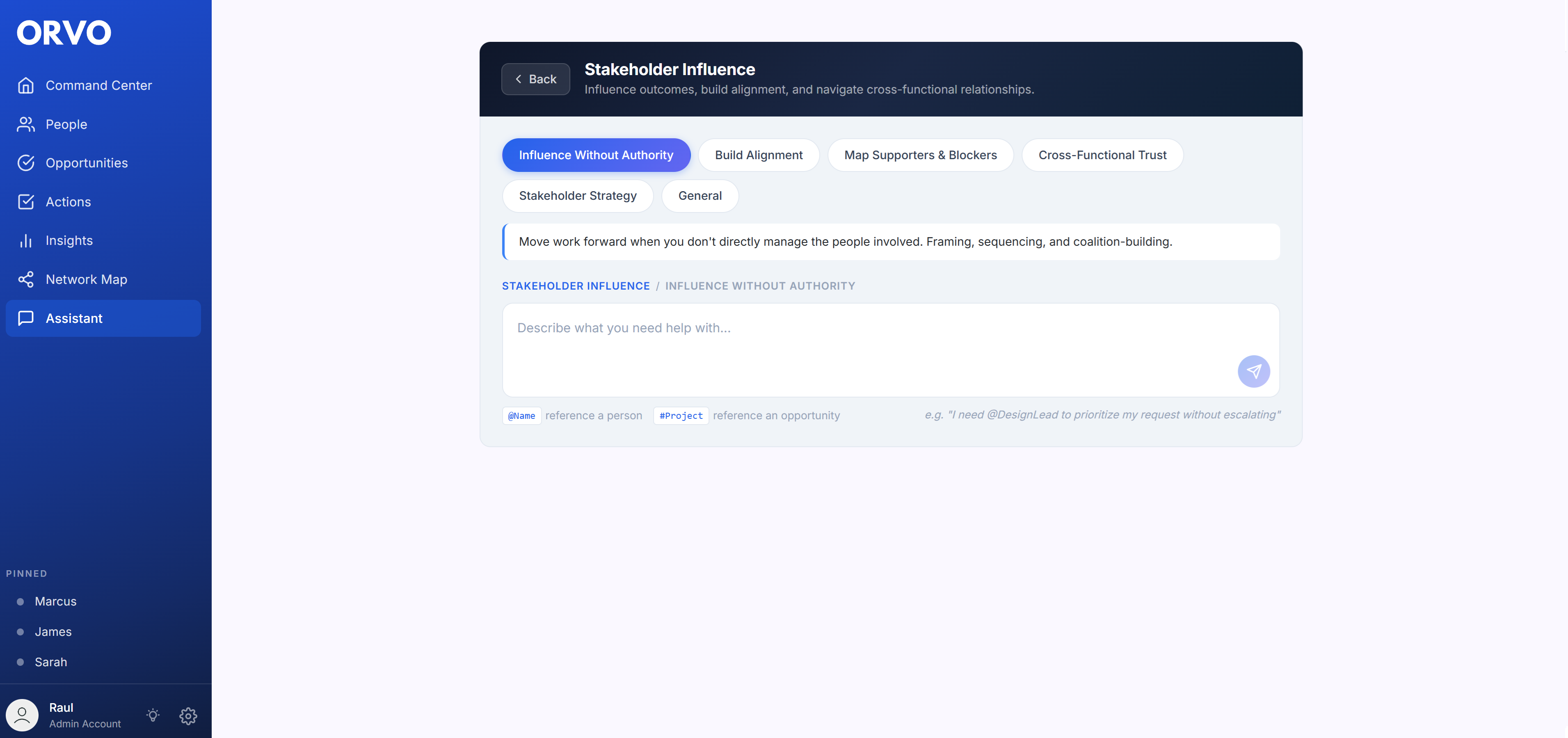
Orvo solves this by letting you log every informational interview, track which companies each contact works at, set follow-up reminders, and prepare for conversations with full context from previous interactions. When a PM at your target company says "reach out in Q2 when we are hiring," Orvo makes sure that follow-up actually happens.
| Phase | What You Need | Tool | Why |
|---|---|---|---|
| Learn Skills | Structured courses | Product School + Coursera | Targeted PM curriculum with case studies |
| Build Portfolio | Case studies + PRDs | Notion + Figma | Document your product thinking in shareable formats |
| Network | Track 50-100 PM contacts | Orvo | Log informational interviews, set follow-ups, track referral pathways |
| Apply | Application tracking | Teal or spreadsheet | Track applications, interview stages, and timelines |
| Interview Prep | Practice + context | Orvo + ChatGPT | Review contact notes before interviews, practice PM cases with AI |
| Post-Interview | Follow-up system | Orvo | Thank-you notes within 24 hours, track next steps with each company |
The 6-Month PM Transition Playbook
Here is the month-by-month plan that has worked for hundreds of successful career changers. This assumes you are transitioning while employed (the most common scenario).
Month 1: Foundation
- Take one PM course (Product School's free intro or Coursera's Digital Product Management)
- Read *Inspired* by Marty Cagan and *Cracking the PM Interview* by Gayle McDowell
- Set up your relationship tracking system in Orvo
- Identify 10 PMs to reach out to for informational interviews (start with 2nd-degree LinkedIn connections)
Month 2: Skill Building + First Conversations
- Complete SQL basics (Mode Analytics free tutorial)
- Write your first product case study (redesign a feature of a product you use daily)
- Conduct 4-6 informational interviews with PMs at various companies
- Log every conversation in Orvo with key takeaways and follow-up items
Month 3: Portfolio Development
- Write 2 product specs (PRDs) for hypothetical features
- Create a product case study with user research, data analysis, and wireframes
- Attend 2 PM meetups or online events (track new contacts in Orvo)
- Follow up with Month 2 contacts — share something valuable, ask for introductions
Month 4: Targeted Networking
- Identify your top 10 target companies
- Find PM contacts at each company (LinkedIn + your existing network)
- Conduct 6-8 more informational interviews, focused on target companies
- Practice PM interview questions (estimation, product design, analytical)
- Ask 2-3 PM mentors to review your case studies
Month 5: Application Preparation
- Refine your resume with PM-relevant framing (impact metrics, cross-functional work)
- Prepare your "PM transition story" — why PM, why now, what you bring
- Request referrals from contacts at target companies (this is where your Orvo relationship history pays off)
- Start applying to 5-10 roles per week
Month 6: Interview Sprint
- Before each interview, review your Orvo notes on contacts at that company
- Practice cases daily (product design, estimation, behavioral)
- Send thoughtful follow-ups after every interview (reference specific conversation points)
- Continue networking — some of your best leads will come from Month 2-3 contacts who now have openings
Track every PM conversation, manage your referral pipeline, and never miss a follow-up — try Orvo free for 14 days →
Start Free TrialThe Networking Strategy That Actually Gets You Hired
The biggest mistake career changers make is treating networking as a checkbox: "I need 10 informational interviews" → check → move on. Real networking is relationship-building over time, and the people who do it systematically get dramatically better results.
Here is the framework that works:
The 5-Touch Rule: Before asking anyone for a referral, you should have had at least 5 meaningful interactions with them. An informational interview counts as one. Sharing a relevant article is another. Commenting thoughtfully on their LinkedIn post is another. By the time you ask for a referral, they feel like they know you — not like you are a stranger asking for a favor.
The Value-First Approach: Every interaction should include something valuable for the other person. Share an article relevant to their work. Introduce them to someone in your network. Offer a perspective from your current domain that could help their product thinking. People refer people they like, and they like people who give before they take.
The Long Game: Some of your most valuable connections will not pay off for 3-6 months. The PM you talked to in Month 2 might move to a new company in Month 5 and bring you in as a referral. The key is maintaining those relationships — and that is where most people fail.
Without a system, you will forget to follow up. You will lose track of who works where. You will miss the window when a contact posts about their team hiring. A relationship tracking tool like Orvo automates the maintenance: it reminds you when a relationship is going cold, surfaces relevant context before every interaction, and ensures no connection falls through the cracks.
Internal Transfers: If you are already at a tech company, the fastest path to PM is often an internal transfer. Build relationships with PMs on your team: volunteer to write product specs, join their user research sessions, and ask to shadow product reviews. Track these relationship-building activities and their outcomes — when an internal PM opening appears, you want 3-4 PMs who can vouch for your product thinking.
The Future of Product Management in the AI Era
Product management is evolving faster than any other tech role. As Sorin Ciornei wrote in *The Future is Now* (thereach.ai), we are entering the Curating Economy — where the ability to synthesize information, connect dots across domains, and orchestrate complex systems matters more than any single technical skill.
This shift favors PMs enormously. AI can generate code, create designs, analyze data, and even write product specs. But AI cannot (yet) navigate organizational politics, build trust with skeptical engineers, align competing stakeholder priorities, or make the judgment calls that define great products.
The PM role in 2026 and beyond is less about execution and more about orchestration. The PMs who thrive will be the ones who can:
1. Manage stakeholder complexity — More cross-functional dependencies, more competing priorities, more need for systematic relationship management 2. Synthesize AI-generated insights — AI produces analysis; PMs curate it into decisions 3. Build trust at scale — Remote and hybrid work means deliberate relationship-building replaces casual office interactions 4. Navigate ambiguity — As AI handles the well-defined tasks, PMs own the ambiguous, high-judgment decisions
This is actually good news for career changers: the skills that differentiate great PMs in the AI era — stakeholder management, cross-functional communication, strategic thinking — are skills you have been building in your current career. The key is packaging and positioning them correctly.
Manage your PM transition like a product — systematically. Try Orvo free for 14 days →
Get Orvo Free要点まとめ
- ✓ 65% of PM hires come through referrals — your transition strategy must be a networking strategy.
- ✓ Most career changers already have 60-70% of PM skills. The gap is network, not knowledge.
- ✓ Use the 6-month playbook: Foundation → Skills → Portfolio → Networking → Applications → Interviews.
- ✓ The 5-Touch Rule: have 5 meaningful interactions before asking for a referral.
- ✓ Track every PM conversation in a relationship tool (Orvo) to maintain connections over 6-12 months.
- ✓ AI is making stakeholder management the #1 PM differentiator — lean into your soft skills.