
What is a personal CRM and who needs one?
A personal CRM (Customer Relationship Management) is software designed for individuals — not sales teams — to manage their professional relationships. It tracks the people you know, the conversations you have had, the commitments you have made, and the follow-ups you need to complete. It is the difference between managing your network with memory and managing it with a system.
The term "personal CRM" has been around for a decade, but the category has transformed dramatically. Early personal CRMs were essentially fancy address books — you stored contact details and maybe added a note. In 2026, the leading tools offer AI-powered relationship intelligence, automated interaction tracking, stakeholder mapping, voice note transcription, and career navigation coaching.
Who needs a personal CRM? Anyone whose professional success depends on relationships — which is essentially everyone. But the people who get the most value are:
- Consultants and freelancers juggling multiple client relationships simultaneously
- Managers and leaders navigating complex stakeholder landscapes
- Founders and entrepreneurs maintaining relationships with investors, advisers, and partners
- Job seekers and career builders who need to activate and maintain their network strategically
- Conference networkers who meet dozens of people and need to follow up systematically
According to Future Market Insights, the personal CRM market reached $2.48 billion in 2024 and is projected to grow to $7.5 billion by 2035 at a 10.6% CAGR. This is not a niche category — it is a rapidly maturing market driven by professionals who have realised that their phone's built-in contacts app is woefully insufficient.
Personal CRM vs. business CRM: why Salesforce is the wrong answer
The most common mistake career-focused professionals make is trying to use a business CRM — HubSpot, Salesforce, Pipedrive — for personal relationship management. These tools were built for a fundamentally different problem.
Business CRMs are designed around deals. Everything flows through a sales pipeline: leads enter, get qualified, move through stages, and either close or drop out. The data model, the interface, the reports — everything assumes you are tracking commercial transactions between a company and its customers.
Personal CRMs are designed around people. There is no pipeline. There is no lead scoring. Instead, the focus is on understanding each person in your network — their context, your history together, what you have discussed, and what you need to do next. The value is not in closing deals but in maintaining and strengthening relationships over years.
The practical consequences of using the wrong tool are significant. A Nucleus Research study found that CRM adoption rates drop below 30% when the tool does not match the user's workflow. Salesforce's free tier requires you to think in terms of Accounts, Contacts, Opportunities, and Cases — abstractions that make zero sense when you are tracking your relationship with a mentor or preparing for a skip-level meeting.
The right personal CRM should feel natural from day one. Import your contacts, add notes after conversations, set follow-up reminders, and see your entire relationship landscape at a glance. If the tool requires a training course, it is built for someone else.
| Dimension | Business CRM (Salesforce, HubSpot) | Personal CRM (Orvo, Dex, Folk) |
|---|---|---|
| Primary user | Sales teams, marketing teams | Individual professionals |
| Core data model | Deals, pipeline stages, revenue | People, interactions, relationship context |
| Success metric | Deals closed, revenue generated | Relationships maintained, opportunities created |
| AI focus | Lead scoring, deal prediction | Meeting prep, relationship health, stakeholder coaching |
| Setup time | Hours to weeks (admin required) | Minutes (import contacts and go) |
| Typical cost | $25-300/user/month | $0-39/month |
| Complexity | High (designed for teams) | Low (designed for individuals) |
The 7 features that define a great personal CRM in 2026
The personal CRM landscape has matured significantly. Here are the seven features that separate the best tools from the mediocre ones.
1. Multi-source contact sync. Your relationships live across Google Contacts, Outlook, WhatsApp, iCloud, and LinkedIn. The best personal CRMs sync with all of them automatically. If you have to manually import a CSV every time you meet someone new, the tool has already failed.
2. Per-person notes and interaction history. Every conversation should be logged against the person, not floating in a separate notes app. The best tools support rich notes, voice memos, and automatic interaction capture from email and calendar.
3. Follow-up reminders tied to people. Not generic calendar events — reminders that show you the full relationship context when they fire. "Follow up with Sarah" is useless. "Follow up with Sarah — discussed partnership opportunity on March 15th, she asked for proposal by end of month" is actionable.
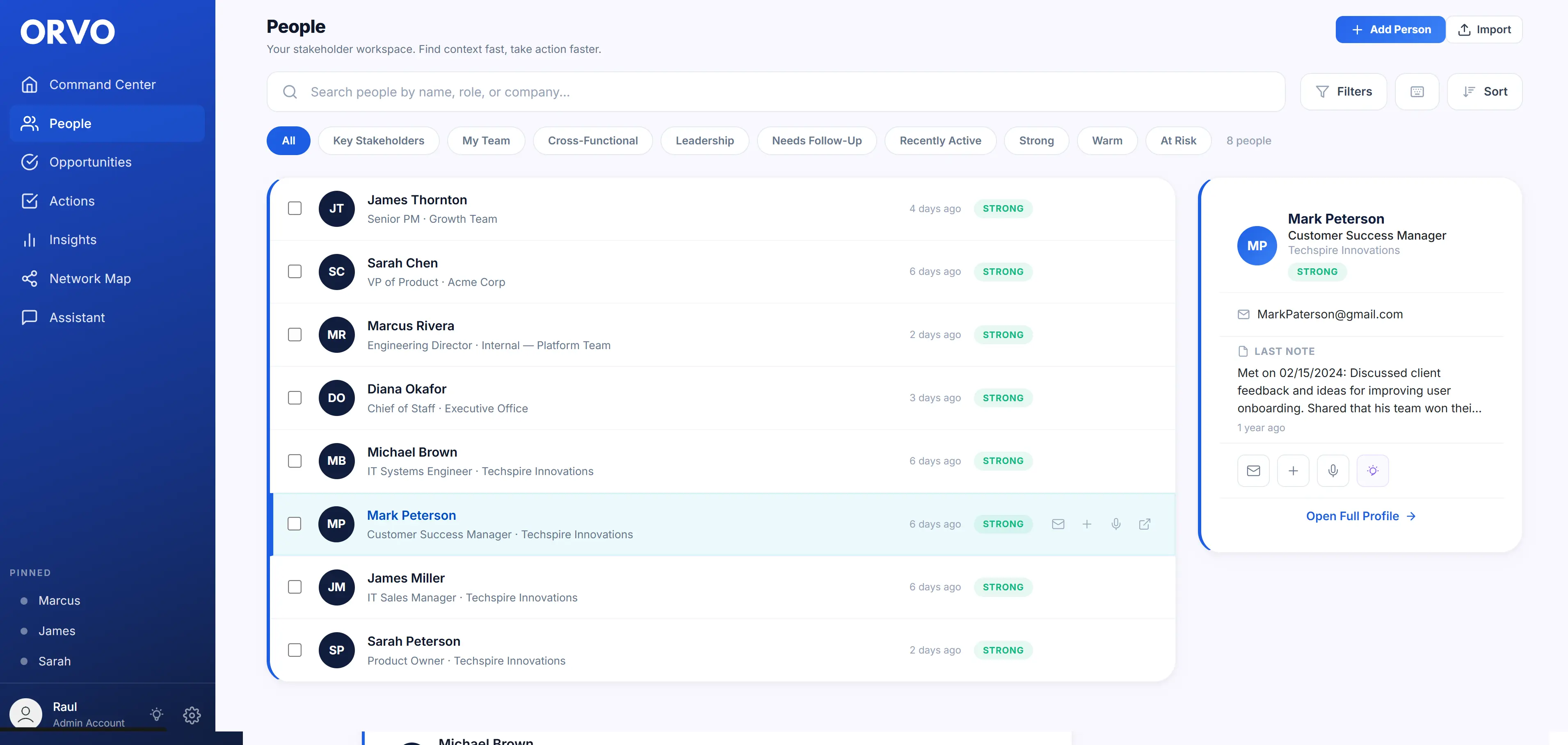
4. Visual network and stakeholder mapping. Understanding the structure of your relationships — who connects to whom, reporting lines, influence flows — is critical for anyone navigating an organisation. The best tools visualise this as an interactive map, not just a flat list.
5. AI-powered relationship intelligence. In 2026, this is the table-stakes differentiator. AI that analyses your interaction patterns, scores relationship health, prepares meeting briefs, and coaches you on stakeholder dynamics. Forrester predicts that by 2027, 65% of CRM interactions will be augmented by AI.
6. Voice notes with transcription. The fastest way to capture context after a meeting is speaking, not typing. The best personal CRMs let you record a voice note and automatically transcribe it, associate it with the right contact, and make it searchable.
7. Export and sharing capabilities. Your relationship intelligence should not be locked inside the app. The ability to export contact briefs as PDF, share stakeholder maps with your team, and generate org charts turns personal data into professional assets.
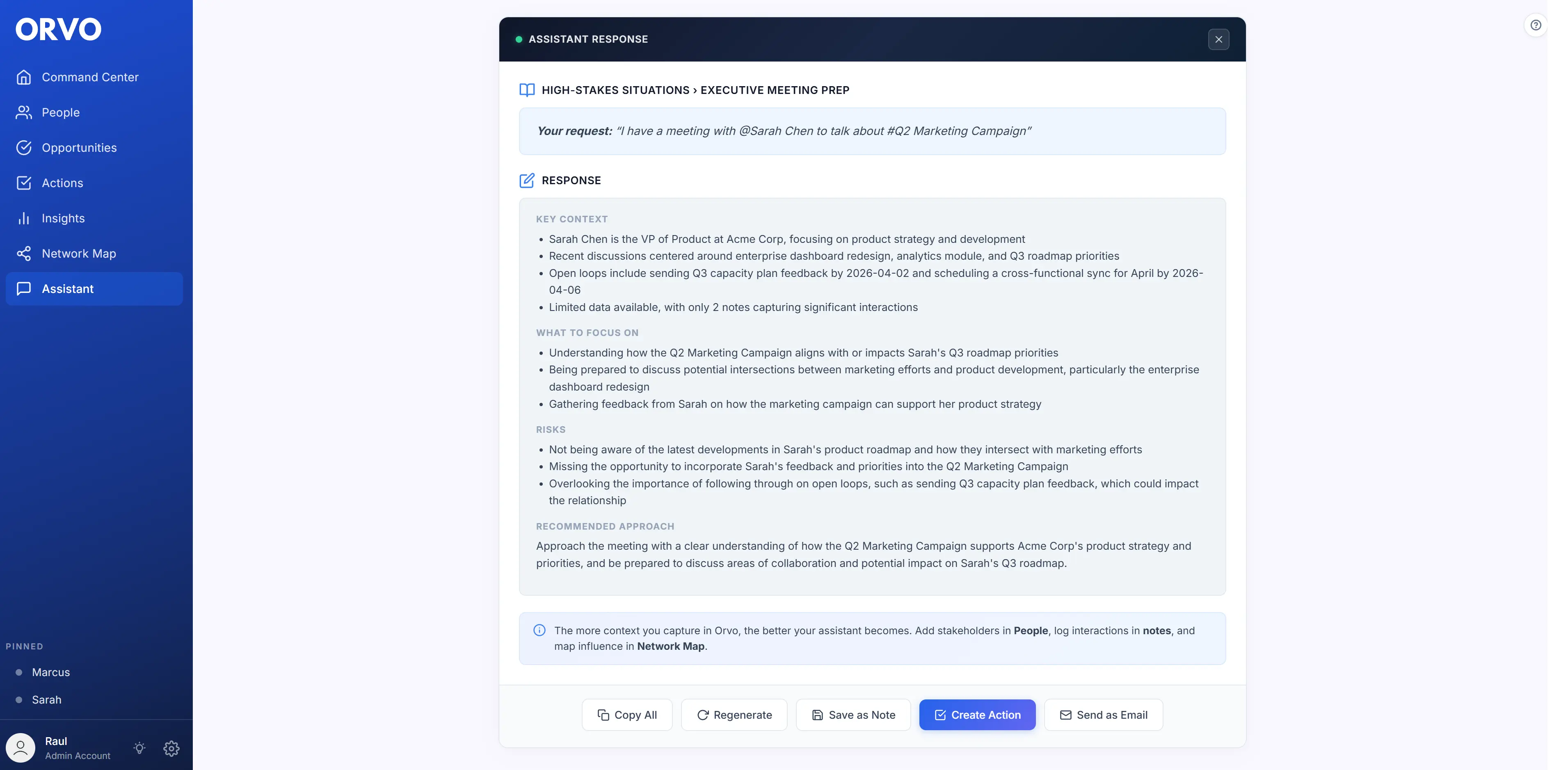
Orvo includes all 7 features out of the box starting at $19/month → Try it free
How the best personal CRMs compare in 2026
The personal CRM market has several credible players, each with a distinct approach. Here is an honest comparison of the tools that matter.
Orvo — The most complete personal CRM for career-focused professionals. It is the only tool that combines relationship tracking, AI-powered career intelligence (four specialised modules), visual stakeholder mapping, voice note transcription, and PDF export. Built for individuals navigating complex professional landscapes — managers, consultants, founders, and anyone who needs to track more than just contact details. Starts at $19/month with unlimited contacts and full AI.
Folk — A team-oriented CRM that works well for small agencies and sales teams. Strong on email sequences and pipeline management, but lacks AI career coaching, stakeholder mapping, and voice notes. Better suited for teams than individuals. Starts at $20/user/month.
Dex — A LinkedIn-centric contact organiser with a clean interface. Good for keeping your Rolodex tidy and setting basic reminders. Limited AI capabilities and no stakeholder intelligence. Best for light personal contact management. Free tier available, paid plans from $12/month.
Monica — An open-source, self-hosted personal CRM for the privacy-conscious. Free to run on your own server but requires technical setup. No AI, no mobile app, no contact sync. Best for developers who want full control over their data.
Notion/Airtable CRM templates — DIY solutions that are free and flexible but require significant setup and maintenance. No automation, no AI, no sync. They work until your contact list exceeds 50 people, at which point they become an administrative burden rather than a productivity tool.
| Feature | Orvo | Folk | Dex | Monica | Notion/Airtable DIY |
|---|---|---|---|---|---|
| Contact sync (Google, Outlook, WhatsApp) | ✓ | ✓ (partial) | ✓ (LinkedIn-centric) | ✗ | ✗ |
| AI relationship intelligence | ✓ (4 modules) | ✗ | Limited | ✗ | ✗ |
| Stakeholder / network map | ✓ | ✗ | ✗ | ✗ | ✗ |
| Voice notes + transcription | ✓ | ✗ | ✗ | ✗ | ✗ |
| Career coaching AI | ✓ | ✗ | ✗ | ✗ | ✗ |
| Export contact briefs (PDF) | ✓ | ✗ | ✗ | ✗ | ✗ |
| Follow-up reminders | ✓ | ✓ | ✓ | ✓ | ✗ (manual) |
| Chrome extension | ✓ | ✓ | ✓ | ✗ | ✗ |
| Price from | $19/mo | $20/user/mo | Free–$12/mo | Free (self-host) | Free |
| Best for | Career builders | Sales teams | LinkedIn users | Developers | Tiny networks |
See detailed head-to-head comparisons: Orvo vs Folk, Orvo vs Dex, Orvo vs Notion, and more →
Start Free TrialHow career builders actually use a personal CRM
Abstract feature lists do not capture the real value. Here is how professionals use a personal CRM in their day-to-day work.
Before a meeting: You have a 1-on-1 with your skip-level in 30 minutes. Instead of scrambling through old emails and Slack messages, you open Orvo and see your complete history — what you discussed last time, what you committed to, their current priorities, and AI-suggested talking points. You walk in prepared, not winging it.
After a conference: You met 12 people at an industry event. You record voice notes on your phone for each one — their name, what they do, what you discussed, and any follow-up promised. Orvo transcribes the notes, creates the contacts, and sets follow-up reminders. Two weeks later, you have sent personalised follow-ups to all 12 instead of the usual 2-3.
During a promotion campaign: You are building your case for promotion over 6 months. You use Orvo's Network Map to identify the 8 stakeholders who will influence the decision. You track your interactions with each one, ensure you are engaging at the right frequency, and use the AI career navigation module to prepare for the promotion conversation with your manager.
Managing client relationships: As a consultant with 15 active and 40 past clients, you use Orvo to maintain all relationships — not just the active ones. When a past client's company announces a new initiative in their RSS feed, Orvo surfaces it. You send a congratulatory note. Six months later, they bring you in for the next engagement.
Preparing for a board meeting: You export Contact Briefs as PDF for each board member — a formatted one-pager with their background, your interaction history, their priorities, and AI-generated talking points. You walk into the boardroom with more preparation than anyone else at the table.
The personal CRM is evolving into something bigger
The term "personal CRM" is already becoming insufficient for what the best tools in this category actually do. Managing contacts is where these tools start, but it is not where they end.
The next evolution — already underway — is from personal CRM to relationship intelligence platform. Instead of simply storing and organising your contacts, these platforms actively help you understand, navigate, and leverage your professional relationships. They do not just remember who you know — they help you make better decisions about those relationships.
This evolution mirrors what happened in the enterprise space. Salesforce started as a contact database and evolved into a business intelligence platform. The same trajectory is happening for individual professionals, but with AI accelerating the timeline from decades to years.
The practical implication: when evaluating a personal CRM today, do not just look at what it does now. Consider the trajectory. Is the tool investing in AI? Does it offer stakeholder intelligence, not just contact storage? Can it help you navigate career decisions, not just remind you to follow up? The tools that will dominate this category in 2-3 years are the ones building relationship intelligence today.
Orvo is built on this thesis. It started as a personal CRM but was redesigned from the ground up as a relationship intelligence platform — with AI-powered career navigation, stakeholder influence coaching, working style analysis, and meeting preparation that draws on your actual relationship data. The contact management features are the foundation, but the intelligence layer is what delivers the real value.
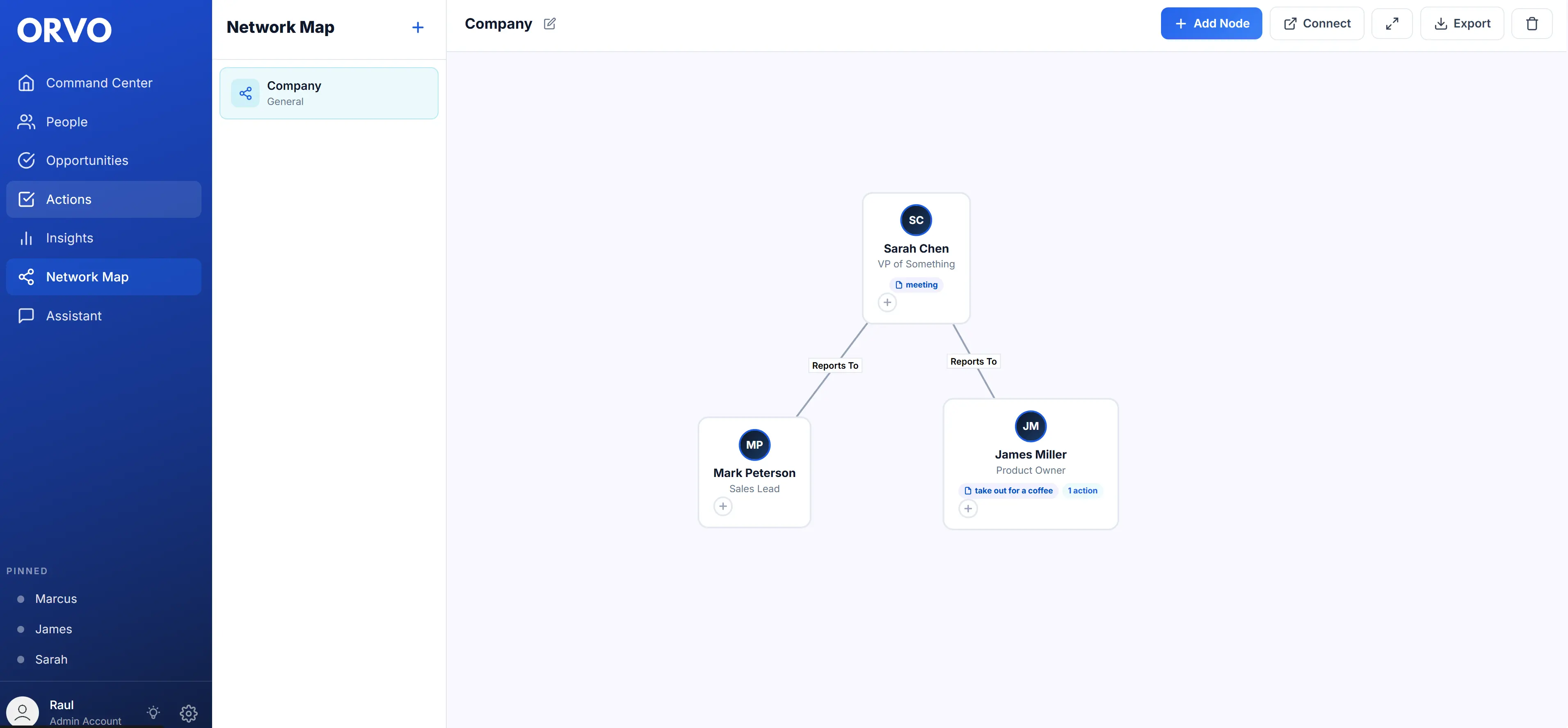
The personal CRM has evolved. See what relationship intelligence looks like — try Orvo free.
Get Orvo Free要点まとめ
- ✓ A personal CRM helps individuals manage professional relationships — it is built for your career, not a sales pipeline
- ✓ The personal CRM market reached $2.48 billion in 2024 and is growing at 10.6% annually
- ✓ Business CRMs (Salesforce, HubSpot) are the wrong tool for personal use — adoption drops below 30% when the tool does not match the workflow
- ✓ The 7 essential features in 2026: contact sync, per-person notes, follow-up reminders, network mapping, AI intelligence, voice notes, and export
- ✓ Orvo is the most complete personal CRM for career builders — the only tool with AI career coaching, stakeholder mapping, and PDF export
- ✓ The category is evolving from "personal CRM" to "relationship intelligence platform" — choose a tool that is building toward the future