
The Midcareer Networking Paradox
The professionals who need networking least are the ones who need it most. By 40, you have accumulated deep expertise, a track record of results, and relationships across multiple companies and industries. You have more career capital than at any previous point in your life.
But you are also facing challenges that 25-year-olds never think about:
Your network has gone dormant. You have worked with hundreds of people over 15-20 years, but you have not talked to most of them in years. Those connections — former managers, colleagues, clients — represent enormous potential value that is going to waste.
Your time is more constrained. Family obligations, senior-level responsibilities, and the simple reality of having less energy mean you cannot attend every happy hour. Traditional networking advice does not account for this.
The landscape has shifted. The people you need to know are different than 10 years ago. Your industry may have changed. New power players have emerged. If your network reflects the landscape of 2016, it is not serving you in 2026.
Age bias is real — and networking neutralizes it. A 2025 AARP study found that 78% of workers over 40 have experienced or witnessed age discrimination. But the same study found that candidates referred by trusted connections were 4x less likely to experience age-based screening. Your network is your best defense against bias.
The good news? You are starting from a position of strength. You do not need to build a network from scratch — you need to reactivate and reshape the one you already have.
The 3 Network Layers Every Senior Professional Needs
At this stage of your career, you need three distinct network layers, each serving a different purpose:
Layer 1: The Inner Circle (5-8 people) These are your trusted advisors — the people you call when you are considering a major career move, dealing with a political crisis, or need honest feedback. They know your strengths, your weaknesses, and your goals. Most professionals over 40 have 2-3 of these naturally but need 5-8 for true career resilience.
How to identify: Who would you call at 10 PM about a career emergency? Who gives you feedback you do not want to hear but need to? Who has your back in rooms you are not in?
Layer 2: The Strategic Network (15-25 people) These are the relationships that drive opportunities: current and former managers, industry peers, cross-functional partners, and people in adjacent fields. They do not need to be close friends — they need to know your work and respect your expertise.
How to identify: Who controls access to opportunities you want? Who would you reach out to if you were exploring a new role? Whose endorsement would carry weight in your industry?
Layer 3: The Dormant Network (50-200 people) This is your goldmine. Former colleagues, past clients, conference connections, alumni — people who knew your work but have not heard from you in years. Research from Wharton professor Adam Grant shows that dormant ties (people you have not contacted in 3+ years) are often MORE valuable than active ties for generating new opportunities, because they have access to different information and networks than your current circle.
| Layer | Size | Contact Frequency | Purpose | Action |
|---|---|---|---|---|
| Inner Circle | 5-8 | Weekly/biweekly | Trusted advice, honest feedback, career crises | Deepen — schedule regular dinners/calls |
| Strategic Network | 15-25 | Monthly | Opportunities, referrals, industry intelligence | Maintain — systematic touchpoints via Orvo |
| Dormant Network | 50-200 | Reactivate selectively | Fresh perspectives, new opportunities, bridge to new networks | Reactivate — reach out to 2-3 per month |
How to Reactivate a Dormant Network (Without Being Awkward)
The biggest fear professionals over 40 have about networking is reaching out to people they have not talked to in years. "Won't it be weird?" No — research shows it is far less awkward than you think, and the payoff is enormous.
A study published in *Organizational Behavior and Human Decision Processes* found that 82% of people responded positively to reconnection attempts from dormant ties. People are flattered, not annoyed, when a former colleague reaches out.
Here is the 4-step reactivation framework:
Step 1: Audit Your History Go through your LinkedIn connections, email contacts, and memory. List everyone you have worked with meaningfully over the past 15-20 years. Import them into your relationship tracker (Orvo can sync with LinkedIn, Google Contacts, and email). You will be surprised how many people you have "forgotten."
Step 2: Categorize and Prioritize Not every dormant connection is worth reactivating. Prioritize people who are in industries or roles relevant to your current goals, who you genuinely liked working with, and who have risen to positions of influence. Tag them in your relationship tracker.
Step 3: The Warm Reactivation Message The best reactivation messages have three elements: a specific shared memory, a genuine compliment on something recent, and a low-pressure invitation. Example:
"Hi [Name], I was just thinking about the [specific project] we worked on at [company] — your approach to [specific thing] still influences how I think about [topic]. I noticed you are now leading [their current role/project] — that is impressive. Would love to catch up over coffee if you are open to it. No agenda, just reconnecting."
Step 4: Systematic Follow-Through Reactivate 2-3 dormant connections per month. Log every interaction. Set follow-up reminders. The goal is not a single conversation — it is bringing these relationships back to active status in your strategic network.
The Tool Stack for Senior Professional Networking
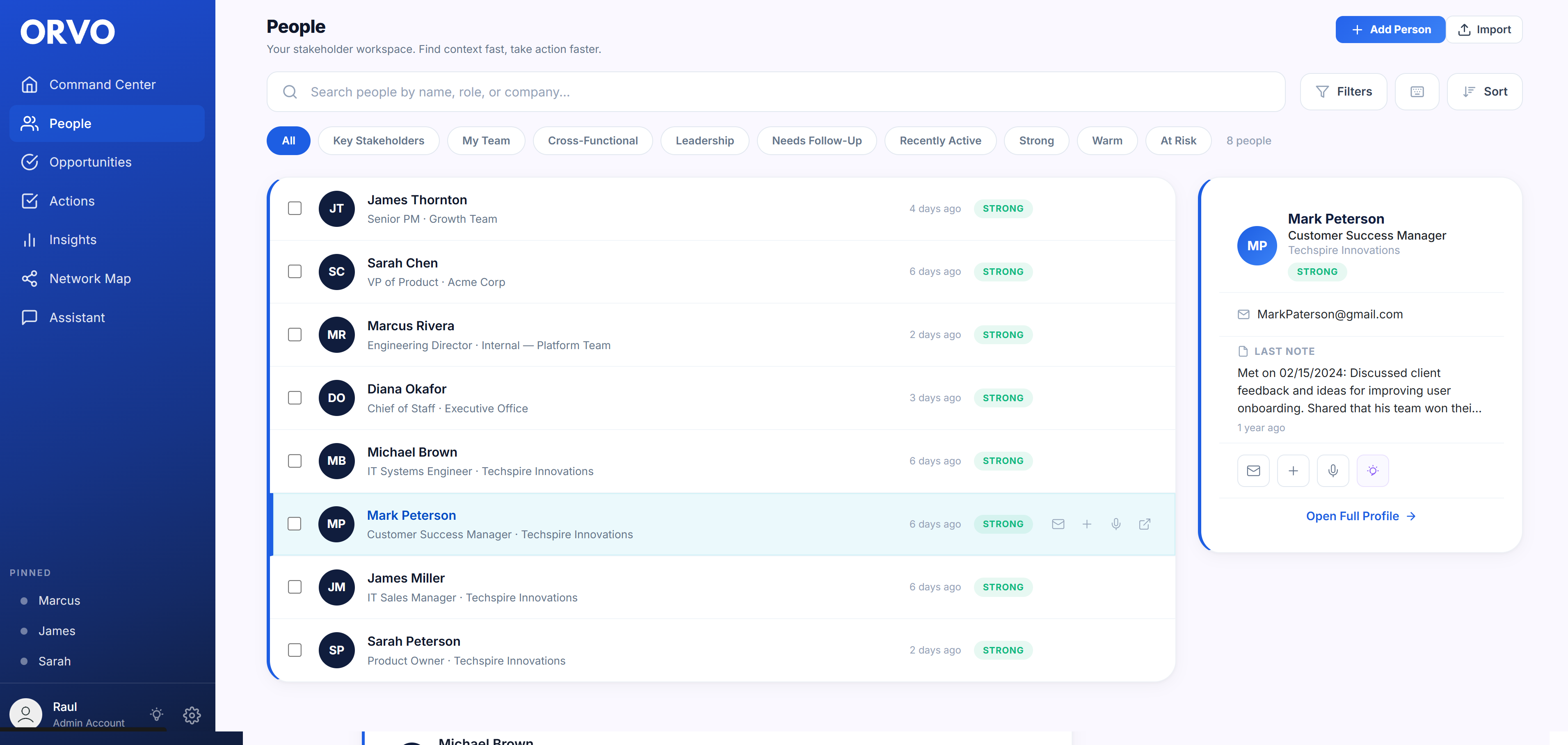
At this career stage, you need tools that respect your time and work with the network you already have — not tools designed for people building from scratch.
| Need | Tool | How It Serves Senior Professionals |
|---|---|---|
| Relationship management | Orvo | Track 100+ relationships across Inner Circle, Strategic, and Dormant layers. Set follow-up cadences, log conversations, prepare for meetings with full history |
| Network intelligence | LinkedIn + Orvo | LinkedIn for surface-level updates; Orvo for deep relationship context and stakeholder mapping |
| Meeting preparation | Orvo AI Assistant | Before a board meeting or executive 1-on-1, generate a brief with relationship history and talking points |
| Calendar management | Google Calendar | Block networking time like any other meeting — 2 hours per week, non-negotiable |
| Content strategy | Publish insights from your expertise to attract inbound connections (1-2 posts per month) |
The Monthly Networking System for Busy Senior Professionals
You do not have 10 hours a week for networking. You have maybe 2. Here is how to make those 2 hours count:
Week 1: Inner Circle Maintenance (30 min)
- One meaningful interaction with an Inner Circle member (call, dinner, or detailed message)
- Review and update notes from recent conversations
Week 2: Strategic Network Touchpoints (30 min)
- Send 3-4 personalized messages to Strategic Network contacts
- Share something valuable: an article, an introduction, a congratulations on a recent achievement
- Review Orvo for overdue follow-ups
Week 3: Dormant Network Reactivation (30 min)
- Reach out to 2-3 dormant connections using the warm reactivation framework
- Log responses and set follow-up reminders for those who engage
Week 4: Strategic Positioning (30 min)
- One LinkedIn post sharing a professional insight (position yourself as a thought leader)
- OR attend one targeted event (industry roundtable, executive dinner, advisory board)
Quarterly: Network Audit (60 min) Every 3 months, review your relationship tracker and ask:
- Are my 3 layers adequately staffed? (5-8 Inner Circle, 15-25 Strategic, active dormant pipeline)
- Has anyone in my Strategic Network risen to a position that moves them to Inner Circle potential?
- What new connections do I need to match my evolving career goals?
- Which dormant connections should I prioritize reactivating this quarter?
Manage your career network in 2 hours per week — track relationships, reactivate dormant ties, prepare for every meeting. Try Orvo free for 14 days →
Start Free TrialThe Future of Midcareer Networking in the AI Era
The AI revolution is reshaping career trajectories for professionals over 40 — and your network is your greatest adaptation tool.
As Sorin Ciornei wrote in *The Future is Now* (thereach.ai), the Curating Economy rewards professionals who can synthesize expertise, manage complex stakeholder relationships, and navigate ambiguity. These are skills that take decades to develop. Your 15-20 years of experience are not liabilities in the AI era — they are your greatest assets.
But you need a network that keeps you current. AI is changing industries faster than any individual can track alone. Your network is your early warning system: the colleague who warns you about a market shift, the mentee who explains a new technology, the former client who invites you into an adjacent industry.
The professionals who will thrive in their 40s, 50s, and beyond are not the ones with the most LinkedIn connections. They are the ones who have built genuine, reciprocal relationships with a curated network — and who maintain those relationships systematically.
AI tools are making this easier than ever. Relationship tracking, automated follow-up reminders, meeting preparation briefs, and stakeholder analysis can now be handled by software — freeing your time and energy for the human connection that no AI can replicate.
Your network is not just a career tool. At this stage of life, it is an insurance policy, a learning system, and a legacy. Invest accordingly.
Reactivate your network and build the relationships that fund your next decade. Try Orvo free for 14 days →
Get Orvo Free要点まとめ
- ✓ Your dormant network (people you have not contacted in 3+ years) is often more valuable than your active network for generating new opportunities.
- ✓ Build 3 layers: Inner Circle (5-8), Strategic Network (15-25), Dormant Network (50-200 to reactivate).
- ✓ Referred candidates over 40 are 4x less likely to face age-based screening — your network is your best defense.
- ✓ Reactivate 2-3 dormant connections per month using the warm reactivation framework.
- ✓ 2 hours per week is enough: Inner Circle, Strategic touchpoints, dormant reactivation, and positioning.
- ✓ Import your existing contacts into Orvo and classify them into 3 layers in 30 minutes.