
Why the "just quit" advice is wrong (and what to do instead)
Every career advice thread on the internet says the same thing: life is short, quit and find something better. This advice is emotionally satisfying and strategically disastrous for most people.
The reality: the average job search takes 3-6 months. In a competitive market, it can take longer. Quitting without a plan means you are searching from a position of weakness — financially stressed, explaining a gap, and making decisions under pressure. A Gallup study found that 85% of employees worldwide are disengaged or actively disengaged at work. If everyone who hated their job quit tomorrow, the global economy would collapse. Hating your job is normal. What you do about it is what separates strategic professionals from reactive ones.
The alternative is the Strategic Stay — a deliberate, time-bound plan to extract maximum career value from a bad situation while preparing your exit. This is not about staying forever. It is about staying smart.
A Strategic Stay typically lasts 3-9 months. During that time, you are doing three things simultaneously: stabilising your emotional state so the job does not destroy you, extracting every transferable relationship and skill from the situation, and building the external network and options that will fund your exit.
The professionals who execute this well leave bad jobs with better resumes, stronger networks, and multiple offers. The ones who rage-quit leave with a gap on their resume, depleted savings, and the pressure to take the first offer they get — which is often another bad job.
This is not about staying in a toxic situation indefinitely. If your job is damaging your physical or mental health, or involves ethical issues, the calculus changes. But for the majority of people who are unhappy at work — bad manager, boring work, no growth, political dysfunction — the Strategic Stay is the highest-return career move available.
Phase 1: Stabilise (weeks 1-2) — stop the emotional bleeding
Before you can think strategically, you need to stop the job from consuming you emotionally. Unhappiness at work has a way of bleeding into every part of your life — your evenings, your weekends, your relationships, your health. Phase 1 is about containment.
Set hard boundaries on work hours. If you have been working late because of guilt or pressure, stop. Do your contracted hours and protect your evenings and weekends. The job you hate does not deserve your best energy — your future career does. This is not quiet quitting. It is energy reallocation.
Identify your one anchor. Find one thing at work that does not drain you. Maybe it is a colleague you genuinely like. Maybe it is a skill you are developing. Maybe it is a project that is actually interesting. This anchor gives you a reason to show up that is not just "I need the paycheck." It makes the Strategic Stay sustainable.
Start a private journal. Every evening, write three things: one thing that went well today, one thing you learned, and one thing you are grateful for (even if it is small). This is not toxic positivity — it is cognitive reframing. Research from the University of Pennsylvania shows that gratitude journaling reduces workplace burnout by 28% over 8 weeks. You are not pretending the job is good. You are training your brain to notice the value you are extracting from it.
Tell one person. Not your manager. A trusted friend, partner, or mentor outside work. Say: "I am unhappy at work and I am building a plan to leave. I need someone to talk to about it." Having one person who knows your situation reduces the emotional isolation that makes bad jobs feel unbearable.
Reframe the narrative. You are not "stuck in a job you hate." You are "executing a strategic stay to maximise your exit position." This is not just semantics. How you frame your situation to yourself determines whether you feel like a victim or an agent. Victims endure. Agents extract value.
Phase 2: Extract (months 1-3) — pull maximum value from the situation
Here is the reframe that changes everything: your current job — even one you hate — contains career assets that your next employer will value. Your job is to identify and extract them before you leave.
Asset 1: Relationships. The people at your current company are your future network. Your manager might become a reference. Your peers might end up at companies you want to join. The VP you once presented to might remember you when they are hiring. Do not let your unhappiness with the role poison these relationships.
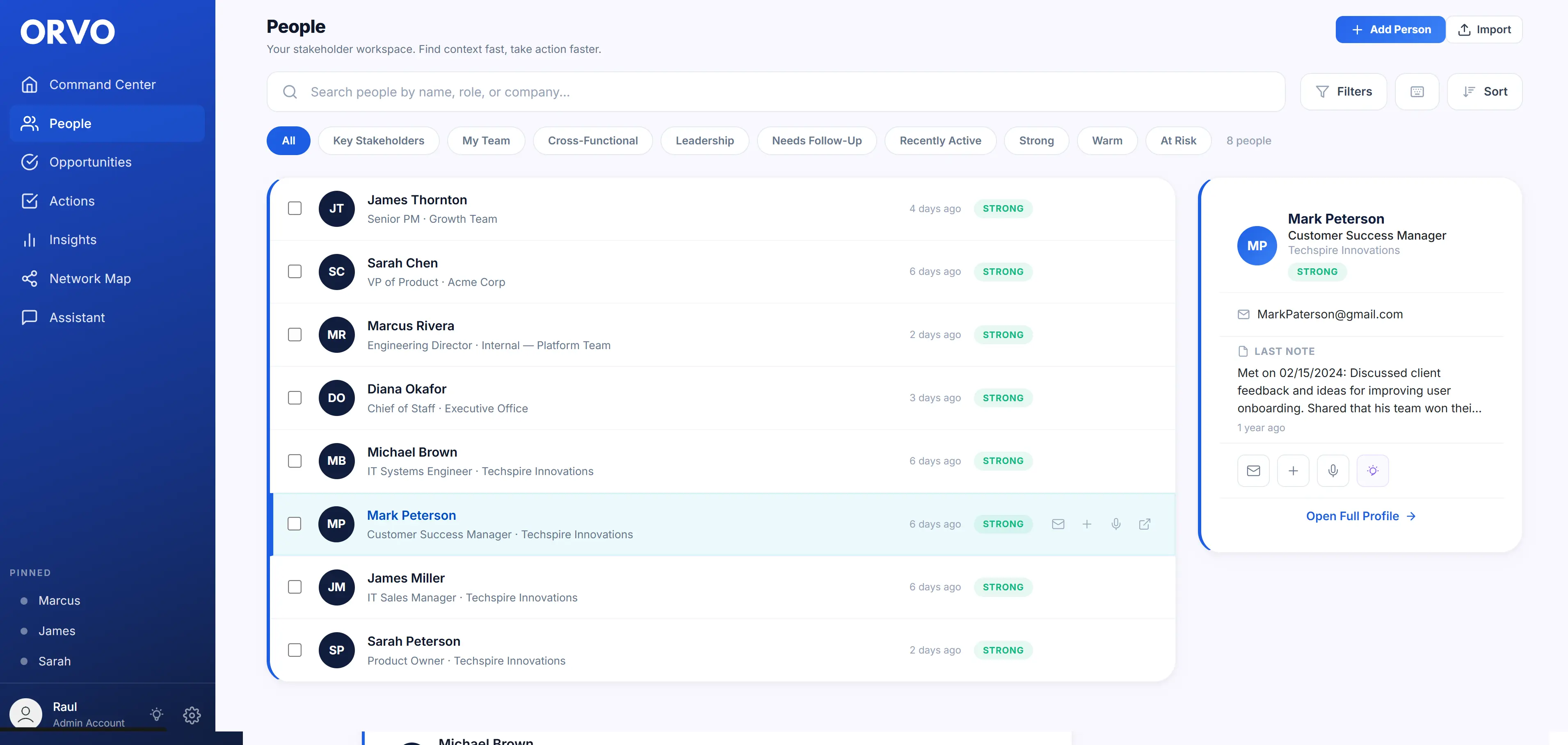
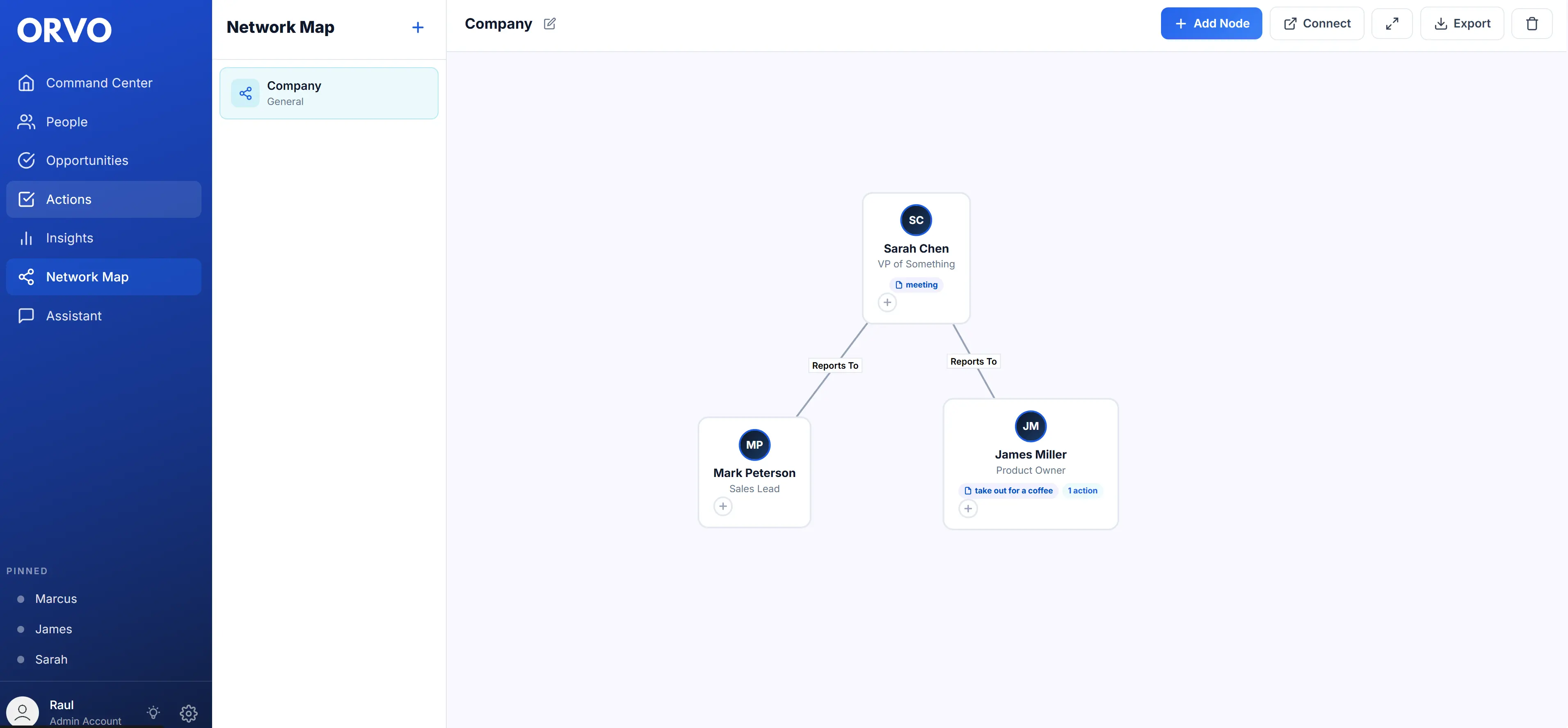
Make a list of 10-15 people at your current company worth maintaining a relationship with after you leave. These are people you respect, people who do interesting work, people in positions of influence, and people who are likely to move to other companies. Start investing in these relationships now — have coffee, offer help, share knowledge. Log every interaction in Orvo so you have a record of the relationship when you need it later.
Asset 2: Skills. What skills can you develop in the next 3-6 months that will make you more valuable in your next role? Is there a project you could volunteer for? A cross-functional initiative? A new tool or technology your company is adopting? Your current employer is paying you to learn. Take full advantage.
The best skill investments are the ones that are valuable in your current role AND your next one. If you are in marketing but want to move to product management, volunteer for a cross-functional project that gives you exposure to product work. If you are in engineering but want to move into leadership, take on mentoring or project coordination responsibilities.
Asset 3: Achievements. Document every measurable achievement while you are still in the role. Revenue generated, costs saved, processes improved, projects delivered, team members mentored. You will need these for your resume, your LinkedIn profile, and your interview stories. Most people try to reconstruct their achievements months after leaving and forget the specific numbers. Document them now, while the data is accessible.
Asset 4: Market intelligence. Your current company gives you a front-row seat to an industry. What trends are emerging? What problems are companies struggling with? What skills are in demand? This intelligence is valuable in interviews — it shows you are strategic and market-aware, not just looking to escape a bad situation.
Use Orvo to track all of this systematically — the relationships you are building, the skills you are developing, the achievements you are documenting. When it is time to leave, you will have a complete portfolio of career assets instead of vague memories.
| Career Asset | What to Extract | How to Track It | Why It Matters for Your Exit |
|---|---|---|---|
| Relationships | 10-15 people worth maintaining post-exit | Log in Orvo with context and follow-up reminders | Future references, introductions, and job leads |
| Skills | Cross-functional experience, new tools, leadership exposure | Document in a personal skills inventory | Makes you more competitive in your next role |
| Achievements | Revenue, cost savings, project outcomes, team impact | Track with specific numbers while data is accessible | Resume ammunition and interview stories |
| Market Intelligence | Industry trends, competitive landscape, emerging needs | Keep a running notes document | Shows strategic thinking in interviews |
Phase 3: Position (months 2-6) — build your exit runway
While you are extracting value internally, you should be building your external exit runway in parallel. The goal: by the time you are ready to leave, you should have multiple options, not a desperate scramble.
Activate your external network. Reach out to former colleagues, university contacts, industry connections, and anyone who might know about opportunities. Do not lead with "I am looking for a job." Lead with curiosity: "I am thinking about what is next for my career and would love to hear about what you are working on." This is warmer, more genuine, and more likely to produce useful conversations.
Aim for 2-3 external conversations per week. Not interviews — conversations. Coffee chats, phone calls, LinkedIn messages. The goal is to understand what is out there, who is hiring, and what skills are in demand. These conversations often lead to opportunities that are never posted publicly.
Update your professional presence. Refresh your LinkedIn profile — but do it gradually, not all at once (sudden LinkedIn updates signal to your current employer that you are looking). Update your headline, add recent achievements, and start posting or commenting on industry content. This builds visibility without setting off alarms.
Have exploratory conversations with recruiters. Reach out to 2-3 recruiters who specialise in your industry or function. Be honest: "I am not actively looking yet, but I am exploring what is available in the next 3-6 months. What are you seeing in the market?" Good recruiters appreciate this — it gives them time to find the right match instead of rushing.
Build your "exit story." Every interviewer will ask why you are leaving. Your answer needs to be honest, professional, and forward-looking. Never trash your current employer. The formula: "I have accomplished X and Y at my current company and I am now looking for an opportunity that offers Z" — where Z is something your current company genuinely cannot provide (growth, scope, industry, culture).
Set your exit criteria. Define exactly what would make you leave: a specific role, a minimum compensation, a particular type of company, or a geographic requirement. Without clear criteria, you will either stay too long (because nothing feels "right enough") or leave too early (because anything feels better than now). Write your criteria down and review them monthly.
Use Orvo as your exit command centre. Track every external conversation, every recruiter relationship, every warm lead. Note what each contact told you about the market, which companies are hiring, and what roles match your criteria. When you are ready to pull the trigger, your Orvo records give you a complete picture of your options — not a vague sense that "you had a few conversations a while back." The professionals who exit best are the ones who treated their exit like a project: systematic, tracked, and intentional.
The financial preparation. Start building a financial runway as soon as you decide to execute a Strategic Stay. Reduce discretionary spending. Build an emergency fund that covers 3 months of expenses. This is not about quitting immediately — it is about having the freedom to say no to a bad offer. The professional with 3 months of savings negotiates differently from the one who needs next month's rent. Financial pressure forces bad career decisions.
When the job is actually toxic (not just boring)
There is an important distinction between a job you hate and a job that is toxic. The Strategic Stay is designed for jobs you hate — bad manager, boring work, no growth, political dysfunction, cultural misalignment. These are uncomfortable but survivable. A toxic job is different. It involves behaviour that actively damages your wellbeing, and the calculus changes.
Signs the job is toxic, not just bad:
- Your manager publicly humiliates you or takes credit for your work consistently
- You are being gaslit about your performance — told you are failing despite objective evidence of success
- The company asks you to do things that are unethical or illegal
- You are experiencing discrimination, harassment, or bullying
- Your physical health is deteriorating — insomnia, panic attacks, chronic stress symptoms that persist on weekends and holidays
- You have been isolated from colleagues or excluded from meetings as a form of punishment
If any of these apply, the Strategic Stay should be compressed. You still extract assets (relationships, skills, achievements, documentation), but you prioritise speed over completeness. A 4-6 month strategic stay becomes a 4-6 week exit sprint.
Document everything. In a toxic environment, documentation is your protection. Save emails. Screenshot messages. Note dates, times, and witnesses for incidents. Keep this documentation outside company systems — on personal devices or cloud storage. If you ever need to involve HR, legal, or a future employer, contemporaneous documentation is the difference between a credible claim and a he-said-she-said.
Build your external support. A toxic job erodes your self-confidence. You start to believe the negative narrative the environment creates about you. Counteract this by maintaining strong relationships outside the company — people who can remind you of your actual capabilities and worth. A mentor, a former manager who valued you, a friend in the same industry.
Know your rights. If you are experiencing discrimination, harassment, or retaliation, you have legal protections. Document the behaviour, consult an employment attorney (many offer free initial consultations), and understand your options before you resign. In some cases, leaving quietly is the right move. In others, formal complaints protect both you and future employees.
The financial safety net. If possible, build a 3-month emergency fund before leaving a toxic job. If that is not possible, consider whether the health cost of staying exceeds the financial cost of leaving. Medical bills from stress-related illness, therapy costs, and career damage from prolonged toxicity often exceed the cost of a few months between jobs.
The Strategic Stay is a tool for maximising your exit position. But no career strategy is worth your health, your integrity, or your dignity. If the job is truly toxic, the best strategy is the fastest safe exit you can manage.
The quiet quitting trap (and why it ruins your exit)
When you hate your job, the temptation to do the bare minimum is overwhelming. Quiet quitting — showing up physically but checking out mentally — feels like a rational response to an irrational situation. It is actually the worst strategic move you can make.
Here is why: the last 6 months at a job disproportionately shape how people remember you. Recency bias is powerful. Your manager, peers, and senior leaders will remember how you showed up at the end — not the two great years before it. If you coast, that becomes your reputation. And your reputation follows you.
Your manager writes your reference. Your colleagues become your future network. The VP who sees you phoning it in might be the hiring manager at your dream company in two years. The professional world is smaller than you think, especially within industries.
The alternative is not grinding yourself into the ground for a job you hate. It is strategic effort allocation:
Do solid work in fewer hours. Use AI tools, better processes, and clear prioritisation to produce good output without overextending. You are not trying to win Employee of the Year. You are trying to maintain a reputation for reliability.
Redirect your energy, not your effort. Instead of putting extra energy into work that drains you, redirect it toward relationship building, skill development, and your exit strategy. Your total effort level stays the same — the allocation shifts.
Choose one visible project. Find one initiative that you can own and execute well during your Strategic Stay. Something with visible results. This becomes your "closing story" — the thing people remember about your last months. It also gives you fresh material for interviews.
Be genuinely helpful to others. Help a colleague with a problem. Mentor a junior team member. Share knowledge generously. These small acts of generosity build goodwill that outlasts your tenure. The colleague you helped becomes the person who refers you to their next company.
The irony of the Strategic Stay: by investing in relationships and doing solid (not heroic) work during a period when you would rather be anywhere else, you create the exact conditions that make leaving easy — strong references, warm network, and a professional reputation that opens doors.
The Strategic Stay in action: what it looks like week by week
Abstract frameworks are useful. Here is what a Strategic Stay actually looks like in practice, week by week.
Week 1-2: Stabilise. You set boundaries on work hours. You identify your one anchor — the colleague you genuinely enjoy working with. You start your private journal. You tell your partner what you are doing and why. You reframe: you are not stuck. You are executing a plan.
Week 3-4: Audit. You make your list of 10-15 relationships worth maintaining. You identify 3 transferable skills to develop. You start documenting achievements with specific numbers. You begin logging key interactions in Orvo.
Month 2: Build internally. You volunteer for one cross-functional project that develops a skill for your next role. You have coffee with two senior people you have not engaged with before. You deliver solid work — not heroic, but reliable. You are building assets, not burning energy.
Month 3: Build externally. You start 2-3 external conversations per week. You update your LinkedIn gradually. You reach out to one recruiter. You refine your exit story. You check your exit criteria monthly.
Month 4-6: Position. Your external conversations are producing warm leads. Your relationship portfolio is documented and active. Your skill development is visible. You have a clear exit story. You start applying to specific roles that match your criteria.
Exit. You leave with multiple options, strong references, and a narrative that positions your move as strategic growth, not escape. Your Orvo records ensure you maintain every relationship from your current company — because the colleague who was kind during a bad period often becomes the person who refers you to your best opportunity three years later.
| Phase | Timeline | Focus | Key Actions |
|---|---|---|---|
| Stabilise | Weeks 1-2 | Emotional containment | Set boundaries, find anchor, start journal, tell one person |
| Audit | Weeks 3-4 | Asset identification | Map relationships, identify skills, document achievements |
| Build (Internal) | Month 2 | Value extraction | Cross-functional project, senior relationships, reliable delivery |
| Build (External) | Month 3 | Exit runway | 2-3 external conversations/week, update LinkedIn, contact recruiter |
| Position | Months 4-6 | Exit preparation | Apply to matching roles, refine story, activate network |
| Exit | When criteria met | Strategic departure | Leave with options, references, and relationships intact |
How to know when it is time to leave (the decision framework)
The Strategic Stay is not meant to last forever. It is a defined phase with a clear exit point. Here is how to know when it is time to stop staying and start leaving.
Leave when you have options, not when you hit bottom. The worst time to leave a job is when you have reached maximum misery and have no alternatives. The best time is when your Strategic Stay has produced results: you have built external relationships, developed new skills, and have at least 2-3 real opportunities (or warm conversations) in progress.
Leave when the extraction is complete. If you have documented your achievements, built the relationships worth maintaining, learned the skills available to you, and gathered market intelligence — there is nothing left to extract. Staying beyond this point is pure endurance, not strategy.
Leave when the cost exceeds the benefit. Monitor your physical and mental health. If the job is causing sleep problems, anxiety, relationship strain, or health issues, the cost of staying is too high regardless of strategic value. No career advantage is worth your health.
Leave when you have your exit story. Can you explain your departure in a way that is honest, professional, and forward-looking? If yes, you are ready. If your only answer is "I hate my boss," stay a little longer and develop a better narrative.
Do NOT leave because of a single bad day. Bad days happen everywhere. The worst career decisions are made on Friday afternoon after a terrible week. If you are tempted to rage-quit, give yourself a 48-hour cooling period before taking any action.
Use this decision matrix to evaluate monthly:
| Signal | Stay (Strategic Stay continues) | Leave (Exit window open) |
|---|---|---|
| External options | Fewer than 2 conversations in progress | 2+ real opportunities or offers in hand |
| Skill extraction | Still learning or developing transferable skills | No new skills available — plateau reached |
| Relationship building | Key relationships still need investment | Network is strong and documented |
| Health impact | Manageable with boundaries and self-care | Sleep, anxiety, or health deteriorating despite boundaries |
| Exit story | Cannot explain departure professionally yet | Clear, honest, forward-looking narrative ready |
| Financial runway | Would need to take first offer out of pressure | 3-6 months of savings or offer in hand |
Your Strategic Stay starts with tracking the relationships that will fund your exit. Orvo helps you build your career intelligence — log stakeholder interactions, set follow-up reminders, and never lose a professional connection. Start free →
Get Orvo Free要点まとめ
- ✓ Being stuck in a job you hate is temporary. How you use that time is what determines your next career move.
- ✓ The Strategic Stay has three phases: Stabilise (stop the emotional bleeding), Extract (pull maximum value from the situation), and Position (set up your exit from strength)
- ✓ Your current job — even one you hate — contains relationships, skills, and opportunities that your next employer will value. Extract them systematically.
- ✓ The biggest mistake is quiet quitting. It destroys the relationships and reputation you need for your next move.
- ✓ Build your external network NOW, while you are still employed. It is 10x harder to network from unemployment.
- ✓ Track every relationship, skill, and achievement during your strategic stay — this becomes the foundation of your exit strategy
- ✓ Leave from a position of strength: with offers in hand, relationships intact, and a story that positions your move as strategic, not reactive