
The INTJ superpower at work (and why it is not enough)
INTJs are systems thinkers. You see the architecture behind everything — organisational structures, market dynamics, product strategies, team interactions. While others are dealing with the immediate problem, you are already modelling the second and third-order effects. This is an extraordinary strategic advantage.
In roles that require analysis, planning, and complex problem-solving — strategy, product management, engineering, consulting, research — INTJs consistently outperform. A 2023 study by CPP (the publisher of the MBTI assessment) found that INTJs are overrepresented in senior strategic roles by a factor of 3x relative to their population share.
But here is the career paradox that frustrates every INTJ: the skills that make you excellent at your job are not the same skills that get you promoted. Promotions, influence, and leadership opportunities are not distributed based on who has the best analysis. They are distributed based on who has the strongest stakeholder relationships, the most visible impact, and the best communication with leadership.
INTJs typically underinvest in three areas that determine career advancement: relationship building (you prefer working alone and find small talk exhausting), self-promotion (you find it distasteful and assume your work speaks for itself), and political navigation (you view office politics as irrational and refuse to engage). Each of these creates a specific career ceiling that no amount of technical excellence can break through.
The good news: you do not need to become an extrovert. You do not need to play political games. You need to apply your strategic mind to relationships and visibility with the same rigour you apply to everything else. That is what this playbook teaches.
The INTJ blind spots that stall careers
Every INTJ has heard some version of these: "You are hard to read." "You need to build more relationships." "Your work is excellent but you need more executive presence." These are not personality flaws — they are communication gaps between how INTJs naturally operate and what corporate environments expect.
Blind spot 1: Assuming competence is visible. INTJs believe that excellent work speaks for itself. It does not. Research from the Center for Talent Innovation found that performance accounts for only 10% of career advancement. Image (how you are perceived) accounts for 30%. Exposure (who knows about your work) accounts for 60%. An INTJ who produces brilliant analysis but never presents it to leadership is invisible to the people who make promotion decisions.
Blind spot 2: Undervaluing small talk. For INTJs, small talk feels inefficient and inauthentic. But research consistently shows that casual interactions build the familiarity and trust that precede professional collaboration. The colleague who knows your weekend hobbies is more likely to support your initiative than the one who only knows your quarterly report. You do not need to become a social butterfly — you need 2-3 minutes of genuine connection at the start of meetings.
Blind spot 3: Showing contempt for less strategic thinkers. INTJs process faster than most people and can be visibly impatient with colleagues who need more time. The eye-roll when someone asks a question you answered ten minutes ago. The visible frustration when a meeting goes in circles. These micro-expressions are career poison. People who feel judged by you will not support you — even when you are right.
Blind spot 4: Avoiding politics entirely. INTJs view office politics as irrational and beneath them. But politics is simply the management of influence and interests in groups. It is not irrational — it follows patterns and systems, exactly the kind of thing INTJs are good at analysing. Refusing to engage means refusing to navigate the system that determines your career trajectory.
Blind spot 5: Giving feedback too directly. INTJs value honesty and efficiency. "This approach will not work because X" is clear and logical. It is also experienced as dismissive and hostile by many colleagues. The INTJ who learns to say "I see the logic in this approach — can I share a concern about X that might strengthen it?" delivers the same message without the relationship damage.
Blind spot 6: Perfectionism that delays visibility. INTJs want to share work only when it is perfect. The problem: by the time you have refined your analysis to your satisfaction, the decision has already been made based on someone else's 80%-good-enough version. Learning to share early, imperfect drafts — and framing them as "initial thinking for your input" — is uncomfortable but strategically necessary. The INTJ who shares a rough framework in Tuesday's meeting shapes the conversation. The one who shares a perfect analysis on Friday is told "we already decided on Tuesday."
Blind spot 7: Dismissing emotional intelligence as weakness. INTJs often view emotional intelligence as a soft, optional skill. This is a strategic error. A 2024 TalentSmart study found that emotional intelligence accounts for 58% of job performance across all roles, and 90% of top performers score high in EQ. The INTJ who develops emotional intelligence does not become less analytical — they become more effective at deploying their analysis, because they can read the room, time their input, and frame their insights in ways that resonate with different audiences.
| INTJ Blind Spot | What You Think | What Others Experience | The Fix |
|---|---|---|---|
| Invisible competence | "My work speaks for itself" | "I don't know what they do" | Send monthly impact summaries to leadership |
| Avoiding small talk | "It's a waste of time" | "They're cold and unapproachable" | 2-3 minutes of genuine connection before meetings |
| Visible impatience | "Why can't they keep up?" | "They think I'm stupid" | Practice patience — people who feel respected support you |
| Avoiding politics | "It's irrational" | "They don't play the game" | Reframe: politics = stakeholder management = a system to master |
| Too-direct feedback | "I'm just being honest" | "That was harsh" | "I see the logic — can I share a concern that might strengthen it?" |
The INTJ relationship strategy: quality over quantity
INTJs do not need large networks. They need strategic ones. The good news: the INTJ approach to relationships — deep, selective, trust-based — is actually more valuable for career advancement than a large but shallow network. Research from Rob Cross at the University of Virginia found that professionals with 5-8 deep cross-functional relationships outperform those with 50+ superficial connections.
Here is the INTJ-specific relationship playbook:
1. Build your Strategic Five. Identify the 5 people who most influence your career trajectory: your direct manager, your skip-level leader, one cross-functional peer who is well-connected, one senior leader who sees your work, and one external mentor or industry contact. These five relationships are your career infrastructure. Invest in each one deliberately.
2. Schedule relationship maintenance. INTJs will not maintain relationships spontaneously — it is not natural for you. So systematise it. Monthly 1-on-1 with your manager (if not already scheduled). Quarterly coffee with your skip-level. Bi-monthly check-in with your cross-functional peer. This is not networking — it is infrastructure maintenance.
3. Lead with your strategic value. INTJs are terrible at small talk but excellent at providing strategic insight. Use that. Your relationship currency is not charm — it is the ability to see patterns others miss. When you share a strategic insight with a senior leader ("I noticed a pattern in our Q2 data that suggests our enterprise segment is softening — we might want to discuss mitigation"), you are building a relationship based on value. That is authentic and sustainable.
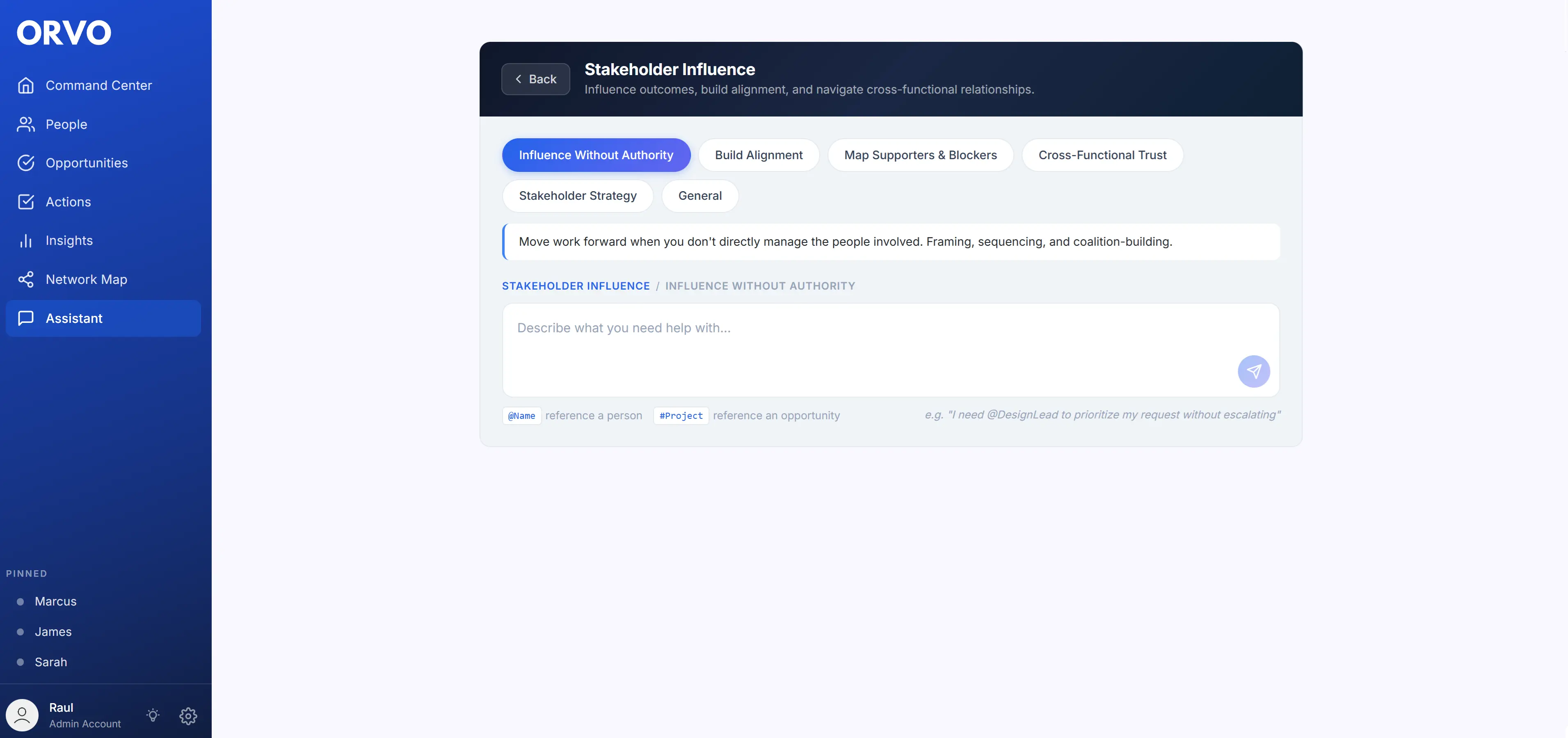
4. Track relationships like systems. INTJs love systems. Apply your systems thinking to relationships. Use Orvo to track your Strategic Five: when you last met, what you discussed, what they care about, and what follow-up is needed. Review before every interaction. This turns relationship management from an uncomfortable social exercise into a structured system — which is how INTJs operate best.
5. Practise the 2-minute warm-up. Before every meeting, spend 2 minutes on genuine human connection. Ask about a project they mentioned last time. Comment on something they posted on LinkedIn. Ask how their weekend was. You do not need to sustain 20 minutes of small talk. You need 2 minutes of warmth before you shift to the strategic content you are comfortable with. This small investment changes how people experience you dramatically.
6. Create recurring relationship rituals. INTJs do not maintain relationships spontaneously — and that is fine. Create structures instead. A monthly stakeholder review where you look at your Strategic Five and assess each relationship. A quarterly "reconnection week" where you reach out to 5-10 dormant contacts with a genuine message. A pre-meeting ritual where you spend 3 minutes reviewing the person's Orvo profile before walking in. These rituals remove the need for spontaneous relationship maintenance (which INTJs will never do consistently) and replace it with systematic relationship investment (which INTJs are excellent at).
7. The INTJ relationship ROI framework. Think about relationships the way you think about investments. Not every relationship requires the same level of investment. Your Strategic Five get weekly attention. Your extended stakeholder network (15-20 people) gets monthly attention. Your broader professional network (50-100 people) gets quarterly attention. This tiered approach prevents the INTJ trap of either over-investing in 2-3 relationships or neglecting all of them. Track the tiers in Orvo and review monthly.
Why this matters more than you think: A 2024 study from MIT Sloan found that the single strongest predictor of career advancement for analytical professionals (the INTJ archetype) was not IQ, technical skill, or work output — it was the diversity of their professional network. Analytical professionals with relationships spanning 3+ organisational functions advanced 2.1x faster than those whose networks were concentrated in their own department. For INTJs, building cross-functional relationships is not optional — it is the single highest-leverage career investment they can make.
Visibility without self-promotion: the INTJ approach
INTJs find self-promotion distasteful. "I should not have to tell people I am good — my work should show it." This is an admirable value. It is also career suicide in any organisation larger than 20 people.
The fix is not to become a self-promoter. It is to make your impact visible through systems and structure.
The monthly impact summary. Every month, send your manager a brief email (3-5 bullet points) summarising what you delivered, the impact it had, and what you are working on next. Frame everything in terms of business outcomes. "Reduced customer churn in the enterprise segment by 8% through the retention model I built" not "Built a retention model." Your manager uses this in calibration meetings. You are not bragging — you are providing information.
The strategic insight drop. When you notice a pattern or risk others missed, share it proactively with a senior leader. "I have been looking at Q3 numbers and noticed our mid-market conversion is declining while enterprise is growing. This might affect resource allocation. Happy to share the analysis." This positions you as a strategic thinker without self-promotion.
Let others amplify your work. Find 1-2 colleagues who appreciate your contributions and will mention your work in meetings. The peer who says "the analysis from [your name] was crucial here" creates more visibility than any amount of self-promotion.
Volunteer for presentations. The hardest one for INTJs, but the highest ROI. Your analytical depth shines in leadership presentations. One strong presentation to the executive team creates more visibility than six months of excellent silent work.
Create a visibility cadence. INTJs will not self-promote spontaneously, so build it into your workflow. First Monday of every month: send the impact summary. When you complete a significant piece of work: share the key insight with one senior leader. When you spot a strategic risk or opportunity: surface it proactively. Each of these takes 10-15 minutes but cumulatively creates a reputation as someone who is strategic, proactive, and informed. After 6 months of this cadence, leadership will associate your name with strategic thinking — not because you told them you are strategic, but because you consistently demonstrated it.
The INTJ advantage in visibility. Here is the counterintuitive truth: INTJs who learn to share their thinking actually stand out MORE than extraverts who share constantly. Because INTJs share selectively, when they do speak up, people listen. The INTJ who sends a quarterly strategic memo to the leadership team — thoughtful, concise, insightful — creates more impact than the extravert who sends weekly updates that everyone skims. Quality over quantity applies to visibility too. Your natural inclination toward depth and precision is an advantage — you just need to actually share the output.
INTJ communication: how to be direct without being destructive
INTJs communicate to convey information efficiently. Most people communicate to build connection. This mismatch creates the majority of INTJ workplace friction.
The INTJ communication formula: Acknowledge → Concern → Solution.
Instead of: "This approach will not work." Try: "I see the logic in this approach [acknowledge]. My concern is that X might create a problem when we scale [concern]. What if we modified it to handle X? [solution]"
The content is identical. The delivery takes 10 extra seconds. The relationship impact is dramatically different.
In emails: Add one human sentence at the start. "Hope the Q3 push is going well" or "Thanks for the quick turnaround." This takes 5 seconds and prevents your email from feeling like a directive from a machine.
In meetings: Count to 3 before responding. INTJs process fast and respond immediately, which can feel dismissive. This tiny pause signals that you considered what was said.
With feeling-oriented colleagues: Lead with impact on people before presenting the logical analysis. "This change will help the team by reducing frustrating manual work" before "This reduces costs by 15%." Same recommendation, different entry point.
Tracking communication preferences per stakeholder is where Orvo becomes essential. Note which stakeholders respond to data, vision, or team impact. Review before every meeting.
| Situation | INTJ Default | More Effective Version | Why |
|---|---|---|---|
| Disagreeing | "This won't work" | "I see the logic — can I share a concern?" | Validates before challenging |
| Feedback | "Missing X and Y" | "Strong analysis. Two additions would strengthen it" | Opens with affirmation |
| Responding | [Instant response] | [3-second pause, then response] | Signals consideration |
| Emails | Dense, no greeting | One warm sentence, then content | Prevents "cold machine" perception |
| Presenting to F-types | Lead with data | Lead with people impact, then data | Matches their decision framework |
The INTJ career path: where your type thrives (and where it does not)
Not all careers reward INTJ strengths equally. Understanding where your type naturally excels helps you choose roles that play to your strengths rather than constantly fighting your wiring.
Roles where INTJs thrive: Strategy, product management, systems architecture, data science, management consulting, research, investment analysis, and technical leadership. These roles reward deep analytical thinking, long-term planning, and the ability to see complex systems. INTJs in these roles often feel energised because the work itself matches how their mind operates.
A 2024 analysis of LinkedIn career data found that INTJs are 4x more likely to hold titles containing "architect," "strategist," or "principal" compared to the general population. This is not coincidence — these roles require the exact combination of systems thinking and independent judgment that defines the INTJ.
Roles where INTJs struggle: Account management (too much relationship maintenance without strategic depth), event planning (too many logistical details without a system to design), HR generalist (too much emotional processing without clear frameworks), front-line sales (too much repetitive social interaction), and community management (too much sustained extroversion). These roles drain INTJ energy because they require sustained behaviour that conflicts with natural preferences.
The INTJ leadership style: INTJs lead by competence and vision. They set clear direction, expect high performance, and give autonomy. This is effective with senior, self-directed teams. It is less effective with junior teams that need more emotional support and hands-on guidance. The INTJ leader who recognises this gap and intentionally provides more check-ins, more encouragement, and more explicit feedback becomes exceptionally effective — because they combine strategic vision with deliberate people investment.
The INTJ career risk: Plateauing at senior IC (individual contributor) level because they resist the relationship-building required for executive roles. Many INTJs become the brilliant VP who never makes SVP because they refuse to invest in the political and relational dimensions of leadership. The INTJ who applies their strategic mind to stakeholder management — treating it as another system to master rather than a distasteful obligation — breaks through this ceiling.
Famous INTJs in leadership: Elon Musk, Mark Zuckerberg, and Michelle Obama are frequently typed as INTJs. What they share is not warmth or charisma — it is vision, strategic thinking, and the ability to build systems that scale. They also all invested heavily in learning to communicate their vision to stakeholders who think differently than they do.
Orvo is built for how INTJs think about relationships: systematically. Track your Strategic Five, log communication preferences, and review stakeholder profiles before every meeting. Start free →
Start Free TrialThe INTJ at different career stages
The INTJ's challenges and opportunities shift at each career stage. Here is what to focus on at each level.
Early career (IC, 0-5 years). Your analytical skills are your primary currency. You are probably the person on the team who sees problems first and solves them most elegantly. The risk at this stage: becoming so good at independent work that you never develop collaborative skills. The investment: build 2-3 genuine peer relationships. Volunteer for one cross-functional project per year. Start practising the 2-minute warm-up in meetings.
Mid-career (Senior IC or first management role, 5-12 years). This is where the relationship gap becomes career-limiting. You are technically excellent but you notice that less capable peers are getting promoted because they have stronger stakeholder relationships. The investment: build your Strategic Five. Start the monthly impact summary. Volunteer for one leadership presentation per quarter. If managing people for the first time, invest heavily in understanding each direct report's communication style.
Senior career (Director+, 12+ years). At this level, strategy is table stakes — everyone in the room is strategic. The differentiator is influence: the ability to get organisational buy-in for your ideas, build coalitions across functions, and navigate executive politics. The investment: every strategic initiative should be preceded by a stakeholder alignment campaign. Before proposing anything, map who supports it, who opposes it, and who is undecided. Meet individually with the undecided before the group meeting. This is not politics — it is strategic stakeholder management, and it is exactly how INTJs should think about influence.
Executive aspirations. If you want to reach the C-suite, accept that 50%+ of your job will be stakeholder management, not strategy. The CEO does not do the most analysis — they make the most important relationship-dependent decisions. The INTJ who can combine strategic depth with executive-level stakeholder management is extraordinarily rare and extraordinarily valuable.
| Career Stage | INTJ Strength | INTJ Risk | Priority Investment |
|---|---|---|---|
| Early (0-5 years) | Analytical depth, problem-solving | Isolation — too good at solo work | 2-3 peer relationships, 1 cross-functional project/year |
| Mid (5-12 years) | Systems thinking, strategic vision | Relationship gap — less capable peers get promoted | Strategic Five, monthly impact summaries, presentations |
| Senior (12+ years) | Strategic depth, architectural thinking | Influence gap — great ideas die without coalitions | Stakeholder alignment campaigns before every initiative |
| Executive | Vision, long-term thinking | 50%+ of the job is people, not strategy | Accept and master the relationship dimension |
The INTJ networking playbook: strategic connections, not cocktail parties
INTJs hate networking events. The small talk, the business card exchange, the forced enthusiasm — it feels inauthentic and exhausting. And INTJs are right to question the traditional networking playbook — research from the University of Chicago Booth School of Business found that professionals who network for instrumental purposes (to get something) experience what researchers call "moral contamination" — they feel dirty and perform worse at networking than those who network for genuine intellectual exchange. INTJs intuitively sense this, which is why forced networking feels so wrong.
But the research also shows that professionals with diverse, high-quality networks earn 30-50% more over their careers, get promoted faster, and have more career options during downturns. The question is not whether to network — it is how to network in a way that aligns with INTJ values.
Good news: traditional networking is not the only way, and it is not even the best way.
The INTJ networking approach: depth over breadth.
Instead of attending a networking event and having 20 shallow conversations, have 2-3 deep, substantive conversations with people who think at your level. Here is how:
1. Write instead of mingle. Publish your strategic thinking on LinkedIn. Write about patterns you have noticed, frameworks you have developed, or analyses you have done. INTJs produce excellent written content because they think deeply and communicate precisely. A single well-written LinkedIn post reaches more relevant people than a month of networking events — and it attracts people who value strategic thinking.
2. Build through intellectual value. When you reach out to someone new, lead with an insight, not a request. "I read your article on X and had a thought about how it connects to Y — would you be interested in discussing?" INTJs build the best relationships through intellectual exchange, not social pleasantries.
3. One-on-one, not group settings. INTJs are at their best in focused, one-on-one conversations. Instead of attending a conference mixer, schedule 3-4 individual meetings during the conference. You will have more meaningful conversations and build stronger connections.
4. Curate a small, high-quality external network. You do not need 500 LinkedIn connections. You need 15-20 people outside your company who respect your thinking, will take your call, and can provide perspective or opportunities. Maintain these relationships with quarterly check-ins — brief, substantive, and genuine.
5. Use conferences strategically. If you attend a conference, research the speakers and attendees in advance. Identify 3-5 people you want to meet. Prepare specific questions or insights to share with each. This turns a dreaded social event into a targeted mission — which is how INTJs operate best.
Log every external relationship in Orvo. Note what you discussed, what they care about, and when to follow up. Your external network is your career insurance — the safety net that gives you options if your current role or company changes. Maintaining it systematically is an investment that compounds over years.
INTJs think in systems. Orvo turns relationship management into one. Track your Strategic Five, log stakeholder preferences, and prepare for every meeting with rigour. Start free →
Get Orvo Free要点まとめ
- ✓ INTJs are overrepresented in senior strategic roles by 3x — but the gap between capability and advancement is almost always a relationship and visibility problem
- ✓ Five blind spots: invisible competence, avoiding small talk, visible impatience, refusing to engage with politics, and too-direct feedback
- ✓ Build a Strategic Five — the 5 people who most influence your career. Invest deliberately.
- ✓ Visibility without self-promotion: monthly impact summaries, strategic insight drops, letting others amplify your work, volunteering for presentations
- ✓ The INTJ communication formula: Acknowledge → Concern → Solution. Takes 10 extra seconds. Changes the entire dynamic.
- ✓ Treat relationships as a system to master, not a social obligation to endure.
- ✓ The INTJ career ceiling is not competence — it is the assumption that competence alone will be recognised.