
The ENFP superpower: why people want to work with you
ENFPs make up about 8% of the population — one of the more common types — and you are disproportionately influential in every organisation you join. People gravitate toward ENFPs because you have a rare combination of warmth and vision. You see possibilities where others see problems. You connect ideas across domains that others keep separate. And you make people feel genuinely valued — not through flattery but through authentic interest in who they are.
In terms of career impact, the ENFP superpower is network building. ENFPs build the widest, most diverse professional networks of any type — not because they "network" strategically but because they genuinely find people interesting. A 2024 study from LinkedIn's Economic Graph team found that professionals with diverse cross-functional networks advance 34% faster than those with concentrated networks. ENFPs build diverse networks naturally.
ENFPs also excel at the critical career skill that most professionals struggle with: making others feel heard. In a corporate world full of people trying to be the smartest person in the room, the ENFP who asks genuine questions and actually listens creates loyalty that no performance bonus can buy. Your direct reports will run through walls for you. Your peers will support your initiatives. Your leadership will see you as someone who builds culture and morale.
The ENFP career challenge is not a deficit of any single skill — it is a surplus of energy without a system to direct it. You start strong in every role, impress everyone in the first 90 days, and then... something shifts. The novelty wears off. You start thinking about the next thing. Your attention fragments. The brilliant start does not translate into sustained impact. This playbook fixes that specific pattern.
The ENFP blind spots that undermine your potential
Every ENFP has heard these. Understanding them is not about beating yourself up — it is about building systems that compensate for patterns you are unlikely to change.
Blind spot 1: The shiny object problem. ENFPs are energised by novelty. New projects, new ideas, new people, new roles. This makes you an incredible innovator and a terrible finisher. The ENFP who starts 10 initiatives and finishes 2 has less career impact than the colleague who starts 3 and finishes 3 — even though the ENFP's ideas were better.
Blind spot 2: Over-committing. ENFPs say yes to everything because everything sounds interesting and you hate disappointing people. The result: 40 commitments at 60% quality instead of 10 commitments at 100% quality. Your reputation shifts from "enthusiastic and capable" to "unreliable" — which is devastating for an ENFP because you genuinely intended to deliver on every promise.
Blind spot 3: Avoiding tedious but essential tasks. The follow-up email. The expense report. The project documentation. The performance review preparation. ENFPs know these matter but find them physically painful to do. They get deferred, forgotten, and eventually create problems — missed deadlines, incomplete records, overlooked details that undermine excellent work.
Blind spot 4: Depth sacrifice. ENFPs can have 50 professional relationships and zero deep ones. You are so good at surface-level connection that you rarely push past the initial rapport into genuine trust. But career advancement depends on deep relationships — people who know your work intimately, who will advocate for you behind closed doors, and who will tell you hard truths. Width without depth is a career vulnerability.
Blind spot 5: Emotional volatility. ENFPs feel everything intensely. The Monday morning meeting that goes well makes the whole week glow. The critical email on Thursday ruins your Friday. This emotional range is part of your charisma, but it makes you inconsistent to work with. The team that never knows which ENFP is showing up — the energised optimist or the deflated cynic — learns to work around you rather than with you.
| ENFP Blind Spot | The Pattern | The Career Cost | The System Fix |
|---|---|---|---|
| Shiny objects | Start 10 things, finish 2 | Less impact than less creative peers who finish more | The 3-project rule: never have more than 3 active initiatives |
| Over-committing | Say yes to everything | Reputation shifts from capable to unreliable | The 24-hour rule: never commit in the moment. Sleep on it. |
| Avoiding tedium | Defer admin and follow-up | Important details fall through cracks | Batch tedious tasks: 30 min every Friday morning |
| Shallow depth | 50 relationships, zero deep ones | No advocates behind closed doors | The Deep Five: choose 5 relationships to invest in deeply |
| Emotional volatility | Monday optimist → Thursday cynic | Team learns to work around you | The 10-minute buffer: process emotions before reacting |
The ENFP focus system: channelling your energy without killing your spark
The worst advice anyone gives ENFPs: "Just focus." It is like telling a fish to fly. Focus, for ENFPs, is not a discipline problem — it is a design problem. You need a system that channels your energy, not one that suppresses it.
The 3-Project Rule. At any given time, you should have exactly 3 active projects: one you are starting (novelty energy), one you are in the middle of (building momentum), and one you are finishing (completion discipline). When you want to start something new, you must first finish or formally close one of the three. This creates a forcing function: your desire for novelty drives you to finish things faster so you can start the next interesting thing.
The Monday-Friday Bookend. Monday morning: spend 20 minutes reviewing your 3 projects and writing down the ONE thing that must happen this week for each. Friday afternoon: spend 20 minutes reviewing what you actually delivered. Log it. This bookend prevents the ENFP pattern of arriving on Monday with enthusiasm, fragmenting attention all week, and arriving on Friday unsure what you accomplished.
The Commitment Delay. When someone asks you to take on something new, never answer in the moment. Say: "That sounds interesting — let me check my current commitments and get back to you by tomorrow." This 24-hour delay saves ENFPs from their biggest career trap: enthusiastic yes-es that become regretful overcommitments. Check against your 3-project list. If it does not replace one of the three, the answer is no.
The Tedium Batch. Block 30 minutes every Friday morning for the tasks you hate: follow-up emails, expense reports, documentation, admin. Do them all in one batch while listening to music or a podcast. This is not enjoyable, but it is manageable — and it prevents the slow accumulation of undone admin that eventually creates a crisis.
The Completion Ritual. When you finish a project, celebrate it. ENFPs get energy from starting things and almost none from finishing them. Create a ritual: tell someone you are proud of the finish, update your Orvo profile with the achievement, and take yourself out for coffee. Train your brain to associate completion with reward, not just novelty with excitement.
The Energy Audit. Once a month, review your calendar and categorise each activity: energising, neutral, or draining. ENFPs often discover that 60% of their week is spent on activities that drain them — not because the activities are bad but because they accumulated through enthusiastic yes-es. Reduce draining activities by 20% each month. Delegate, decline, or restructure them. Over three months, you reclaim 6-8 hours per week for the work that actually energises you and produces your best output.
The ENFP productivity paradox. ENFPs are more productive in 4 focused hours than in 8 scattered ones. Yet most ENFPs fill 10-hour days with meetings, context-switching, and reactive work — then wonder why they feel busy but unproductive. The fix: protect 2-hour blocks of uninterrupted creative time 3 times per week. No meetings, no Slack, no email. These blocks produce 80% of your meaningful work. The remaining meetings and interactions are where your social energy creates value. Structure your day to alternate between deep creative blocks and social interaction blocks — not the ENFP default of constant task-switching.
The ENFP relationship strategy: turning your network into a career engine
ENFPs build the widest networks of any type. The challenge is converting that width into depth and career impact.
The Deep Five. Of your 50+ professional relationships, choose 5 to invest in deeply. These should be: your direct manager, one senior leader who champions your work, one peer who complements your weaknesses (an ISTJ or INTJ who brings structure and analytical depth), one external mentor, and one junior person you are developing. These 5 relationships are your career infrastructure.
The ENFP networking advantage. Your social energy is genuine and people feel it. Use this deliberately: when you attend an event, your goal is not to meet 20 people. It is to have 3-4 conversations where you make a genuine connection and follow up within 48 hours. Your follow-up is your differentiator — most people never follow up. You do, because you actually care.
The relationship maintenance challenge. ENFPs are excellent at starting relationships and poor at maintaining them. The connection fades not because you do not care but because something new captured your attention. Use Orvo to set monthly check-in reminders for your Deep Five and quarterly reminders for your wider network. The system does the remembering that your ENFP brain will not do spontaneously.
Pair with complementary types. Your biggest career risk is that your network is full of people like you — enthusiastic, creative, big-picture thinkers. Deliberately build relationships with people who are different: the ISTJ who ensures projects are completed on time, the INTJ who sees risks you miss, the ESTJ who turns your vision into an operational plan. These complementary relationships multiply your effectiveness.
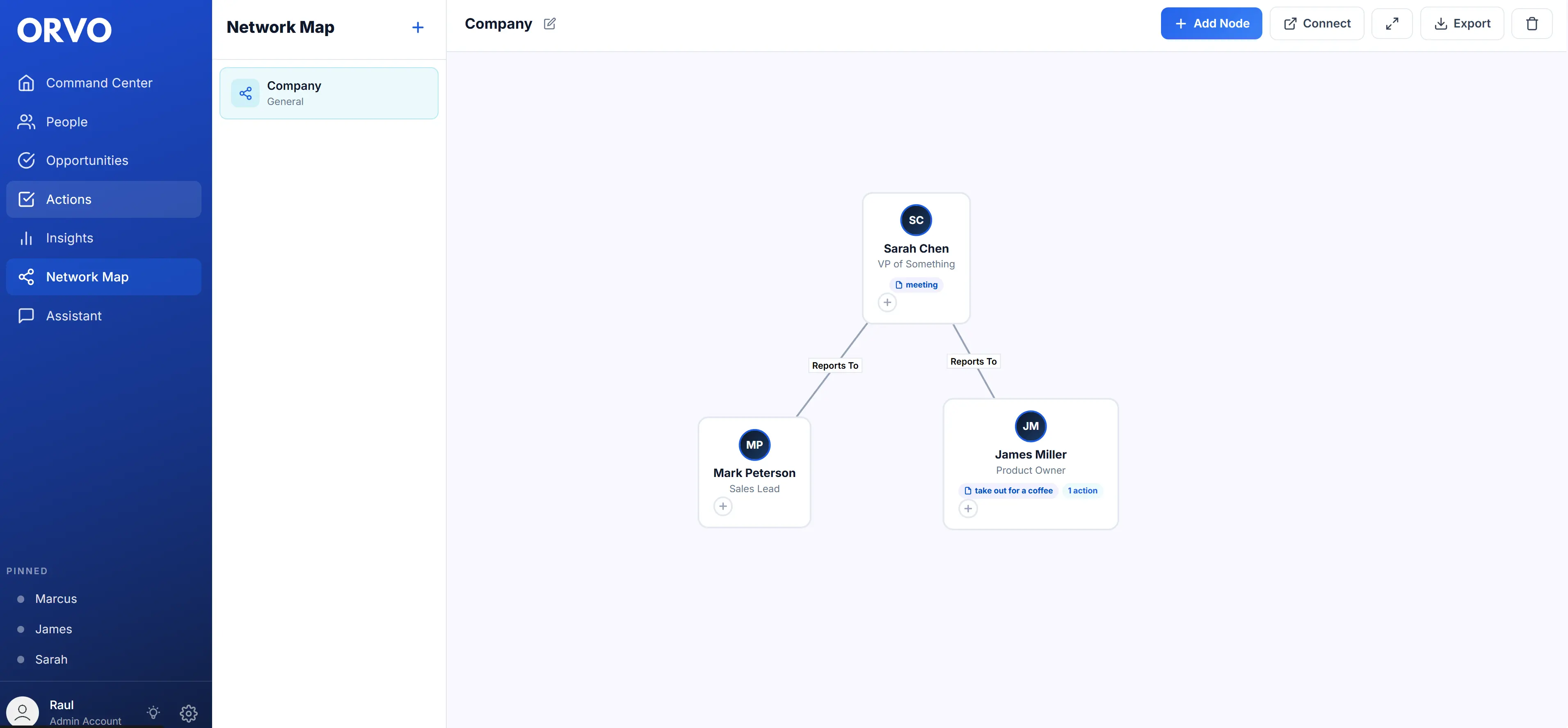
Log every relationship in Orvo with notes on what each person brings: "Sarah — INTJ, strategic thinker, helps me see blind spots. Review stakeholder analyses with her before presenting." This turns your network from a social asset into a career system.
The ENFP referral power. You know more people than almost anyone in your organisation. Use this: when someone needs a connection, be the person who makes the introduction. This positions you as a connector — one of the most valuable roles in any network. People who are known as connectors receive 3x more unsolicited opportunities than those who are not. (Source: Adam Grant, "Give and Take")
The ENFP career path: where your energy becomes an asset
ENFPs thrive in roles that combine people interaction, creative problem-solving, and variety. The ideal ENFP role changes frequently enough to maintain your interest while providing enough structure that your energy produces impact rather than motion.
Roles where ENFPs thrive: Marketing and brand strategy, sales and business development, entrepreneurship, coaching and training, public relations, creative direction, product management (discovery-heavy roles), community building, event management, and any role with high variety and people interaction. ENFPs in these roles describe work as "energising" rather than "draining."
Roles where ENFPs struggle: Accounting and bookkeeping (too repetitive), data entry and processing (too routine), long-cycle research (too slow), compliance and regulatory roles (too restrictive), and solo technical roles with no people interaction. ENFPs in these roles experience what feels like career depression — not clinical depression, but a deep lack of energy that comes from doing work that conflicts with every natural preference.
The ENFP career zigzag. ENFPs often have non-linear career paths — moving between industries, functions, and even careers. This is not floundering. Research from Emsi Burning Glass (2024) found that professionals with cross-functional experience are 28% more likely to reach VP-level positions than those with single-function careers. Your zigzag is not a bug — it is a feature, IF you can articulate the thread that connects your experiences.
The thread for most ENFPs: "I am drawn to roles where I understand people and help organisations connect with them." Whether that was marketing, then sales, then product, then coaching — the thread is consistent. Articulating this thread in interviews and performance reviews turns a fragmented resume into a compelling narrative of breadth.
The ENFP leadership style. ENFPs lead through inspiration, enthusiasm, and personal connection. Your team feels genuinely valued. Your energy is contagious. Your vision is compelling. The weakness: follow-through. The ENFP leader who inspires the team and then moves to the next initiative before seeing the current one through creates "vision fatigue" — the team stops getting excited because they know the enthusiasm will fade. The fix: pair your inspiration with a structured accountability partner (an ISTJ or ESTJ direct report or peer) who ensures that the vision you set is actually executed.
| ENFP Career Factor | What Energises You | What Drains You | Career Implication |
|---|---|---|---|
| Work content | Variety, creativity, people interaction | Routine, repetition, solo technical work | Choose roles with built-in variety and human connection |
| Work environment | Collaborative, informal, values-driven | Rigid, hierarchical, rules-heavy | Seek cultures that value creativity over compliance |
| Growth | New challenges, cross-functional exposure | Deep specialisation in one narrow area | Build a career narrative around your breadth |
| Leadership | Inspiring teams, building culture | Detailed project management, process enforcement | Pair with a structured partner for follow-through |
The ENFP at different career stages
The ENFP career arc has a specific pattern: explosive early energy, mid-career restlessness, and — for those who build the right systems — a senior phase of compounding influence.
Early career (0-5 years). ENFPs make incredible first impressions and ramp up faster than any type. You are the new hire who knows everyone's name by day 3, has ideas by day 7, and is leading an initiative by month 2. The risk: burning bright and burning out. Use the 3-Project Rule from day one. Build your Deep Five early. Start logging relationships in Orvo so you do not lose the connections you make.
Mid-career (5-12 years). This is the danger zone for ENFPs. The novelty of career advancement has worn off. You have been in 2-3 roles and are starting to wonder if you are in the right field. Many ENFPs make impulsive career changes at this stage. Before you do: apply the Commitment Delay to your career. Take 3 months to explore alternatives before making a move. Often the restlessness is about needing a new challenge within your current trajectory, not a new trajectory entirely.
Senior career (12+ years). ENFPs who reach senior levels are often described as "the person everyone wants in the room." Your network is vast. Your cross-functional experience gives you perspective that specialists lack. Your ability to connect people and ideas across silos is exactly what organisations need at the executive level. The challenge: can you sustain focus long enough to execute a multi-year strategy? The ENFPs who succeed at this level have built systems (accountability partners, structured review cadences, completion rituals) that channel their energy into sustained impact.
The ENFP compound effect. ENFPs meet more people in a year than most types meet in five. If you systematically maintain even 20% of those connections — logging them in Orvo, setting quarterly check-ins, following up after meetings — you build a professional network of extraordinary breadth and moderate depth. By your 40s, this network becomes your most valuable career asset: opportunities find you because someone in your vast network thought of you.
The ENFP career mistake to avoid at every stage: Do not confuse activity with progress. ENFPs are the busiest type in any office — running between meetings, connecting people, generating ideas, volunteering for initiatives. But busyness is not advancement. Every month, ask yourself: "What did I finish this month that moved my career forward?" If the answer is "nothing, but I started 5 things and helped 12 people," you are building goodwill without building your career. The Deep Five, the 3-Project Rule, and the monthly reflection email are designed to prevent this specific pattern.
Famous ENFPs in leadership: Robin Williams, Walt Disney, and Robert Downey Jr are frequently typed as ENFPs. What they share is not discipline — it is the ability to channel creative energy into sustained projects that defined their fields. Disney built an empire by surrounding himself with structured executors (ISTJs and ESTJs) who turned his visions into operational reality. The lesson for career ENFPs: you do not need to become disciplined. You need to build a system — and relationships with complementary types — that provides the discipline your natural wiring does not.
ENFP communication: your greatest strength and subtle liability
ENFPs are among the best verbal communicators of all 16 types. You think on your feet, read audiences intuitively, and adapt your message in real-time. This is an extraordinary career advantage.
The subtle liability: you can be so engaging that people do not realise you did not say anything concrete. The ENFP who gives an inspiring 10-minute update that, on reflection, contained no specific deliverables or timelines has created enthusiasm without accountability. Over time, stakeholders learn to enjoy your presentations but not trust your commitments.
The ENFP communication upgrade:
1. Anchor every conversation with a specific commitment. Before ending any meeting, state: "To confirm, I am committing to X by Y date." This grounds your enthusiasm in something concrete. If you cannot state a specific commitment, you are not ready to present.
2. Follow up in writing. After every important conversation, send a brief written summary: "Great discussion today. Here is what I am taking away and what I will deliver." Your verbal skills create the energy. Your written follow-up creates the accountability. Together, they make you unstoppable.
3. Listen more than you talk. ENFPs are such good talkers that they often dominate conversations without realising it. In your next meeting, count how many minutes you speak versus how many you listen. If the ratio is above 50/50, you are talking too much. The ENFP who asks one great question and genuinely listens to the answer builds more trust than the one who gives a 5-minute monologue.
4. Underpromise and overdeliver. ENFPs naturally overpromise because their enthusiasm makes everything seem achievable. Train yourself to commit to 80% of what you think you can deliver. When you deliver 100% of a modest commitment, you build a reputation for reliability. When you commit to 100% and deliver 80%, you build a reputation for overcommitting — even though you delivered more in absolute terms.
| Communication Habit | ENFP Default | The Upgrade | Reputation Impact |
|---|---|---|---|
| Meeting updates | Inspiring but vague | Anchor with specific commitments | Trusted AND inspiring |
| Follow-up | Verbal only — no written record | Written summary within 24 hours | Builds accountability trail |
| Listening ratio | Talk 70%, listen 30% | Target 50/50 or better | Others feel heard, not entertained |
| Commitments | Enthusiastic overpromise | Commit to 80%, deliver 100% | Reliable instead of "all talk" |
The ENFP secret weapon: emotional intelligence as career capital
ENFPs have the highest natural emotional intelligence of any type. You read emotions instinctively, empathise genuinely, and adapt your behaviour to make others comfortable. This is not a soft skill — it is career capital worth more than any technical certification.
Research from TalentSmart shows that EQ accounts for 58% of job performance across all roles. ENFPs start with a natural advantage here. The key is deploying it strategically rather than just socially.
Strategic EQ for ENFPs:
In negotiations: You intuitively sense the other party's emotional state. Use this: when someone becomes defensive, soften your approach before they shut down. When someone is excited, accelerate the conversation before the energy fades. Your ability to read and respond to emotional dynamics in real-time is a superpower in negotiations that data-driven types cannot match.
In conflict resolution: ENFPs are natural mediators. You understand both sides because you genuinely care about both sides. Use this formally: volunteer to mediate team conflicts, facilitate difficult conversations, or bridge gaps between departments. These contributions are highly visible and build a reputation for leadership.
In change management: ENFPs feel the emotional pulse of an organisation. When a restructuring is announced, you know instantly who is scared, who is excited, and who is about to quit. This intelligence is invaluable to senior leadership — share it. "I am sensing significant anxiety in the product team about the reorg. A town hall addressing their specific concerns could prevent attrition." This positions you as an organisational strategist, not just a people person.
Track emotional intelligence observations in Orvo. Note each stakeholder's emotional patterns, what triggers their anxiety, what energises them, and how they respond to change. This systematic emotional intelligence gives you a preparation advantage that no other type naturally builds.
The ENFP EQ edge in interviews. ENFPs are the strongest interviewers of any type — on both sides of the table. As a candidate, your warmth, enthusiasm, and ability to read the interviewer's energy make you immediately likeable. As a hiring manager, your empathy helps you assess cultural fit and potential in ways that structured interviews miss. Use this: when preparing for a high-stakes interview (either as candidate or interviewer), review the person's Orvo profile if you have one. Note their communication style, what they value, and what previous interactions revealed. Your natural EQ plus systematic preparation is an unbeatable combination.
The ENFP emotional regulation challenge. Your emotional range is part of your charisma — when you are excited, the room is excited. But the inverse is also true: when you are frustrated or disappointed, the room feels it. Senior leaders expect emotional consistency. Not flatness — consistency. Practice a pre-meeting emotional check: "Am I bringing an emotion from a previous interaction into this meeting?" If yes, take 5 minutes to reset. The ENFP who brings Monday's enthusiasm to every meeting, regardless of what happened at lunch, builds a reputation for leadership presence that compounds over years.
ENFPs connect with people naturally. Orvo ensures those connections compound into career capital — track relationships, set follow-up reminders, and build the network that powers your career. Start free →
Get Orvo Free要点まとめ
- ✓ ENFPs build the widest, most diverse networks of any type — professionals with diverse networks advance 34% faster
- ✓ Five blind spots: shiny object syndrome, over-committing, avoiding tedium, shallow relationships, and emotional volatility
- ✓ The 3-Project Rule channels your energy: one starting, one in progress, one finishing. Want something new? Finish one first.
- ✓ Build a Deep Five: 5 relationships you invest in deeply. Your wide network creates breadth; your Deep Five creates career impact.
- ✓ Communication upgrade: anchor conversations with specific commitments, follow up in writing, underpromise and overdeliver.
- ✓ Your emotional intelligence is career capital — deploy it strategically in negotiations, conflict resolution, and change management.
- ✓ The ENFP career zigzag is an asset IF you can articulate the thread. Cross-functional experience leads to VP-level positions 28% more often.