
Why High Performers Still Get Laid Off (And Who Actually Survives)
Layoffs and reorganisations don't concentrate on the lowest performers — they concentrate on the lowest-visibility roles. The structural reason why, and the five capabilities career-resilient professionals build deliberately.
This piece is part of Orvo's European Career Outlook Report 2026, a long-form analysis of the four structural forces reshaping European white-collar work — and the two compounding levers (visibility and AI fluency) that determine which professionals thrive.
You have watched this happen. A reorganisation announcement lands. A team gets restructured. Some people keep their jobs; others don't. And among the ones who lose their roles, there is at least one — usually more than one — who should not be on the list. Strong reviews. Demonstrably capable work. The kind of person who, on paper, is more productive than half the people whose roles were preserved.
It is the kind of outcome that makes everyone watching uncomfortable. It contradicts the implicit promise of corporate work: that performance is what matters. And every time it happens, the same set of half-explanations gets passed around the watercooler. Politics. Personality. Bad luck. Wrong manager. The wrong project at the wrong time.
The half-explanations are not wrong. They are incomplete. The structural reason is simpler and much less comfortable: the people who survived had a property the high performer did not. Their roles were visible. Theirs were not.
In 2026, your job security is not determined by how well you perform — but by how visible your work is to the people who decide.
This is what we call the Visibility Principle, and it is the single most predictive variable in determining who survives a European reorganisation in 2026. It is also the variable most career advice systematically ignores.
What the Visibility Principle says
In structurally stagnant economies, layoffs and outsourcing concentrate not on the lowest performers but on the lowest-visibility roles. The professional who survives reorganisation is not the one with the best technical skills — it's the one whose role has become inseparable from their relationships, their visibility, and their ability to navigate the organisation.
It sounds, at first, like a complaint about office politics. It is not. It is a description of how organisations actually make headcount decisions when they are forced to.
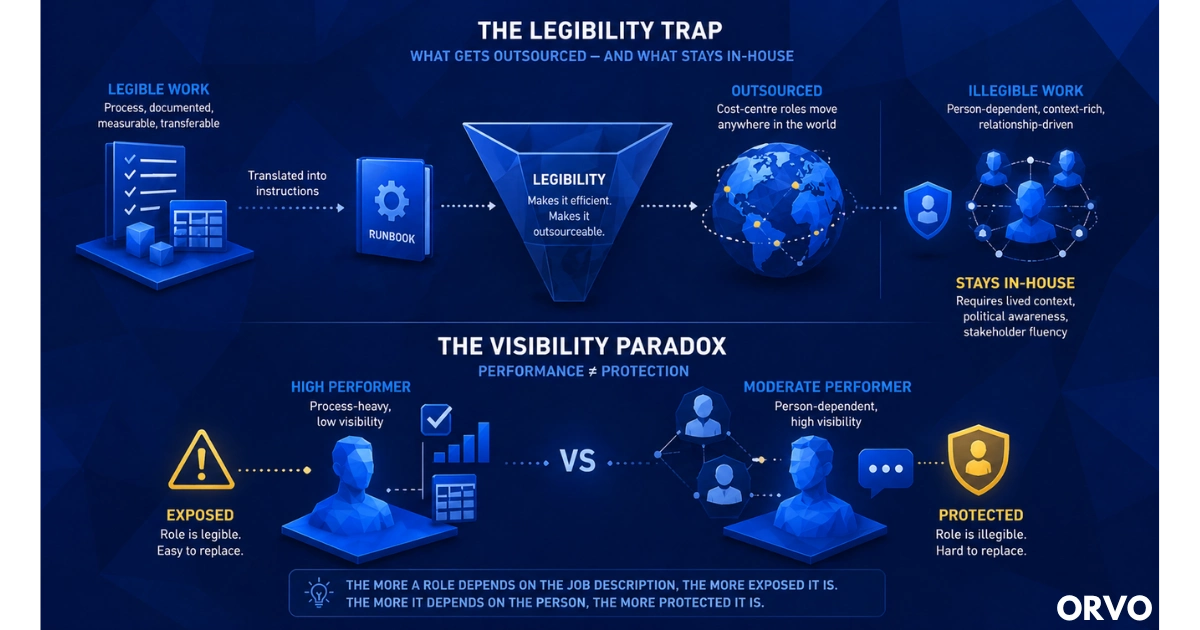
When a company has to reduce headcount — because of cost pressure, a market shift, a corporate restructuring, an acquisition — the people doing the cutting are usually three or four levels above the affected roles. They cannot, and do not, evaluate individual performance from that distance. What they evaluate is legibility. They look at organisational charts, role descriptions, headcount-by-function summaries, and a small number of input signals from senior managers.
In that evaluation, two things determine survival: how visible the role is to people who matter, and how clearly the work cannot be transferred to someone else (or to nothing at all).
A high-performing back-office banker, doing excellent work that is invisible to anyone outside her immediate team, fails both tests. A moderate-performing programme manager who chairs a cross-functional steering committee that includes the executive sponsor, an external regulator, and three department heads passes both tests. The first one disappears in the spreadsheet. The second one is "the person running the X programme" — a phrase the executive committee can recall by name.
Performance does not protect you when the metric of evaluation is the role itself, not the person filling it.
The legibility trap
The deeper structural point is harder to face: the thing that makes a role efficient is often the thing that makes it outsourceable.
When a role is well-defined, well-documented, and produces measurable outputs in a predictable cadence, it can be evaluated cleanly. It can also be moved. To another team. To another country. To a software system. To an AI agent. The pre-translation into instructions that made the role legible to a manager is the same pre-translation that makes it legible to anyone else who might pick it up.
We call this the legibility trap. It is the mechanism behind the Visibility Principle.
What stays in-house, in expensive Western European cities and senior-level corporate roles, is the work that depends on the person rather than the job description. Work that requires political awareness, stakeholder fluency, cross-functional influence, and the kind of context that takes years to build and cannot be transferred via a runbook. Work whose execution is illegible to anyone who has not lived the relationships behind it.
The cost-centre roles get outsourced first because they have been pre-formatted for outsourcing. The high-status roles stay because they have not.
This is not a moral statement. It is mechanical. And once you see it, you cannot un-see it — because it explains essentially every reorganisation outcome you have witnessed.
Consider a recent restructuring at a large European bank. Two analysts were on the same team, with similar performance reviews and roughly equivalent technical capability. One had spent the previous eighteen months supporting a cross-functional risk committee that reported to the COO; her quarterly outputs were referenced in board materials, and three senior managers across two functions could name her work. The other had spent the same eighteen months producing strong analysis consumed inside her immediate team. When the headcount-reduction list went to the steering committee, only one of those names was legible to the people doing the cutting. The first analyst stayed. The second did not.
This is not unfair, in the technical sense. It is mechanical. And it is the structural reality every European professional needs to plan around.
A 30-second test: which quadrant are you in?
Before reading further, answer four questions about yourself, honestly. One point per yes.
- Could three senior leaders outside your immediate team name something specific you delivered in the last quarter?
- Is the output of your work consumed regularly by more than one function?
- Could you articulate the impact of your last quarter's work in a single tight paragraph, in under 60 seconds?
- Have you, in the last 30 days, used AI tools to fully replace a workflow you previously did manually — not draft a single email, but replace an end-to-end process?
Questions 1–2 score your visibility. Questions 3–4 score your AI fluency. Two yeses on each pair puts you in the Architect quadrant. Two yeses on one pair and zero on the other puts you in either Legacy or Invisible Builder. Zero or one yes total puts you in Exposed. The map below explains what each position means and what to do about it.
The four positions
If we map out the two compounding levers — visibility and AI fluency — into a 2×2, four distinct career positions emerge in 2026:
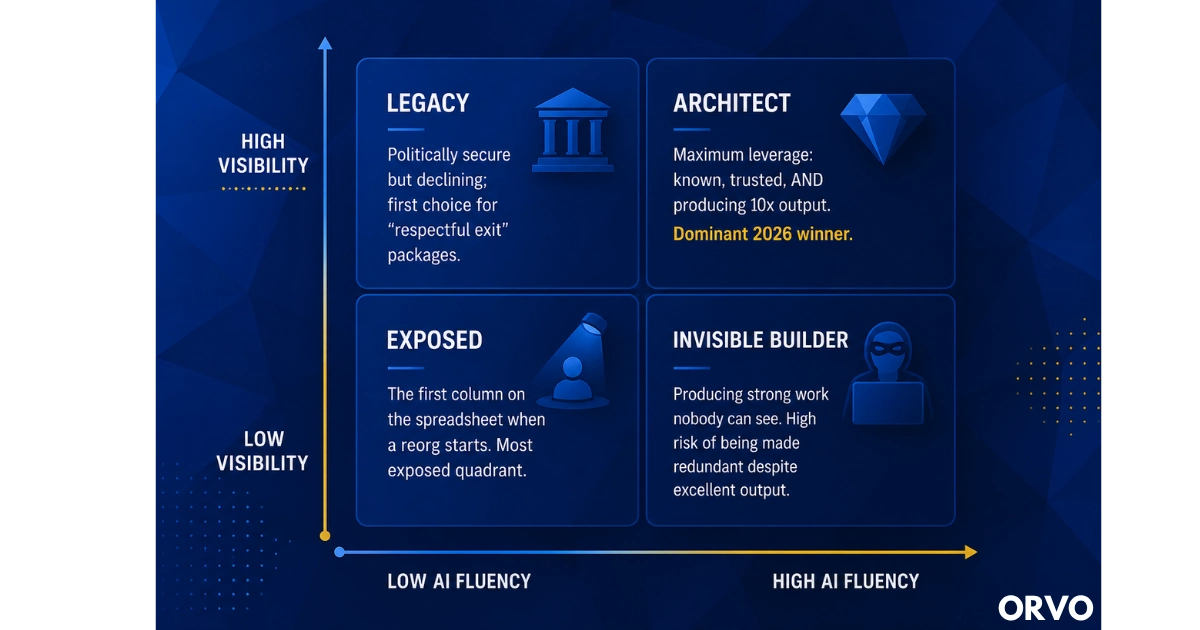
The four positions are not personality types — they are positions any professional can move between, in either direction, by deliberate work over twelve to twenty-four months. The Architect quadrant is the goal. The Exposed quadrant is acute structural risk.
The most painful quadrant to occupy is the Invisible Builder — strong work, real AI fluency, but no organisational visibility. The professionals in this quadrant tend to be exactly the people who would be good colleagues to keep, and exactly the people who get cut anyway because nobody senior can articulate why their work matters.
The Legacy quadrant is the second-most painful, in slow motion. These professionals are politically secure and well-known internally — but their AI fluency lag means their output is being eclipsed quarter by quarter by Architect-quadrant peers. In the short term they are protected by relationships. In the medium term, the organisation finds dignified ways to ease them out as their relative productivity drops.
The Architects win. The Exposed lose first. The Invisible Builders are surprised when they lose. The Legacy quadrant gets the longest goodbye.
For the macro context that puts these dynamics in motion across Europe specifically, see the European Career Outlook Report 2026.
What visibility actually is (and what it isn't)
The most common objection to the Visibility Principle is that it sounds like a defence of office politics. It is not.
Visibility is not self-promotion. It is not LinkedIn humblebragging. It is not taking credit for other people's work. It is not the loudest voice in the meeting. The professionals who try to manufacture visibility through those tactics are usually obvious to the rest of the organisation, and they tend to discover that high-volume self-promotion reduces their visibility with the people who actually decide their roles.
Visibility, properly understood, is a structural property of how your role connects to the rest of the organisation. A role is visible when:
- Its output is consumed across multiple functions, not just by the home team
- It interfaces routinely with senior stakeholders two or more levels above
- Its impact is measurable and attributable to a named individual, rather than buried in an aggregate team metric
- It carries natural cross-functional surface area — project work, customer interface, regulatory or compliance work, executive support
- The person filling it has known relationships with people who would notice if they left
Conversely, a role is invisible when its output is consumed by a single internal team, when senior-stakeholder exposure is limited, when impact is buried in team performance, when the work is purely individual-contributor mode with no cross-functional rituals, and when the relationships are concentrated in a small number of immediate colleagues.
The good news: the structural properties of a role are not fixed. They are partly determined by the role's design and partly by what the person filling it does. A professional with the same job title can be highly visible or highly invisible depending on choices they make, deliberately, over the course of a year.
The five capabilities of career-resilient professionals
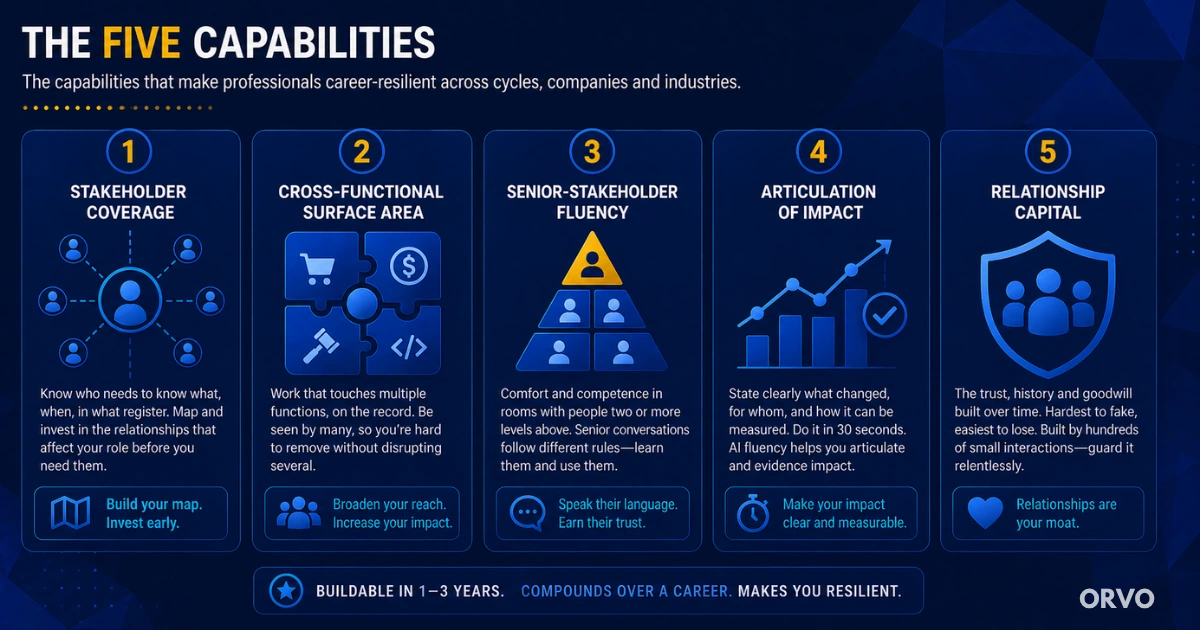
The professionals who survive reorganisations consistently — across multiple cycles, multiple companies, multiple industries — share a recognisable profile. We call these the five capabilities, and they are buildable on a horizon of one to three years.
1. Stakeholder coverage
Knowing who needs to know what, when, in what register. Career-resilient professionals maintain a deliberate map of the people whose decisions affect their roles, and they invest in those relationships before they need them. Use the Career Relationship Audit to start; the Stakeholder Map for Career Growth extends it into a working system.
2. Cross-functional surface area
Doing work that touches multiple functions, regularly, on the record. The compounding effect of being seen by procurement, finance, legal, and engineering at the same time creates a profile that is hard to remove without disrupting four functions instead of one. Career-resilient professionals volunteer for cross-functional initiatives early, take regulatory or compliance interfaces seriously, and treat executive support rotations as career investments rather than chores.
3. Senior-stakeholder fluency
Comfort and competence in rooms with people two or more levels above your own. This is a learnable skill. The Preparing for a 1:1 with Your CEO playbook addresses it directly. The pattern: senior-level conversations follow different rules than peer-level conversations, and the professionals who navigate them gracefully accumulate visibility at every interaction.
4. Articulation of impact
The ability to state, in clear language, what your work changed in the organisation and how it can be measured. This is where AI fluency multiplies the visibility lever directly. Professionals who can produce a tight, evidenced articulation of their impact in 30 seconds — to an executive, to a journalist, to themselves — accumulate visibility every time they are asked. Professionals who answer the same question with vague generalities lose visibility every time.
5. Relationship capital
The accumulated trust, history, and goodwill across the people who matter to your role's continuation. This is the single hardest capability to fake and the easiest to lose through inattention. Relationship capital is built by hundreds of small interactions over years — and it is destroyed by a small number of large failures. Career-resilient professionals treat their relationships as a deliberate practice, not as something that happens by accident around their work.
The full treatment of these five capabilities lives in our Career Intelligence Guide.
How to actually build visibility this quarter
Reading about visibility does not produce visibility. The work is, ultimately, behavioural. Three concrete moves you can begin this week:
Audit your stakeholder map. Open a blank document. Write down every senior person whose decisions affect your role — your manager, your manager's manager, the executive sponsor of your function, the leaders of the functions you interface with, the senior people in adjacent organisations who know your work. For each, score the strength of the relationship and the frequency of recent contact. The gaps you find — and most professionals find more gaps than they expected — will tell you which conversations to have first.
Take one cross-functional initiative on this quarter that wasn't already assigned to you. Volunteer for a project that crosses your function's boundary. Join the regulatory working group. Take the executive support rotation. Pick the one that gives you natural surface area with people you don't currently know. The work itself matters less than the relationship-building it produces.
Articulate your last quarter's impact in a single tight paragraph. Not a slide. Not a deck. Five sentences. What changed because of your work, who benefited, how it was measured, what comes next, and what you specifically did. If you cannot produce this paragraph in fifteen minutes, you are an Invisible Builder by default — even if your output is excellent. The articulation gap is the visibility gap, and AI tools make it easier than ever to close. Use them.
For the full playbook, including geographic diversification and the seven moves that compound visibility over a year, see the European Career Outlook Report 2026 individual playbook.
The visibility–AI fluency multiplier
The Visibility Principle does not stand alone in 2026. It compounds with AI fluency in ways that make the Architect quadrant — high visibility, high AI fluency — increasingly dominant.
The mechanism is straightforward. Visibility means more people know your work. AI fluency means you produce more work, faster, at higher quality. Together, they produce a profile that is known to be productive at scale. The reverse is also true: low visibility plus low AI fluency produces a professional who is neither known nor productive at the new baseline — the worst possible position to occupy in a stagnating European corporate environment.
The two levers are multiplicative, not additive. A senior PM who is visible across the organisation but cannot vibe-code is being eclipsed every quarter by a peer who can. A senior PM who can vibe-code but whose work is buried inside a single product line is producing strong artefacts that nobody outside the team can name. Both halves are required.
The good news: both halves are buildable, deliberately, over the same horizon. A professional who decides today to invest in visibility and AI fluency for the next twelve months will, by mid-2027, be in a structurally different career position than they are today. The lever exists. It just has to be pulled.
What this means for your next twelve months
If you are currently in the Exposed quadrant — low visibility, low AI fluency — your highest-leverage move is to build AI fluency first. AI fluency creates output. Output, made visible, builds visibility. The reverse path (visibility-first, AI fluency-second) is harder because raw visibility without underlying productivity is brittle.
If you are currently in the Invisible Builder quadrant — high AI fluency, low visibility — your highest-leverage move is to begin articulating, distributing, and being seen producing the work you are already capable of. The output already exists. The visibility does not. Closing that gap is the highest-return investment available to you.
If you are currently in the Legacy quadrant — high visibility, low AI fluency — your highest-leverage move is to acquire AI fluency in the next six months, before your relative productivity gap with younger peers becomes a topic in your performance review.
If you are currently in the Architect quadrant, your highest-leverage move is to compound your existing position. Mentor downwards. Build cross-organisational visibility deliberately. Take on the cross-functional initiatives that the Exposed quadrant cannot. The compounding accelerates.
For the role-specific exposure scores that map onto these quadrants, see The Most Resilient Careers in Europe in 2026 — and the Ones Most at Risk.
A final note
The Visibility Principle is uncomfortable because it implies that performance is not enough. For most of us, that contradicts decades of training that said the work matters most. The work does matter most — but in a stagnating European environment with rolling reorganisations, the work alone is not legible enough to determine survival on its own.
The professionals who navigate this decade well will not be the ones who refuse to learn this lesson. They will be the ones who, having seen the high performer cut from the team that should not have lost them, took it as a planning input rather than an injustice — and built the visibility their work deserves.
This analysis is part of The European Career Outlook Report 2026 by Orvo, the career intelligence platform for ambitious professionals. To receive the full PDF — pillar plus all five companion analyses — join our newsletter.
Republication permitted with attribution to Orvo and a link back to this article (Creative Commons Attribution 4.0).