
Why "learn to code" is the wrong answer to AI disruption
Every time a technology shift threatens existing jobs, the default advice is the same: learn to code. It was wrong in 2015 and it is wrong in 2026. Not because coding is unimportant — but because AI has fundamentally changed what coding means.
When a project manager at Google can build a working prototype with AI tools in a few hours — without writing a single line of code themselves — the value proposition of "learn to code" collapses. The skill is not coding. The skill is knowing what to build, who to build it for, and how to get the right people to support it. As Dan Thomasset observed from inside Google: PMs are running circles around engineers not because they code better, but because they removed the translation layer between vision and prototype.
The same logic applies across every industry. AI is not just a tool that automates tasks. It is a capability amplifier that changes the economics of every profession. A marketing manager with AI does the analytical work of a data scientist. A salesperson with AI does the research of an analyst. A consultant with AI produces the output of a team. The question is not "can AI do my job" — it is "what can I do with AI that makes my job more valuable?"
The professionals who answer this question well share a common trait: they invest in the human skills that AI amplifies rather than the technical skills that AI replaces. Communication. Stakeholder management. Relationship building. Strategic thinking. These are not soft skills — they are the hard foundation of career resilience.
A 2025 World Economic Forum report found that the top skills employers expect to grow in importance by 2030 are: analytical thinking, creative thinking, resilience and flexibility, motivation, and curiosity. Notice what is absent from the top of the list: coding. Not because coding does not matter, but because AI has made it accessible to everyone. The scarce, valuable skills are human ones.
The career resilience framework: three pillars that protect you for the next decade
Future-proofing your career is not about predicting which specific technologies will matter in 2030 or 2035. It is about building capabilities that remain valuable regardless of which technologies emerge. Here is a practical framework built on three pillars.
Pillar 1: AI Fluency (the capability multiplier). This is not about mastering every AI tool. It is about being comfortable using AI in your daily work and knowing how to learn new tools as they appear. The specific tools will change — ChatGPT in 2025 may be replaced by something better in 2027. But the underlying skill — translating your professional needs into AI-compatible instructions and evaluating AI output with domain judgment — will compound over time.
Practical benchmark: you should be using at least one AI tool every working day. If you are not, you are falling behind the 15% of professionals who have integrated AI into their core workflows and are producing disproportionate results.
Pillar 2: Relationship Capital (the moat AI cannot cross). Your professional relationships are the single most valuable career asset that AI cannot replicate or erode. The people who know your work, trust your judgment, will take your call, recommend you for opportunities, and support your initiatives — this network is your career insurance. Not the LinkedIn connection count. The actual relationships where mutual trust exists.
The professionals with the strongest relationship capital are the most resilient to any disruption. If your role is eliminated, your relationships open doors. If your industry transforms, your relationships provide intelligence and introductions. If your company reorganises, your stakeholder relationships determine whether you land well or get sidelined.
Pillar 3: Domain Judgment (the quality filter). AI generates output. Humans judge whether that output is good, relevant, and appropriate for the specific context. This judgment comes from deep domain experience — understanding the nuances of your industry, your company, your market, and your stakeholders. A junior analyst cannot evaluate AI output as well as a senior one because they lack the contextual knowledge to spot what is wrong, missing, or misleading.
Domain judgment appreciates with time. The longer you work in a field and the more relationships you build within it, the better your judgment becomes. This is why experienced professionals who adopt AI tools are often more effective than junior AI-native employees — they have the judgment to direct AI toward the right problems and evaluate its output accurately.
| Pillar | What It Is | How to Build It | Why AI Cannot Replace It |
|---|---|---|---|
| AI Fluency | Comfortable using AI tools daily; quick to adopt new ones | Use one AI tool daily → expand to 2-3 → build custom workflows | AI tools change; the meta-skill of learning them does not |
| Relationship Capital | Deep professional relationships with mutual trust | Track systematically (Orvo) → invest in key relationships → follow up consistently | AI cannot build trust, navigate politics, or earn personal advocacy |
| Domain Judgment | Ability to evaluate AI output against real-world context | Deep experience in your field → diverse exposure → continuous learning | AI lacks organisational context, political awareness, and historical nuance |
Quarter-by-quarter: a 12-month career resilience plan
Abstract frameworks are useful but insufficient. Here is a concrete 12-month plan to future-proof your career, broken into quarterly milestones.
Q1: Foundation (months 1-3).
AI Fluency: Choose one AI tool and use it every day for your most time-consuming recurring task. Meeting prep, email drafting, research, or analysis. Build a prompt library of what works. By the end of Q1, this tool should feel as natural as your email client.
Relationship Capital: Audit your current professional network. Use Orvo or a similar tool to catalogue your key stakeholders — the 20-30 people who most influence your career. For each one, note: when you last interacted, what they care about, and what the current state of the relationship is. Identify 5 relationships that have gone cold and need re-engagement.
Domain Judgment: Start a weekly practice of reviewing AI output critically. When AI generates a report, presentation, or analysis for you, spend 10 minutes identifying what is wrong, what is missing, and what would not work in your specific context. This builds the critical evaluation muscle.
Q2: Expansion (months 4-6).
AI Fluency: Add a second AI tool — preferably domain-specific. If you are in sales, try AI-powered prospecting or CRM intelligence. If you are in product, try AI prototyping. If you are in management, try AI-assisted performance tracking or meeting analysis. Start combining tools: AI generates the first draft, you refine with domain judgment, then you use your relationship intelligence to deliver it to the right audience.
Relationship Capital: Re-engage the 5 cold relationships you identified. Reach out with genuine value — share an article, make an introduction, ask about their work. Set up a regular cadence for your top 10 stakeholder relationships (monthly check-in, quarterly coffee, or similar). Log every interaction in Orvo so you build a relationship history you can reference.
Domain Judgment: Take on a project that stretches your domain expertise into an adjacent area. If you are in marketing, learn about product analytics. If you are in engineering, learn about customer research. Cross-domain knowledge strengthens your judgment and makes you harder to replace.
Q3: Integration (months 7-9).
AI Fluency: Build custom workflows that combine AI with your human judgment. Create templates for recurring tasks: stakeholder updates, meeting preparation, competitive analysis. These templates encode your domain knowledge into AI-assisted processes, making you dramatically more efficient without sacrificing quality.
Relationship Capital: Expand beyond your immediate circle. Identify 5-10 people outside your team or company who could be valuable professional relationships. Attend an industry event, join a professional community, or reach out on LinkedIn with specific, non-generic messages. The goal is to build relationship capital that transcends your current role.
Domain Judgment: Mentor someone junior on AI adoption. Teaching forces you to articulate your approach, identify gaps, and refine your methods. It also builds your reputation as an AI-literate leader — a valuable signal in any organisation.
Q4: Compounding (months 10-12).
AI Fluency: You should now be saving 5-10 hours per week through AI tools and producing higher-quality work. Focus on the next frontier: using AI for strategic thinking, not just tactical execution. Use AI to model scenarios, stress-test strategies, and generate options you might not have considered.
Relationship Capital: Review your relationship portfolio. Which relationships delivered the most value this year? Which new relationships should you invest in? Use your Orvo data to identify patterns: who introduced you to opportunities, who provided critical advice, who amplified your work. Double down on these relationships.
Domain Judgment: Share your perspective publicly. Write a LinkedIn post about what you have learned. Present at a team meeting or industry event. The professionals who are known for their judgment attract opportunities — and in the AI era, judgment is the scarcest and most valuable commodity.
The professionals who are already winning: five real patterns
The three-pillar framework is not theoretical. Here are five patterns from professionals who are already thriving in the AI-transformed workplace.
Pattern 1: The AI-augmented consultant. A strategy consultant at a mid-tier firm started using AI tools for market research and financial modelling in early 2025. Within six months, she was producing deliverables that previously required a team of three. But the real advantage was not speed — it was that she reinvested the time into client relationships. She doubled her client meeting frequency, started providing ad-hoc strategic advice between formal engagements, and built a reputation as the consultant who "actually understands our business." Her billing rate increased 35% in one year, and she was promoted to principal ahead of schedule.
Pattern 2: The product manager who prototypes. A PM at a mid-stage startup adopted AI coding tools and started building working prototypes of every feature proposal. Instead of presenting Figma mockups and written specs, she showed the CEO and engineering lead a working product. The CEO could click through it. Engineering could evaluate the technical approach. Decisions that used to take three meetings took one. She shipped more features in six months than the previous PM had shipped in 18. Her secret: she also used Orvo to track every stakeholder conversation, so she knew exactly what each executive cared about and how to frame each proposal.
Pattern 3: The teacher who went from administrator to mentor. A high school teacher in Singapore adopted AI tools for lesson planning, grading, and progress tracking. The administrative burden that consumed 40% of her time dropped to 15%. She used the recovered time to launch a student mentoring programme and a parent communication initiative. Student satisfaction scores increased 28%. She was appointed head of department — a promotion driven not by AI skills but by the relationship-building those skills enabled.
Pattern 4: The sales leader who anticipated, not reacted. A regional sales director started using AI to analyse customer data, predict churn risk, and identify upsell opportunities. But his real advantage was using the AI insights as conversation starters with his clients — reaching out to discuss potential issues before they became problems, and suggesting solutions before clients had to ask. His team's retention rate went from 82% to 94% in one year. AI provided the data. Relationship intelligence — knowing each client's priorities, communication style, and decision-making process — provided the impact.
Pattern 5: The operations manager who created a new role. An operations manager at a logistics company was asked to evaluate AI tools for route optimisation. She implemented the tool, which reduced fuel costs by 15%. But she also noticed that the AI-optimised routes created new coordination challenges between drivers, warehouse managers, and customer service teams. She proposed a new role — AI Operations Coordinator — to manage the human side of AI-optimised workflows. She was promoted into the role she created, overseeing both the AI systems and the cross-functional relationships they require.
What to do this week: five concrete actions
The 12-month plan provides the roadmap. But you do not need to wait until next quarter to start. Here are five actions you can take this week — each takes less than an hour — that will immediately move you toward career resilience.
Action 1: Replace one task with AI (30 minutes). Pick the most tedious recurring task in your week. Meeting preparation, writing weekly updates, researching a client or competitor, or summarising meeting notes. Use ChatGPT, Claude, or any AI tool to handle it instead. Do not worry about perfection — the goal is to break the habit of doing everything manually.
Action 2: Audit your top 10 relationships (20 minutes). Write down the 10 people who most influence your career right now. Your manager, skip-level leader, key peers, important clients or stakeholders, and one or two people outside your organisation. For each, note: when did you last have a meaningful interaction? What do they care about? Is the relationship growing, stable, or fading? This audit reveals which relationships need investment.
Action 3: Set up a relationship tracking system (15 minutes). Start tracking your professional relationships systematically. You can use Orvo (purpose-built for this), a spreadsheet, or even a notes app — but start. Log the 10 people from Action 2. Add a note about your last conversation with each. Set a reminder to reach out to the two relationships that have been dormant the longest.
Action 4: Send one relationship-building message (10 minutes). Reach out to one person on your list with genuine value. Share an article they would find useful, congratulate them on a recent achievement, or simply ask how a project they mentioned is going. This is not networking — it is relationship maintenance. The compound effect of doing this weekly is enormous.
Action 5: Block one hour for AI learning next week (5 minutes). Put a recurring one-hour block on your calendar for AI tool exploration. Use it to try new features of tools you already use, explore a new tool, or refine your prompt library. Consistent weekly investment builds fluency faster than occasional deep dives.
These five actions take less than 90 minutes combined. But they establish the two habits that define career resilience: using AI daily and investing in relationships systematically. Everything else builds on this foundation.
| Action | Time | Pillar | Why It Matters |
|---|---|---|---|
| Replace one task with AI | 30 min | AI Fluency | Breaks the manual habit — you will not go back |
| Audit top 10 relationships | 20 min | Relationship Capital | Reveals where to invest and where relationships are fading |
| Set up relationship tracking | 15 min | Relationship Capital | Systematises what most professionals leave to chance |
| Send one relationship message | 10 min | Relationship Capital | Compounds weekly — one message = 50+ touchpoints per year |
| Block AI learning time | 5 min | AI Fluency | Consistent weekly practice beats occasional deep dives |
The jobs AI creates: why net employment keeps growing
The fear narrative focuses on jobs AI eliminates. The data tells a different story. The World Economic Forum's 2025 Future of Jobs Report projects that AI and automation will create 170 million new jobs globally while displacing 92 million — a net positive of 78 million new roles by 2030.
These are not abstract predictions. We can already see the new job categories emerging:
AI-augmented specialists. IKEA's interior design consultants who work alongside AI tools. Financial advisors who use AI for portfolio analysis and spend more time on client relationships. Doctors who use AI for diagnostic screening and spend more time on patient care. These are not new job titles — they are existing jobs elevated by AI.
AI operations roles. Prompt engineers, AI trainers, AI ethicists, AI integration specialists. These roles did not exist five years ago. Today they are among the fastest-growing job categories. LinkedIn reported a 2,000% increase in job postings mentioning "AI" skills between 2022 and 2025.
Relationship-intensive roles. As AI automates routine work, companies are investing more in roles that require human connection: customer success managers, community builders, partnership managers, executive coaches, stakeholder engagement specialists. The IKEA pattern — AI handles the routine, humans handle the relationship — is being replicated across industries.
Creative-strategic roles. AI can generate content, designs, and code. But deciding what content to create, which designs to pursue, and what products to build requires strategic judgment and creative vision. These roles are growing, not shrinking.
The professionals who position themselves at the intersection of AI fluency and human skills are not just surviving the transition — they are defining the new job categories that will dominate the next decade.
The mistake most professionals make: learning AI tools without building relationships
There is a trap that ambitious professionals fall into: they invest heavily in AI fluency — mastering every new tool, building complex workflows, becoming the team's "AI expert" — while neglecting the relationship capital that makes AI fluency valuable.
This is like becoming an expert driver without knowing where to go. Speed without direction is just faster wandering.
The pattern is visible in every organisation. The AI power user who produces impressive outputs but cannot get stakeholder buy-in. The data analyst who builds beautiful AI-generated reports that no one reads because they did not understand what the executive team actually needed. The PM who builds rapid prototypes but cannot navigate the political landscape to get engineering resources allocated.
The opposite mistake is equally common: the relationship-heavy professional who ignores AI entirely. They have deep stakeholder connections, strong organisational credibility, and years of trust — but they are falling behind in output because colleagues who use AI produce more, faster. Their relationships are a depreciating asset because they cannot keep up with the pace of AI-augmented peers.
The sweet spot — and the entire thesis of this article — is the professional who builds both simultaneously. They use AI to produce better work in less time. They use the time saved to invest in relationships. They use their relationships to direct their AI-amplified output toward the right problems, the right audiences, and the right stakeholders. Each pillar reinforces the other.
A practical test: if you spent the last month getting better at AI tools but cannot name five stakeholders whose priorities you understand deeply, you are out of balance. If you spent the last month building relationships but have not used an AI tool in your daily work, you are leaving capability on the table. The goal is to advance both — every week, every month.
This dual investment is not common today. Which is exactly why it represents such an enormous career advantage for the professionals who commit to it.
The relationship portfolio: your most AI-proof career asset
Of the three pillars — AI fluency, relationship capital, and domain judgment — relationship capital is the one that compounds most powerfully and is most resistant to technological disruption.
Consider this: if a new AI tool emerges that is 10x better than the current ones, your AI fluency needs to be rebuilt with the new tool. If your industry shifts dramatically, some of your domain judgment needs to be updated. But your relationships — the trust you have built, the reputation you have earned, the network of people who know your work and value your judgment — those persist through any technological or industry change.
The professionals with the strongest relationship portfolios have options that others do not. When one door closes, three others open — because someone in their network heard about an opportunity, thought of them, and made an introduction. This is not networking in the superficial sense. It is the accumulated result of years of genuine relationship investment: following through on commitments, sharing value generously, supporting others' careers, and maintaining connections even when there is no immediate benefit.
Building this portfolio systematically is what separates intentional career builders from passive ones. Most professionals leave relationship management to chance — they stay in touch with people they happen to see regularly and let other relationships fade. The professionals who track their relationships intentionally — noting who they have met, what matters to each person, when they last connected, what follow-up is needed — maintain a portfolio that is five to ten times larger and deeper than their peers'.
This is the core purpose of Orvo. Not as a database of contacts, but as a system for relationship intelligence. When you know that you have not spoken to your former VP in three months, that she recently moved to a new company, and that she was the one who championed your last promotion — that is actionable intelligence. When you are preparing for a meeting and can review every previous conversation, the stakeholder's priorities, and their communication preferences — that is career-level preparation.
AI tools will continue to evolve. The AI landscape of 2030 will look nothing like 2026. But the relationships you build and maintain today will still be your most valuable career asset in 2030, 2035, and beyond.
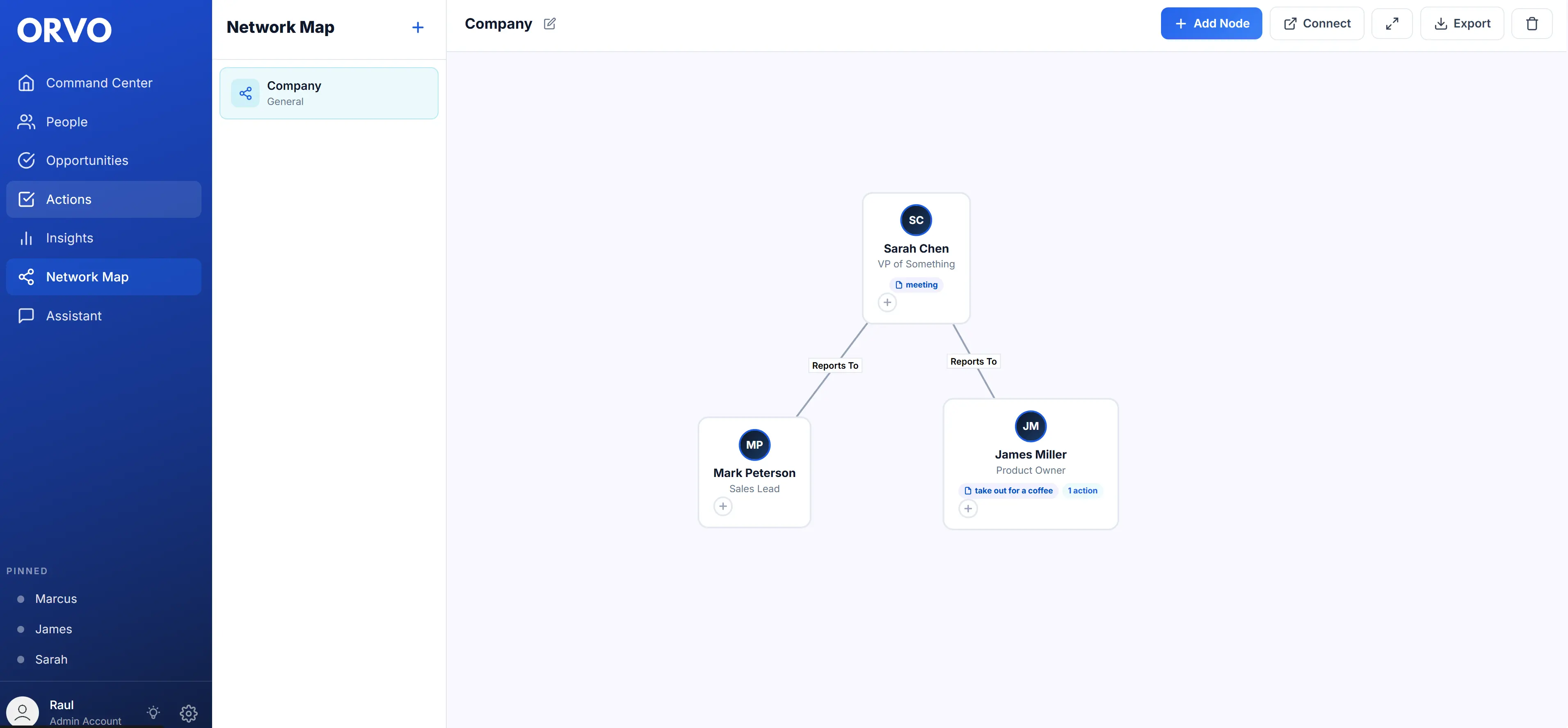
AI changes every year. Your relationships compound every year. Orvo helps you build the career asset that no technology can disrupt — your professional relationship portfolio. Start free →
Get Orvo FreeWichtige Erkenntnisse
- ✓ Future-proofing your career requires three pillars: AI fluency, relationship capital, and domain judgment
- ✓ "Learn to code" is the wrong answer — AI has democratised building. The scarce skills are communication, stakeholder management, and strategic thinking
- ✓ The World Economic Forum projects AI will create 78 million net new jobs by 2030. The fear narrative is wrong.
- ✓ Your relationship portfolio is your most AI-proof career asset — it compounds over time and persists through any technology change
- ✓ Use the 12-month plan: Q1 build AI foundation, Q2 expand tools and relationships, Q3 integrate into workflows, Q4 compound and share
- ✓ Jensen Huang's insight: AI elevates workers. Every professional can now operate at a higher level — if they invest in the right skills
- ✓ Track your professional relationships systematically — the combination of AI fluency and relationship intelligence is the career strategy for the next decade