
The AI proficiency gap: why most professionals are falling behind
There is a growing disconnect in every industry: companies are adopting AI faster than their employees are learning to use it. A 2025 Microsoft Work Trend Index found that 75% of knowledge workers now use AI at work — but most use it sporadically, for simple tasks like rewriting an email or summarising a document. Fewer than 15% have integrated AI into their core daily workflows.
This gap represents an enormous career opportunity. When 75% of people use a tool casually and 15% use it deeply, the 15% produce disproportionate results. They finish in two hours what takes others a full day. They come to meetings with deeper research. They prototype ideas instead of just describing them. They are not working harder — they are working with a multiplier.
The professionals most at risk are not those in specific industries or roles. They are the ones in every industry and every role who refuse to learn. Jensen Huang was explicit about this: when choosing between two equally qualified candidates, he would hire the one who is expert in using AI. This is already happening in hiring decisions across Big Tech, consulting, finance, and product management. AI proficiency is moving from the "nice to have" column to the "requirement" column on job descriptions.
The good news: the skills required to become AI-proficient are not primarily technical. You do not need to learn to code, understand neural networks, or build machine learning models. The most important AI skill turns out to be something most ambitious professionals already practice — clear, precise communication.
The three skill categories that actually matter
Forget the long lists of "top AI skills" that read like a computer science syllabus. For career-focused professionals, AI skills fall into three practical categories — and only one of them is about technology.
Category 1: AI Tool Proficiency (the technical layer). This is knowing how to use AI tools effectively in your specific domain. For a marketer, it is using AI for audience analysis, content drafting, and campaign optimisation. For a PM, it is using AI for rapid prototyping, user research synthesis, and stakeholder communication. For a manager, it is using AI for meeting preparation, performance analysis, and decision support.
The key insight: you do not need to master every AI tool. You need to master the 2-3 tools that are most relevant to your role and use them daily until they become second nature. Start with a general-purpose tool (ChatGPT or Claude), add a domain-specific tool (a product analytics AI, a sales intelligence tool, or a CRM with AI features like Orvo), and layer in a productivity tool (an AI meeting assistant or writing tool).
Category 2: Communication Precision (the amplifier layer). This is the skill Dan Thomasset highlighted from inside Google — the ability to write with precision and clarity. AI tools are only as good as the instructions they receive. A vague prompt gets a vague result. A precise, well-structured prompt gets an actionable result.
This is why PMs are outperforming engineers with AI tools in many contexts. PMs practice clear communication every day — writing specs, crafting user stories, presenting to stakeholders. They are trained to articulate requirements without ambiguity. This skill translates directly to AI proficiency. An engineer who writes beautiful code but vague prompts will get worse results from AI than a PM who writes clear natural language.
Category 3: Relationship Intelligence (the human layer). This is the skill AI cannot automate and the one most professionals underinvest in. Relationship intelligence means systematically understanding who matters in your professional landscape, what their priorities are, how to communicate with them, and when to engage. It means knowing that the CFO needs data before she supports an initiative, that the VP of Product responds best to visual prototypes, that the key decision on your project will be made in an informal hallway conversation, not in the scheduled review meeting.
AI can help you prepare for these interactions — it can research a stakeholder, draft talking points, summarise previous conversations. But it cannot replace the human act of building trust, reading the room, and navigating organisational politics. The professionals who combine AI fluency with systematic relationship management are the ones who become truly indispensable.
| Skill Category | What It Is | How to Build It | Time to Proficiency |
|---|---|---|---|
| AI Tool Proficiency | Using AI tools effectively in your specific role | Pick 2-3 tools → use daily for 2 weeks → build workflows | 2-4 weeks for basic fluency |
| Communication Precision | Writing clear instructions that AI (and humans) can act on | Practice structured prompts → review outputs → refine | 1-2 months of daily practice |
| Relationship Intelligence | Systematically tracking stakeholder dynamics and trust signals | Use a tool like Orvo → log interactions → review before meetings | Ongoing (compounds over time) |
AI tool proficiency: a practical 30-day plan
Most AI skills advice is abstract. Here is a concrete 30-day plan to go from casual AI user to proficient AI professional. This is not a course — it is a practice routine.
Week 1: Replace one manual task. Identify one thing you do every day that takes 30+ minutes and is largely repetitive. Meeting prep. Email drafting. Research summaries. Report formatting. Use an AI tool to do it instead. The goal is not perfection — it is building the habit of reaching for AI first.
Week 2: Build a prompt library. By the end of week 1, you will have written dozens of prompts. Some worked well. Some did not. Save the ones that worked into a personal prompt library — a document or note with your best prompts for recurring tasks. This is your AI playbook. Refine it as you learn what produces the best output.
Week 3: Add a second tool. You have been using a general-purpose AI (ChatGPT, Claude, or similar). Now add a domain-specific tool. If you are in sales or account management, try an AI-powered CRM like Orvo that provides relationship intelligence. If you are in product, try an AI prototyping tool. If you are in marketing, try an AI analytics tool. The goal is to see how AI works differently in specialised contexts.
Week 4: Combine AI with your human judgment. This is where most people stop growing. They use AI to generate output and then accept it. The professionals who become indispensable use AI to generate options and then apply their domain expertise, stakeholder knowledge, and judgment to choose the best one. AI drafts the presentation — you know which framing will resonate with this specific audience. AI summarises the research — you know which findings matter for this specific decision.
By the end of 30 days, you will have saved 5-10 hours per week and produced higher-quality work. More importantly, you will have developed the intuition for when AI helps and when human judgment is irreplaceable.
Communication precision: why writing clearly is the most underrated AI skill
The thread from Google's Dan Thomasset revealed a truth that the tech industry is only beginning to acknowledge: the most valuable skill in the AI era is not coding. It is communication.
A software engineer responding to Thomasset's post put it perfectly: "A major determinant for successfully using AI is the ability to write with precision and clarity. PMs and tech writers tend to do this already, but the skill is not evenly distributed among software engineers. This is why interdisciplinary education matters so much: it builds a stronger foundation for long-term adaptation."
Think about what this means. The hierarchy that has dominated tech companies for decades — where engineers sit at the top because they can build things — is being inverted. AI gives everyone the ability to build. What differentiates is the ability to articulate what should be built, why it matters, and how it fits into the larger picture.
This is not limited to tech. In every industry, the professionals who communicate clearly are getting disproportionate value from AI tools. A consultant who can write a precise brief gets a useful draft analysis from AI. A consultant who writes vaguely gets generic output and wastes time refining. A manager who can articulate exactly what they need from a stakeholder report gets a polished document. A manager who says "make it better" gets noise.
How to improve communication precision for AI (and humans):
1. Structure before you write. Before giving an AI tool any instruction, write the structure first: what is the goal, who is the audience, what format do you need, what constraints exist. This discipline produces better AI output and better human communication.
2. Be specific about what you do not want. AI tools respond well to exclusion criteria. "Write a stakeholder update, but do not include technical details and do not exceed 200 words" produces better results than "write a stakeholder update."
3. Give context. AI tools cannot read your mind or your organisational context. The more relevant context you provide — who the audience is, what they care about, what has happened before — the more useful the output. This is the same skill that makes you effective in meetings and presentations.
4. Review and refine. The professionals who get the most from AI do not accept the first output. They review it, identify what is missing or wrong, and give precise feedback. This iterative refinement is a communication skill, not a technical one.
Relationship intelligence: the skill AI cannot automate
Every article about AI skills focuses on the tools. Few talk about the skill that AI makes more valuable, not less: systematically managing your professional relationships.
Here is the logic. AI automates tasks that used to take hours: research, drafting, analysis, prototyping. This compression means you can do more, faster. But doing more, faster only matters if you are doing the right things — and in any organisation, knowing what the right things are depends on knowing people. Who has the authority to approve your initiative? Who will block it if not consulted? Who has the context you need to make a good decision? Who needs to hear about your results to advance your career?
These questions cannot be answered by AI. They can only be answered by someone who systematically tracks their professional relationships — who they have met, what was discussed, what each person cares about, who is connected to whom, and what the current dynamics are.
Consider the IKEA example again. The company could use AI to answer 60% of customer queries. But identifying the $1 billion opportunity in the remaining 40% required human judgment — understanding what customers actually wanted, recognising the gap between existing services and unmet needs, and having the organisational relationships to push for a new division. No AI tool would have proposed "retrain customer service staff as interior design consultants." That required human insight and relationship context.
The same principle applies to your career. AI can help you prepare a flawless presentation. But knowing that you should present to the COO first (because she influences the CEO's opinion) and frame it as a risk-reduction initiative (because the COO is risk-averse after last quarter's miss) — that is relationship intelligence. And it is the difference between a presentation that gets polite nods and one that gets funded.
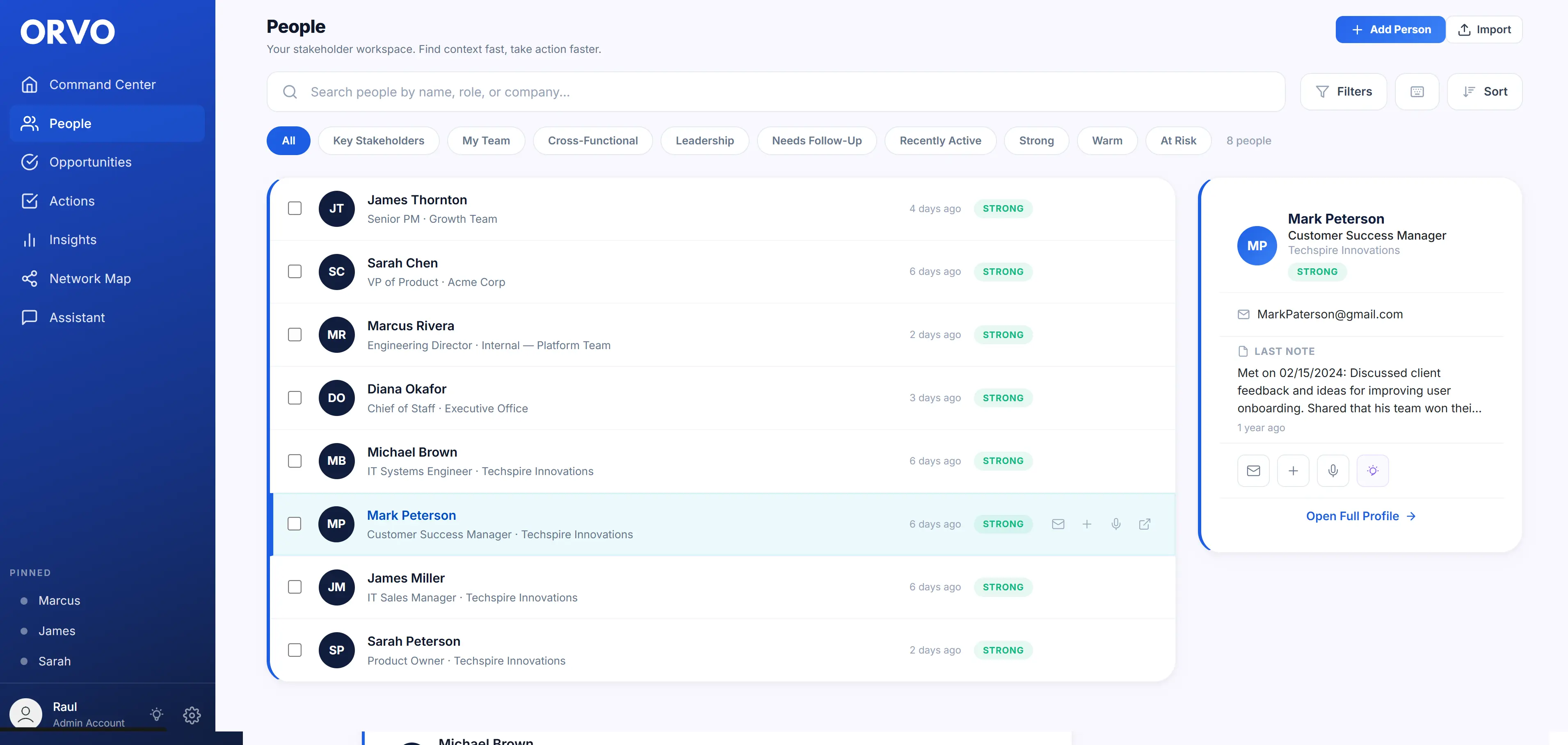
Orvo exists for exactly this purpose. While your AI tools handle the tactical work — drafting, researching, prototyping — Orvo tracks the relationship layer: stakeholder preferences, meeting history, follow-up commitments, and the organisational dynamics that determine whether your work actually gets adopted, approved, and rewarded.
The AI-proficient professional in practice: what a typical day looks like
Theory is useful. But what does an AI-proficient professional actually do differently on a Tuesday morning? Here is a realistic day-in-the-life comparison.
8:30 AM — Meeting prep. The non-AI professional scans their calendar, opens last week's notes, and walks into a stakeholder meeting with a general sense of what to discuss. The AI-proficient professional asks their AI tool to summarise the last 3 meetings with this stakeholder, highlights any open action items, and reviews their Orvo profile for this person — their communication preferences, current priorities, and any relationship notes. They walk in prepared with specific talking points and a clear agenda. Time saved: 20 minutes. Quality difference: enormous.
10:00 AM — Research and analysis. The non-AI professional spends 2 hours pulling data from multiple sources, building a spreadsheet, and formatting findings. The AI-proficient professional feeds the data sources into an AI tool, asks for specific analyses, and gets a first draft in 15 minutes. They spend the remaining time applying judgment — which findings matter for this audience, what the implications are, what action to recommend. They produce better work in less time because they use AI for the mechanical parts and reserve their energy for the strategic parts.
1:00 PM — Stakeholder communication. The non-AI professional drafts an update email from scratch, struggles with tone, and sends something adequate. The AI-proficient professional has a prompt template for stakeholder updates — they feed in the key points and get a polished draft in 2 minutes. They customise the tone for each recipient (more data-driven for the CFO, more narrative for the CEO) because they have logged each stakeholder's communication preferences.
3:00 PM — Project work. The non-AI professional writes a spec document and sends it to engineering for a prototype they will see in 3 weeks. The AI-proficient PM builds a working prototype with AI tools in 2 hours, tests it with a colleague, iterates, and presents a vetted prototype to engineering — who can now focus on making it scalable rather than guessing what the PM meant.
The difference is not marginal. The AI-proficient professional does 50-100% more high-quality work in the same hours. And crucially, they spend more time on the human parts of their job — relationship building, stakeholder alignment, creative strategy — because AI handles the mechanical parts.
| Time | Traditional Professional | AI-Proficient Professional | Difference |
|---|---|---|---|
| Meeting prep | Scans calendar and notes | AI summary + Orvo stakeholder review | Better prepared, specific talking points |
| Research | 2 hours manual data pulling | 15 min AI analysis + 45 min judgment | Higher quality in half the time |
| Communication | Draft from scratch, struggle with tone | AI draft + customise per stakeholder | Faster and more audience-appropriate |
| Project work | Write spec → wait 3 weeks for prototype | Build prototype in hours → hand engineers vetted implementation | Weeks faster, no translation gap |
| Relationship tracking | Memory and scattered notes | Systematic tracking in Orvo | Never forget context, always prepared |
AI skills get you in the door. Relationship intelligence keeps you there. Orvo combines both — AI-powered career intelligence that tracks your stakeholders, preps your meetings, and builds your professional edge. Start free →
Get Orvo FreeCommunication precision: why writing clearly is the most underrated AI skill
The thread from Google's Dan Thomasset revealed a truth that the tech industry is only beginning to acknowledge: the most valuable skill in the AI era is not coding. It is communication.
A software engineer responding to Thomasset's post put it perfectly: "A major determinant for successfully using AI is the ability to write with precision and clarity. PMs and tech writers tend to do this already, but the skill is not evenly distributed among software engineers. This is why interdisciplinary education matters so much: it builds a stronger foundation for long-term adaptation."
Think about what this means. The hierarchy that has dominated tech companies for decades — where engineers sit at the top because they can build things — is being inverted. AI gives everyone the ability to build. What differentiates is the ability to articulate what should be built, why it matters, and how it fits into the larger picture.
This is not limited to tech. In every industry, the professionals who communicate clearly are getting disproportionate value from AI tools. A consultant who can write a precise brief gets a useful draft analysis from AI. A consultant who writes vaguely gets generic output and wastes time refining. A manager who can articulate exactly what they need from a stakeholder report gets a polished document. A manager who says "make it better" gets noise.
How to improve communication precision for AI (and humans):
1. Structure before you write. Before giving an AI tool any instruction, write the structure first: what is the goal, who is the audience, what format do you need, what constraints exist. This discipline produces better AI output and better human communication.
2. Be specific about what you do not want. AI tools respond well to exclusion criteria. "Write a stakeholder update, but do not include technical details and do not exceed 200 words" produces better results than "write a stakeholder update."
3. Give context. AI tools cannot read your mind or your organisational context. The more relevant context you provide — who the audience is, what they care about, what has happened before — the more useful the output. This is the same skill that makes you effective in meetings and presentations.
4. Review and refine. The professionals who get the most from AI do not accept the first output. They review it, identify what is missing or wrong, and give precise feedback. This iterative refinement is a communication skill, not a technical one.
Relationship intelligence: the skill AI cannot automate
Every article about AI skills focuses on the tools. Few talk about the skill that AI makes more valuable, not less: systematically managing your professional relationships.
Here is the logic. AI automates tasks that used to take hours: research, drafting, analysis, prototyping. This compression means you can do more, faster. But doing more, faster only matters if you are doing the right things — and in any organisation, knowing what the right things are depends on knowing people. Who has the authority to approve your initiative? Who will block it if not consulted? Who has the context you need to make a good decision? Who needs to hear about your results to advance your career?
These questions cannot be answered by AI. They can only be answered by someone who systematically tracks their professional relationships — who they have met, what was discussed, what each person cares about, who is connected to whom, and what the current dynamics are.
Consider the IKEA example again. The company could use AI to answer 60% of customer queries. But identifying the $1 billion opportunity in the remaining 40% required human judgment — understanding what customers actually wanted, recognising the gap between existing services and unmet needs, and having the organisational relationships to push for a new division. No AI tool would have proposed "retrain customer service staff as interior design consultants." That required human insight and relationship context.
The same principle applies to your career. AI can help you prepare a flawless presentation. But knowing that you should present to the COO first (because she influences the CEO's opinion) and frame it as a risk-reduction initiative (because the COO is risk-averse after last quarter's miss) — that is relationship intelligence. And it is the difference between a presentation that gets polite nods and one that gets funded.
Orvo exists for exactly this purpose. While your AI tools handle the tactical work — drafting, researching, prototyping — Orvo tracks the relationship layer: stakeholder preferences, meeting history, follow-up commitments, and the organisational dynamics that determine whether your work actually gets adopted, approved, and rewarded.
The AI-proficient professional in practice: what a typical day looks like
Theory is useful. But what does an AI-proficient professional actually do differently on a Tuesday morning? Here is a realistic day-in-the-life comparison.
8:30 AM — Meeting prep. The non-AI professional scans their calendar, opens last week's notes, and walks into a stakeholder meeting with a general sense of what to discuss. The AI-proficient professional asks their AI tool to summarise the last 3 meetings with this stakeholder, highlights any open action items, and reviews their Orvo profile for this person — their communication preferences, current priorities, and any relationship notes. They walk in prepared with specific talking points and a clear agenda. Time saved: 20 minutes. Quality difference: enormous.
10:00 AM — Research and analysis. The non-AI professional spends 2 hours pulling data from multiple sources, building a spreadsheet, and formatting findings. The AI-proficient professional feeds the data sources into an AI tool, asks for specific analyses, and gets a first draft in 15 minutes. They spend the remaining time applying judgment — which findings matter for this audience, what the implications are, what action to recommend. They produce better work in less time because they use AI for the mechanical parts and reserve their energy for the strategic parts.
1:00 PM — Stakeholder communication. The non-AI professional drafts an update email from scratch, struggles with tone, and sends something adequate. The AI-proficient professional has a prompt template for stakeholder updates — they feed in the key points and get a polished draft in 2 minutes. They customise the tone for each recipient (more data-driven for the CFO, more narrative for the CEO) because they have logged each stakeholder's communication preferences.
3:00 PM — Project work. The non-AI professional writes a spec document and sends it to engineering for a prototype they will see in 3 weeks. The AI-proficient PM builds a working prototype with AI tools in 2 hours, tests it with a colleague, iterates, and presents a vetted prototype to engineering — who can now focus on making it scalable rather than guessing what the PM meant.
The difference is not marginal. The AI-proficient professional does 50-100% more high-quality work in the same hours. And crucially, they spend more time on the human parts of their job — relationship building, stakeholder alignment, creative strategy — because AI handles the mechanical parts.
| Time | Traditional Professional | AI-Proficient Professional | Difference |
|---|---|---|---|
| Meeting prep | Scans calendar and notes | AI summary + Orvo stakeholder review | Better prepared, specific talking points |
| Research | 2 hours manual data pulling | 15 min AI analysis + 45 min judgment | Higher quality in half the time |
| Communication | Draft from scratch, struggle with tone | AI draft + customise per stakeholder | Faster and more audience-appropriate |
| Project work | Write spec → wait 3 weeks for prototype | Build prototype in hours → hand engineers vetted implementation | Weeks faster, no translation gap |
| Relationship tracking | Memory and scattered notes | Systematic tracking in Orvo | Never forget context, always prepared |
AI skills get you in the door. Relationship intelligence keeps you there. Orvo combines both — AI-powered career intelligence that tracks your stakeholders, preps your meetings, and builds your professional edge. Start free →
Get Orvo FreeWichtige Erkenntnisse
- ✓ AI literacy is becoming a baseline job requirement, not a differentiator — like email or spreadsheets before it
- ✓ The three skill categories that matter: AI tool proficiency, communication precision, and relationship intelligence
- ✓ You do not need to code to be AI-proficient — the most important skill is writing clear, precise instructions
- ✓ AI amplifies your existing strengths. A strong communicator with AI tools becomes a superpower. A poor communicator with AI tools just produces more noise faster
- ✓ The highest-value professionals combine AI fluency with deep stakeholder management skills — they use AI for speed and relationships for impact
- ✓ Start with one AI tool in your daily workflow this week. Build fluency through daily use, not courses
- ✓ Track the relationships AI cannot manage — stakeholder dynamics, trust signals, political context — systematically with a tool like Orvo