
The ISTJ superpower: operational excellence that makes organisations work
ISTJs do what they say they will do. Every time. This sounds simple. It is extraordinarily rare. A 2024 study by the Project Management Institute found that only 35% of projects are completed on time and on budget. ISTJs are disproportionately responsible for the 35% that succeed — because they plan thoroughly, execute precisely, and track progress relentlessly.
The ISTJ operational advantage extends beyond reliability. You bring three capabilities that organisations desperately need:
1. Institutional memory. ISTJs remember what worked, what failed, and why. When someone proposes an initiative that was tried and failed three years ago, you are the person who remembers the context. This institutional memory prevents expensive repetition of past mistakes.
2. Risk identification. While visionary types paint exciting futures, ISTJs see the risks. "What happens when the system fails?" "What if the vendor cannot deliver?" "Have we tested the backup process?" These questions are not pessimism — they are operational intelligence that prevents costly failures.
3. Process design. ISTJs create the processes that make organisations scalable. The handbook, the checklist, the standard operating procedure, the quality control system — these are ISTJ creations that allow organisations to maintain quality as they grow.
The ISTJ career paradox: these capabilities are essential but invisible. Nobody thanks the quality system for preventing errors — they only notice when errors occur. Nobody credits the process designer when the team ships on time — they credit the team lead. The ISTJ's excellence creates the foundation that everyone else builds on, and the foundation gets taken for granted.
A Korn Ferry study found that professionals who score highest on "execution" and "detail orientation" are rated 20% lower on "leadership potential" than those who score highest on "strategic vision" — despite producing better results. This is the systemic bias ISTJs face in virtually every corporate environment, and this playbook addresses it directly with practical tools.
The ISTJ blind spots that create a leadership ceiling
ISTJs are not held back by lack of skill. They are held back by specific patterns that make their strategic capability invisible.
Blind spot 1: Process loyalty over strategic adaptation. ISTJs follow established processes precisely — which is their strength. But when the process is wrong, outdated, or insufficient, ISTJs often continue following it rather than challenging it. The ability to say "this process no longer serves us, here is a better one" is seen as strategic thinking. The ability to follow any process perfectly is seen as execution.
Blind spot 2: Communicating the what without the why. ISTJs report what was done, how it was done, and when it was done. They rarely communicate why it matters. "I completed the Q3 audit with zero findings" is execution reporting. "The Q3 audit confirmed we are fully compliant, which protects us from the regulatory risk that cost our competitor $5M last quarter" is strategic framing. Same work. Different perception.
Blind spot 3: Discomfort with ambiguity. ISTJs want clear requirements, defined processes, and known outcomes. But senior leadership roles are defined by ambiguity — incomplete information, conflicting stakeholder needs, and decisions without clear right answers. ISTJs who cannot operate in ambiguity are perceived as "not ready for the next level" even when their executional capability exceeds everyone else's.
Blind spot 4: Underinvestment in relationships. ISTJs value work product over relationships. You believe that the quality of your output should be sufficient to advance your career. It is not. Research consistently shows that relationships, visibility, and perception account for 60-70% of career advancement. The ISTJ who produces the best work but has no senior sponsors, no cross-functional relationships, and no champion advancing their cause will be outpaced by less capable colleagues who invested in people.
Blind spot 5: Resistance to change. ISTJs prefer stability and are naturally sceptical of change. This is often wisdom — most changes are poorly planned. But the perception of resistance to change is a career limitation. The fix is not embracing every change uncritically. It is asking: "What would it take for this change to work?" instead of "Why this change will not work." The first response is seen as strategic. The second is seen as obstructive.
| ISTJ Blind Spot | What You Do | How It Is Perceived | The Fix |
|---|---|---|---|
| Process loyalty | Follow the process precisely | "Good executor, not strategic" | Improve the process — propose a better one when current fails |
| What without why | Report completion, not impact | "Does the work, does not see the big picture" | Frame every accomplishment in terms of business impact |
| Ambiguity discomfort | Request clarity before acting | "Needs too much direction" | Act on 80% information. Iterate. Comfort with ambiguity is trainable. |
| Relationship underinvestment | Let output speak for itself | "Great worker, but I don't really know them" | Build 5 strategic relationships — monthly investment |
| Change resistance | "Why this will not work" | "Obstructive, not forward-thinking" | "What would it take for this to work?" — same scepticism, better framing |
Strategic framing: how to make ISTJ work look like leadership
The single highest-ROI skill for ISTJs is strategic framing — translating your operational work into the language of business impact and strategic value.
The ISTJ Communication Upgrade: Activity → Impact → Implication.
ISTJ default: "I completed the vendor compliance audit for all 47 suppliers."
Upgrade: "I completed the vendor compliance audit [activity] and identified 3 suppliers with material risk exposure totalling $2.3M [impact]. I have already initiated corrective actions that will be resolved by Q4, protecting us from the regulatory penalties our competitor faced last quarter [implication]."
Same work. The first version is invisible. The second version is memorable.
The "So what?" test. Before sharing any update with your manager or in a meeting, ask yourself: "So what?" If you cannot explain why your work matters in business terms, you have not finished the framing. "I filed all Q3 reports" → So what? → "All Q3 reports are filed, meaning we are fully prepared for the audit that starts next week, avoiding the delays that caused issues last year." The "so what" is where the strategic value lives.
The monthly strategic update. Send your manager a monthly email with 3-5 bullet points framed using Activity → Impact → Implication. This is not self-promotion. It is strategic communication — and it is exactly what senior leaders do when they report to their boards. You are practising executive communication at every level.
Reframe your resume language. ISTJs write resumes full of activities: "Managed the procurement process for 200+ vendors." Rewrite every bullet as impact: "Designed and managed the vendor procurement process that reduced costs by 15% and eliminated all compliance violations across 200+ suppliers — protecting $12M in annual spend." The first version gets a "solid executor" reaction. The second gets a "strategic leader" reaction. Same person, same work.
Present your risk identification as strategic foresight. When you spot a risk, frame it proactively: "I have identified a potential issue with our Q4 timeline. If we do not address the vendor delay now, it will push our launch by 3 weeks. Here is my recommended mitigation plan." This transforms your natural risk-spotting from "pessimism" into "strategic foresight" — which is exactly what it is.
The ISTJ relationship strategy: building trust through reliability
ISTJs build relationships differently from other types — not through charm or social energy but through demonstrated reliability over time. This is actually the strongest form of professional trust. The colleague who shows up consistently for 3 years earns deeper trust than the charming extravert who impresses for 3 weeks.
The ISTJ Strategic Five.
1. Your manager. Schedule monthly career conversations (not just task check-ins). Share your aspirations explicitly. Ask: "What would it take for me to be considered for [specific next role]?"
2. A senior sponsor. Identify one leader 2+ levels above you who has seen your work. Build this relationship through consistent delivery on anything they are involved in. The ISTJ's greatest sponsorship asset: when you commit to something for a senior leader and deliver perfectly, you earn trust that no amount of networking can replicate.
3. A cross-functional peer. Build one genuine relationship with someone in a different function. This expands your perspective (you see the organisation from another angle) and creates a cross-functional advocate.
4. A complementary type (ENTP or ENFP). ISTJs and ENTPs/ENFPs are natural complements. They bring the vision and energy you lack. You bring the execution and reliability they lack. This partnership produces results that neither could achieve alone. The ISTJ-ENTP pair is one of the most productive in corporate life.
5. An external contact. One person outside your company who gives you perspective on your career and market value. ISTJs tend to become so focused on internal execution that they lose sight of external opportunities.
The ISTJ relationship maintenance approach. You will not maintain relationships through spontaneous social interaction. That is fine. Set calendar reminders: monthly 1-on-1 with your manager, quarterly touchpoint with your sponsor, bi-monthly coffee with your cross-functional peer. The system does the maintaining. You show up and deliver value through thoughtful conversation.
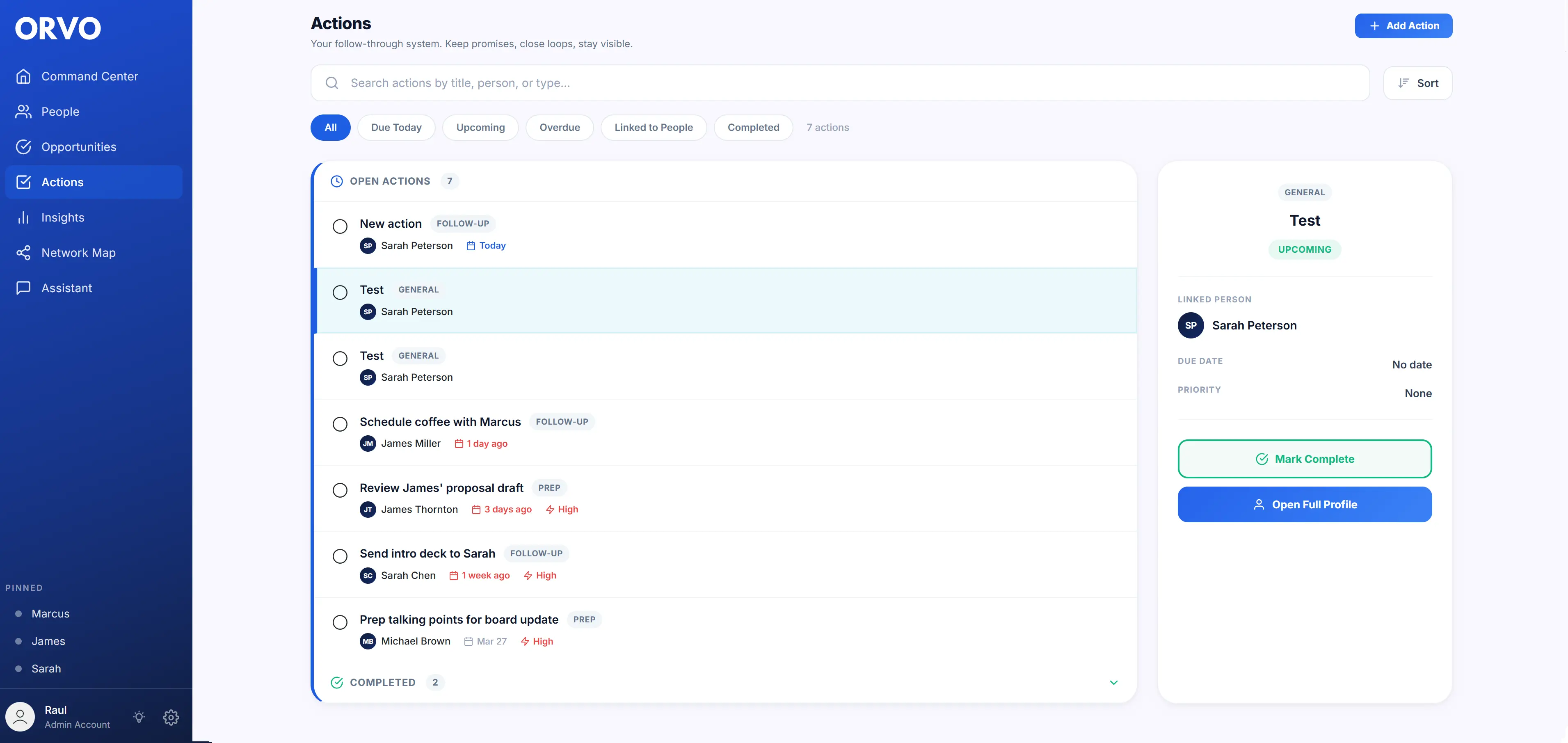
Use Orvo to track your Strategic Five. Log each interaction, note their priorities and communication preferences, and review before every meeting. ISTJs excel at systematic processes — apply that strength to relationship management. Before meeting your senior sponsor, review your Orvo notes: what they care about, what you discussed last time, what you committed to. This systematic preparation makes every interaction feel personalised and thoughtful — because it is.
The ISTJ career path: from executor to strategic leader
ISTJs thrive in roles that require precision, process, and reliability. The career challenge is moving from being valued for execution to being valued for strategic leadership.
Roles where ISTJs thrive: Accounting and finance, engineering, quality assurance, compliance and regulatory, project management, operations management, supply chain, law, military, and any role where precision and reliability are the core requirements. ISTJs in these roles consistently receive the highest performance ratings.
Roles where ISTJs struggle: Creative roles with no clear process (too ambiguous), startup chaos without defined structures (too unstructured), roles requiring heavy improvisation and public speaking (too performative), and positions where the rules change constantly (too unstable).
The ISTJ leadership trajectory. Early career: valued for reliability and execution. Mid-career: promoted into management because you can be trusted with responsibility. Senior career: the ceiling appears — you need to demonstrate strategic thinking, comfort with ambiguity, and the ability to inspire (not just direct) a team. The ISTJs who break through this ceiling learn to frame their operational expertise as strategic capability — "I build the systems that make strategy executable."
The ISTJ in the AI era. ISTJs have a unique advantage: they are the best at evaluating AI output. While others accept AI-generated work uncritically, ISTJs check the details, verify the accuracy, and catch the errors that AI produces. This critical quality assurance capability becomes significantly more valuable as AI generates more content, analysis, and decisions. The ISTJ who positions themselves as "the person who ensures AI output is reliable" has a career that appreciates in value as AI adoption grows.
Famous ISTJs: Warren Buffett, Angela Merkel, and Jeff Bezos (early career) are frequently typed as ISTJs. What they share is not charisma — it is systematic thinking, long-term reliability, and the ability to build organisational systems that compound over time.
| Career Stage | ISTJ Strength | ISTJ Ceiling | Investment Required |
|---|---|---|---|
| Early (0-5 years) | Reliability, precision, delivery | Typecast as "good executor" | Strategic framing + monthly impact summaries |
| Mid (5-12 years) | Process design, risk management | Perceived as "not visionary" | Build Strategic Five + comfort with ambiguity |
| Senior (12+ years) | Institutional knowledge, system building | Seen as operator, not leader | Frame operations AS strategy. "I build executable strategy." |
Comfort with ambiguity: the ISTJ growth edge
Ambiguity tolerance is the specific skill that separates ISTJs who reach senior leadership from those who plateau. It is also the skill ISTJs resist most — because your strength is precision, and ambiguity is the opposite of precision.
The ISTJ ambiguity framework: Structure the Unstructured.
You do not need to become comfortable with chaos. You need to bring your ISTJ superpower — creating structure — to ambiguous situations. When faced with uncertainty:
1. Define what you know. List the facts. ISTJs are the best fact-gatherers of any type. Start there.
2. Define what you do not know. List the unknowns explicitly. This is not anxiety — it is analysis. Naming the unknowns makes them manageable.
3. Define what you would need to know to decide. This is the strategic step that transforms ISTJ analysis into leadership. "I need clarity on X, Y, and Z before I can recommend a direction. Here is how I plan to get that clarity by Friday."
4. Act on 80%. The hardest step. ISTJs want 100% information before acting. In senior leadership, you rarely have more than 80%. Practise making decisions with 80% confidence and iterating based on results. The first few times feel uncomfortable. By the tenth time, you discover that 80% confidence decisions made quickly are usually better than 100% confidence decisions made late.
The ambiguity reframe. You are not bad at ambiguity. You are the person who resolves ambiguity. When a project is chaotic, the ISTJ who says "Let me create a framework for this" is providing the highest-value leadership in the room. Your instinct to structure is not a weakness in ambiguous situations — it is exactly what the situation needs.
Practise with safe ambiguity. Volunteer for one project per quarter that does not have a clear playbook. Not a high-stakes transformation — a medium-stakes initiative where the process has not been defined. Use it to practise the framework above. After three such projects, ambiguity tolerance stops being a weakness and starts being a demonstrable skill.
The ISTJ ambiguity advantage that nobody talks about. Here is a counterintuitive truth: ISTJs who learn to operate in ambiguity are actually MORE effective than naturally ambiguity-comfortable types (ENTPs, ENFPs) because ISTJs bring structure to chaos while ENTPs often add more chaos. The team that needs someone to say "OK, here is what we know, here is what we do not know, and here is our next step" needs an ISTJ, not another brainstormer. Your discomfort with ambiguity is what drives you to resolve it — and resolving ambiguity is one of the highest-value leadership actions in any organisation.
A 2024 McKinsey study of transformation leaders found that the most effective change leaders were not the most visionary — they were the most systematic at converting ambiguous situations into structured action plans. This is the ISTJ superpower applied to change management. You do not need to love change. You need to be the person who makes change manageable for everyone else.
The ISTJ at different career stages
Early career (0-5 years). You are the most reliable new hire on any team. You learn processes quickly, deliver consistently, and produce error-free work. The risk: being given more and more execution tasks without strategic exposure. The investment: volunteer for one project per quarter that requires more than execution — something that involves stakeholder alignment, ambiguity, or cross-functional coordination. Start your evidence file with impact framing from day one.
Mid-career (5-12 years). You have been promoted into a management role because you are the most trustworthy person on the team. The challenge: managing people is not the same as managing processes. People are ambiguous, emotional, and unpredictable — everything ISTJs find uncomfortable. The investment: develop your people management skills deliberately. Have regular 1-on-1s. Ask your direct reports what motivates them. Learn that different people need different management approaches. Build your Strategic Five.
Senior career (12+ years). ISTJs who reach senior levels are often the most respected leaders in their organisation — because their track record of reliability spans decades. The challenge: senior roles require inspiring others, not just directing them. The ISTJ who can paint a vision of the future ("Here is where we are going") while also providing the operational roadmap ("Here is exactly how we will get there") is extraordinarily compelling. Most leaders can do one. The ISTJ who learns to do both is nearly unstoppable.
The ISTJ compound effect. Reliability compounds. Every commitment met is a deposit in the trust bank. Over 15-20 years, the ISTJ has a trust balance that no amount of charisma can match. When the ISTJ says "I can deliver this," everyone in the room believes it — because you have never failed to deliver. This trust is the most valuable career asset any professional can build. Track it deliberately in Orvo. Your relationship history IS your career capital.
The ISTJ career mistake to avoid at every stage. Do not confuse being indispensable in your current role with career advancement. The ISTJ who is "too valuable to promote" is the ISTJ who never taught anyone else to do their job. Document your processes. Train your replacement. Make yourself promotable by making yourself replaceable in your current role — while simultaneously demonstrating that you can operate at the next level.
The ISTJ and salary negotiation. ISTJs tend to accept compensation based on what they believe is fair according to established scales and structures. But salary bands have ranges, and where you fall in that range depends on how effectively you advocate. Research your market value annually using Glassdoor, PayScale, and industry surveys. If your compensation is below the midpoint for your experience and performance, schedule a conversation: "Based on my contributions this year [cite evidence file] and the market data for this role [cite range], I would like to discuss an adjustment to X." This is not confrontational — it is systematic. And ISTJs are the best at systematic approaches.
The ISTJ networking in the AI era. ISTJs can use AI tools to make networking feel less uncomfortable. Use ChatGPT to draft personalised follow-up messages after meetings. Use AI to research stakeholders before conversations. Use Orvo's AI features to generate meeting preparation briefs. The combination of AI-assisted preparation and ISTJ reliability creates interactions that feel natural and productive — because you walk in fully prepared, which is when ISTJs are at their best.
The ISTJ and innovation: how to contribute without betraying your nature
ISTJs are not innovators in the traditional sense — you do not generate wild ideas or propose radical change. But you contribute to innovation in ways that are essential and undervalued.
The ISTJ innovation contribution: making ideas work.
For every ENTP who generates a brilliant idea, there needs to be an ISTJ who figures out how to implement it reliably, at scale, without breaking existing systems. This is not a lesser contribution — it is the contribution that determines whether an idea becomes a product or dies in a PowerPoint.
Innovation roles for ISTJs:
1. The feasibility analyst. When someone proposes an initiative, you assess: Can it be done? What does it require? What are the risks? This assessment is essential — and it is innovation work, not obstruction.
2. The process innovator. You see inefficiencies in systems that others accept. Your innovation is not creating new products — it is creating new processes that make everything more efficient. A 15% process improvement across an organisation often generates more value than a single new product.
3. The quality guardian. You ensure that innovation does not break what already works. The ISTJ who says "I support this change, and here is how we implement it without disrupting our existing commitments" is practising the most practical form of change management.
The ISTJ innovation language. Instead of "This will not work" (perceived as obstructive), try "Here is what it would take to make this work" (perceived as constructive). Instead of "We have tried this before" (perceived as resistant), try "When we tried something similar in 2022, here is what we learned — and here is how I think we could approach it differently this time" (perceived as institutional wisdom).
The ISTJ who learns to frame their natural caution as constructive contribution — rather than resistance — becomes the most trusted voice in any innovation discussion. Because when the ISTJ says "I think this can work," everyone believes it. That credibility is your innovation superpower.
The ISTJ quality brand. Over a career, ISTJs build a reputation for quality that becomes a personal brand. When the ISTJ reviews a document, people trust it is error-free. When the ISTJ signs off on a project, people trust it is ready. When the ISTJ says a timeline is achievable, people plan around it. This quality brand is a career asset that appreciates with every year of consistent delivery.
Build it deliberately. Use Orvo to track your quality contributions — errors caught, risks identified, processes improved, deadlines met. When review season comes, this log transforms vague reliability into specific, measurable impact that justifies promotion and compensation increases.
The ISTJ and delegation. ISTJs struggle to delegate because nobody else meets their standards. "It is faster to do it myself" is the ISTJ mantra. This is true in the short term and career-limiting in the long term. Leaders who cannot delegate cannot scale. Practise delegating one task per week to a direct report — and accept that 90% quality from them is acceptable if it frees you for 100% quality strategic work that only you can do. Delegation is not lowering your standards. It is applying your standards where they create the most value.
ISTJs build the systems that make organisations work. Orvo builds the system that makes your career work — track stakeholders, prepare with evidence, and turn your reliability into recognised leadership. Start free →
Get Orvo FreeWichtige Erkenntnisse
- ✓ ISTJs are responsible for the 35% of projects that deliver on time and on budget. Your operational excellence is measurable business value.
- ✓ Five blind spots: process loyalty over adaptation, reporting what without why, ambiguity discomfort, relationship underinvestment, and perceived change resistance
- ✓ Strategic framing: Activity → Impact → Implication. Add the "so what" to every update.
- ✓ Build a Strategic Five: manager, senior sponsor, cross-functional peer, complementary type (ENTP/ENFP), and external contact.
- ✓ Comfort with ambiguity: you do not need to love chaos. You need to bring structure TO chaos. That IS strategic leadership.
- ✓ In the AI era, ISTJs who evaluate and verify AI output become more valuable — quality assurance of AI is a growing career advantage.
- ✓ Reliability compounds. 15-20 years of consistent delivery creates a trust balance that no charisma can match.