
What MBTI actually is (and what it is not)
The Myers-Briggs Type Indicator sorts people along four dimensions: Extraversion (E) vs Introversion (I), Sensing (S) vs Intuition (N), Thinking (T) vs Feeling (F), and Judging (J) vs Perceiving (P). This creates 16 personality types, each a four-letter code like ENTJ or ISFP.
MBTI is the most widely used personality assessment in the world. An estimated 50 million people have taken it, and 88% of Fortune 500 companies use it in some form for team development, leadership training, or hiring insight. If you work in a large corporation, you will encounter it — probably multiple times.
Here is what MBTI is NOT: it is not a scientifically rigorous predictor of job performance. The test-retest reliability is around 50% — meaning half of people get a different type when they retake it. Academic psychologists generally prefer the Big Five model (OCEAN) for research purposes.
But here is what MBTI IS useful for: it gives teams a shared vocabulary for talking about communication preferences. When your ESTJ manager says "just give me the bottom line" and your INFP colleague wants to discuss how the change makes the team feel — that is not a personality conflict. It is a communication style difference. MBTI helps name these differences so you can adapt instead of clash.
The practical value of MBTI is not in typing yourself. It is in understanding how to adapt your communication style to each stakeholder. That is a career skill worth developing.
The four dimensions that actually matter at work
Forget memorising 16 types. For career purposes, focus on the four dimensions — each one tells you something practical about how to work with someone.
Extraversion (E) vs Introversion (I) — How they recharge. Extraverts think out loud. They process by talking. If you schedule a meeting with an E-type, expect them to brainstorm verbally — they are not presenting final thoughts, they are thinking. Introverts process internally. They need time to reflect before responding. If you ambush an I-type with a question in a meeting, you will get a worse answer than if you send the question 24 hours ahead.
Sensing (S) vs Intuition (N) — How they take in information. Sensors want facts, details, and proven approaches. "Show me the data. What worked before?" Intuitives want patterns, possibilities, and the big picture. "What could this become? What are we not seeing?" Most miscommunication in corporate life happens on this axis. Your S-type CFO wants a spreadsheet. Your N-type CEO wants a vision. Same project, different language.
Thinking (T) vs Feeling (F) — How they make decisions. Thinkers decide based on logic, consistency, and objective criteria. Feelers decide based on values, impact on people, and harmony. Neither is better. But if you pitch a restructuring to a T-type with "the team will feel more supported," it will not land. Lead with the efficiency gains. Conversely, presenting a cold cost-benefit analysis to an F-type without acknowledging the human impact will feel tone-deaf.
Judging (J) vs Perceiving (P) — How they organise their work. Judgers want plans, deadlines, and closure. They are uncomfortable with open-ended ambiguity. Perceivers want flexibility, options, and room to adapt. They feel constrained by rigid timelines. If you work for a J-type boss, send the agenda before the meeting and deliver on time. If you work for a P-type boss, leave room for pivots and do not lock in too early.
| Dimension | Style A | Style B | At Work This Means... |
|---|---|---|---|
| E vs I | Extraversion: thinks out loud, energised by people | Introversion: thinks internally, energised by solo work | Send I-types agendas ahead of time; let E-types brainstorm verbally |
| S vs N | Sensing: wants data, details, proven methods | Intuition: wants big picture, patterns, possibilities | Give S-types spreadsheets; give N-types the vision |
| T vs F | Thinking: decides on logic and consistency | Feeling: decides on values and people impact | Lead with ROI for T-types; lead with team impact for F-types |
| J vs P | Judging: wants plans, deadlines, closure | Perceiving: wants flexibility, options, adaptability | Give J-types timelines; give P-types room to pivot |
How to use MBTI to communicate with any stakeholder
The real career value of MBTI is not knowing your own type — it is adapting your communication style to each stakeholder. Here is a practical framework.
Step 1: Observe, don\'t test. You do not need to ask people their type (and you should not — it sounds weird). Instead, pay attention to cues. Do they want the executive summary or the full analysis? Do they decide quickly or need time? Do they lead with data or with how the team feels? Two meetings of observation is enough to place someone on each dimension.
Step 2: Log it. Keep a brief note on each stakeholder\'s communication preferences. Not their four-letter type — that is too abstract. Instead: "Prefers data over vision. Decides quickly. Wants agenda in advance. Cares about team morale." This is more useful than "ESTJ."
Step 3: Adapt your prep. Before any important meeting, review your stakeholder\'s preferences and adjust your approach. Presenting to an ST (Sensing-Thinking) executive? Lead with numbers and a clear recommendation. Presenting to an NF (Intuitive-Feeling) leader? Lead with the vision and how the team will benefit.
Step 4: Adapt during the conversation. If someone keeps asking "but how will the team feel about this?" — they are an F-type. Stop pushing data and address the human impact. If someone keeps asking "what does the data say?" — they are an S-type or T-type. Stop painting the vision and show them the spreadsheet.
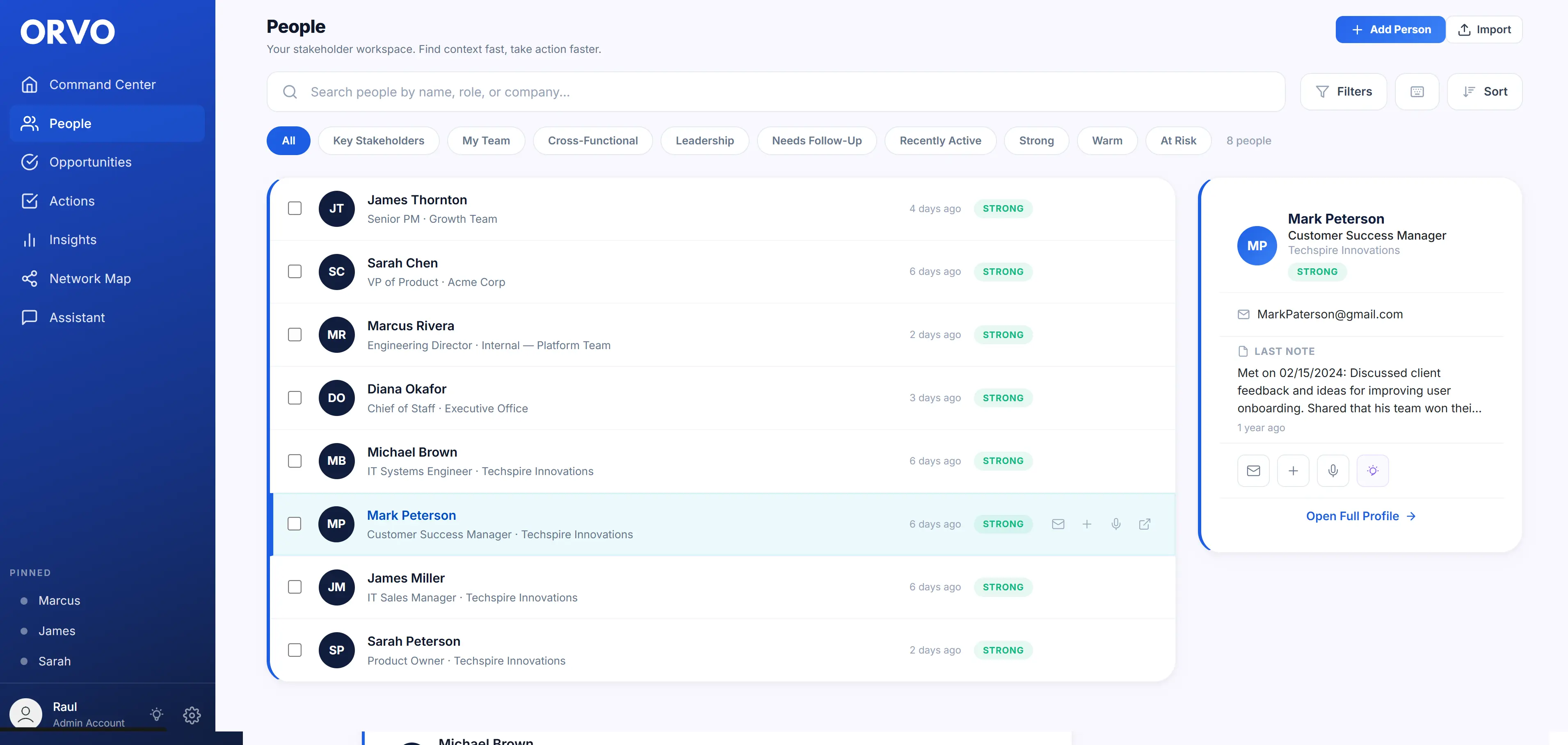
Relationship management tools like Orvo let you tag each contact with communication preferences and review them before meetings. Over time, this builds into a personal playbook for every important stakeholder in your life.
MBTI for managers: leading a team of different types
If you manage a team, MBTI gives you a framework for avoiding the most common leadership mistake: managing everyone the way you want to be managed.
An ENTJ manager (direct, decisive, big-picture) managing an ISFP employee (reflective, detail-oriented, values-driven) will instinctively give rapid-fire strategic direction and expect quick execution. The ISFP will feel steamrolled and disengaged. Not because the direction is wrong — but because the delivery does not match how they process.
Practical adaptations for each dimension:
For introverts on your team: Do not put them on the spot in group meetings. Send questions in advance. Create space for written input. Schedule 1-on-1s where they can share ideas privately. Introverts are not disengaged — they are processing internally.
For sensors on your team: Give concrete instructions and clear deliverables. "Redesign the onboarding flow" is too abstract for an S-type. "Reduce onboarding completion time from 45 minutes to 20 minutes by simplifying steps 3-7" is actionable.
For feelers on your team: Frame feedback in terms of growth, not failure. "This approach will help you build stronger client relationships" lands better than "your client communication is below standard." F-types are not less capable — they process feedback through a values lens.
For perceivers on your team: Give outcomes, not rigid processes. "We need this delivered by Friday" works. "Use this exact template and follow steps 1-8 in order" does not. P-types do their best work when they have freedom to adapt.
The best managers do not treat their team uniformly. They build a profile for each direct report — their communication preferences, what motivates them, how they process feedback — and adapt accordingly. This is what executive coaches charge hundreds per hour for. It is also what a good relationship management system lets you do for free.
Beyond MBTI: other assessments worth knowing
MBTI is the most common corporate personality assessment, but it is not the only one. Here are the others you will likely encounter, and what each adds.
Enneagram maps nine personality types based on core motivations and fears. Where MBTI tells you *how* someone communicates, Enneagram tells you *why*. A Type 3 (Achiever) is motivated by success and recognition. A Type 5 (Investigator) is motivated by competence and understanding. Knowing someone\'s Enneagram type helps you understand what drives them at a deeper level.
DiSC profiles four communication styles: Dominance, Influence, Steadiness, and Conscientiousness. It is simpler than MBTI and more directly actionable for workplace communication. Many sales teams use DiSC because the four quadrants map directly to "how to pitch this person."
CliftonStrengths (StrengthsFinder) identifies your top 5 strengths out of 34 themes. Unlike MBTI (which maps preferences), StrengthsFinder maps talents. It is useful for career planning — leaning into your natural strengths rather than fixing weaknesses.
Emotional Intelligence (EQ) assessments measure self-awareness, self-regulation, motivation, empathy, and social skill. Research by TalentSmart found that EQ accounts for 58% of job performance across all types of jobs. Unlike personality type (relatively fixed), EQ is highly trainable.
The smart approach: do not obsess over any single framework. Instead, use them all as lenses. When you meet a new stakeholder, observe their communication style (DiSC/MBTI), try to understand their motivation (Enneagram), and track everything in one place so you can adapt your approach next time.
| Assessment | What It Measures | Best For | Corporate Adoption |
|---|---|---|---|
| MBTI | Communication preferences (4 dimensions, 16 types) | Understanding how people process and decide | 88% of Fortune 500 |
| Enneagram | Core motivations and fears (9 types) | Understanding why people behave the way they do | Growing — popular in tech and coaching |
| DiSC | Communication style (4 quadrants) | Quick adaptation for meetings and pitches | Very common in sales and leadership training |
| CliftonStrengths | Top 5 natural talents (34 themes) | Career planning and team composition | Common in HR and L&D programmes |
| EQ Assessment | Emotional intelligence (5 components) | Self-improvement and leadership development | Standard in leadership programmes |
Building your stakeholder communication playbook
Here is the practical system for turning personality assessment knowledge into a career advantage.
Week 1: Profile your top 10 stakeholders. For each person, note: Do they prefer data or vision? Do they decide with logic or values? Do they want agendas in advance or spontaneous discussion? Do they process out loud or need think time? You can answer these from observation — no test required.
Week 2-4: Adapt and test. Before each meeting, review your stakeholder\'s profile and consciously adjust your approach. Track what works. "Led with data for CFO meeting — much better response than last time when I led with the vision." Refine your notes.
Ongoing: Build the habit. After every interaction, spend 15 seconds updating your stakeholder notes. Over 3 months, you build a communication playbook that makes you the most effective communicator in any room.
The tools: Orvo lets you log communication preferences as tags and notes on each contact, then surfaces them in AI-generated meeting prep briefs. LinkedIn gives you background on someone\'s role and history. Your company\'s MBTI/DiSC results (if shared) give you a head start on profiling.
The goal is not to manipulate people. It is to communicate in the way they can best receive. That is respect — and it is the single most undervalued career skill in corporate life.
Stop guessing how to communicate with each stakeholder. Orvo lets you log their preferences and review them before every meeting — free trial, no credit card.
Get Orvo FreeWichtige Erkenntnisse
- ✓ MBTI is used by 88% of Fortune 500 companies — you will encounter it, so learn to use it practically
- ✓ The real value is not your own type — it is adapting your communication to each stakeholder's preferences
- ✓ Focus on two questions per stakeholder: Do they want data or vision? Do they decide with logic or values?
- ✓ Observe communication styles in meetings — you do not need to ask anyone their type
- ✓ Log stakeholder preferences and review before meetings to become the most effective communicator in any room
- ✓ Complement MBTI with Enneagram (motivations), DiSC (communication), and StrengthsFinder (talents) for a complete picture