
Why the right questions change everything in 1-on-1s
A Harvard Business Review study found that people who ask more questions in professional conversations are perceived as more competent and more likeable — even though they shared less information. Questions signal curiosity, confidence, and preparation. Status updates signal that you have nothing more interesting to offer.
The highest-performing professionals treat 1-on-1 meetings as intelligence-gathering sessions. Every conversation is a chance to learn what your stakeholder cares about, what pressure they are under, and how you can create value for them. Dale Carnegie wrote it in 1936 and it is still true: "You can make more friends in two months by becoming interested in other people than you can in two years by trying to get other people interested in you."
But not all questions are equal. "How are you?" is a waste of a 1-on-1. "What is the biggest challenge your team is facing this quarter?" opens a real conversation. The difference is preparation and intent.
Here are 15 questions organised into three categories: questions for your manager, questions for skip-level and senior leaders, and questions for cross-functional peers. Steal them. Save them. Pull them up before every meeting.
5 questions for your manager
Your 1-on-1 with your manager is the most important recurring meeting on your calendar. Do not waste it on status updates — they can read those in Slack. Use it to build alignment, get feedback, and position yourself for growth.
1. "What is the one thing I could do differently that would make the biggest impact?" This is the single best question you can ask your manager. It forces specific, actionable feedback instead of vague "you\'re doing great." If they struggle to answer, that itself is useful information — it means you are performing at or above expectations and should ask about the next level instead.
2. "What is keeping you up at night right now?" This tells you where your manager\'s stress is. If you can help solve their problem — even partially — you become invaluable. Most employees add to their manager\'s stress. The ones who reduce it get promoted.
3. "How is the team being perceived by leadership?" This gives you visibility into how the broader organisation sees your group. If the perception is negative, you know to increase your personal visibility beyond the team. If positive, you know your work is landing.
4. "What would need to be true for me to be considered for [next level]?" Do not ask "can I get promoted?" — ask what the criteria are. This reframes the conversation from a request to a planning session. Write down their answer. Hold them to it in 6 months.
5. "Is there anything I should know about that I might not be seeing?" This is the trust-building question. It invites your manager to share context — reorganisations, budget changes, political dynamics — that you would not get otherwise. Not every manager will answer honestly, but the ones who do give you a massive information advantage.
5 questions for skip-level and senior leaders
Skip-level meetings and interactions with senior leaders are high-stakes, low-frequency. You might get 30 minutes with your VP once a quarter. These questions make every second count.
6. "What does success look like for the organisation in the next 12 months?" This tells you where the company is heading and lets you align your work to what leadership cares about. It also signals that you think beyond your immediate role — a key differentiator at the senior-IC and manager level.
7. "What is the biggest gap you see in the team right now?" This is a courageous question. It signals that you want to help fill gaps, not just execute your job description. Listen carefully — the gap they describe might be your next opportunity.
8. "What do you wish more people at my level understood about how decisions are made here?" This is the corporate secret decoder ring. Most executives will give you a genuine answer because nobody asks them this. You will learn about budget cycles, calibration processes, strategic priorities, and unwritten rules that most people at your level never discover.
9. "Who else should I be connecting with?" This question does two things. It signals that you are proactive about building cross-functional relationships (which executives value). And it gives you warm introductions to stakeholders you might not have access to otherwise. Always follow up on the introductions.
10. "What career advice would you give yourself at my stage?" This is the relationship-builder. Senior leaders love this question because it lets them share wisdom without being asked to solve a problem. It also gives you genuinely useful perspective. And they will remember you for asking it.
5 questions for cross-functional peers
Cross-functional relationships are the most undervalued career asset. The person in marketing, finance, or engineering who knows and trusts you will be your advocate in rooms you are not in.
11. "What is your team working on that I should know about?" This is the intersection question. Understanding what other teams are doing — and where it connects to your work — makes you the person who sees the whole picture. Most people operate in silos. The ones who connect across teams become indispensable.
12. "What can my team do better to make your life easier?" This is the value-creation question from Carnegie\'s playbook. When you ask how to help, you build trust and goodwill. You also learn about friction points that you can solve — which creates visibility for you with their leadership.
13. "What does success look like from your team\'s perspective on [shared project]?" Different teams define success differently. Engineering cares about technical quality. Sales cares about deal velocity. Product cares about user impact. Understanding their definition of success lets you frame your work in their language — which is how you build alignment without authority.
14. "Who on your team should I build a relationship with?" This expands your network strategically. Instead of randomly meeting people, you are getting recommendations from a trusted source. Follow up within a week — warm introductions have a short shelf life.
15. "What is the biggest challenge in your world right now?" This is the empathy question. It signals that you see them as a whole person with real challenges, not just a functional partner. The conversations that start here often lead to the strongest cross-functional alliances.
How to use these questions (the system)
Having great questions is step one. Using them consistently is what separates the professionals who build influence from the ones who read an article and forget about it.
Before every 1-on-1: Review the person\'s profile — what you discussed last time, what they care about, any open commitments. Pick 2-3 questions from the list above that are relevant to the current context. You do not need to use all 15 in one meeting.
During the meeting: Ask, then listen. Do not jump to the next question — follow the thread. The best 1-on-1s feel like a conversation, not an interview. If they share something important, write it down. It signals respect.
After the meeting: Log the key points immediately. What did you learn? What did you commit to? What should you follow up on? This takes 60 seconds and creates a compounding relationship history that makes every future meeting more productive.
Orvo is built for exactly this workflow. Pull up the person\'s profile before the meeting, review your history, and use the AI meeting prep to generate a brief. After the meeting, add notes and set follow-up reminders. Over time, you build a relationship intelligence system that makes you the most prepared person in every conversation.
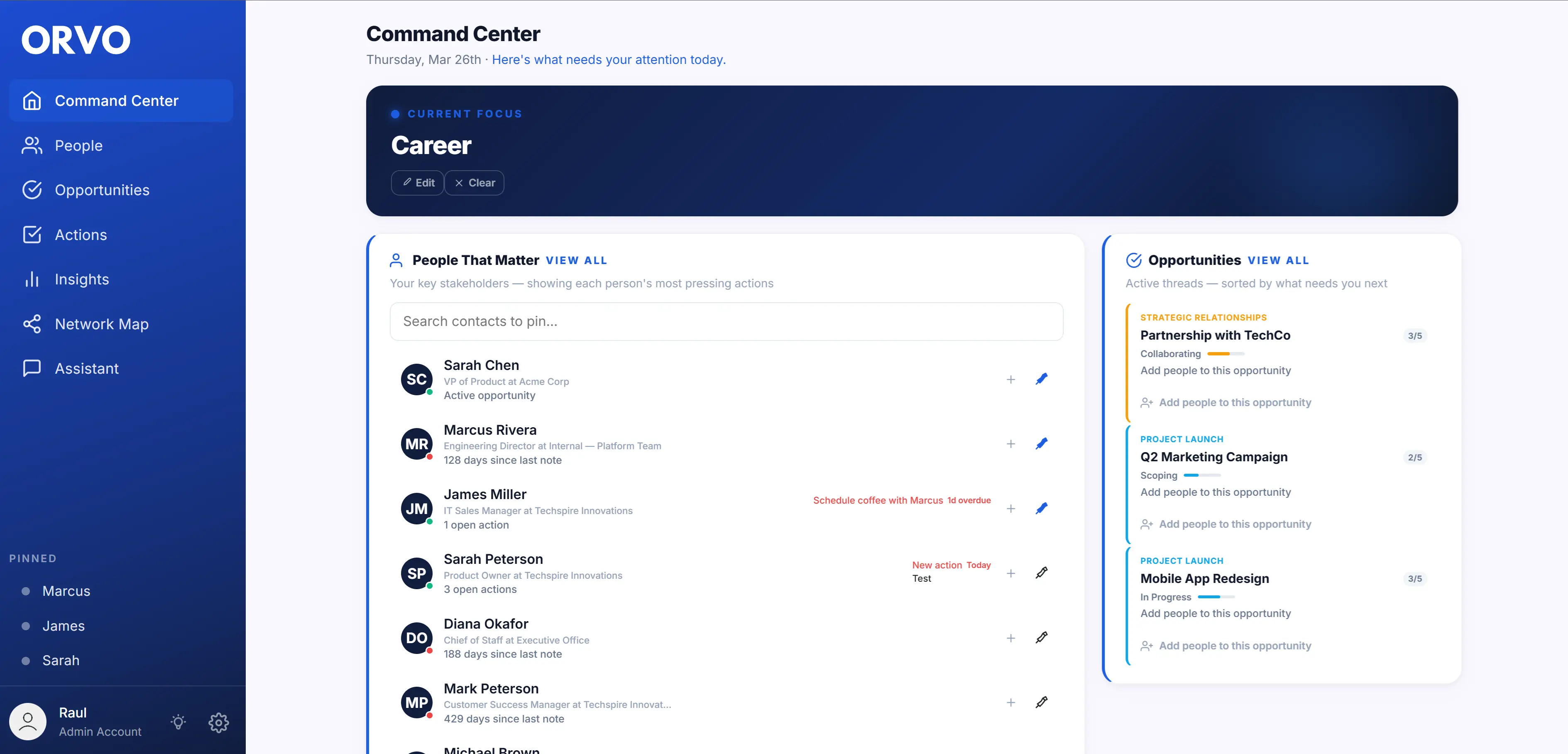
Stop winging your 1-on-1s. Orvo helps you prepare for every meeting with stakeholder context and AI-powered briefs — free trial, no credit card.
Get Orvo FreeWichtige Erkenntnisse
- ✓ People who ask more questions are perceived as more competent and more likeable (Harvard Business Review)
- ✓ For managers: ask about impact, their stress, team perception, promotion criteria, and hidden context
- ✓ For senior leaders: ask about org success, gaps, decision-making, connections, and career advice
- ✓ For peers: ask about their work, how to help, their success criteria, team introductions, and challenges
- ✓ Pick 2-3 questions per meeting — do not interview people, have a conversation
- ✓ Log every conversation immediately after — 60 seconds of notes creates compounding relationship intelligence