
Why most people never get promoted (and what actually works)
The biggest misconception about promotions is that great work speaks for itself. It does not. A LinkedIn Workplace Learning Report found that 85% of jobs are filled through networking — and internal promotions work the same way. The decision is influenced by who knows you, who advocates for you, and whether decision-makers can picture you at the next level.
Harvard Business Review research shows that professionals who systematically manage stakeholder relationships advance 40% faster than those who rely on performance alone. The difference is not talent or politics — it is visibility. The people who get promoted are the ones who have built relationships with decision-makers across the organisation, not just their direct manager.
Most professionals make three mistakes. First, they assume their manager will advocate for them — but most managers are too busy managing their own careers. Second, they wait until review season to demonstrate their value — but by then the decision is already made. Third, they work harder instead of working more visibly — putting in 60-hour weeks that nobody sees.
This playbook fixes all three. It is a month-by-month system for building the relationships, visibility, and positioning that lead to promotion.
Months 1-3: Build the map
The first three months are about intelligence gathering. You are not asking for a promotion — you are building the map of who decides, who influences, and what they care about.
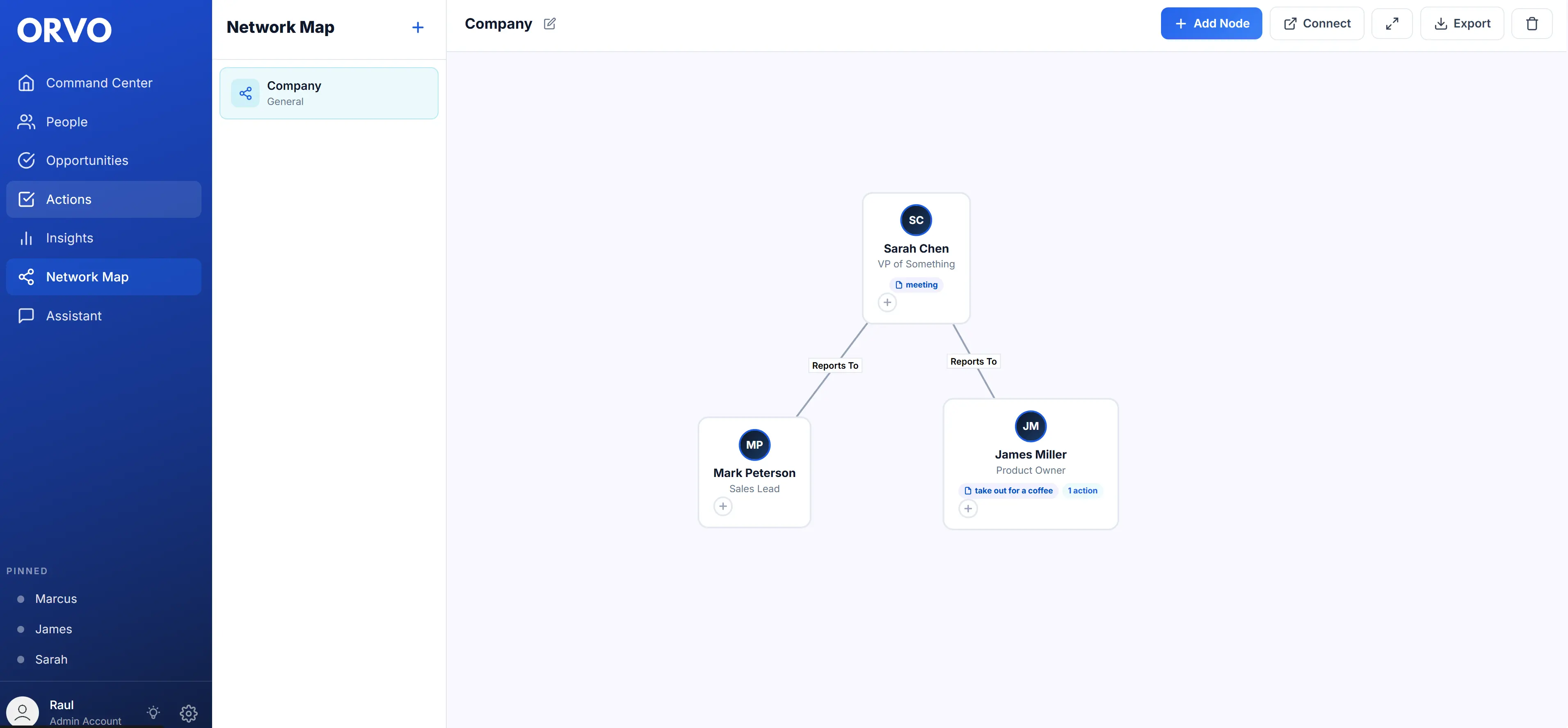
Month 1 — Identify the decision-makers. Who actually decides promotions in your organisation? It is rarely just your manager. There is usually a calibration committee, a skip-level leader, an HR business partner, and 2-3 peer managers who provide input. Identify all of them. Map them. Start tracking them in a relationship management tool like Orvo — their priorities, their style, their impression of you.
Month 1 — Have the career conversation. Schedule a 1-on-1 with your direct manager. Not to ask for a promotion, but to ask: "What would I need to demonstrate to be considered for the next level in the next review cycle?" Write down their answer verbatim. This is your scorecard for the next 11 months.
Month 2 — Build cross-functional visibility. Volunteer for one project or initiative that puts you in front of decision-makers outside your team. A cross-functional task force, a tiger team, a company-wide initiative. The goal is simple: get known by people who will be in the room when promotion decisions are made. At Cisco, the common advice was to seek exposure to different teams every 2 years. You do not need to wait that long — one visible project is enough.
Month 3 — Establish your baseline. Document your current responsibilities, key metrics, and stakeholder relationships. This becomes your "before" picture. In 9 months, you will compare it to your "after" — and the gap becomes your promotion case.
Months 4-6: Build relationships and deliver proof
Now you have the map. Months 4-6 are about building relationships with decision-makers and creating undeniable evidence of your capability.
Month 4 — Start the skip-level relationship. If you do not already have a relationship with your manager\'s manager, build one now. A monthly or bi-monthly check-in is ideal. Keep it light — share what you are working on, ask for their perspective on the business. The goal is not to go around your manager. It is to ensure the person who ultimately approves your promotion knows who you are and what you deliver.
Month 5 — Create a signature win. You need one accomplishment that is big enough to be cited in a promotion discussion. Not busywork — a project that moves a number, solves a visible problem, or delivers something others said could not be done. The "Dragon-Slaying Story" framework works well here: Challenge (what was the problem), Action (what you specifically did), Result (the measurable impact). Document this as it happens — dates, numbers, quotes from stakeholders.
Month 5 — Build your personal board. Identify 3-5 people who can advocate for you: your manager, your skip-level, 1-2 cross-functional leaders, and optionally a mentor. Each should have a clear line of sight to your work. Research from the Center for Creative Leadership shows that 75% of executives credit their advancement to having sponsors — not just mentors who give advice, but sponsors who put their reputation on the line for you.
Month 6 — Midpoint check-in. Schedule another career conversation with your manager. Reference the scorecard from Month 1. Show progress. Ask: "Am I on track? What else should I focus on?" This does two things: it keeps the promotion conversation alive, and it gives your manager talking points for when they advocate for you.
Months 7-9: Amplify and position
By month 7, you should have strong relationships with decision-makers and at least one signature win. Now you amplify.
Month 7 — Share your wins strategically. Most professionals either do not share their accomplishments (and get overlooked) or share them clumsily (and seem arrogant). The best approach: share wins in the context of team or business impact. "The team shipped X, which saved Y" — not "I personally did X." Send concise updates to your skip-level and cross-functional stakeholders. Use the self-promotion email framework: Result → Context → Credit others → Link to business priority.
Month 8 — Start operating at the next level. This is the most important shift. Stop waiting for the promotion to behave like the promoted version of yourself. If you want to be a manager, start mentoring. If you want to be a director, start thinking cross-functionally. The goal is that when the decision-makers discuss your promotion, they say: "They are already operating at that level" — not "They have potential."
Month 9 — Prepare your promotion packet. Whether your company requires a formal packet or not, create one. Include: your current vs. expanded responsibilities, your signature wins with measurable impact, testimonials or quotes from stakeholders (ask 2-3 people to write a brief endorsement), and your vision for what you will do at the next level. Even if you never formally submit this, giving it to your manager arms them to advocate for you.
Months 10-12: Close the deal
The final three months are about closing. The relationships are built, the evidence exists, and now you ensure the decision goes your way.
Month 10 — Activate your sponsors. Circle back to your personal board — the 3-5 people who can advocate for you. Let each know that you are targeting the next promotion cycle. Ask: "Is there anything else I should do or demonstrate before the discussion?" This is not a surprise — you have been building this relationship for 9 months. You are asking them to activate.
Month 11 — Pre-wire the decision. In most organisations, the promotion decision is made before the formal meeting. It is made in hallway conversations, in pre-meetings, and in calibration prep. Your manager should be doing this advocacy work for you — and if they are not, your skip-level and cross-functional sponsors should be. Your job: make sure each advocate has the same narrative about why you deserve the promotion. Consistency matters in calibration.
Month 12 — Have the direct conversation. If you have not already, ask your manager directly: "I have been working toward [next level] and I believe I am ready. What is your recommendation?" If the answer is yes — great, the system worked. If the answer is "not yet" — ask specifically what is missing and start a new 6-month cycle. Either way, you are miles ahead of where you would be without a system.
One important note: even if the promotion does not come in exactly 12 months, the relationships, visibility, and positioning you have built will compound. They do not reset. Every investment you made carries forward to the next cycle, and the next, and the next.
Track your promotion stakeholders, log every win, and prepare for every career conversation. Orvo gives you the system — free trial, no credit card required.
Get Orvo FreeThe complete 12-month timeline
Here is the full playbook in one view. Save this, print it, or track it in your relationship management system.
| Month | Phase | Key Actions | Stakeholder Focus |
|---|---|---|---|
| 1 | Map | Identify decision-makers; have career conversation with manager | Manager, skip-level, HR |
| 2 | Map | Join cross-functional project; build visibility outside your team | Cross-functional leaders |
| 3 | Map | Document baseline responsibilities and metrics | All mapped stakeholders |
| 4 | Build | Start skip-level relationship; monthly check-ins | Skip-level manager |
| 5 | Build | Create signature win; build personal board of 3-5 sponsors | Sponsors and advocates |
| 6 | Build | Midpoint career check-in with manager; show progress on scorecard | Manager |
| 7 | Amplify | Share wins strategically to stakeholders; send impact updates | All decision-makers |
| 8 | Amplify | Operate at next level; mentor, think cross-functionally | Peers and direct reports |
| 9 | Amplify | Prepare promotion packet with evidence and endorsements | Manager + sponsors |
| 10 | Close | Activate sponsors; ask what else is needed | Personal board |
| 11 | Close | Pre-wire the decision through sponsor advocacy | All decision-makers |
| 12 | Close | Have direct promotion conversation with manager | Manager |
Wichtige Erkenntnisse
- ✓ Promotions are bets on future capability — not rewards for past performance
- ✓ The first 3 months: map decision-makers, have the career conversation, build cross-functional visibility
- ✓ Months 4-6: build skip-level relationship, create a signature win, assemble your personal board of sponsors
- ✓ Months 7-9: share wins strategically, operate at the next level before the promotion, prepare your packet
- ✓ Months 10-12: activate sponsors, pre-wire the decision, have the direct conversation
- ✓ Even if the promotion takes longer, the relationships and visibility you built compound into the next cycle