
Why Conference Networking Fails (and the 80/20 Rule)
A 2025 Event Marketing Institute survey found that 87% of conference attendees exchange contact information with at least 10 people. But only 12% follow up within a week. And only 3% convert those contacts into meaningful professional relationships.
The math is brutal: you spend $3,000 and two days at a conference, talk to 15 people, and end up with zero new relationships. Why?
The Conference Networking Problem: 1. No preparation: You arrive not knowing who is attending, who you want to meet, or what you want to discuss 2. Shallow interactions: "What do you do? Here is my card" repeated 15 times does not create relationships 3. No follow-up system: You return to your desk, get buried in emails, and the business cards sit in a drawer 4. Wrong metric: You measure "people met" instead of "relationships started"
The 80/20 Rule of Conference Networking: 80% of the value comes from 20% of the people you meet — the 3-5 connections that could genuinely impact your career. The goal is not to meet as many people as possible. It is to identify, connect with, and follow up on those 3-5 high-value connections.
This means the work happens before and after the conference, not just during it. The conference itself is just the handshake. The preparation determines who you shake hands with. The follow-up determines whether that handshake turns into a relationship.
Before the Conference: The 2-Week Preparation Playbook
The professionals who extract maximum value from conferences start 2 weeks before registration opens.
Week 1: Research + Target List
1. Review the attendee list (most conferences publish speakers, sponsors, and registrants). Identify 10-15 people you specifically want to meet. 2. Research each target: What are they working on? What have they published recently? What could you discuss that goes beyond small talk? 3. Check for warm introductions: Do any of your existing contacts know your targets? A warm introduction at a conference converts 5x better than a cold approach. 4. Log targets in Orvo: Create entries for each target contact with notes on their work, talking points, and any mutual connections.
Week 2: Schedule + Strategy
5. Pre-schedule meetings: Reach out to your top 5 targets: "I see we are both attending [conference]. I would love to grab 15 minutes to discuss [specific topic]. Are you free for coffee on Day 1 afternoon?" 6. Map the schedule: Identify which sessions your targets are speaking at or attending. Plan your conference itinerary around the people, not just the content. 7. Prepare conversation starters: For each target, prepare one specific, thoughtful question that shows you have done your homework. "I read your recent article on [topic] — I am curious how you are applying that to [their current work]." 8. Set your goal: "I will have meaningful conversations with 5-8 specific people and follow up with all of them within 48 hours." Not "I will meet as many people as possible."
| Prep Activity | When | Time Required | Tools |
|---|---|---|---|
| Build target list (10-15 people) | 2 weeks before | 45 min | Conference site + LinkedIn + Orvo |
| Research each target | 10 days before | 30 min | LinkedIn, Google, recent publications |
| Check for warm intros | 1 week before | 15 min | Orvo Network Map + LinkedIn mutual connections |
| Pre-schedule 3-5 meetings | 1 week before | 20 min | Email/LinkedIn DM + Calendly |
| Prepare conversation starters | 2 days before | 20 min | Orvo notes for each target |
During the Conference: The Execution System
The 3 Types of Conference Conversations:
Type 1: Pre-Scheduled Meetings (highest value) These are the conversations you arranged before the conference. They are focused, prepared, and have built-in context. Treat them like a condensed informational interview: ask your prepared questions, listen actively, and identify one specific follow-up action.
Type 2: Session-Adjacent Conversations (high value) After a session, approach the speaker or a fellow attendee with a specific, thoughtful comment about the content. "Your point about [specific thing] resonated because I am dealing with [specific challenge]. How would you approach it?" This signals that you were actually listening, not just networking.
Type 3: Serendipitous Connections (variable value) Conference hallways, coffee lines, and evening events. The key here is filtering quickly: within 2 minutes, determine if this is a conversation worth deepening. If yes, invest 10-15 minutes. If not, exchange information politely and move on.
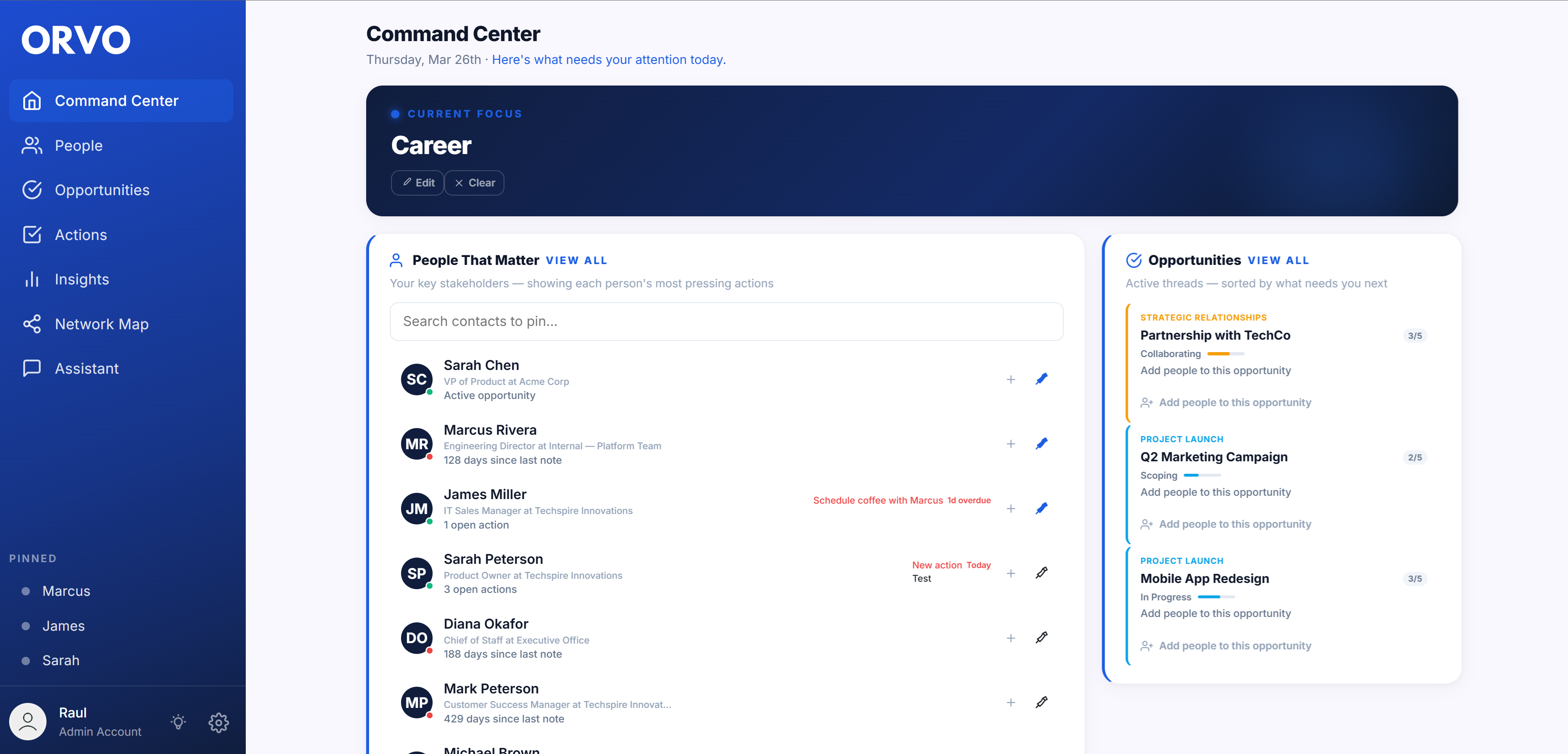
The Real-Time Logging System: This is the habit that separates conference networking winners from everyone else: after every meaningful conversation, spend 60 seconds logging it in Orvo. Step away to the hallway or bathroom and note:
- Their name and role (you will forget by end of day)
- The 1-2 things you discussed that were most relevant
- Any commitments made ("I will send you that article")
- A follow-up action and timeline
If you do this for 5-8 conversations per day, you leave the conference with a complete action plan — not a pile of business cards.
Energy Management: Conferences are exhausting. Do not try to network for 12 hours straight. Block recovery time: 30 minutes alone after every 2-3 hours of interaction. The quality of your conversations at hour 8 depends on how you managed your energy at hour 4.
After the Conference: The 48-Hour Follow-Up Sprint
This is where 97% of conference networking dies. And where you win.
The 48-Hour Rule: Every meaningful conversation from the conference gets a personalized follow-up within 48 hours. Not 2 weeks. Not "when things settle down." 48 hours. The connection is fresh, the context is vivid, and the follow-up shows you are serious.
The Follow-Up Template:
"Hi [Name], great meeting you at [conference] — I really enjoyed our conversation about [specific topic]. [One specific reference to what you discussed.] As promised, here is [the article/resource/introduction you committed to]. I would love to continue the conversation — would you be open to a 20-minute call in the next few weeks?"
Why this works: It is specific (proves you remember them), delivers on a commitment (builds trust), and proposes a next step (keeps the relationship alive).
The Post-Conference Workflow:
Day 1 (on the plane home or that evening):
- Review all conference conversation notes in Orvo
- Prioritize: which 5-8 contacts have the highest potential for a meaningful relationship?
- Draft personalized follow-up messages for your top priority contacts
Day 2:
- Send all follow-up messages
- Fulfill any commitments you made (send articles, make introductions)
- Add non-priority contacts to a "Conference - [Name] 2026" tag in Orvo with basic notes
Week 2:
- Follow up with anyone who responded positively — schedule the call or meeting
- Send a LinkedIn connection request to all contacts with a personalized note
Month 2-3:
- Continue nurturing the 3-5 connections that showed the most potential
- Set recurring follow-up reminders in Orvo (monthly for top contacts)
The Compound Effect: If you attend 2-3 conferences per year and convert 3-5 contacts from each into genuine relationships, you add 6-15 high-quality connections to your network annually. Over 5 years, that is 30-75 curated professionals — many of whom have risen to influential positions. This is how conferences become career investments instead of expensive business trips.
Turn conferences into career investments — prepare, log conversations, and follow up systematically. Try Orvo free for 14 days →
Start Free TrialThe Tool Stack for Conference Networking
Conferences are high-volume, high-speed networking environments. You need tools that work fast and capture context on the go.
| Need | Tool | How It Maximizes Conference ROI |
|---|---|---|
| Pre-conference research | Orvo + LinkedIn | Build target list, research attendees, check for warm intros via Network Map |
| Real-time logging | Orvo (mobile) | Log conversations in 60 seconds between sessions — name, context, commitments, follow-up |
| Follow-up management | Orvo reminders | 48-hour follow-up sprint with personalized messages, then monthly cadences for top contacts |
| Contact syncing | Orvo + LinkedIn | Connect on LinkedIn at the conference, sync to Orvo for deep tracking |
| Meeting scheduling | Calendly | Pre-schedule meetings and make it easy for new contacts to book post-conference calls |
The Future of Conference Networking in the AI Era
Conferences are evolving — but in-person connection remains irreplaceable. AI is changing how you prepare and follow up.
As Sorin Ciornei wrote in *The Future is Now* (thereach.ai), the Curating Economy elevates professionals who can manage information and relationships systematically. AI makes conference networking more effective:
- Pre-conference intelligence: AI generates attendee research briefs — their recent work, mutual connections, conversation starters — in minutes instead of hours
- Real-time transcription: Voice notes captured during or after conversations, automatically transcribed and linked to contact profiles
- Smart follow-up: AI drafts personalized follow-up messages referencing specific conversation points from your logged notes
- Network analysis: AI identifies which conference connections fill gaps in your existing network and should be prioritized
The conferences of 2026 and beyond are not just about meeting people. They are about meeting the right people, logging the right context, and following up with the right message at the right time. The system determines the ROI.
Your next conference could be a \$3,000 waste or a career-changing investment. The difference is the system. Try Orvo free for 14 days →
Get Orvo FreePoints clés
- ✓ Only 3% of conference contacts become meaningful relationships — the gap is follow-up systems, not networking skill.
- ✓ 2-week preparation: build a target list, research attendees, pre-schedule 3-5 meetings, prepare conversation starters.
- ✓ During: log every meaningful conversation in 60 seconds (name, context, commitments, follow-up action).
- ✓ The 48-Hour Rule: personalized follow-up to every priority contact within 48 hours of the conference.
- ✓ Block 2 hours post-conference for follow-up — this is the single highest-ROI hour of the entire event.
- ✓ Use Orvo for the full cycle: pre-conference research, real-time logging, follow-up management, ongoing relationship tracking.