
Why Your Existing Network Is Your Biggest Asset (Even for a Pivot)
The conventional wisdom about career pivots is wrong. Most career changers believe they need to start networking from scratch in their target industry. They do not.
A 2024 LinkedIn Economic Graph study found that 78% of successful career changers landed their new role through a connection who bridged their old and new industries — not through cold networking into the target field. These "bridge connections" are people who know your work in your current industry AND have visibility into your target industry.
Think about it: your former colleague who moved to tech, your MBA classmate who works in a different sector, your vendor who serves multiple industries, your mentor who sits on boards across fields. These people can introduce you to the right people in your target industry with credibility — something a cold LinkedIn request can never achieve.
The first step in any career pivot is not reaching out to strangers in your target industry. It is auditing your existing network for bridge connections. And most professionals are shocked by how many they already have — they just never thought to look.
This is where a relationship tracking system proves its value: when you can see every person you know, tagged by industry, company, and relationship strength, the bridge connections become immediately visible. What would take weeks of manual LinkedIn scrolling takes minutes in a structured system.
The Bridge Connection Framework
Before you network into your target industry, map the bridges you already have.
Step 1: Audit Your Existing Network Go through your contacts — LinkedIn, email, phone, and any relationship tracking tool — and identify everyone who has visibility into your target industry. This includes:
- Former colleagues who moved to your target industry
- Classmates (college, MBA, bootcamp) working in the target field
- Vendors, consultants, or agencies that serve both your current and target industries
- People in your current network who sit on boards, advise startups, or invest across sectors
- Alumni from professional programs, conferences, or industry groups
Step 2: Categorize Bridge Strength Not all bridges are equal. Rank them:
- Strong Bridges: People who know your work well AND work in your target industry. These can make warm introductions with personal endorsement.
- Medium Bridges: People who know you AND know people in your target industry. They can make introductions, but the endorsement is lighter.
- Weak Bridges: People who work in your target industry but barely know you. You need to rebuild the relationship before asking for anything.
Step 3: Activate Bridges Strategically Start with Strong Bridges: reactivate the relationship, share your career transition story, and ask for 2-3 introductions to people in your target industry. Then move to Medium Bridges. Only cold-network after you have exhausted your bridge connections.
| Bridge Type | Relationship to You | Access to Target Industry | Strategy | Expected Yield |
|---|---|---|---|---|
| Strong Bridge | Knows your work well | Works in target industry | Warm reactivation → ask for 2-3 intros | 2-3 high-quality introductions each |
| Medium Bridge | Knows you personally | Knows people in target industry | Reconnect → share pivot story → request intros | 1-2 introductions each |
| Weak Bridge | Acquaintance at best | Works in target industry | Rebuild relationship first → ask later | 1 introduction after relationship rebuilt |
| Cold Outreach | No existing relationship | In target industry | Last resort — personalized, value-first approach | 10-15% response rate |
The Informational Interview System for Career Changers
Informational interviews are the highest-ROI networking activity for career pivots — if you do them systematically.
The Purpose Is Intelligence, Not Job-Hunting An informational interview has three goals: understand the reality of the target role/industry, build a genuine relationship with an insider, and get referred to 2-3 more people. It is NOT a disguised job interview. People can tell the difference, and they resent it.
The 5-Question Framework: 1. "What does a typical day/week look like in your role?" (Reality check) 2. "What skills or experiences are most valued that outsiders might not realize?" (Intelligence) 3. "What would you recommend for someone transitioning from [your current field]?" (Tailored advice) 4. "What is the biggest challenge in this industry/role right now?" (Shows genuine interest) 5. "Who else would you recommend I talk to?" (Expands network — this is the key question)
The Follow-Up System: This is where career changers fail. You have a great informational interview, send a thank-you email, and then... nothing. Three months later, you have forgotten what they said, and they have forgotten you.
The system: after every informational interview, log the conversation in Orvo — key insights, names they mentioned, advice they gave, and their response to your pivot story. Set a follow-up reminder for 3-4 weeks. When the reminder fires, share something relevant to what they told you: an article about their industry, a congratulations on a recent achievement, or an update on your transition progress.
After 3-4 touchpoints over 2-3 months, you have a genuine relationship — not just a one-time conversation. When a role opens at their company, your name comes to mind.
The Numbers Game: Plan for 20-30 informational interviews over 3-4 months. Each one should yield 2-3 referrals to other people. By interview #20, you have a network of 40-60 people in your target industry, several of whom are becoming genuine advocates for your transition.
Track every informational interview, manage referral chains, and never miss a follow-up — try Orvo free for 14 days →
Start Free TrialThe Tool Stack for Career Pivot Networking
A career pivot is a 6-12 month networking project. You need tools that keep you organized, consistent, and strategic over that entire period.
| Need | Tool | How It Supports Your Career Pivot |
|---|---|---|
| Relationship tracking | Orvo | Track 50-100 new contacts across your target industry. Log every conversation, set follow-up reminders, track who referred whom. |
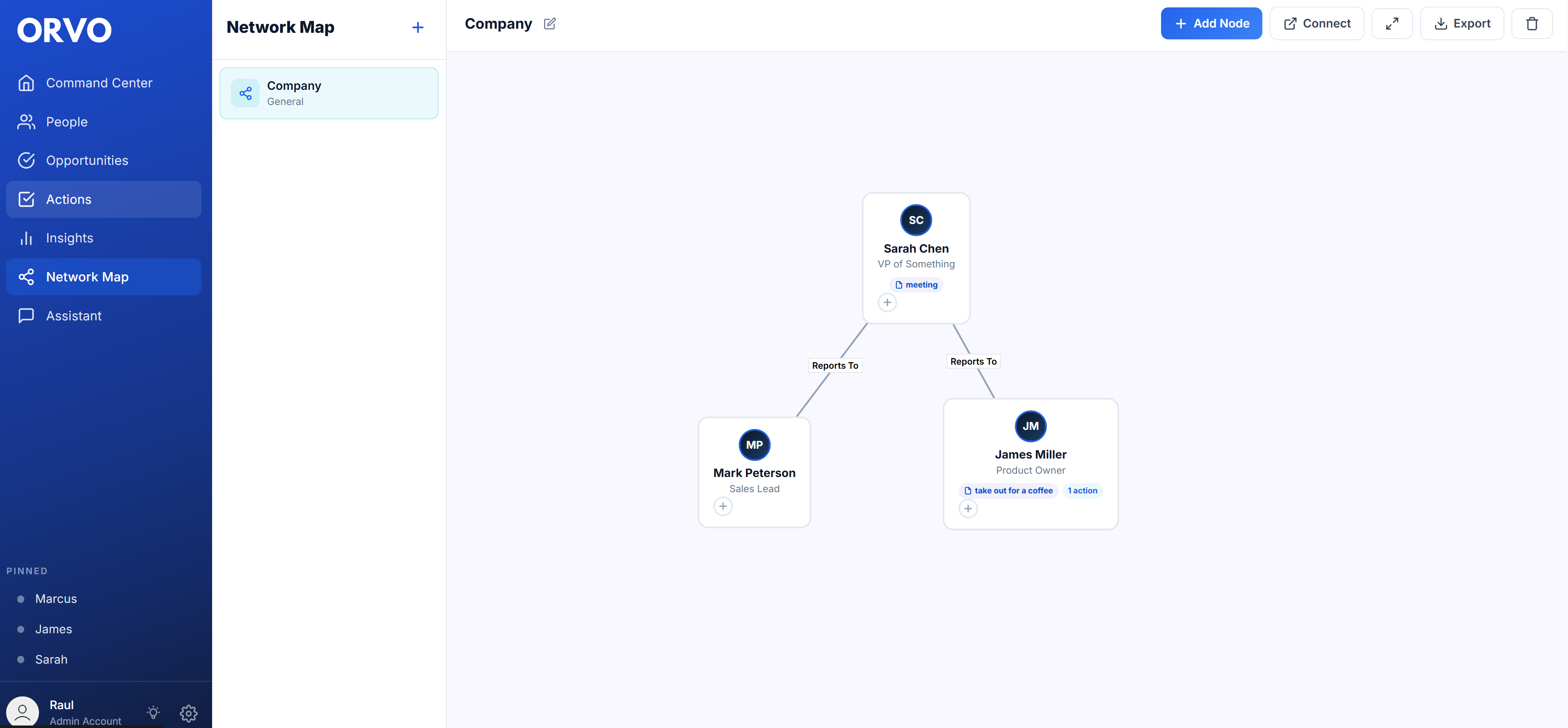
| Bridge connection mapping | Orvo Network Map | Visualize connections between your current and target industries. Identify bridge contacts instantly. |
| Meeting preparation | Orvo AI Assistant | Before each informational interview, generate a prep brief: the person's background, mutual connections, suggested questions. |
| Industry research | LinkedIn + industry publications | Follow target industry leaders, join relevant groups, share informed perspectives |
| Application tracking | Teal or spreadsheet | Track applications, interview stages, and company-specific relationship notes |
| Skill building | Coursera / Udemy / industry programs | Fill verified skill gaps identified through informational interviews |
The 6-Month Career Pivot Networking Timeline
Here is the month-by-month networking plan for a successful career pivot:
Month 1: Foundation + Bridge Audit
- Import all contacts into Orvo and tag by industry
- Identify 10-15 bridge connections to your target industry
- Reactivate 5 strong bridge connections — share your pivot story, ask for introductions
- Begin skill-building based on identified gaps
- Conduct 3-4 informational interviews from bridge referrals
Month 2: Expand + Deepen
- Conduct 5-6 informational interviews (bridge referrals + referrals from Month 1 interviews)
- Follow up with Month 1 contacts — share an article, update on your progress
- Join 1-2 industry groups or communities (Slack, LinkedIn groups, local meetups)
- Identify your top 5 target companies based on informational interview intelligence
- Start building your narrative: "I bring [current expertise] to solve [target industry problem]"
Month 3: Build Credibility
- Conduct 5-6 more informational interviews, now focused on target companies
- Write 1-2 LinkedIn posts demonstrating knowledge of target industry (share insights from your research)
- Volunteer for a cross-industry project, freelance gig, or advisory role that bridges your old and new fields
- Follow up systematically with all contacts using Orvo reminders
- Your network in the target industry should be 25-35 people
Month 4: Position + Target
- Conduct 4-5 focused informational interviews at target companies
- Request referrals from your strongest contacts — you have earned them through consistent follow-up
- Tailor your resume and narrative for the target industry
- Begin monitoring job postings at target companies
- Your target industry network should be 40-50 people
Month 5-6: Activate + Convert
- Apply to roles at target companies through referral connections
- Before each interview, review Orvo notes on every contact at that company
- Leverage informational interview insights for interview preparation (industry context, company challenges)
- Continue maintaining all relationships — even with contacts not at target companies (they may move or have new connections)
- Send thoughtful follow-ups after every interview using conversation context from your relationship tracker
The Future of Career Pivots in the AI Era
Career pivots are becoming both more common and more feasible — and the networking strategy matters more than ever.
As Sorin Ciornei wrote in *The Future is Now* (thereach.ai), the Curating Economy is making career boundaries more fluid. AI is disrupting industries at a pace that makes career pivots not just optional but necessary for many professionals. The World Economic Forum estimates that 44% of workers' core skills will change by 2030.
This means more people will need to pivot, and the ones who succeed will be those with the strongest cross-industry networks. The relationship infrastructure you build today is not just for your current pivot — it is career insurance for whatever comes next.
AI tools are making career pivot networking more effective:
- Relationship intelligence surfaces bridge connections you did not know you had
- Meeting preparation briefs help you show up informed for every informational interview
- Follow-up automation ensures no relationship goes dormant during your 6-month pivot
- Network visualization reveals referral chains and introduction pathways across industries
The career changers who combine genuine relationship-building with systematic tools will pivot faster, land stronger roles, and build networks that continue generating opportunities for decades.
Your career pivot is a networking project. Manage it like one. Try Orvo free for 14 days →
Get Orvo FreePoints clés
- ✓ 78% of successful career changers land their role through bridge connections — not cold networking.
- ✓ Audit your existing network first: former colleagues, classmates, and vendors who bridge your old and new industries.
- ✓ Plan for 20-30 informational interviews over 3-4 months, each yielding 2-3 referrals.
- ✓ The follow-up system is everything: log every conversation, set reminders, share value over 2-3 months.
- ✓ Use Orvo to track 50-100 new contacts, map referral chains, and maintain relationships during your 6-month pivot.
- ✓ AI makes career pivots more common and more networked — relationship infrastructure is career insurance.