
The AI CRM hype problem: most tools are faking it
Here is the uncomfortable reality of the AI CRM market in 2026: the majority of tools labelling themselves "AI-powered" are doing the bare minimum. They added a GPT-powered email composer, maybe an auto-transcription feature, and slapped "AI" on their marketing page. That is not AI-powered CRM — that is a CRM with a chatbot bolted on.
Genuine AI in relationship management means the software understands your relationships, not just your data. It means the tool can tell you which stakeholder you have been neglecting, prepare you for a meeting by synthesising everything you know about a person, coach you on navigating organisational politics, and predict which relationships are likely to generate value. That requires deep integration between the AI layer and your relationship data — not a generic language model answering questions about CRM best practices.
The market data tells the story of why so many tools are rushing to add AI, whether it is real or performative. According to DataIntelo, the AI-driven CRM market is projected to grow from $1.42 billion in 2024 to $10.1 billion by 2033 — a 21.6% compound annual growth rate. Gartner predicts that by 2027, 80% of CRM vendors will incorporate some form of generative AI into their products. The incentive to claim AI capabilities is enormous, which is exactly why you need to evaluate what the AI actually does, not what the landing page says it does.
This guide evaluates AI CRMs on what their AI features actually do with your data — not on marketing claims or feature lists that sound impressive but deliver nothing in practice.
The four AI capabilities that actually matter in a CRM
After evaluating dozens of AI CRM tools, the features that genuinely change how professionals manage relationships fall into four categories. Everything else — AI email drafting, auto-categorisation, smart search — is nice but incremental. These four are transformational.
1. Contextual meeting preparation. The highest-value AI feature in any CRM is the ability to brief you before a conversation. Not a generic summary — a contextual brief that pulls together your past interactions with this person, your open commitments, their current priorities, recent news about their company, and any relationship dynamics you should be aware of. A Gartner survey found that 72% of sales leaders report AI-powered meeting prep directly improved their outcomes. The same applies to any professional conversation — a prepared person builds trust faster than an unprepared one.
2. Relationship health scoring. Your brain cannot track the decay rate of 200 professional relationships simultaneously. AI can. The best tools monitor your interaction patterns and flag relationships that are going cold — the mentor you have not spoken to in three months, the client whose response time has doubled, the stakeholder who used to engage actively but has gone silent. Salesforce research found that 68% of business relationships erode due to perceived indifference, not active conflict. Relationship health scoring prevents this invisible decay.
3. Stakeholder influence coaching. This is the most advanced and least common AI feature. It analyses organisational dynamics — reporting structures, communication patterns, decision-making influence — and coaches you on how to navigate them. Who should you align with before proposing a new initiative? Which stakeholder needs to be brought in early versus informed after? Where are the hidden blockers? This capability used to require an executive coach. Now AI can do it using your actual relationship data.
4. Interaction pattern analysis. AI can reveal patterns in your networking behaviour that you cannot see yourself. Are you over-investing in low-value relationships and under-investing in high-value ones? Do you consistently fail to follow up with a certain type of contact? Are there clusters in your network that are disconnected from each other? Pattern analysis turns your relationship data into strategic intelligence.
| AI Capability | What It Does | Who Benefits Most | Impact |
|---|---|---|---|
| Contextual meeting prep | Auto-briefs before conversations using your relationship data | Managers, consultants, founders | Gartner: 72% report improved outcomes |
| Relationship health scoring | Flags contacts going cold before you notice | Anyone with 100+ contacts | Prevents the 68% of relationships lost to neglect |
| Stakeholder influence coaching | Navigates org dynamics, builds alignment strategies | Mid-senior professionals, PMs | Replaces $500/hr executive coaching |
| Interaction pattern analysis | Reveals blind spots in your networking behaviour | All professionals | Helps rebalance time toward high-value relationships |
The 7 best AI CRMs in 2026, ranked
We evaluated the leading AI CRM tools across the four capabilities above, plus pricing, integrations, and target audience. Here is how they compare.
1. Orvo — Best for individual professionals and career intelligence. Orvo is the only AI CRM built specifically for individual professionals who want to manage relationships for career advancement, not sales pipeline management. Its AI Assistant includes four purpose-built modules: Stakeholder Influence (navigate organisational dynamics and power structures), Career Navigation (promotion preparation, visibility strategy, new role onboarding), Meeting Preparation (contextual briefs drawn from your actual relationship data), and Working Style Analysis (understand how different people prefer to communicate and be influenced). It syncs with Google, Outlook, WhatsApp, and iCloud, includes voice note transcription, visual network mapping, and a kanban-style opportunity tracker. Pricing starts at $19/month with all AI features included.
2. HubSpot (with AI features) — Best for sales teams wanting a free starting point. HubSpot's AI features include email writing assistance, predictive lead scoring, conversation intelligence, and an AI chatbot for customer interactions. The free tier is generous for basic CRM but the meaningful AI features are locked behind the Professional tier ($800/month for 5 users). The AI is sales-focused — it predicts deal outcomes and optimises outreach sequences, but offers nothing for stakeholder management or career intelligence. Best for teams who are already in the HubSpot ecosystem.
3. Salesforce Einstein — Best for enterprise sales organisations. Salesforce Einstein is the most powerful AI CRM engine on the market — if you are a large sales organisation. It offers predictive analytics, opportunity scoring, automated activity capture, and conversational intelligence. According to Salesforce's own data, Einstein users see a 30% increase in deal close rates. However, it requires a Salesforce Enterprise license ($165/user/month minimum) and significant setup. Completely unsuitable for individual professionals — this is a tool for sales ops teams managing hundreds of reps.
4. Clay — Best for data enrichment and outbound sales. Clay's AI shines at data enrichment — automatically finding and verifying contact information, enriching profiles with company data, and building targeted outreach lists. It integrates with 100+ data providers and can automate complex prospecting workflows. However, Clay is not a relationship management tool. It does not track interactions, manage follow-ups, or provide stakeholder intelligence. It is a sales research and outreach platform priced at $149/month and up. Different category entirely.
5. Cloze — Best for automated activity capture. Cloze quietly tracks your email, phone, and calendar interactions and automatically builds a relationship timeline without manual data entry. Its AI analyses communication patterns and suggests who to follow up with. The approach is elegant — zero-input relationship tracking. The limitation is that the AI is reactive (it surfaces data) rather than proactive (it does not coach you or prepare you for meetings). Pricing starts at $17/month.
6. Folk — Best for team-based contact management with light AI. Folk added AI email writing and contact enrichment in 2025, but its core value proposition remains collaborative contact management for teams. The AI features are supplementary rather than foundational — they help you write emails faster, not understand your relationships better. No stakeholder mapping, no relationship intelligence, no career coaching. Pricing starts at $20/user/month.
7. Dex — Best for LinkedIn-centric contact organising with minimal AI. Dex's AI is limited to basic contact enrichment and reminder suggestions. It is primarily a contact organiser that syncs with LinkedIn, not an AI-powered relationship intelligence tool. Good for keeping your Rolodex tidy, but lacks the depth of AI that defines the category in 2026. Free tier available, paid plans from $12/month.
| Tool | Meeting Prep AI | Relationship Health | Stakeholder Coaching | Pattern Analysis | Price From | Best For |
|---|---|---|---|---|---|---|
| Orvo | ✓ | ✓ | ✓ | ✓ | $19/mo | Individual professionals |
| HubSpot | ✗ | ✓ (sales-focused) | ✗ | ✓ (pipeline only) | Free–$800/mo | Sales teams |
| Salesforce Einstein | ✓ (sales calls) | ✓ (deals only) | ✗ | ✓ (enterprise) | $165/user/mo | Enterprise sales orgs |
| Clay | ✗ | ✗ | ✗ | ✗ | $149/mo | Outbound sales research |
| Cloze | ✗ | ✓ | ✗ | ✓ (basic) | $17/mo | Auto-tracking contacts |
| Folk | ✗ | ✗ | ✗ | ✗ | $20/user/mo | Team contact management |
| Dex | ✗ | ✗ | ✗ | ✗ | Free–$12/mo | LinkedIn contact organiser |
See detailed head-to-head comparisons: Orvo vs HubSpot, Orvo vs Folk, Orvo vs Cloze →
Enterprise AI CRM vs. personal AI CRM: different tools for different problems
One of the biggest mistakes professionals make when shopping for an AI CRM is evaluating enterprise tools for personal use. Salesforce Einstein and HubSpot AI are extraordinary products — for sales organisations managing thousands of leads across dozens of reps. Using them to manage your 200 professional relationships is like hiring a logistics company to help you move a sofa.
The distinction matters because enterprise AI CRMs optimise for fundamentally different outcomes. They predict deal close probability, automate outreach sequences, score leads by conversion likelihood, and generate sales forecasts. Their AI is trained on sales data, tuned for revenue metrics, and designed for team-level analytics.
Personal AI CRMs optimise for relationship quality. They help you prepare for important conversations, track commitments across dozens of stakeholders, identify which relationships need attention, and navigate complex organisational dynamics. Their AI is trained on interaction patterns, tuned for relationship health, and designed for individual decision-making.
According to a Nucleus Research study, the average enterprise CRM delivers $8.71 for every dollar spent — but only when used by sales teams in contexts it was designed for. When individual professionals adopt enterprise CRMs, adoption rates drop below 30% because the tools are too complex, require too much manual data entry, and surface insights that are irrelevant to non-sales use cases. The ROI calculation changes completely when the tool matches the user's actual workflow.
The question is not which AI CRM has the most features. It is which AI CRM is built for your specific use case.
What AI actually looks like inside a CRM (with examples)
Abstract feature lists do not tell you what using an AI CRM actually feels like day-to-day. Here are concrete examples of how AI transforms specific professional scenarios.
Scenario 1: Preparing for a board meeting. You have a quarterly board meeting with five directors. Without AI, you spend 45 minutes re-reading past meeting notes across multiple apps, trying to remember what each director cares about and what you committed to last quarter. With Orvo's AI Meeting Prep, you get a single contextual brief for each attendee — their priorities, your interaction history, open commitments, and suggested talking points. Total prep time: 10 minutes.
Scenario 2: Noticing a relationship going cold. Your most important client has not responded to your last two emails. Without AI, you might not notice for weeks — you are busy, and the silence blends into your overflowing inbox. With relationship health scoring, the AI flags this pattern within days: "Engagement with [Client Name] has declined 60% over the past 3 weeks. Last interaction: March 8th." You reach out before the relationship deteriorates further.
Scenario 3: Navigating a promotion. You want to get promoted but are unsure which stakeholders influence the decision. Without AI, you guess based on org chart proximity. With Orvo's Stakeholder Influence module, the AI analyses your organisational context and identifies the specific people who will be in the calibration meeting, suggests which relationships to strengthen, and coaches you on the best approach for each stakeholder based on their communication style.
Scenario 4: Following up after a conference. You met 15 people at a conference and took voice notes on your phone. Without AI, those notes sit in a voice memo app until you forget about them. With Orvo, voice notes are transcribed, associated with the right contact, and the AI suggests personalised follow-up messages based on what you discussed. The 15 follow-ups that would have taken 2 hours take 20 minutes.
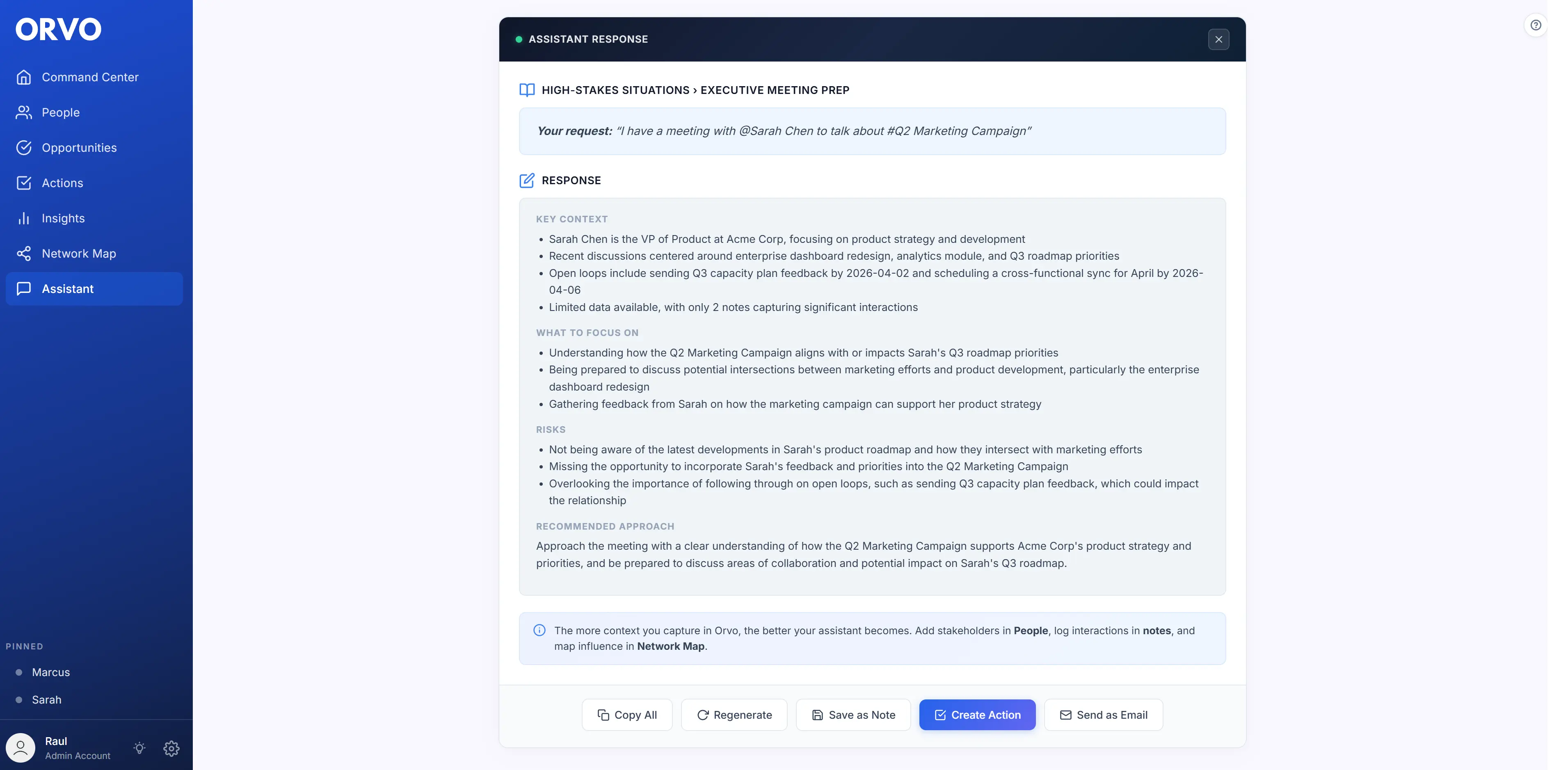
See AI-powered relationship intelligence in action — try Orvo free for 14 days.
Start Free TrialThe real ROI of AI-powered CRM
AI CRM tools deliver value across three dimensions: time saved, relationships preserved, and opportunities captured.
Time savings are the most immediate and measurable. McKinsey estimates that AI-powered tools reduce time spent on administrative relationship tasks by up to 40%. In practical terms, if you spend 5 hours per week on meeting prep, follow-up management, and contact research, AI cuts that to 3 hours. That is 100+ hours per year returned to high-value work. Accenture's research puts the average productivity gain of AI-augmented CRM at 30% across all user types.
Relationship preservation is the hidden ROI. Bain & Company found that a 5% increase in customer retention increases profits by 25-95%. The same principle applies to professional relationships. Every mentor, client, or stakeholder who drifts away represents lost opportunity. AI-powered relationship health scoring prevents this silent decay — which no amount of manual effort can replicate at scale. Salesforce data shows that 68% of customers leave because they feel neglected, and research from the Harvard Business Review confirms that professionals with systematically maintained networks are 40% more likely to receive promotions.
Opportunity capture is the long-term multiplier. When AI surfaces insights about your relationship patterns — who you are under-engaging, which connections could open doors, when the optimal time to follow up is — it creates opportunities that would otherwise never materialise. First Round Capital found that founders with structured relationship practices are 3x more likely to raise their next round. LinkedIn reports that 85% of jobs are filled through networking. The question is not whether these opportunities exist — it is whether your system is good enough to capture them.
The total cost of a professional AI CRM like Orvo is $228 per year. If it helps you land one consulting engagement, close one deal, or earn one promotion faster, the ROI is 10-100x.
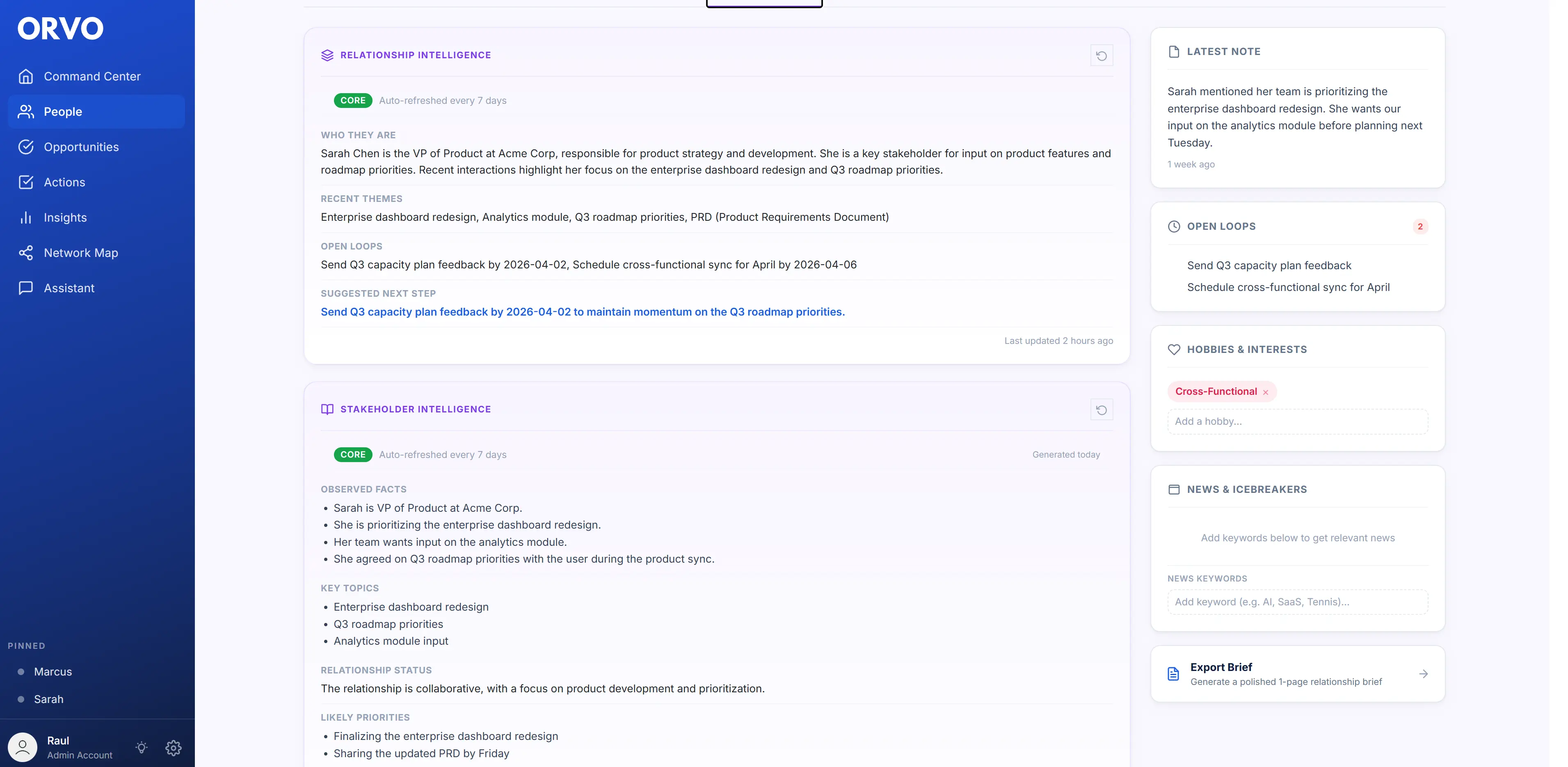
Where AI CRM is heading: 2026 and beyond
The AI CRM category is evolving faster than any other segment of professional software. Based on current trajectories and industry research, here is where the technology is heading.
Ambient relationship intelligence. The next generation of AI CRMs will not require you to log anything manually. They will passively monitor your communication channels (with permission) and automatically update relationship records, detect sentiment shifts, flag important commitments, and surface action items from conversations. Forrester predicts that by 2028, 50% of CRM data entry will be fully automated through ambient AI capture.
Predictive relationship mapping. Today's tools show you your network as it is. Tomorrow's tools will predict how it should evolve. AI will identify gaps in your professional network ("You have no relationships with anyone in the finance department, which is critical for your upcoming budget proposal"), suggest specific people to connect with, and even facilitate warm introductions through mutual contacts.
Real-time conversation coaching. Some tools are already experimenting with live meeting analysis — AI that listens to your calls and surfaces real-time prompts: "The stakeholder just mentioned budget concerns — here is what you discussed about ROI in your last conversation." Gartner predicts that real-time AI coaching will be standard in premium CRM tools by 2028.
Cross-platform relationship graphs. The most valuable data about your relationships is fragmented across email, Slack, WhatsApp, LinkedIn, calendar, and video calls. The next wave of AI CRMs will unify these signals into a single relationship graph — giving you a complete, real-time picture of every professional relationship across every channel. According to a Deloitte Digital survey, 73% of professionals say they struggle to maintain a complete view of their professional relationships because information is scattered across too many platforms.
The direction is clear: AI CRMs are moving from passive record-keeping to active relationship co-pilots. The tools that win will be the ones that feel like having a chief of staff for your professional life — someone who knows everyone you know, remembers everything they said, and helps you navigate every interaction strategically.
How to evaluate an AI CRM: the 5-minute test
You should not need a week to evaluate whether an AI CRM is worth your time. Here is a 5-minute test you can run on any tool to separate genuine AI value from marketing noise.
Minute 1: Import your contacts. Does the tool connect to your existing contact sources (Google, Outlook, WhatsApp) with one click, or does it ask you to upload a CSV and manually map fields? Friction at the import stage is a red flag — it means the tool prioritises its own data model over your workflow.
Minute 2: Pick a contact and ask the AI something. Select someone you know well and ask the AI to prepare you for a meeting with them. Does it pull from your actual interaction history, or does it give generic advice that could apply to anyone? If the AI does not use your data, it is a chatbot with a CRM wrapper.
Minute 3: Check the follow-up system. Add a follow-up reminder for a specific person. Is the reminder tied to the contact with full context, or is it a disconnected calendar event? The best AI CRMs link every action to a person, so when the reminder fires, you see the complete relationship context — not just "Follow up with Sarah."
Minute 4: Look at the network view. Does the tool visualise your relationships in a way that reveals structure — who knows whom, reporting lines, clusters, gaps? Or is it just an alphabetical list of names? A network map is what separates relationship intelligence from an address book.
Minute 5: Check the pricing page. Are the AI features included in the base plan, or locked behind an enterprise tier? If meaningful AI costs $50+/month or is marked "Coming Soon," the tool is not an AI CRM — it is a traditional CRM with AI aspirations.
Orvo passes all five in under five minutes. But do not take our word for it — run the test yourself on every tool you are evaluating. The gap between AI marketing and AI reality becomes obvious quickly.
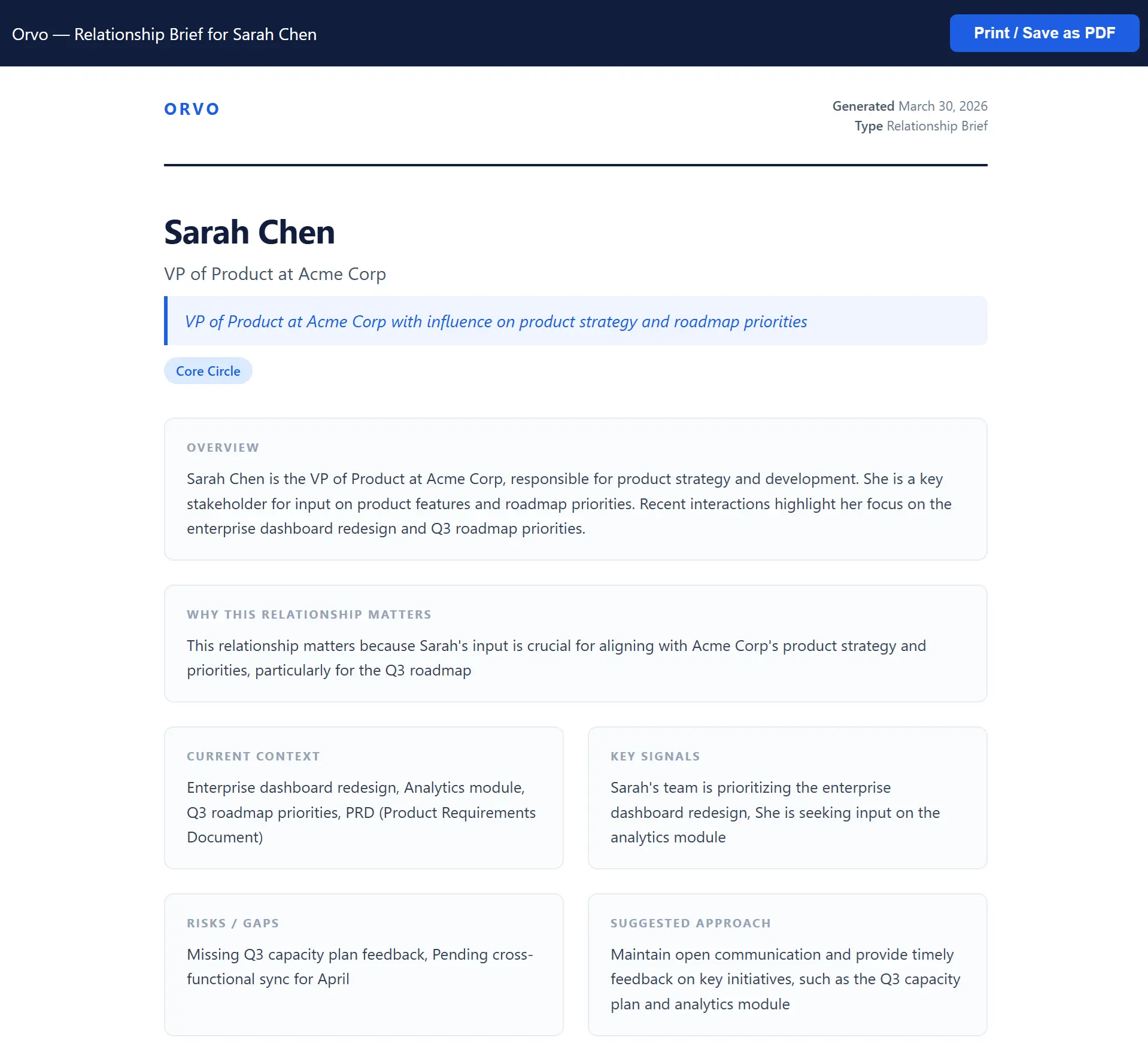
Run the 5-minute test on Orvo — import your contacts, ask the AI, and see relationship intelligence in action. Free trial, no credit card.
Get Orvo FreePoints clés
- ✓ Most "AI CRMs" use AI for basic automation (email drafts, data entry) — only a few offer genuine relationship intelligence
- ✓ The AI CRM market is growing at 21.6% CAGR and is projected to reach $10.1 billion by 2033
- ✓ The four AI capabilities that actually matter: contextual meeting prep, relationship health scoring, stakeholder coaching, and interaction pattern analysis
- ✓ Enterprise AI CRMs (Salesforce Einstein, HubSpot) are built for sales teams — individual professionals need purpose-built tools
- ✓ Orvo is the only AI CRM that combines relationship intelligence with career navigation and stakeholder influence coaching
- ✓ AI-augmented CRM tools increase user productivity by an average of 30% compared to traditional systems
- ✓ The best AI CRM is the one that matches your use case — sales teams, individual professionals, and networkers have fundamentally different needs