
Why 70% of Professionals Are Underrated in Performance Reviews
Performance reviews are supposed to be objective assessments of your contributions. In reality, they are shaped by recency bias, manager perception, and the quality of your self-advocacy.
A 2025 Gallup workplace study found that 70% of employees feel their performance review does not accurately reflect their work. The most common reason? Managers can only remember the last 6-8 weeks of a 12-month review period. If your biggest achievements happened in Q1 but your review is in Q4, they are effectively invisible.
This is not your manager's fault. They have 5-15 direct reports, each with dozens of projects, contributions, and interactions throughout the year. No human can recall 12 months of detailed performance across that many people without a system.
The professionals who consistently receive top ratings share one trait: they systematically document their work and strategically present it during the review process. They do not have better memories — they have better systems.
Here is what the top-rated professionals understand:
- Your review starts on Day 1 of the review period, not the week before your review meeting
- Your manager writes the review, but you control the inputs — the self-assessment, the stakeholder feedback, and the narrative
- Perception is as important as reality — work that is visible and well-documented gets rated higher than identical work that is invisible
- Relationships matter — the feedback your manager collects from stakeholders weighs heavily, and those stakeholders remember professionals who invested in the relationship
The Year-Round Performance Documentation System
The biggest mistake professionals make is treating performance reviews as an event. Top performers treat them as a year-round process.
Here is the system:
The Weekly Win Log (5 minutes every Friday) Every Friday, spend 5 minutes answering three questions: 1. What did I accomplish this week that moved the needle? 2. Who did I help or collaborate with? 3. What positive feedback or recognition did I receive?
Log these in a dedicated system — not scattered across emails, Slack messages, and memory. By the time your review arrives, you have 50 weeks of documented accomplishments instead of scrambling to remember.
The Monthly Impact Summary (15 minutes per month) Once a month, review your weekly logs and extract the biggest achievements. Frame each one using the STAR format:
- Situation: What was the context?
- Task: What were you responsible for?
- Action: What specifically did you do?
- Result: What was the measurable impact?
This monthly exercise means your self-assessment writes itself — you are just selecting the top 8-10 achievements from a year of documented impact.
The Stakeholder Relationship Tracker Your review is not just about what you did — it is about who saw you do it and what they think of you. Track your key stakeholder relationships throughout the year: who you collaborate with, what feedback they give you, and how those relationships evolve. When your manager asks stakeholders for 360 feedback, you want those stakeholders to have recent, positive interactions to reference.
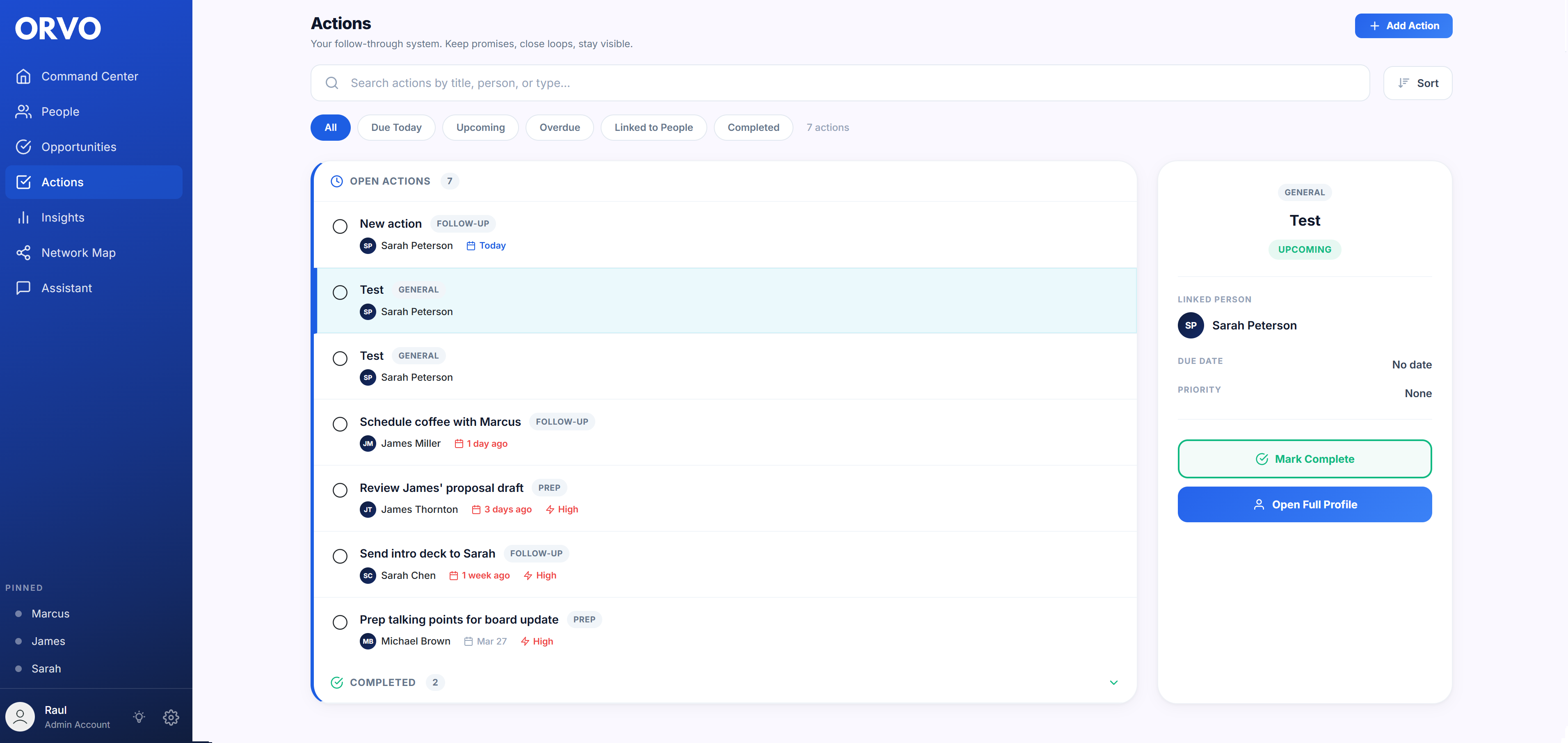
This is where a tool like Orvo transforms your review preparation: it automatically tracks your interactions, logs conversation context, and shows you which relationships need attention — so when 360 feedback time comes, every key stakeholder has a fresh, positive impression.
How to Write a Self-Assessment That Gets You Promoted
Your self-assessment is the single most influential document in your review process. It frames the narrative. It jogs your manager's memory. It provides the language and structure that often gets copied directly into the formal review.
Here is the framework for writing a self-assessment that positions you for the highest possible rating:
Open with Impact, Not Activity Bad: "I worked on the platform migration project." Good: "I led the platform migration that reduced system downtime by 73% and saved the company $2.4M in annual operational costs."
The difference: the first describes what you did (activity). The second describes what changed because of you (impact). Reviewers and calibration committees care about impact.
Quantify Everything Every achievement should include a number: revenue generated, costs saved, efficiency gained, people mentored, projects delivered, stakeholders influenced. If you cannot quantify the result directly, quantify the scope: "Led cross-functional initiative spanning 4 departments and 23 stakeholders."
Show Cross-Functional Impact At the senior level, the most valued contributions are cross-functional. Highlight how your work created value beyond your immediate team. Reference specific stakeholders by name (your manager may reach out to them for confirmation).
Address Development Areas Proactively Do not pretend you have no growth areas. Instead, frame them as areas of active investment: "I identified stakeholder communication as a development area in Q1 and actively worked on it — securing positive feedback from 3 cross-functional partners by Q3."
End with Forward-Looking Goals Signal ambition and self-awareness: "For the next review period, I aim to [specific goal] by [specific method]." This shows you are thinking beyond the current cycle and positions you for stretch roles and promotions.
| Self-Assessment Element | Common Mistake | High-Impact Approach |
|---|---|---|
| Opening statement | List of projects worked on | Lead with your single biggest impact metric |
| Achievement descriptions | What you did (activity) | What changed because of you (impact + metrics) |
| Scope indicators | Only mention your team | Highlight cross-functional reach and stakeholders influenced |
| Development areas | Skip them or be vague | Show active investment and measurable progress |
| Closing | Repeat achievements | Forward-looking goals that signal promotion readiness |
The Tool Stack for Performance Review Excellence
The professionals who consistently ace their performance reviews do not have better memories — they have better systems. Here is the complete tool stack:
| Need | Tool | How It Drives a Better Review Rating |
|---|---|---|
| Win tracking | Orvo | Log accomplishments weekly, tag by project/stakeholder, and auto-compile a year of documented impact when review time comes |
| Stakeholder relationships | Orvo | Track every key stakeholder interaction — when 360 feedback comes, they remember you positively because you followed up consistently |
| Meeting prep | Orvo AI Assistant | Generate a review preparation brief: your relationship history with your manager, their priorities, what they value most |
| Self-assessment writing | ChatGPT + your win log | Feed your documented wins into AI to draft impact-framed achievement statements |
| Manager 1-on-1 tracking | Orvo | Log every 1-on-1 with your manager: their feedback, your commitments, their evolving priorities. Review before your formal review meeting. |
| Calendar review | Google Calendar | Scan past calendar for projects, meetings, and presentations you may have forgotten to log |
The 30-Day Review Preparation Sprint
If you have not been tracking year-round (most people have not), here is how to prepare in the 30 days before your review:
Week 1: The Archaeological Dig (2 hours)
- Search email for sent messages containing "delivered," "completed," "launched," "saved," "improved"
- Review your calendar for key meetings, presentations, and project milestones
- Scan Slack/Teams for kudos, thank-yous, and positive feedback from colleagues
- Check project management tools for completed milestones and deliverables
- Import key stakeholders into Orvo and log what you remember about your interactions
Week 2: Stakeholder Intelligence (1 hour)
- Identify the 5-8 stakeholders most likely to be asked for 360 feedback
- Send each one a brief, genuine message: update them on a recent success, ask about their work, or share something useful
- This is not manipulation — it is ensuring that your recent interactions are positive and top-of-mind when feedback is requested
- Log each interaction in Orvo for your records
Week 3: Draft Your Self-Assessment (2 hours)
- Select your top 8-10 achievements from the archaeological dig
- Frame each using STAR format with quantified impact
- Write a 1-page narrative that connects your achievements to team/company goals
- Include development areas with evidence of progress
- Have a trusted colleague or mentor review your draft
Week 4: Prepare for the Conversation (1 hour)
- Review your Orvo notes on your manager: their priorities, what feedback they have given throughout the year
- Prepare 3 talking points: your biggest impact, your growth trajectory, and your forward-looking goals
- Anticipate questions: "What could you have done better?" and "What do you need to develop?"
- Prepare your ask (raise, promotion, new responsibilities) with supporting evidence
Never scramble for performance review evidence again — track wins, stakeholder relationships, and manager feedback year-round. Try Orvo free for 14 days →
Start Free TrialThe Future of Performance Reviews in the AI Era
Performance reviews are evolving — and the professionals who adapt their preparation strategy will gain a significant edge.
As Sorin Ciornei wrote in *The Future is Now* (thereach.ai), the Curating Economy rewards professionals who can systematically organize and present their contributions. AI is accelerating this shift:
AI-assisted self-assessments are here. Professionals who maintain year-round documentation can now feed their accomplishments into AI tools to generate polished, impact-framed self-assessments in minutes. The output is only as good as the input — which means the professionals with better documentation systems produce dramatically better self-assessments.
Continuous feedback is replacing annual reviews. Many organizations are shifting to quarterly or continuous review cycles. This makes year-round documentation even more critical — you need to produce evidence of impact every 90 days, not just once a year.
Relationship intelligence is the new edge. As reviews become more relationship-dependent (360 feedback, stakeholder input, collaboration metrics), the professionals who systematically manage their stakeholder relationships will consistently outperform those who do not. Tools like Orvo make this management automatic rather than heroic.
The calibration game favors the documented. In calibration meetings, your manager advocates for your rating against other managers advocating for their reports. Your manager can only advocate as strongly as the evidence you provide. A year of documented, quantified achievements gives your manager ammunition that no one else in the calibration room can match.
Your performance review is too important to wing it. Build your evidence system today. Try Orvo free for 14 days →
Get Orvo FreeWichtige Erkenntnisse
- ✓ 70% of employees are underrated due to recency bias — managers only remember the last 6-8 weeks.
- ✓ The Weekly Win Log (5 min/Friday) is the single highest-ROI career habit you can build.
- ✓ Your self-assessment frames the narrative — lead with impact metrics, not activity descriptions.
- ✓ Track stakeholder relationships year-round so 360 feedback reflects your actual contributions.
- ✓ Use Orvo to log accomplishments, track manager 1-on-1s, and prepare stakeholder intelligence before review season.
- ✓ The 30-day sprint works if you start now: archaeological dig → stakeholder outreach → self-assessment → conversation prep.