
Why You Need a Board of Advisors, Not a Single Mentor
The traditional advice — "find a mentor" — is incomplete. Relying on a single mentor creates a single point of failure. They may not have expertise in every challenge you face. They may change jobs, retire, or lose relevance to your career trajectory.
A 2024 study from the Center for Creative Leadership found that professionals with 3-5 active advisory relationships advance 2.3x faster than those with one mentor or none. The key word is "active" — not formal mentor titles, but genuine advisory relationships where both parties exchange value.
The Personal Board of Advisors model replaces the single-mentor myth with a portfolio approach:
The Industry Expert: Someone 10-15 years ahead of you in your specific field. They know the career paths, the pitfalls, and the unwritten rules of your industry.
The Cross-Functional Advisor: Someone in a different function or industry who provides perspective you cannot get from your own silo. Engineers need marketing perspective. Marketers need technical perspective.
The Sponsor-Mentor: Someone senior enough to advocate for you in rooms you are not in. They do not just give advice — they open doors. This is the most valuable and hardest to build.
The Peer Advisor: Someone at your level going through similar challenges. Peer mentorship provides accountability, emotional support, and real-time intelligence that senior mentors cannot always offer.
The Reverse Mentor: Someone earlier in their career who keeps you current on new technologies, trends, and generational perspectives. This relationship is reciprocal — you provide career guidance, they provide fresh perspective.
How to Identify Potential Mentors (The Signal Method)
Do not look for mentors. Look for people you already learn from.
The Signal Method:
Step 1: Over the next 30 days, notice who gives you energy and insight. Whose perspective makes you think differently? Whose career path inspires yours? Who do you reference when explaining an idea? These signals point to natural mentor candidates.
Step 2: Categorize them by what they offer:
- Skill mentors: People whose specific competency you want to develop
- Career mentors: People who have navigated the career path you aspire to
- Wisdom mentors: People whose judgment and values you deeply respect
- Network mentors: People who can connect you to opportunities and communities
Step 3: Check proximity. The best mentor relationships form when you have regular, natural touchpoints — a colleague in your organization, an alumni contact, a conference connection. Mentors you never see in person are harder to maintain (though remote mentoring works with the right system).
Where to find mentor candidates:
- Your current organization: skip-level managers, leaders in adjacent teams, retired executives who consult
- Professional communities: industry associations, local business groups, alumni networks
- Online communities: LinkedIn thought leaders you genuinely learn from, industry Slack groups, professional forums
- Formal programs: many organizations and industry groups run mentorship matching programs
Track all potential mentor candidates in your relationship management system. Note why you identified them, what you hope to learn, and the first natural touchpoint you can create.
| Board Seat | What They Provide | Where to Find Them | Ideal Cadence |
|---|---|---|---|
| Industry Expert | Career path navigation, industry insight | Your organization, alumni network, industry events | Monthly |
| Cross-Functional Advisor | Different perspective, blind-spot coverage | Cross-functional projects, MBA classmates, friends in other fields | Monthly |
| Sponsor-Mentor | Door-opening, advocacy in senior rooms | Senior leaders in your org who know your work | Biweekly (requires more investment) |
| Peer Advisor | Accountability, emotional support, real-time intel | Colleagues, cohort members, professional groups | Weekly |
| Reverse Mentor | Fresh perspective, current trends, new technology | Junior colleagues, recent graduates, interns | Monthly |
How to Approach a Potential Mentor (Without the Awkward Ask)
Never say "Will you be my mentor?" This creates performance anxiety, implies a time commitment, and rarely leads to authentic relationships.
Instead, use the Gradual Depth Strategy — build the advisory relationship through escalating interactions:
Level 1: The Specific Question (First Contact) Reach out with a specific, thoughtful question that respects their expertise. Not "Can I pick your brain?" but "I am working on [specific challenge] and noticed your approach to [specific thing]. Would you be open to a 15-minute conversation about how you think about [specific topic]?"
Why this works: it is flattering (you noticed their expertise), specific (not a vague time commitment), and bounded (15 minutes).
Level 2: The Follow-Up + Value (2-4 weeks later) Share the outcome of their advice: "I took your suggestion about [topic] and here is what happened." Then share something valuable for them: an article relevant to their work, an introduction to someone they should know, or a perspective from your experience that could help them.
Why this works: it closes the loop (their advice mattered) and establishes reciprocity.
Level 3: The Recurring Touchpoint (monthly) After 2-3 successful exchanges, suggest an ongoing cadence: "I have found our conversations incredibly valuable. Would you be open to a monthly coffee/call? I would love to continue learning from your perspective."
Why this works: by now there is an established relationship. You are not asking a stranger to be your mentor — you are asking someone who already enjoys talking to you to do it regularly.
Level 4: The Natural Mentorship (3-6 months in) After several months of regular conversations, you have a mentor — without ever using the word. The relationship is built on genuine mutual value, not a formal label.
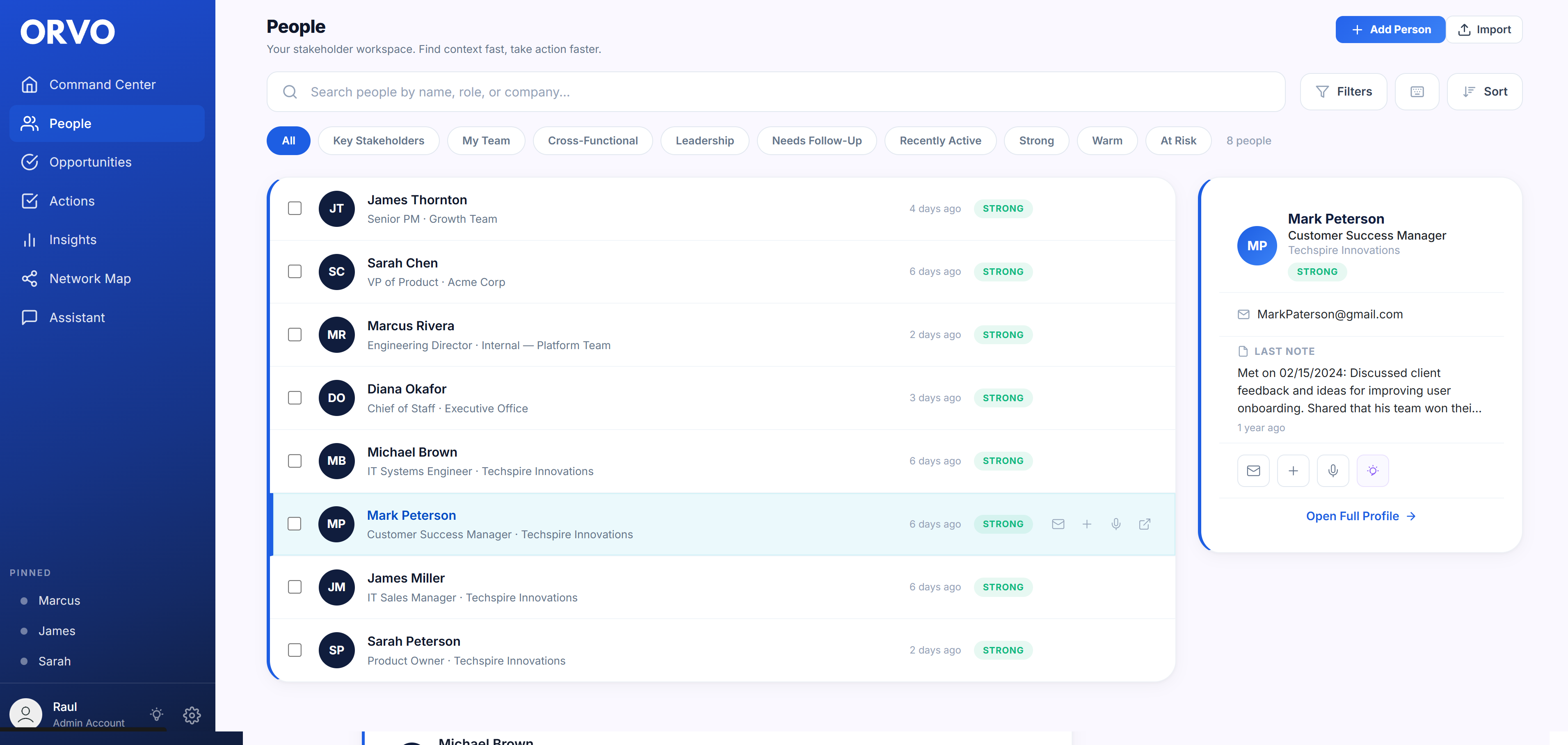
Track every interaction in Orvo: what advice they gave, what you implemented, what value you provided back. This context makes every subsequent conversation richer.
The Tool Stack for Managing Mentor Relationships
Mentorships fail when follow-through fails. Here is the system that keeps advisory relationships active and productive.
| Need | Tool | How It Strengthens Mentorships |
|---|---|---|
| Mentor tracking | Orvo | Dedicated entries for each advisor: conversation history, advice given, commitments made, value exchanged. See the full arc of every mentorship. |
| Follow-up cadences | Orvo reminders | Set monthly/biweekly reminders for each board seat. Never let an advisory relationship go cold through neglect. |
| Meeting preparation | Orvo AI Assistant | Before each mentor meeting, generate a brief: their recent advice, your progress on commitments, topics to discuss. Walk in prepared and make every minute count. |
| Value tracking | Orvo notes | Log what you have given back: articles shared, introductions made, help provided. Ensure the relationship stays reciprocal. |
| Network expansion | LinkedIn + Orvo | When a mentor introduces you to someone, track the referral chain. Your mentor's network becomes your extended advisory ecosystem. |
How to Be a Great Mentee (The Reciprocity Playbook)
The best mentees are not passive receivers of wisdom. They are active contributors to a two-way relationship.
The Reciprocity Playbook:
Always come prepared. Before every meeting, review your notes from the last conversation. Prepare 2-3 specific questions. Share an update on how you applied their previous advice. A prepared mentee respects the mentor's time and deepens every interaction.
Close the loop. When a mentor gives advice, follow up with the outcome — even if it did not work. "You suggested I approach the VP directly. I did, and here is what happened..." Mentors invest more in mentees who act on their guidance.
Give value back. Share articles relevant to their interests. Introduce them to someone useful. Offer your own expertise in areas where you are strong. A mentee who only takes eventually exhausts the relationship.
Be honest about challenges. The fastest way to deepen a mentorship is to be vulnerable about real struggles. "I am dealing with a political situation I do not know how to navigate" is far more valuable than "Everything is going great" — mentors want to help with real problems.
Know when to evolve. Some mentorships naturally run their course. Your needs change, their relevance shifts. It is okay to reduce cadence or let a mentorship become a warm contact rather than an active advisory relationship. Maintain the connection through annual touchpoints.
Build your personal board of advisors — track mentor conversations, set follow-up cadences, prepare for every meeting. Try Orvo free for 14 days →
Start Free TrialThe Future of Mentorship in the AI Era
Mentorship is being transformed by AI — but not replaced. The human element of mentorship (wisdom, empathy, advocacy, sponsorship) cannot be automated. What AI changes is the infrastructure around mentorship.
As Sorin Ciornei wrote in *The Future is Now* (thereach.ai), the Curating Economy demands that professionals manage their advisory relationships as systematically as they manage their projects.
AI makes mentorship more effective:
- Meeting preparation: AI generates briefs before every mentor conversation — past advice, your progress, topics to explore
- Pattern recognition: AI identifies which mentors you are neglecting and which advisory gaps exist in your board
- Relationship tracking: AI helps you maintain the context that makes each conversation build on the last
- Mentor matching: AI-powered platforms are making it easier to find mentors aligned with your specific career challenges
But the core truth remains: mentorship is a human relationship built on trust, vulnerability, and mutual investment. AI makes the system around it better. The relationship itself — that is still you.
The professionals who combine genuine human advisory relationships with systematic relationship management will build the most powerful mentorship networks in their generation.
Build your personal board of advisors with a system. Track, prepare, and grow every mentorship. Try Orvo free for 14 days →
Get Orvo FreeWichtige Erkenntnisse
- ✓ Build a 5-person board of advisors, not a single mentor dependency.
- ✓ Never ask "Will you be my mentor?" — use the Gradual Depth Strategy over 3-6 months.
- ✓ The Reciprocity Playbook: come prepared, close the loop, give value back, be honest about struggles.
- ✓ Track every mentor conversation in Orvo: advice given, commitments made, value exchanged.
- ✓ Professionals with 3-5 active advisory relationships advance 2.3x faster.
- ✓ AI improves mentorship infrastructure — but the human relationship remains irreplaceable.