
The one-sentence definitions (before the confusion sets in)
Let us start with clarity. These three concepts each answer a different question:
Vision answers: *Where are we going?* It is a picture of the future you want to create. It is aspirational, long-term, and describes a state of the world — not your company's activities.
Mission answers: *Why do we exist?* It is the purpose of your organisation right now. It describes who you serve, what you do for them, and why it matters. It is present-tense and grounded.
Strategy answers: *How will we win?* It is the set of choices you make about where to play and how to compete. It is specific, time-bound, and involves trade-offs — saying no to some things so you can say yes to the right ones.
The relationship between them is sequential: the vision defines the destination, the mission defines why you are making the journey, and the strategy defines the route you will take.
Most organisational confusion comes from mixing these up. A company that says "Our vision is to provide excellent customer service" has written a mission, not a vision. A company that says "Our strategy is to be the market leader" has written a vision, not a strategy. A company that says "Our mission is to transform the industry" has written a vision, not a mission.
Getting these right is not an academic exercise. It is the foundation of stakeholder alignment. When your CEO talks about "the vision" and your VP of Product thinks she means "the strategy," every meeting becomes a miscommunication.
| Vision | Mission | Strategy | |
|---|---|---|---|
| Question it answers | Where are we going? | Why do we exist? | How will we win? |
| Time horizon | Long-term (5-20 years) | Ongoing (always true) | Medium-term (1-5 years) |
| Nature | Aspirational, future state | Grounding, present purpose | Specific, actionable choices |
| Changes over time? | Rarely — only with major pivots | Almost never — core identity | Regularly — adapts to market |
| Example (Tesla) | Accelerate the world's transition to sustainable energy | Design, manufacture, and sell electric vehicles and clean energy products | Build the best EV, then use scale and battery tech to enter energy storage and solar |
Vision: the picture of the future you want to create
A vision statement describes the world as you want it to be — not your company as you want it to be. This is the most common mistake. "To be the leading provider of X" is not a vision. It is an ambition for your company. A vision is about the world your company is trying to create.
Great vision examples:
Microsoft (Satya Nadella era): "Empower every person and every organisation on the planet to achieve more." This is about the world — a world where technology amplifies human capability. It does not mention Microsoft's products, market share, or revenue.
IKEA: "To create a better everyday life for the many people." Not "to sell affordable furniture" — that is the mission. The vision is about the impact: better everyday life, for everyone.
Orvo: "A world where every professional has the relationship intelligence to reach their full potential." Not "to build the best CRM" — that is a strategy. The vision is about a world where career success is not limited by who you happen to know.
What makes a strong vision:
1. It describes a future state, not current activities. If it could be true today, it is not a vision. 2. It is bigger than your company. A vision should survive even if your company changes its products or strategy. 3. It is inspiring but credible. "End all human suffering" is too vague. "A world where every person has access to clean water" is specific and motivating. 4. It provides direction for decisions. When someone asks "should we do X or Y?" the vision should help answer: "which one moves us closer to the future we want to create?"
The stakeholder alignment function of vision: In practice, the vision is the tool you use to align people who disagree on tactics. When your product team wants to go left and your sales team wants to go right, the vision is the North Star: "which direction moves us toward the future we described?" Without a clear vision, these disagreements become political battles. With one, they become strategic discussions.
Mission: why your organisation exists (right now)
If the vision is the destination, the mission is the engine — the reason you get out of bed every day. A mission statement describes your organisation's purpose in the present tense: who you serve, what you do for them, and why it matters.
Great mission examples:
Patagonia: "We're in business to save our home planet." Specific about purpose (saving the planet), grounded in the present (we are in business), and clear about priority (the planet comes first, profit second).
Google: "To organise the world's information and make it universally accessible and useful." Describes what they do (organise information), for whom (the world), and the standard (accessible and useful).
Orvo: "To give professionals the tools to manage their most valuable career asset — their relationships — with the same rigour they apply to every other aspect of their work." Describes who we serve (professionals), what we do (relationship management tools), and why it matters (relationships are career assets).
The difference between vision and mission in practice:
The vision of IKEA is "a better everyday life for the many people." That could be achieved through furniture, food, services, or technology. The mission is more specific: "to offer a wide range of well-designed, functional home furnishing products at prices so low that as many people as possible will be able to afford them." The mission describes how they pursue the vision right now.
When your mission is wrong, everything breaks. A company whose mission says "to make the best products" but whose actual behaviour is "to maximise quarterly revenue" will have misaligned teams. People will say one thing in all-hands meetings and do another in sprint planning. The gap between stated mission and actual behaviour is one of the biggest drivers of workplace cynicism.
For your career: Understanding your company's real mission (not the one on the wall, the one that actually drives decisions) is essential relationship intelligence. It tells you what leaders actually care about, how decisions really get made, and what kind of work gets rewarded. Orvo helps you track these patterns — noting which stakeholders prioritise which aspects of the mission, and how to frame your work accordingly.
Strategy: the choices that determine how you win
Strategy is the most misunderstood of the three. Most people confuse strategy with goals ("our strategy is to grow 30%"), tactics ("our strategy is to run more ads"), or aspirations ("our strategy is to be the market leader"). None of these are strategies. They are wishes.
Strategy is a set of integrated choices about where to play and how to win. The key word is choices — because strategy is fundamentally about what you will NOT do. A company that tries to serve every customer, in every market, with every product does not have a strategy. It has a to-do list.
The Roger Martin framework (the best one):
Roger Martin, former dean of the Rotman School of Management, defines strategy through five cascading choices:
1. What is our winning aspiration? (Connects to vision) 2. Where will we play? (Which markets, customers, channels, geographies) 3. How will we win? (What is our competitive advantage in those spaces) 4. What capabilities must we have? (What must we be world-class at) 5. What management systems are required? (How do we measure and support the strategy)
Strategy in practice — IKEA example:
Where to play: Home furnishing for cost-conscious consumers globally. How to win: Self-assembly flat-pack model (lower shipping costs), in-house design (control quality and cost), massive stores with integrated experience (restaurant, children's play area). Capabilities needed: Supply chain excellence, Scandinavian design at scale, retail experience management. What they chose NOT to do: luxury furniture, custom design, delivery-first model (until recently), small-format stores.
Every strategic choice involves a trade-off. IKEA chose low price over premium quality. Apple chose premium experience over affordability. Netflix chose streaming over physical media. The trade-off is what makes it a strategy rather than a wish.
Why this matters for your career: Understanding your company's strategy — the actual trade-offs being made — is essential for stakeholder alignment. If your company's strategy is "low cost," proposing a premium initiative will be rejected no matter how good the idea is. If your company's strategy is "best product," cost-cutting proposals will face resistance. Knowing the strategy lets you frame every proposal, every meeting, and every stakeholder conversation in terms that align with how the organisation has chosen to win.
| Common Mistake | What They Say | What It Actually Is | What Strategy Would Be |
|---|---|---|---|
| Goals as strategy | "Our strategy is to grow 30%" | A goal (outcome, not a choice) | "We will grow 30% by expanding into the mid-market through self-service" |
| Tactics as strategy | "Our strategy is to run more ads" | A tactic (activity, not a direction) | "We will win in paid acquisition by targeting 25-35 professionals on LinkedIn" |
| Aspirations as strategy | "Our strategy is to be the market leader" | An aspiration (wish, not a plan) | "We will lead the personal CRM market by owning career intelligence content" |
| Everything as strategy | "We will serve all segments" | A lack of strategy (no trade-offs) | "We will focus on mid-career professionals and explicitly NOT serve enterprise" |
How vision, mission, and strategy connect (the alignment cascade)
The power of these three concepts is not in any one of them — it is in how they cascade. When they are aligned, an organisation moves with clarity and speed. When they are misaligned, even talented teams produce mediocre results.
The alignment cascade:
Vision (where are we going?) → shapes Mission (why we exist and what we do) → guides Strategy (the choices we make to win) → drives Goals (the measurable outcomes we target) → determines Tactics (the specific actions we take)
Each level constrains and informs the next. A clear vision makes it easier to write a focused mission. A focused mission makes it easier to choose a strategy. A clear strategy makes it easier to set goals. Clear goals make it easier to choose tactics.
When the cascade breaks:
The most common failure mode: a company with a bold vision, a vague mission, and no real strategy. The result is inspirational all-hands meetings followed by confused sprint planning. Everyone knows WHERE the company wants to go but nobody agrees on HOW to get there.
The second most common failure: strategy without vision. The company makes sharp tactical choices but nobody can explain why. Employees execute efficiently but without meaning. This is the company where people say "I am not sure what we are actually trying to achieve."
For stakeholder management: Understanding where your company is strong and weak in this cascade is critical relationship intelligence. If your company has a clear vision but no strategy, your most valuable contribution is helping create strategic clarity — and aligning stakeholders around specific choices. If your company has a clear strategy but no inspiring vision, your contribution might be translating the strategy into a narrative that motivates people.
The professionals who can articulate the vision-mission-strategy cascade clearly — in presentations, in meetings, in stakeholder conversations — are perceived as strategic thinkers. This perception compounds into influence. People listen to the person who can connect daily work to the bigger picture.
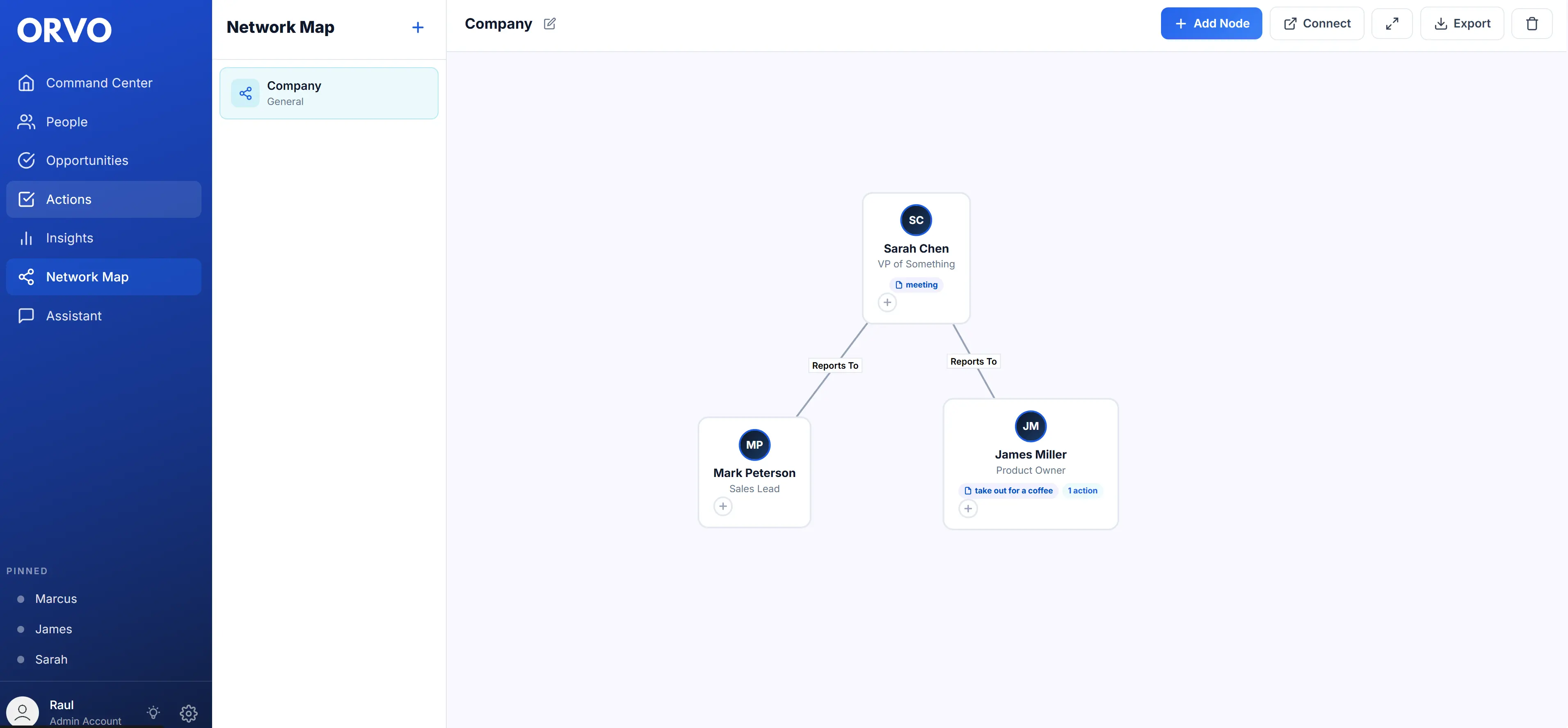
Orvo helps here by giving you a systematic way to track how each stakeholder interprets the vision, mission, and strategy. When you know that the CFO sees the strategy as cost-driven while the CTO sees it as innovation-driven, you can bridge that gap. That bridging is one of the highest-value skills in any organisation.
The 7 most common mistakes companies make with vision, mission, and strategy
Understanding the framework is the first step. Recognising when it is being violated is how you add value. Here are the seven mistakes you will see in almost every organisation — and how to spot them.
Mistake 1: Writing a vision that is actually a goal. "To be the number one provider of cloud solutions in Europe by 2030." This is a goal with a deadline, not a vision. A vision describes the world you want to create, not your market position. Test: does it survive beyond 2030? No. It is not a vision.
Mistake 2: Writing a mission that could belong to any company. "To deliver innovative solutions that exceed customer expectations." Replace the company name with any competitor and the statement still works. A mission should be specific enough that only your company could authentically claim it.
Mistake 3: Calling a to-do list a strategy. "Our strategy: expand into Asia, launch a mobile app, hire 50 engineers, and partner with three enterprise clients." This is a list of initiatives, not a strategy. A strategy explains the logic that connects initiatives — why these four things and not four others. Without the connecting logic and the trade-offs, it is just a plan.
Mistake 4: Changing the vision every year. A vision should be durable — it should last a decade or more. If your company announces a new vision at every annual kickoff, it does not have a vision. It has a marketing tagline that changes with the CEO's mood. Employees stop believing in visions that change annually.
Mistake 5: Having a strategy that requires no trade-offs. "We will serve all segments, across all geographies, with a premium and a budget product line." This is not a strategy. Strategy requires choosing: which segments, which geographies, which product positioning. If you are not saying no to something, you are not being strategic.
Mistake 6: Misalignment between stated and actual strategy. The company says "our strategy is innovation" but the budget allocates 80% to maintaining existing products and 5% to R&D. The actual strategy is maintenance, not innovation. Employees who try to innovate get frustrated because the system does not support what the words promise. This misalignment is one of the biggest sources of organisational dysfunction.
Mistake 7: Skipping from vision to tactics. A company announces a bold vision ("transform healthcare") and immediately jumps to tactics ("build a patient portal") without defining the strategy in between. The result: every team interprets the vision differently and builds whatever they think is right. The patient portal team, the AI diagnostics team, and the insurance integration team all believe they are pursuing the vision — but without a strategy to connect them, they pull in different directions.
Recognising these mistakes in your own organisation is valuable stakeholder intelligence. When you can say to your VP, "I think we are making Mistake 6 — our stated strategy says innovation but our budget says maintenance," you are demonstrating strategic thinking that gets noticed and rewarded.
| Mistake | What It Sounds Like | What Is Actually Wrong | The Fix |
|---|---|---|---|
| Vision as goal | "Be #1 in Europe by 2030" | Has a deadline — it is a goal | Describe the world you want to create, not your market position |
| Generic mission | "Deliver innovative solutions" | Could belong to any company | Name who you serve, what you do, and why — specifically |
| To-do list as strategy | "Expand, launch, hire, partner" | No connecting logic or trade-offs | Explain WHERE you play and HOW you win |
| Vision changes annually | New vision every kickoff | Employees stop believing | Set a durable vision (10+ years) and hold it |
| No trade-offs | "Serve all segments everywhere" | Not a strategy without choices | Define what you will NOT do |
| Stated ≠ actual | "Strategy is innovation" + 5% R&D budget | Budget reveals the real strategy | Align resources to stated strategy or be honest about the real one |
| Vision → tactics (skip strategy) | "Transform healthcare → build a portal" | No strategy connecting vision to execution | Define the strategic choices between vision and tactical work |
How to use this framework in your daily work
Understanding vision, mission, and strategy is not just for executives. Every professional benefits from applying this framework — in meetings, in proposals, and in career decisions.
In meetings: When a discussion becomes circular, it is usually because participants are operating at different levels of the cascade. One person is arguing about vision ("we should be the innovation leader"), another is arguing about strategy ("we should focus on the enterprise segment"), and a third is arguing about tactics ("we should build feature X"). Naming the level breaks the logjam: "It sounds like we agree on the vision but disagree on the strategy. Can we focus on which market segment to prioritise?"
In proposals: Frame every proposal in terms of the company's strategy, not just its merits. "This initiative supports our strategy of winning in the mid-market segment by reducing time-to-value for new customers" is more persuasive than "this initiative will improve onboarding." The first version connects your work to a strategic choice the organisation has already made. The second asks people to evaluate it in a vacuum.
In career decisions: Apply the framework to your own career. What is your career vision — the future state you want to create for yourself? What is your career mission — the work you find meaningful and want to be known for? What is your career strategy — the specific choices about where to focus, what to say no to, and how to differentiate yourself?
Most professionals have vague career aspirations ("I want to be successful") but no career strategy. The ones who define their where-to-play (which industry, which role, which type of company) and how-to-win (what makes them distinctively valuable) make better decisions about which opportunities to pursue, which relationships to invest in, and which skills to develop.
In stakeholder conversations: Different stakeholders care about different levels of the cascade. The CEO cares about vision. The CFO cares about strategy (specifically the financial trade-offs). The VP of Product cares about the translation from strategy to product roadmap. A director cares about the translation from roadmap to team goals. Matching your communication to the stakeholder's level is one of the most effective influence techniques in organisations — and it requires knowing which level each person operates at. Orvo helps you track this: note each stakeholder's strategic perspective, and review it before every conversation.
Real company examples: vision, mission, and strategy dissected
Theory is useful. Let us look at how real companies implement (or fail to implement) the cascade.
Tesla: Vision: Accelerate the world's transition to sustainable energy. Mission: To design, manufacture, and sell electric vehicles and clean energy products. Strategy: Start with a high-end EV (Roadster) to prove the concept, then move downmarket (Model S → Model 3 → Cybertruck) while vertically integrating battery production, charging infrastructure, and energy storage. Why it works: The vision is about the world (sustainable energy), not Tesla. The mission is specific about what Tesla does. The strategy involves clear trade-offs: vertical integration over partnership, direct sales over dealerships, premium first over mass-market first.
Amazon: Vision: To be Earth's most customer-centric company. Mission: To offer customers the widest possible selection of products at the lowest possible prices, with the best possible convenience. Strategy: Invest in infrastructure (fulfilment, AWS, logistics) that reduces costs over time; use those savings to lower prices further; prioritise long-term market position over short-term profitability. Why it works: The strategy makes painful trade-offs (no profits for years) that competitors are unwilling to match.
A cautionary example — WeWork: Vision: "Elevate the world's consciousness." (Too vague, disconnected from what the company actually does.) Mission: "Create a world where people work to make a life, not just a living." (Better, but still more aspirational than operational.) Strategy: Grow as fast as possible by leasing office space and subletting at a premium. Why it failed: The vision had nothing to do with the business. The mission was inspiring but did not constrain decisions. The "strategy" was just a growth tactic with no competitive moat.
The lesson for your career: Study the vision-mission-strategy alignment of any company before you join. Companies with tight alignment (Tesla, IKEA, Amazon) tend to have clear cultures, focused teams, and career trajectories that make sense. Companies with weak alignment (WeWork-style disconnects) tend to have confused cultures, shifting priorities, and career paths that depend more on politics than performance. This analysis takes 20 minutes and can save you years.
| Company | Vision | Mission | Strategy | Alignment |
|---|---|---|---|---|
| Tesla | Sustainable energy future | Design and sell EVs + clean energy | Premium → mass-market, vertically integrate | A — tight cascade |
| Amazon | Most customer-centric company | Widest selection, lowest prices, best convenience | Infrastructure investment → cost leadership | A — strategy matches mission |
| IKEA | Better everyday life for many | Affordable, well-designed home furnishing | Flat-pack, self-assembly, in-house design | A — every choice supports affordability |
| WeWork | Elevate world's consciousness | Work to make a life, not a living | Lease and sublet as fast as possible | F — vision disconnected, no real strategy |
Vision tells you where to go. Strategy tells you how. Relationships tell you who can help you get there. Orvo is relationship intelligence for professionals who think strategically about their careers. Start your free trial →
Get Orvo FreeKey Takeaways
- ✓ Vision answers "where are we going?" (future state). Mission answers "why do we exist?" (present purpose). Strategy answers "how will we win?" (specific choices).
- ✓ The most common mistake: confusing goals, tactics, or aspirations with strategy. Strategy requires trade-offs — choosing what NOT to do.
- ✓ A strong vision describes the world you want to create, not your company's ambition. It should survive a complete change of strategy.
- ✓ A strong mission describes who you serve, what you do, and why it matters — in the present tense.
- ✓ Strategy is a set of integrated choices about where to play and how to win (Roger Martin framework). If there are no trade-offs, it is not a strategy.
- ✓ The alignment cascade (vision → mission → strategy → goals → tactics) is the foundation of organisational clarity.
- ✓ Understanding this framework is essential stakeholder intelligence — it helps you frame every proposal in terms that resonate with leadership.