
The ISFJ superpower: reliability that organisations depend on
ISFJs are the most dependable type in any organisation. When you say you will do something, it gets done — on time, at quality, without drama. You remember what stakeholders need before they ask. You anticipate problems and solve them quietly. You create stability in teams that would otherwise fall apart.
This is not a soft skill. A 2024 study by Gallup found that team reliability — the consistent delivery of commitments — is the single strongest predictor of team performance, outranking innovation, strategy, and even talent. ISFJs are the human embodiment of team reliability.
ISFJs also possess an undervalued form of emotional intelligence: practical empathy. You do not just understand how someone feels — you take action on it. The colleague who is struggling gets a quiet offer of help. The new hire who is overwhelmed gets a clear walkthrough. The manager who is stressed gets a perfectly prepared brief that removes one thing from their plate. This practical empathy builds deep loyalty and trust.
The ISFJ career challenge is brutally simple: the traits that make you indispensable also make you invisible. When everything runs smoothly because of you, nobody notices — because there are no fires, no crises, no drama. The colleague who creates a crisis and then heroically solves it gets more visibility than the ISFJ who prevented the crisis from happening in the first place.
A 2023 analysis by Korn Ferry found that professionals described as "reliable and detail-oriented" were rated 15% lower on "leadership potential" than those described as "visionary and strategic" — despite delivering better results. The corporate system has a visibility bias against the exact qualities that make ISFJs excellent. This playbook corrects for that bias.
The ISFJ blind spots that keep you overlooked
ISFJs are not overlooked because they lack skill. They are overlooked because of specific patterns that make their contributions invisible.
Blind spot 1: Doing the work instead of being seen doing the work. ISFJs handle tasks quietly and efficiently. The expense report gets filed, the meeting notes get distributed, the presentation gets polished — and nobody knows who did it. The ISFJ assumption: "Good work gets noticed." The corporate reality: visible work gets noticed. Good, invisible work gets taken for granted.
Blind spot 2: Saying yes to everything. ISFJs hate disappointing people. The result: you become the person who handles every request, regardless of whether it advances your career. Over time, your role becomes defined by what others need from you rather than by what you are capable of. The administrative tasks pile up. The strategic work gets crowded out. And your manager's perception shifts from "high-potential contributor" to "reliable support person."
Blind spot 3: Deflecting credit. ISFJs are genuinely uncomfortable taking credit. "It was a team effort." "Anyone would have done it." "It was not a big deal." Each deflection erodes your visibility. After 50 deflections, nobody associates any specific achievement with your name — because you trained them not to.
Blind spot 4: Avoiding self-advocacy. ISFJs wait to be recognised rather than advocating for themselves. You assume that your manager sees your contributions and will reward them naturally. They often do not. Managers are busy, distracted, and paying attention to the loudest signals. If you are not providing signal about your own contributions, you are invisible in the noise.
Blind spot 5: Comfort zone loyalty. ISFJs value stability and often stay in roles, teams, or companies longer than is strategically optimal. Loyalty is admirable. But staying in a role where you have outgrown the scope — because leaving feels disloyal — costs you years of career advancement.
| ISFJ Blind Spot | What You Do | What It Costs You | The Fix |
|---|---|---|---|
| Invisible work | Handle everything quietly | Nobody knows what you contribute | Monthly impact summary to your manager |
| Saying yes to everything | Accept every request | Defined by others' needs, not your capability | The strategic no: decline tasks that do not advance your career |
| Deflecting credit | "It was a team effort" | No achievements associated with your name | "Thank you — I'm glad the approach I designed worked well" |
| Avoiding self-advocacy | Wait to be recognised | Manager does not know your aspirations | Quarterly career conversation with your manager |
| Comfort zone loyalty | Stay too long in outgrown roles | Years of missed advancement | Annual career audit: is this role still growing me? |
The ISFJ visibility strategy: making quiet excellence loud enough
ISFJs need a visibility approach that feels authentic — not performative. The good news: you do not need to become a self-promoter. You need to make your impact data available to the people who make decisions about your career.
The ISFJ Visibility Formula: Document → Deliver → Describe.
Document: Keep a running log of your contributions. Every time you solve a problem, complete a project, help a colleague, or prevent an issue — write it down. Include specific outcomes: "Caught the pricing error before the proposal went to the client — saved $45K in potential revenue loss." Most ISFJs are horrified at the idea of tracking their own contributions. Reframe it: you are not bragging. You are creating evidence for your performance review.
Deliver: Continue doing excellent work. This is already your strength. Do not change it.
Describe: Once a month, send your manager a brief update (3-5 bullet points) describing what you delivered and the impact it had. Frame it as keeping them informed, not self-promotion: "I wanted to keep you updated on a few things from this month." Your manager will appreciate the information — and they will use it in their own reports and in calibration meetings.
The quarterly career conversation. Most ISFJs never tell their manager what they want. They assume the manager knows — or they feel it is presumptuous to ask. Schedule a quarterly conversation: "I would love to discuss my career development. What do you see as my growth areas, and what opportunities might be available in the next 6-12 months?" This signals ambition without arrogance. It also gives your manager the information they need to advocate for you.
Make your prevention work visible. ISFJs prevent problems that nobody sees. Start naming them. "I noticed the Q3 data had an inconsistency that would have affected the forecast, so I corrected it before it reached the leadership report." This single sentence transforms invisible work into visible risk management.
Volunteer for one visible project per quarter. Not a flashy initiative — a project that puts your work in front of senior leaders. Preparing a board presentation, leading a cross-functional review, or creating a process improvement that gets documented and shared. One visible project per quarter is enough to shift the perception from "reliable support" to "high-impact contributor."
The ISFJ visibility multiplier: process documentation. ISFJs often build processes that make teams run smoothly — but they never document them. When you create a process, write it down and share it. "I created a quality check workflow that reduced our error rate from 5% to 0.3%. Here is the documentation so the whole team can use it." This transforms your quiet efficiency into a visible, scalable contribution. Documented processes carry your name. They get referenced in leadership meetings. They become evidence of strategic thinking — because designing a system IS strategic thinking, even if it does not feel flashy.
Reframe your language. ISFJs describe their work using modest language that undersells its value. "I just make sure things run smoothly" becomes "I designed and maintain the operational processes that deliver our team's 99% on-time delivery rate." "I help people" becomes "I provide the stakeholder support that contributed to a 95% client retention rate." Same work. Different framing. The second version gets promoted. Practise this reframing in your evidence file until it becomes natural.
The ISFJ and LinkedIn. Most ISFJs have minimal LinkedIn presence because self-promotion feels uncomfortable. But LinkedIn is not self-promotion — it is professional documentation. Update your profile with specific achievements. Post occasionally about processes you have improved or lessons you have learned. Your natural humility and practical focus produces LinkedIn content that is refreshingly genuine in a sea of performative posts. People notice authenticity — and ISFJs have it in abundance.
The ISFJ relationship strategy: deepening the bonds that already exist
ISFJs are natural relationship builders — you just do not recognise it as networking. Every time you remember a colleague's birthday, help someone meet a deadline, or check in on a team member who seemed stressed, you are building relationship capital. The ISFJ's relationship advantage is depth and trust. People genuinely trust you — because you have earned that trust through consistent, caring behaviour over time.
The ISFJ relationship playbook:
1. Recognise your existing network. ISFJs often say "I am not good at networking." You are excellent at networking — you just call it "being helpful." Make a list of every person who would take your call right now because you helped them in the past. That is your network. It is probably larger than you think.
2. The ISFJ Inner Circle (4-6 people). Your manager, one skip-level leader, one peer who champions your work publicly, one person in HR or talent development, one external contact, and optionally one junior person you mentor. These relationships are your career infrastructure.
3. The champion relationship. This is the most important relationship for ISFJs: one person who is naturally vocal and who values your work. When this person says in a meeting, "This was [your name]'s work, and it was outstanding" — that single moment creates more visibility than months of your own modest communication. Invest in this relationship. Make sure your champion knows what you are working on and what you have achieved.
4. Ask for help (the hardest ISFJ skill). ISFJs help everyone and ask for nothing. This creates a one-directional relationship pattern that actually weakens your network over time. People who only give and never receive make others uncomfortable — because the relationship feels unbalanced. Ask for advice, ask for feedback, ask for introductions. Receiving help deepens relationships more than only giving it.
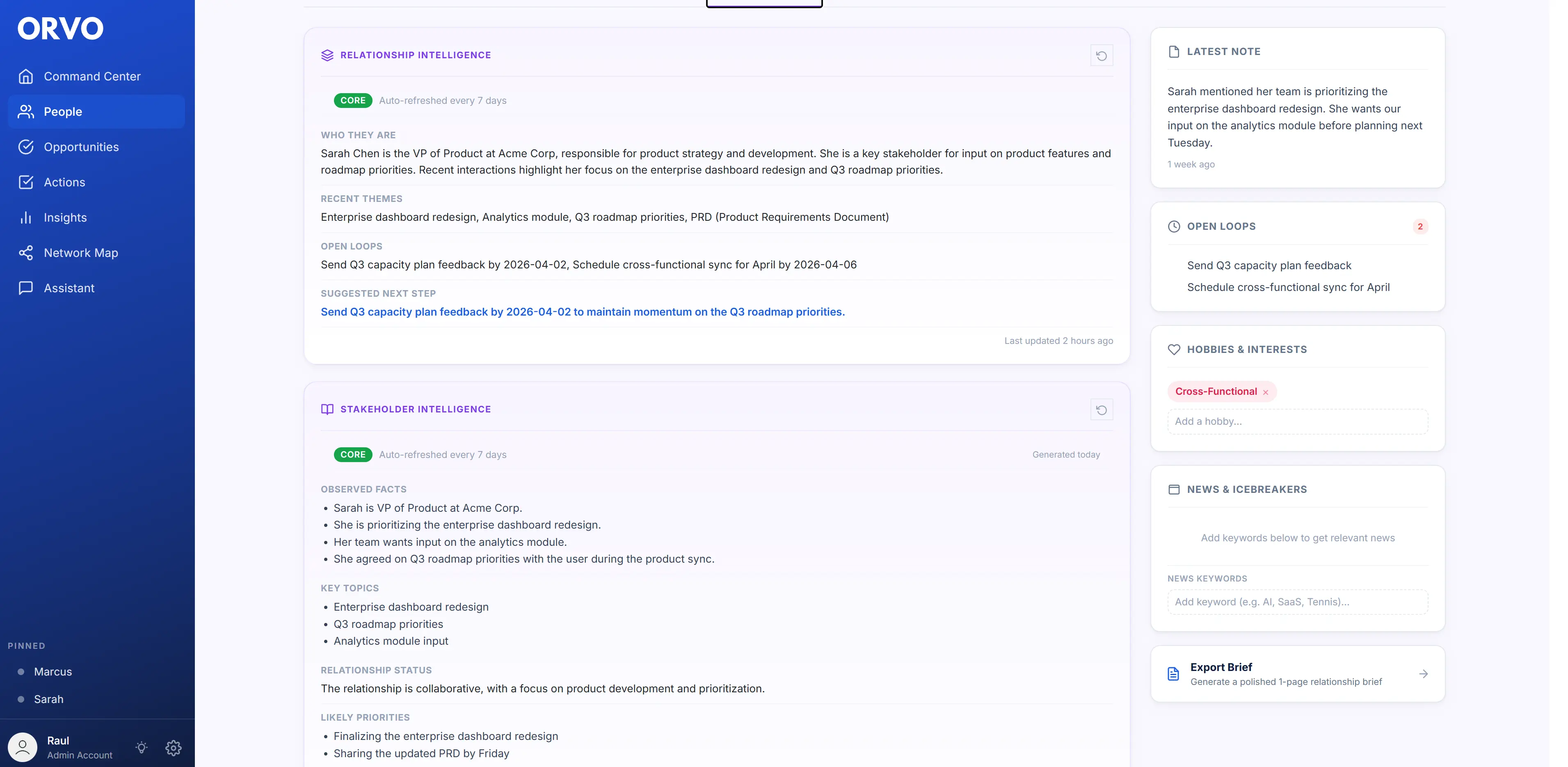
5. Use Orvo to track what you already do naturally. You already remember details about people. You already follow up on commitments. You already maintain relationships through thoughtful gestures. Orvo simply makes this systematic — so you can review before important meetings, track which relationships need attention, and ensure your natural relationship skills are deployed strategically, not just reactively.
The ISFJ career path: where your reliability becomes leadership
ISFJs thrive in roles that require consistency, attention to detail, service orientation, and the ability to support others effectively.
Roles where ISFJs thrive: Healthcare (nursing, medical administration), education and training, HR and people operations, executive assistance, project coordination, quality assurance, customer success, accounting, and any role where reliability, empathy, and attention to detail are the core requirements. ISFJs in these roles consistently receive the highest satisfaction scores of any type.
Roles where ISFJs struggle: High-risk sales with aggressive targets (too much rejection and pressure), startup chaos without clear processes (too much ambiguity), adversarial negotiation (too much conflict), and roles requiring constant public speaking or improvisation. ISFJs in these roles feel perpetually anxious — not because they lack capability but because the role requires sustained behaviour that conflicts with their natural preferences.
The ISFJ leadership style. ISFJs lead through service — they remove obstacles for their team, ensure everyone has what they need, and create stable environments where people can do their best work. This is servant leadership, and research from Regent University (2024) found that servant leaders produce 18% higher team satisfaction and 12% lower turnover than authoritative leaders. The ISFJ leadership style is not weaker than the ENTJ's command style — it is different, and in many contexts, it is more effective.
The ISFJ leadership risk. ISFJs sometimes struggle to make tough decisions that hurt people — performance terminations, reorganisations, budget cuts. The empathy that makes you an outstanding team leader makes you reluctant to cause pain. The fix is not becoming less empathetic — it is reframing tough decisions as acts of care for the broader team. Keeping an underperformer hurts the 10 people who are covering for them. Addressing it is painful for one person and beneficial for ten.
Famous ISFJs: Queen Elizabeth II, Mother Teresa, and Beyoncé are frequently typed as ISFJs. What they share is not flashiness — it is extraordinary consistency, dedication to service, and a quiet strength that becomes legendary over time.
Self-advocacy for ISFJs: asking for what you deserve
Self-advocacy is the single highest-leverage skill for ISFJ career advancement. Not because you lack other skills — but because every other skill you have is invisible without it.
The ISFJ self-advocacy toolkit:
1. The evidence file. Keep a running document (updated weekly) of your contributions. Specific, measurable outcomes. "Processed 147 invoices this month with zero errors" is evidence. "Did a good job" is not. When review season comes, you open your evidence file and your self-assessment writes itself.
2. The career conversation. Every quarter, have a 15-minute conversation with your manager about your career aspirations. The script: "I value this role and want to continue growing. In the next 12 months, I am interested in [specific opportunity — a promotion, a project, a skill]. What would I need to demonstrate to get there?" This is not demanding. It is asking for guidance. Most managers respond positively because it gives them a clear way to support you.
3. The credit claim. When you receive a compliment, stop deflecting. Replace "It was a team effort" with "Thank you — I am glad the approach worked well." Replace "Anyone would have done it" with "I appreciate you noticing. It took some careful planning." These small changes feel uncomfortable at first. They become natural within a month. And they dramatically change how others perceive your contributions.
4. The salary conversation. ISFJs are the type most likely to accept whatever salary is offered without negotiating. A 2024 PayScale study found that professionals who negotiate earn 7.4% more on average — and the gap compounds over a career to hundreds of thousands of dollars. You deserve fair compensation. Negotiating is not greedy — it is professional. The script: "Based on my contributions and the market data I have researched, I believe a salary of X would be appropriate. Can we discuss this?"
5. The sponsorship request. Identify one senior leader who has seen your work and ask them to be your sponsor. Not a mentor (who gives advice) — a sponsor (who advocates for you in rooms you are not in). The script: "I admire your leadership and I am working toward [goal]. Would you be willing to keep me in mind for opportunities that align with my development?" Most senior leaders are flattered by this request and say yes.
6. The performance review preparation. ISFJs typically prepare for performance reviews by... not preparing. They assume their manager has been tracking their contributions. They have not. Two weeks before your review, compile your evidence file into a one-page self-assessment. Frame each contribution in terms of business impact: "Implemented the new quality check process → zero client-facing errors in Q2 → contributed to the account retention that represented $380K in annual revenue." Walk into your review with this document. It changes the conversation from vague appreciation to specific recognition.
7. The ISFJ negotiation framework. ISFJs struggle with negotiation because it feels confrontational. Reframe it: negotiation is not a fight. It is a conversation about fair value. Before any salary discussion, research market rates (Glassdoor, PayScale, Levels.fyi). Prepare a brief: "Based on my contributions [list top 3] and the market data for this role in our region [cite range], I believe a salary of X would be appropriate." Practise saying this to a friend until it feels natural. The preparation removes the anxiety because you are presenting data, not making demands — and data is comfortable territory for ISFJs.
The ISFJ at different career stages
Early career (0-5 years). You ramp up quickly because your reliability and helpfulness make you immediately valuable. The risk: becoming typecast as the "helpful one" rather than the "high-potential one." The investment: document achievements from day one. Volunteer for one visible project per quarter. Build your Inner Circle. Start the evidence file.
Mid-career (5-12 years). This is where ISFJs either break through or plateau. You have been reliable for years. Everyone depends on you. But you may not have been promoted at the rate your contributions deserve. The critical investment: self-advocacy. Have the career conversation. Ask for the promotion explicitly. Stop waiting to be noticed.
Senior career (12+ years). ISFJs who reach senior levels are often described as "the person who holds the organisation together." Your institutional knowledge, your relationship depth, and your reliability make you irreplaceable. The challenge at this level: ensuring your stability is seen as strategic leadership, not just dependability. Frame your contributions in strategic terms: "I built the process that reduced our error rate by 60%" not "I do the quality checks."
The ISFJ compound effect. ISFJs build trust slowly but permanently. By your 40s, you have a reputation for integrity that no flashy competitor can match. People who have worked with you for years become your most powerful advocates — because they have seen your consistency across dozens of situations. This compounding trust is the ISFJ's greatest career asset. Log these long-term relationships in Orvo and maintain them deliberately.
The ISFJ career trajectory compared to other types. ENTJs and ENTPs advance fast early and sometimes plateau when they burn relationships. ISFJs advance slowly early and accelerate in the second half of their careers when their accumulated trust and institutional knowledge become leadership assets. A 2023 analysis of corporate promotion data by Korn Ferry found that professionals with 8+ years at one company were 40% more likely to be promoted to VP than job-hoppers — a finding that favours the ISFJ loyalty pattern. The key is ensuring that loyalty is directed at organisations that reward it, not ones that exploit it.
The ISFJ in the AI era. ISFJs who adopt AI tools for the administrative tasks that consume their time (documentation, scheduling, data processing, routine communication) free themselves for the high-value human work that no AI can replicate: building trust, providing practical empathy, preventing problems through institutional knowledge, and creating stable team environments. AI does not threaten the ISFJ — it amplifies the ISFJ, if you use it to reduce the invisible administrative work and increase the visible strategic contributions.
Setting boundaries: the ISFJ skill that prevents burnout
ISFJs burn out not from hard work but from over-giving. You say yes when you should say no. You take on others' emotional burdens. You work late to help a colleague meet their deadline — again. The pattern is unsustainable, and it leads to the specific kind of burnout where you resent the very people you are helping.
The ISFJ boundary toolkit:
1. The strategic no. Not every request deserves your time. Before saying yes, ask: "Does this advance my career goals, or am I doing it because I hate disappointing people?" If it is the latter, practise this script: "I would love to help, but I am at capacity this week. Can we revisit next week, or is there someone else who could assist?" This is not selfish — it is sustainable.
2. The help budget. Allocate a specific number of hours per week for helping others — say, 3 hours. When the budget is spent, you are done for the week. This prevents the ISFJ pattern of helping until there is no time left for your own priorities.
3. The emotional boundary. ISFJs absorb colleagues' stress, frustration, and anxiety. Like INFPs, you need an emotional airlock: before entering a stressful interaction, set an intention to be supportive without absorbing. After the interaction, take 5 minutes to decompress before moving to the next task.
4. The workload audit. Every month, list everything you are doing. Categorise each item: "My core job," "Helping others," "Administrative overflow," and "Career development." If "Helping others" and "Administrative overflow" exceed 30% of your time, you are being used rather than valued. Have a conversation with your manager about rebalancing.
5. Use Orvo to track what you are carrying. Log your commitments — both your own projects and the help you provide others. When your Orvo dashboard shows 15 active commitments to other people and 2 to your own career development, the imbalance becomes impossible to ignore. Data makes boundaries easier to set because it removes the guilt of guessing.
6. The ISFJ burnout warning signs. ISFJs do not burn out from overwork (they can sustain remarkable workloads). They burn out from feeling unappreciated. The specific warning signs: resentment toward people you normally enjoy helping, a growing cynicism about whether your work matters, physical fatigue that rest does not fix, and the thought "I do everything and nobody notices." If you recognise these signs, the priority is not working harder — it is rebalancing. Have the career conversation. Set boundaries. Start the evidence file. The resentment fades when you take control of your visibility and advocacy.
7. The ISFJ and saying no to your manager. The hardest boundary for ISFJs: declining a request from their manager. But managers who overload their most reliable people are not being strategic — they are being lazy. When your manager adds another task, try: "I want to make sure I deliver quality on everything. Here is my current workload [list]. Which of these should I deprioritise to take on the new request?" This is not saying no. It is asking your manager to make the trade-off decision — which is their job. Most managers, when confronted with the actual list, will either reprioritise or find someone else. This one technique saves ISFJs hundreds of hours per year and protects the quality of work that builds their reputation.
ISFJs are the backbone of every team. Orvo ensures your reliability becomes visible — track contributions, prepare for career conversations, and advocate for yourself with evidence. Start free →
Get Orvo FreeKey Takeaways
- ✓ ISFJs are the most reliable type — team reliability is the strongest predictor of performance. But reliability without visibility leads to being overlooked.
- ✓ Five blind spots: invisible work, saying yes to everything, deflecting credit, avoiding self-advocacy, and comfort zone loyalty
- ✓ The ISFJ Visibility Formula: Document (track contributions), Deliver (keep doing great work), Describe (monthly impact summary)
- ✓ Self-advocacy is your highest-leverage skill. Have quarterly career conversations. Stop deflecting credit. Negotiate your salary.
- ✓ Build a champion relationship — one vocal colleague who credits your work publicly. One champion moment outweighs months of quiet excellence.
- ✓ Set boundaries to prevent burnout. Use a help budget, practise the strategic no, and audit your workload monthly.
- ✓ ISFJs compound trust permanently. By your 40s, your reputation for integrity becomes your most powerful career asset.