
The observation from inside Google that changed the conversation
In March 2026, Dan Thomasset — a Principal Engineer at Google — posted an observation on LinkedIn that generated thousands of reactions and fundamentally reframed how the tech industry thinks about AI and job roles.
"PMs are running circles around SWEs with vibe coding and GenAI prototyping tools, and this is a good thing," he wrote. "The dam has broken for the creatives, and they don't need engineers for the initial phases of their work anymore. Gone are static Figma demos, in with rapid prototyping against production systems."
This was not a casual opinion. It was a report from inside one of the most important technology companies in the world, written by an engineer — someone whose own role could be seen as threatened by the trend he was describing. And he called it a good thing.
Thomassett went further, describing what he called "the new organisational API" — a new model for how product and engineering teams work together. "Remove the early go-rounds between product and engineering teams. Skip the meetings, missed comms, vision dilution, and more. Give the engineering teams full, vetted prototype implementations, rather than specs to be interpreted or conversations to remember."
The post resonated because it described something that people across the industry were already seeing but had not articulated. PMs with access to AI prototyping tools were moving faster, producing better work, and — counterintuitively — creating better outcomes for engineering teams too. Engineers could now focus on what they do best (architecture, scalability, reliability) instead of spending weeks building prototypes that might be thrown away after the first user test.
Why PMs succeed with AI: it is not about coding
The most common misunderstanding about PMs using AI prototyping tools is that they are "learning to code." They are not. They are doing what they have always done — communicating clearly — with a tool that now translates clear communication directly into working software.
One commenter on the original thread explained it precisely: "The advantage is not that PMs code better. It is that they removed the translation layer. Before: PM writes spec, engineer interprets it, drift accumulates. Now: PM owns the spec AND the first prototype, so the interpretation gap does not exist. Engineers are still needed for the scalable, production-ready implementation."
This is a crucial distinction. In the old model, a PM would write a product requirements document (PRD). An engineer would read the PRD, interpret it through their own understanding, ask clarifying questions, get partial answers, and build something that was often 70% of what the PM envisioned. Then came revision cycles — sometimes lasting months — to close the gap between intent and implementation.
AI tools collapse this cycle. The PM describes what they want in natural language — the same language they would use in a PRD or a stakeholder presentation — and gets a working prototype. They can test it, iterate on it, show it to users, and refine it before an engineer ever touches it. When engineering does get involved, they receive not a spec to interpret, but a working prototype to make production-ready.
Pete Simard, a verified tech commentator, summarised the shift: "PMs have always been translating between humans and engineers. Now they can skip the engineer for the prototype. The bottleneck was never the idea, it was waiting three sprints to see if it was even worth building."
Three sprints. Six to nine weeks. That is how long it used to take to test whether an idea was viable. Now it takes hours. The implications for product velocity, team efficiency, and career value are enormous.
| The Old Model | The New Model |
|---|---|
| PM writes PRD (1 week) | PM describes requirements to AI tool (1 hour) |
| Engineer interprets PRD (days) | AI generates working prototype (hours) |
| PM reviews, finds gaps (days) | PM tests prototype immediately, iterates (same day) |
| Revision cycles (2-6 weeks) | Refined prototype ready for engineering (1-3 days) |
| Engineer builds from revised spec | Engineer makes vetted prototype scalable and production-ready |
| Total: 6-12 weeks | Total: 1-2 weeks |
| Risk: spec drift, miscommunication, wasted work | Risk: minimal — prototype was tested before engineering investment |
The three skills that make PMs AI-era superstars
If PM success with AI is not about coding ability, what is it about? Three skills — all of them human, all of them transferable to any role.
1. Communication precision. PMs spend their careers practising the art of clear communication. They write specs that must be understood by engineers, designers, marketers, executives, and users. They present to diverse audiences. They translate between technical and business language daily. This skill translates directly to AI proficiency. A well-written prompt is just a well-written requirement — and PMs have been writing requirements for decades.
Thomassett confirmed this in a reply on his thread: "Communication skills are both the most important part of engineering and the least emphasised in traditional engineering education." A software engineer added: "A major determinant for successfully using AI is the ability to write with precision and clarity. PMs and tech writers tend to do this already, but the skill is not evenly distributed among software engineers."
2. Systemic thinking. PMs do not just build features. They think about how features fit into products, how products fit into markets, how changes in one area ripple across the user experience, the engineering system, the business model, and the competitive landscape. This systemic thinking is exactly what AI tools need from their operators. AI can generate a prototype, but only a systemic thinker can evaluate whether that prototype solves the right problem, for the right audience, at the right time.
3. Stakeholder management. This is the skill that separates PMs who use AI effectively from PMs who just build interesting prototypes that go nowhere. A prototype is only valuable if the right people see it, support it, fund it, and adopt it. PMs who systematically manage their stakeholder relationships — who has influence, who needs to be consulted, who can champion an initiative, who will block it — can move from prototype to production faster than anyone else in the organisation.
This is where tools like Orvo become essential for AI-era PMs. AI handles the prototype. The PM handles the people. And managing the people systematically — tracking stakeholder preferences, logging conversation context, preparing for alignment meetings — is the difference between a prototype that gets funded and one that sits in a demo folder.
What this means for engineers (it is not what you think)
The natural reaction from engineers reading about PMs "running circles" around them is defensiveness. But Thomasset — an engineer himself — was explicit: this is a good thing for engineering too.
In the old model, engineers spent a significant portion of their time on work that was ultimately thrown away. Building prototypes to test product hypotheses. Writing code based on specs that would change after the first user test. Attending meetings to clarify requirements that could have been a working demo. A 2023 study by Stripe estimated that developers spend 42% of their time on "operational" work — debugging, maintaining legacy systems, and building throwaway prototypes.
In the new model, engineers receive vetted prototypes that have already been tested with users and refined through iteration. They can focus on what they do best and what they were trained for: making software scalable, reliable, secure, and maintainable. This is higher-value, more intellectually satisfying work.
Thomassett framed it clearly: "Engineers focus on making products scalable and sustainable. PMs focus on moving the ball forward." This is a better division of labour for everyone. PMs stop waiting. Engineers stop guessing. Products ship faster and with fewer revision cycles.
The engineers who will struggle are not the ones working alongside AI-proficient PMs. They are the ones who defined their value as "I am the only one who can build things" rather than "I build things that are reliable, scalable, and elegant." AI has democratised building. It has not democratised engineering excellence.
For engineers who want to thrive, the playbook is similar to PMs: lean into the skills AI cannot replicate. System design. Architecture decisions. Performance optimisation. Code review. Security analysis. And yes — communication and stakeholder management, because senior engineering roles have always required these skills.
The PM playbook applied to every role: how any professional can use this strategy
The PM-AI success story is not limited to product management. The underlying principle applies to every knowledge worker: use AI for speed and execution, use human skills for alignment and relationships.
For consultants: Use AI to generate research, build presentation decks, and analyse data in a fraction of the time. Invest the time you save into client relationship management — understanding their real concerns, navigating their internal politics, and positioning your recommendations in a way that gets adopted. Track every client stakeholder in Orvo so you walk into every meeting with full context.
For account executives and salespeople: Use AI to research prospects, personalise outreach, and prepare for meetings. Invest the time you save into genuine relationship building — the kind that turns a prospect into a long-term client. The salesperson who uses AI for preparation AND manages relationships systematically will outperform the one who does either alone.
For managers: Use AI for meeting preparation, performance tracking, and communication drafting. Invest the time you save into the human parts of management that define team performance: coaching conversations, trust building, conflict resolution, and career development. No AI tool can replace the impact of a manager who remembers what each team member cares about and follows through on commitments.
For founders and entrepreneurs: Use AI to move faster in every functional area — marketing, product, operations, finance. Invest the time you save into the relationships that make or break a startup: investor relationships, early customer relationships, hiring relationships, and partner relationships. The founder who uses AI for speed and Orvo for relationship intelligence can operate like a team of ten.
The pattern is always the same: AI handles the what. You handle the who. Both are necessary. Neither is sufficient alone.
| Role | Use AI For | Invest Time Saved Into | Orvo Helps With |
|---|---|---|---|
| Project Manager | Prototyping, spec writing, user research | Stakeholder alignment, cross-functional coordination | Tracking stakeholder preferences and meeting context |
| Consultant | Research, analysis, presentation building | Client relationships, navigating internal politics | Client stakeholder profiles and interaction history |
| Account Executive | Prospect research, outreach personalisation | Genuine relationship building, account management | Contact tracking, follow-up reminders, meeting prep |
| Manager | Meeting prep, performance tracking, communication | Coaching, trust building, career development | Team member profiles, one-on-one preparation notes |
| Founder | Marketing, product, operations, finance | Investor, customer, and partner relationships | Relationship pipeline, network mapping, follow-ups |
The data behind PM demand: why companies are hiring more PMs, not fewer
If the anecdotal evidence from Google is compelling, the data is conclusive. Project and product management roles are among the fastest-growing job categories in 2025-2026 — directly because of AI, not despite it.
LinkedIn's 2025 Jobs on the Rise report placed "AI Product Manager" as the third fastest-growing job title globally, with a 67% year-over-year increase in postings. But even traditional PM roles without the "AI" prefix grew 23% — because companies that adopt AI tools need more people who can direct those tools toward the right problems, align stakeholders around the outputs, and navigate the organisational complexity of AI-augmented workflows.
The Project Management Institute's 2025 Talent Gap Analysis projects that the global economy will need 25 million new project professionals by 2030 — an increase from their pre-AI estimate of 22 million. AI is not reducing demand for PMs. It is increasing it, because AI-capable organisations run more projects simultaneously, iterate faster, and need more coordination across more moving parts.
Salary data tells the same story. Glassdoor reports that median PM compensation increased 18% between 2023 and 2025, compared to 6% for software engineering roles over the same period. The market is pricing in what Dan Thomasset observed: PMs with AI fluency are extraordinarily valuable because they combine execution speed (via AI tools) with the human skills that drive organisational outcomes.
The most telling data point: Gartner's 2025 survey of 400 technology companies found that 71% plan to expand their product management teams in the next 12 months, while only 34% plan to expand engineering teams at the same rate. Companies are hiring for the skills that AI amplifies — communication, stakeholder management, product vision — because those are now the bottleneck.
| Metric | Project/Product Managers | Software Engineers | Source |
|---|---|---|---|
| Job posting growth (2023-2025) | +23% (traditional PM), +67% (AI PM) | +8% | LinkedIn Jobs on the Rise 2025 |
| Median compensation growth (2023-2025) | +18% | +6% | Glassdoor Salary Trends 2025 |
| Companies planning team expansion (2025) | 71% | 34% | Gartner Technology Workforce Survey |
| Projected talent need by 2030 | 25 million new PM professionals globally | — | PMI Talent Gap Analysis 2025 |
Beyond Big Tech: PMs thriving in every industry
The Google observation resonated because it articulated something happening far beyond Silicon Valley. The PM-AI advantage is showing up in every industry that has adopted AI tools.
In consulting, project managers who use AI for research and analysis are delivering client proposals in days instead of weeks. McKinsey's internal data shows that AI-proficient project leads complete engagements 30% faster and with higher client satisfaction scores — not because the analysis is better, but because they spend more time on client relationship management and stakeholder alignment.
In financial services, product managers building fintech products can now prototype and user-test features without waiting for engineering sprints. A PM at a major bank described the shift: "I used to spend 70% of my time writing specs and attending alignment meetings. Now I spend 70% of my time talking to customers and stakeholders, because I can build and test prototypes myself."
In healthcare, clinical project managers use AI to process regulatory documentation, analyse trial data, and generate compliance reports. The time saved goes directly into stakeholder coordination — managing relationships between clinicians, administrators, regulatory bodies, and patients. In an industry where a single misaligned stakeholder can delay a project by months, this reallocation of time is transformative.
In manufacturing and operations, project managers use AI for supply chain modelling, demand forecasting, and resource optimisation. The human skill that remains essential: managing the cross-functional relationships between production, logistics, sales, and finance that determine whether an AI-optimised plan actually gets executed. As one operations PM put it: "AI tells me the optimal plan. My job is getting 12 different department heads to agree on it."
The pattern is universal. AI gives PMs the execution capability to move faster. But the differentiator in every industry is the same: the ability to manage stakeholders, build trust across functions, and navigate organisational complexity. These are the skills that justify PM roles, PM salaries, and PM career trajectories — and AI is making them more central, not less.
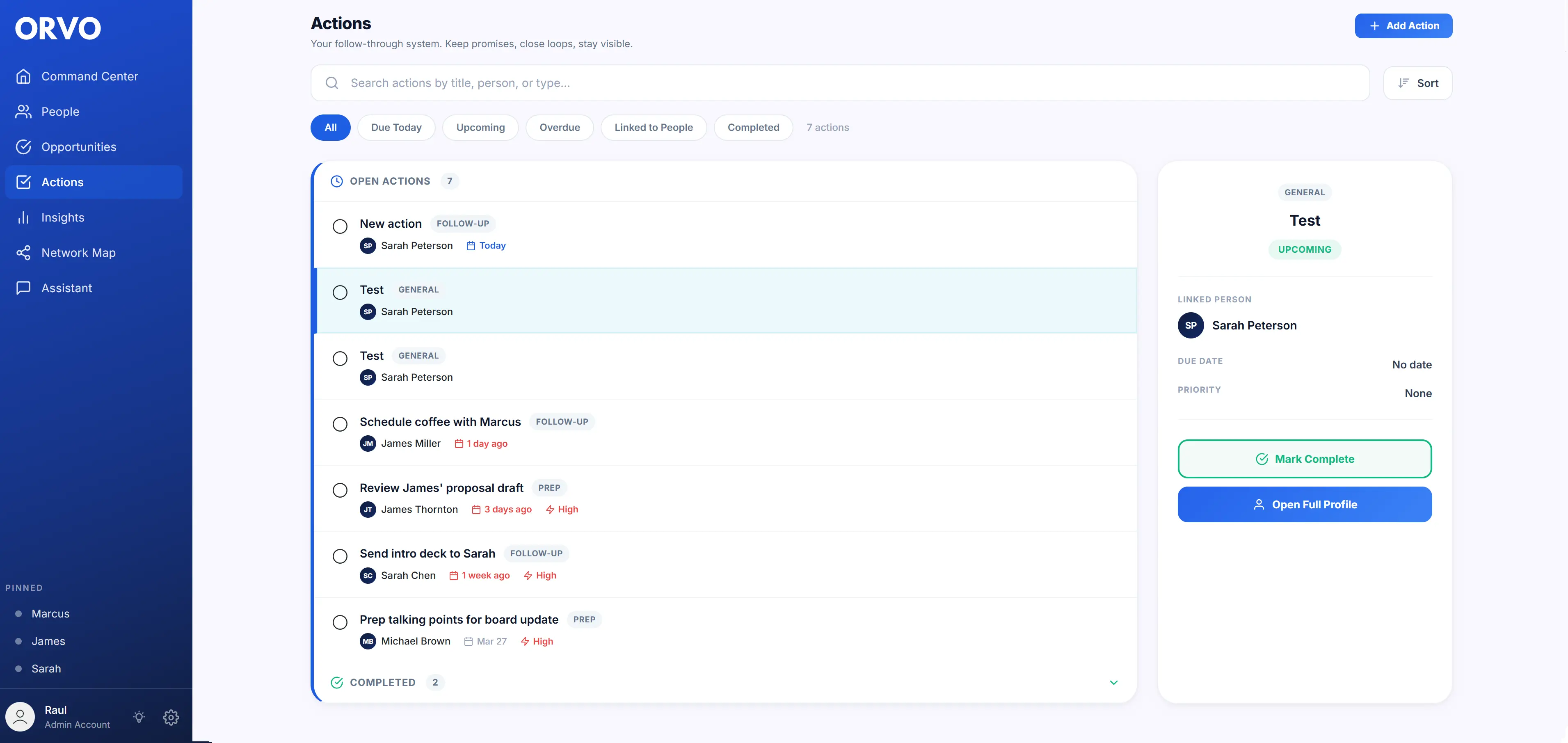
This is precisely why tools like Orvo are becoming essential for the AI-era PM. When you are moving faster — prototyping in hours, iterating daily, presenting to stakeholders weekly — the relationship management challenge multiplies. You are interacting with more people, more frequently, across more projects. Keeping track of every stakeholder's priorities, concerns, communication preferences, and commitments in your head is no longer viable. You need a system.
The PM skills that AI makes more valuable (not less)
The natural question for PMs reading this: which of my existing skills become more important, and which become less relevant? The answer is clear — and it is good news for anyone who invested in the human side of product management.
More valuable: Stakeholder alignment. When you can build a prototype in hours instead of weeks, the bottleneck shifts from "can we build it" to "should we build it and can we get buy-in." The PM who can align engineering, design, sales, marketing, and executive leadership around a product direction is now the most valuable person in the room — because execution speed means nothing if the organisation cannot agree on direction. Stakeholder alignment has always been important. AI makes it the rate-limiting step.
More valuable: Customer empathy and user research. AI can build what you describe. But describing the right thing to build requires deep understanding of customer needs, pain points, and behaviour. The PM who spends time with customers — listening, observing, synthesising — produces better AI prompts and better prototypes because they start with genuine insight rather than assumptions.
More valuable: Strategic prioritisation. AI makes everything faster to build. This creates a new problem: when building is cheap, you can build everything — but you should not. The PM who can ruthlessly prioritise, saying no to good ideas to focus on great ones, becomes essential. This skill requires judgment, market understanding, and the organisational credibility to defend difficult trade-offs.
More valuable: Cross-functional communication. AI tools do not attend standup meetings, resolve conflicts between engineering and design, or explain to the CEO why a feature should be delayed. The PM who can communicate clearly across every function — translating between technical and business language, between executive strategy and team execution, between customer needs and engineering constraints — is more valuable than ever.
Less relevant: Spec writing as a primary output. The 40-page PRD that took two weeks to write is being replaced by a working prototype that took two days. PMs still need to articulate requirements clearly, but the medium has changed from documents to demonstrations.
Less relevant: Project tracking as a primary activity. AI tools can track timelines, update status reports, and flag risks automatically. The PM who spent 30% of their time maintaining Jira boards can now spend that time on customer research and stakeholder alignment.
The net effect: AI is stripping away the administrative overhead of product management and amplifying the strategic, relational, and creative core. PMs who leaned heavily on process and documentation will need to adapt. PMs who built their careers on customer empathy, stakeholder relationships, and strategic thinking will thrive.
| PM Skill | AI Era Impact | Why |
|---|---|---|
| Stakeholder alignment | ↑↑ Much more valuable | Execution speed shifts bottleneck to organisational buy-in |
| Customer empathy / user research | ↑↑ Much more valuable | Better understanding → better prompts → better prototypes |
| Strategic prioritisation | ↑ More valuable | When building is cheap, choosing what to build is the hard part |
| Cross-functional communication | ↑ More valuable | AI cannot attend meetings, resolve conflicts, or explain trade-offs |
| Spec writing (documents) | ↓ Less relevant | Replaced by working prototypes as the primary communication medium |
| Project tracking / Jira management | ↓ Less relevant | AI tools automate status tracking and risk flagging |
How to start: the AI-era PM toolkit in 2026
Whether you are a PM looking to accelerate your career or a professional in any role applying the PM playbook, here is the practical toolkit for 2026.
For prototyping and building: Use AI coding tools (Cursor, Replit, Claude with code generation, or GitHub Copilot) to build working prototypes from natural language descriptions. You do not need to understand the code — you need to understand the product. Describe what you want clearly, test the output, and iterate. If you can write a clear product spec, you can build a prototype.
For research and analysis: Use ChatGPT, Claude, or Perplexity for rapid research synthesis. Feed in competitor products, user research transcripts, market data, and ask for structured analysis. The key is specificity — ask for a comparison table of three competitors across five specific dimensions, not a "general summary."
For communication: Use AI to draft stakeholder updates, meeting agendas, and presentations. Customise each communication for the specific audience — the CFO version is different from the engineering lead version. AI can generate both; you provide the audience intelligence.
For relationship intelligence: Use Orvo to track every stakeholder interaction — what was discussed, what they care about, what commitments were made, when to follow up. This is the layer that AI tools cannot provide because it requires ongoing human observation and judgment. A PM who walks into a meeting knowing exactly what each stakeholder cares about, what was said last time, and what the current dynamics are has a massive advantage over one who relies on memory.
The compound effect: Each tool amplifies the others. AI prototyping produces something concrete to show stakeholders. Stakeholder intelligence (from Orvo) tells you which stakeholders to show it to and how to frame it. Clear communication gets buy-in. Buy-in gets engineering resources. Engineering makes it production-ready. Repeat.
This cycle — prototype → align → build → ship — used to take quarters. With the right toolkit, it takes weeks. The professionals who master this cycle first will define the next era of product development.
AI gives you speed. Orvo gives you stakeholder intelligence. Together, they make you the most effective PM (or professional) in the room. Track every relationship, prep every meeting, never lose context. Start your free trial →
Get Orvo FreePoints clés
- ✓ A Google principal engineer reports PMs are outperforming engineers with AI prototyping tools — and calls it "a good thing"
- ✓ The key advantage is not that PMs code better — it is that AI eliminates the translation layer between spec and prototype
- ✓ PMs succeed with AI because they are good communicators, systemic thinkers, and relationship builders — exactly the skills AI tools need from their human operators
- ✓ The old bottleneck was waiting three sprints to see if something was even worth building. AI removes that bottleneck entirely
- ✓ Engineers are not becoming less important — their role is shifting from "build everything" to "make proven prototypes scalable and production-ready"
- ✓ Every professional can apply the PM playbook: use AI for speed, use relationships for alignment, use communication for impact
- ✓ The future belongs to professionals who combine AI fluency with strong stakeholder management — track those relationships systematically