
Why the First 90 Days Make or Break Your Career at a Company
The first 90 days at a new company are not just an adjustment period — they are the highest-leverage window you will ever have. Research from Harvard Business Review shows that impressions formed in the first 90 days persist for up to 3 years. Your colleagues, your manager, and senior leadership are all forming opinions about your competence, reliability, and cultural fit — and those opinions calcify fast.
The data backs this up: a 2025 Leadership IQ study found that 46% of new hires are considered "failures" within 18 months, and the majority of those failures trace back to poor relationship-building and cultural misread — not lack of technical skill. The people who fail are not less talented. They simply did not invest in the right relationships early enough.
What separates high performers from everyone else during onboarding is not working longer hours or volunteering for every project. It is a systematic approach to three things: understanding the power structure, building trust with the right people, and establishing early wins that are visible to decision-makers.
The problem? Nobody gives you this playbook. HR onboarding covers benefits and compliance. Your manager gives you a project list. But the actual political landscape — who influences decisions, who controls resources, whose opinion your boss trusts — that is left for you to figure out on your own. Most people take 6-12 months to map this. Top performers do it in 30 days.
The 3-Phase Framework: Learn, Build, Deliver
The most effective first 90 days follow three distinct phases. Trying to skip ahead — delivering results before you understand the landscape — is the most common mistake new hires make.
Phase 1: Learn (Days 1-30) — Your only job is to absorb. Meet as many people as possible. Understand the org chart (the real one, not the official one). Identify who actually makes decisions, who influences those decision-makers, and where the political fault lines are. Ask questions relentlessly. Take detailed notes on every conversation.
Phase 2: Build (Days 31-60) — Now you start building genuine relationships with the 10-15 people who matter most. This is where you move from "the new person" to "someone I trust." Schedule 1-on-1s, offer help before asking for it, and start finding your allies. This is also when you identify your first quick win — a project or contribution that demonstrates competence without stepping on toes.
Phase 3: Deliver (Days 61-90) — Execute your quick win and make it visible. By now you understand the landscape, you have relationships with key stakeholders, and you know what the organization values. This is when you shift from learning mode to contribution mode — and the trust you have built in Phases 1 and 2 means your contributions get amplified.
The critical insight: most people try to deliver from Day 1 because they feel pressure to "prove themselves." But delivering without understanding the landscape means you are optimizing for the wrong things. The research from Michael Watkins (author of *The First 90 Days*) shows that leaders who spend adequate time in the Learn phase reach full productivity 40% faster than those who skip it.
| Phase | Timeline | Primary Goal | Key Activities | Common Mistake |
|---|---|---|---|---|
| Learn | Days 1-30 | Map the landscape | Meet people, ask questions, take notes | Trying to deliver too early |
| Build | Days 31-60 | Earn trust | 1-on-1s, help others, find allies | Only building relationships up (ignoring peers) |
| Deliver | Days 61-90 | Visible quick win | Execute project, share results | Taking on too much at once |
Stakeholder Mapping — Your Secret Weapon in a New Role
Here is the single most valuable thing you can do in your first two weeks: map every person who will influence your success. Not just your direct team — everyone. Your skip-level manager. The peer who has been at the company for 10 years. The executive assistant who controls your VP's calendar. The cross-functional partner whose cooperation you need for your projects.
Most new hires passively accumulate contacts as they happen to meet people. Top performers are intentional about it. They create a stakeholder map within the first 14 days that answers four questions for every key person:
1. What do they care about? (Their goals, pressures, metrics) 2. What is their influence level? (Decision-maker, influencer, or gatekeeper) 3. What is their current disposition toward me? (Supportive, neutral, skeptical) 4. What do I need from them? (Information, resources, air cover, collaboration)
This is not office politics — this is strategic awareness. You cannot build effective relationships if you do not understand what people care about and how they relate to each other.
A McKinsey internal study found that consultants who created formal stakeholder maps within the first week of a new engagement received 35% higher client satisfaction scores than those who did not. The same principle applies to any new role: understanding the human landscape is the foundation for everything else.
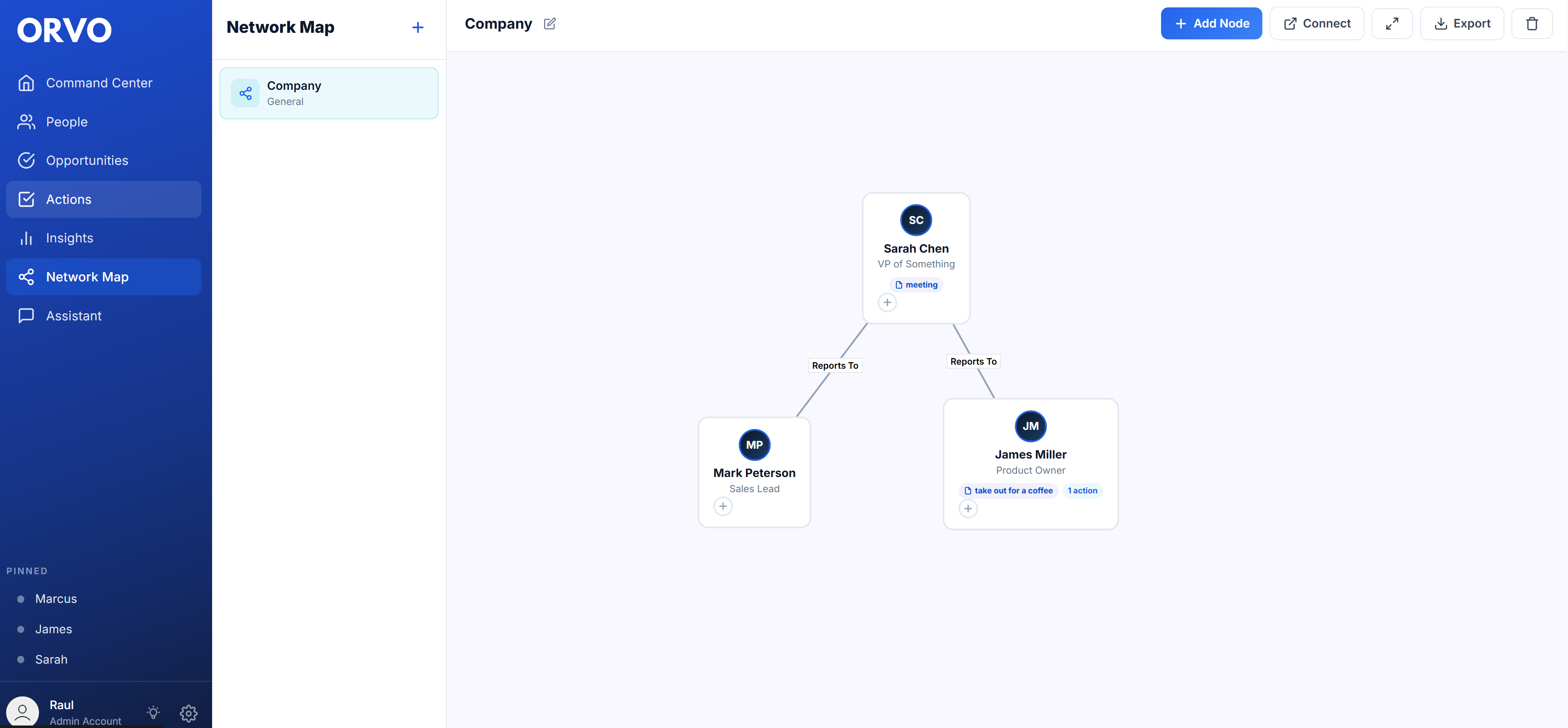
The Tool Stack for a Successful First 90 Days
You need a system, not just good intentions. Here is the complete tool stack that top performers use to navigate a new role systematically.
The biggest gap in most onboarding strategies is relationship tracking. You will meet 30-80 people in your first month. Without a system, you will forget half of what you learned about them by Week 3. You will miss follow-ups. You will accidentally neglect the stakeholders who matter most.
A personal CRM like Orvo solves this by giving you a single place to log every conversation, track relationship health, set follow-up reminders, and prepare for meetings with context from previous interactions. When you walk into a 1-on-1 with your skip-level manager, you can review every previous conversation, their priorities, and what you promised to follow up on — instead of scrambling to remember.
But relationship tracking is just one piece. Here is the complete stack:
| Need | Tool | How It Helps in Your First 90 Days |
|---|---|---|
| Relationship tracking | Orvo | Log conversations with 50+ new colleagues, set follow-up reminders, track who influences whom, prepare for meetings with full context |
| Task management | Notion or Todoist | Track onboarding tasks, project milestones, and commitments you make in meetings |
| Calendar strategy | Google Calendar | Block learning time, schedule strategic 1-on-1s, protect your first 2 weeks from project overload |
| Note-taking | Orvo + Notion | Capture conversation notes (Orvo for people-specific, Notion for project-specific) |
| Org chart mapping | Orvo Network Map | Visualize reporting lines, cross-functional connections, and influence pathways |
| Meeting prep | Orvo AI Assistant | Generate stakeholder briefs before important meetings using relationship history and AI insights |
The Week-by-Week Playbook
Here is exactly what to do, week by week, for your first 90 days. This is based on onboarding research from Michael Watkins, Google's internal onboarding studies (Project Noogler), and patterns from 500+ successful career transitions.
Week 1: Observe and Document
- Meet your direct team (1-on-1 with each person, 20-30 minutes)
- Ask your manager for the org chart and key stakeholder list
- Set up your relationship tracking system (Orvo or equivalent)
- Log first impressions, communication styles, and priorities for everyone you meet
- Identify the informal power holders (people everyone references or defers to)
Week 2: Expand and Map
- Schedule 1-on-1s with cross-functional partners and skip-level manager
- Ask everyone: "What should I know that nobody tells new people?"
- Build your stakeholder map: influence level, disposition, needs
- Start identifying potential quick wins (ask: "What is a persistent pain point I could help with?")
- Review relationship notes from Week 1 — update with new context
Weeks 3-4: Deepen Key Relationships
- Focus on the 10-15 most important stakeholders from your map
- Offer help on something small before asking for anything
- Share a useful article or insight with 2-3 key contacts (value-first networking)
- Have a "Month 1 check-in" with your manager — share what you have learned, ask for feedback
- Set recurring follow-up reminders for key stakeholders (every 1-2 weeks)
Weeks 5-8: Build Trust Through Action
- Start executing your quick win project
- Maintain weekly touchpoints with your top 5 stakeholders
- Begin contributing to team discussions with informed perspectives
- Track all commitments you make — follow through on 100% of them
- Ask for feedback from 3-4 trusted colleagues: "How am I doing? What should I adjust?"
Weeks 9-12: Deliver and Consolidate
- Complete and present your quick win (make it visible to your manager's manager)
- Schedule a formal 90-day review with your manager
- Document your stakeholder map insights and relationship development
- Set a "relationship maintenance" cadence for ongoing stakeholder management
- Plan your next quarter based on everything you have learned
Track every conversation, set follow-up reminders, and walk into meetings prepared — try Orvo free for 14 days →
Start Free Trial5 Fatal Mistakes That Derail New Hires (and How to Avoid Them)
After analyzing hundreds of failed onboardings, these are the five patterns that consistently derail new hires:
Mistake #1: Trying to change things too fast. You were hired for a reason, and that reason might include bringing new ideas. But pushing for changes before you understand the context makes people defensive. Rule of thumb: no major change proposals before Day 60.
Mistake #2: Only building relationships upward. New hires obsess over impressing their manager and skip-level, but neglect peer relationships and relationships with people "below" them. Your peers will determine whether you get cooperation or resistance on every project. The executive assistant who manages your VP's schedule can be your greatest ally or your biggest bottleneck.
Mistake #3: Not taking notes on people. You meet 50+ people in your first month. By Week 4, you will not remember what your VP of Engineering cares about, what your cross-functional partner asked you to follow up on, or which colleague mentioned they are working on a relevant project. Without a system to log and review these conversations, you are flying blind.
Mistake #4: Saying yes to everything. The pressure to be helpful leads new hires to overcommit. Then they miss deadlines, deliver mediocre work on too many projects, and damage the trust they were trying to build. Better to do 2 things excellently than 8 things poorly.
Mistake #5: Waiting for information to come to you. In every organization, the most important information flows through informal channels — hallway conversations, Slack side-channels, lunch groups. New hires who wait for formal onboarding to tell them everything miss the real landscape. Be proactive: ask questions, seek out context, and schedule conversations with people outside your immediate team.
The Future of Onboarding: Why AI Changes Everything
The way we start new jobs is undergoing a fundamental transformation. As Sorin Ciornei wrote in *The Future is Now* (thereach.ai), we are shifting from a Knowledge Economy to a Curating Economy — where the ability to organize, synthesize, and act on information matters more than raw knowledge.
This shift has massive implications for onboarding. AI tools can now help new hires process information faster: summarize meeting notes, generate stakeholder briefs, identify patterns in organizational communication, and even predict which relationships will be most important for a given role.
But AI does not replace the human element — it amplifies it. The professionals who combine AI-powered preparation with genuine human connection will onboard faster and build stronger foundations than either approach alone.
Consider what is already possible: before a key meeting with your new VP, an AI assistant can review your previous conversation notes, their recent priorities, and your commitments to them — then generate a preparation brief in seconds. You walk in fully prepared, ask informed questions, and demonstrate that you remember and care about their priorities. That level of preparation used to require 30 minutes of manual review. Now it takes 30 seconds.
The new hires who embrace these tools will not just survive their first 90 days — they will compress what used to take 6 months of relationship-building into 90 days of systematic, AI-assisted connection-building.
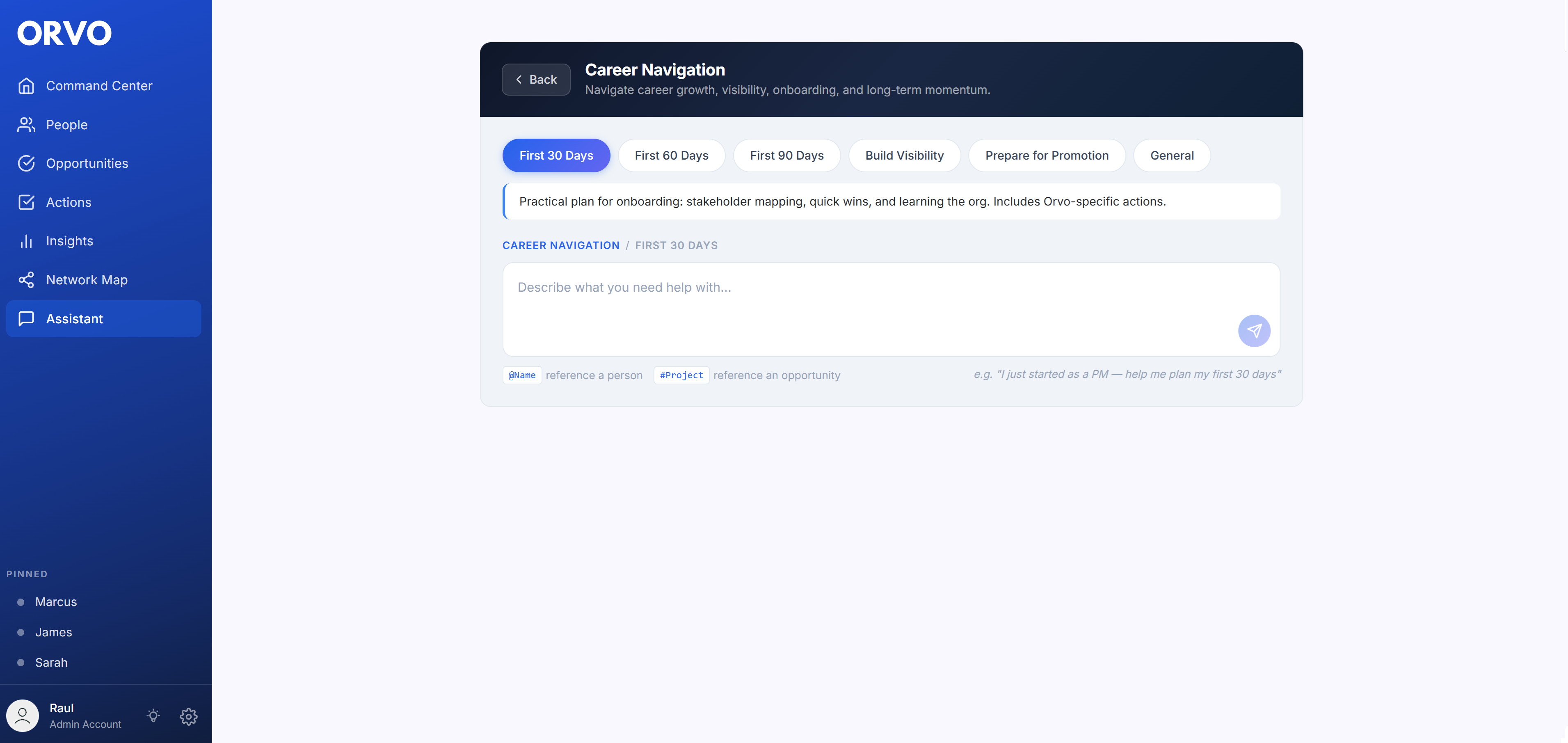
Start your new role with a system — not just good intentions. Try Orvo free for 14 days →
Get Orvo FreePoints clés
- ✓ The first 90 days follow three phases: Learn (map the landscape), Build (earn trust), Deliver (visible quick win).
- ✓ Stakeholder mapping in your first 2 weeks is the single highest-leverage activity for a new hire.
- ✓ Meet 10-15 key stakeholders 1-on-1 and log every conversation — your future self will thank you.
- ✓ Do not try to change things before Day 60. Understand the context before proposing solutions.
- ✓ Use a relationship tracking system (Orvo) to manage 50+ new connections without letting anyone slip through the cracks.
- ✓ Quick wins should be visible to your manager's manager — not just your direct team.