
The ENTJ superpower: why you advance faster than everyone else
ENTJs are the most leadership-correlated type in the Myers-Briggs system. Research from CPP found that ENTJs are overrepresented in senior leadership positions by a factor of 4.5x relative to their population share (roughly 3% of the population). You advance fast because you have a rare combination of strategic thinking, decisiveness, and the willingness to take charge when nobody else will.
In early and mid-career, this is an unqualified advantage. While others hesitate, you decide. While others deliberate, you execute. While others avoid conflict, you address it directly. Organisations desperately need people who can set direction and drive results, and ENTJs do both naturally.
The data backs this up. A 2024 Korn Ferry study of 2,500 executives found that the traits most correlated with rapid promotion to VP level are decisiveness, strategic thinking, and comfort with ambiguity — the ENTJ trifecta. At the VP level and below, pure drive and decisiveness are sufficient. The problems start above.
The ENTJ career paradox: the same traits that get you promoted to VP — directness, speed, command presence — become liabilities at the SVP and C-level, where influence, coalition-building, and trust matter more than authority. The most common feedback ENTJs receive at the VP-to-SVP transition: "You need to bring people along, not just tell them where to go."
The ENTJ blind spots that create a ceiling
Every ENTJ has heard some version of this feedback. Understanding these blind spots is not about changing who you are — it is about removing the friction that prevents your natural leadership from scaling.
Blind spot 1: Bulldozing instead of building consensus. ENTJs see the right answer quickly and want to move. But organisations do not move at the speed of the fastest thinker — they move at the speed of alignment. The ENTJ who announces the decision before the team has processed the problem creates compliance, not commitment. Compliance breaks under pressure. Commitment endures.
Blind spot 2: Confusing speed with effectiveness. ENTJs equate action with progress. But fast decisions made without stakeholder input often need to be revisited, revised, or reversed — which is slower than getting input first. A 2023 study from Wharton found that leaders who consulted 2-3 stakeholders before major decisions had 40% fewer decision reversals than those who decided unilaterally. For ENTJs, the counterintuitive truth: slowing down by 24 hours to consult key stakeholders makes you faster, not slower.
Blind spot 3: Undervaluing emotional data. ENTJs make decisions based on logic, strategy, and results. They often dismiss emotional reactions as irrational. But emotions in organisations are data — they signal trust levels, morale, resistance, and alignment. The ENTJ who ignores the fact that the team feels unheard is ignoring critical organisational intelligence. Not because feelings should drive decisions, but because feelings predict whether decisions get executed.
Blind spot 4: Creating dependency instead of developing people. ENTJs are so competent that they often do things themselves rather than waiting for others to figure it out. This creates a dependency pattern: the team relies on the ENTJ for direction, the ENTJ gets frustrated that the team cannot operate independently, and the cycle reinforces itself. The fix: invest in developing your team's decision-making ability, even when it is slower than doing it yourself.
Blind spot 5: Networking up but not across or down. ENTJs naturally build relationships with senior leaders and decision-makers. They often neglect peer relationships and relationships with junior staff. This creates a political vulnerability: when an ENTJ's proposal requires cross-functional support, their peers may withhold it — not because the proposal is bad, but because the relationship was never built.
| ENTJ Blind Spot | What You Think | What Others Experience | The Fix |
|---|---|---|---|
| Bulldozing | "I see the answer, let's move" | "We were not consulted" | Share your thinking, ask for input, then decide |
| Speed over alignment | "We need to move fast" | "This keeps changing because we didn't think it through" | Consult 2-3 stakeholders — reduces reversals by 40% |
| Dismissing emotions | "That's not logical" | "They don't care how we feel" | Treat emotions as data about trust and alignment |
| Creating dependency | "I'll just do it myself" | "We can't function without them" | Develop team decision-making — coach, don't rescue |
| Networking only upward | "I need the CEO's support" | "They never invest in peer relationships" | Build across and down — peers determine cross-functional support |
The ENTJ relationship strategy: building alliances, not just authority
ENTJs build relationships naturally with people above them in the hierarchy. You are comfortable with power, you speak the language of strategy and results, and senior leaders recognise you as one of their own. This vertical relationship-building is a genuine strength.
The gap is horizontal and downward. Peer relationships and team trust are the two areas where ENTJs most commonly underinvest — and they are the two areas that most commonly stall ENTJ careers at the VP level.
The ENTJ Alliance Framework:
1. Peer alliances (horizontal). Identify the 3-4 peers whose support you need for your initiatives to succeed. These are the leaders of adjacent teams, cross-functional partners, and potential rivals. Schedule quarterly 1-on-1s with each. The agenda: understand their priorities, offer help with their challenges, and build mutual trust. When you need their support for a proposal, the relationship is already there.
2. Team trust (downward). Your direct reports need to trust you, not just respect you. Trust requires vulnerability — sharing your reasoning, admitting uncertainty, and asking for input genuinely (not performatively). One powerful practice: in your next team meeting, present a problem you are wrestling with and say "I do not have the answer yet. What do you think?" This is uncomfortable for ENTJs but transformative for team trust.
3. Senior sponsorship (upward — your natural strength). Continue building relationships with senior leaders, but add depth. Instead of only presenting results, share your strategic thinking process. This positions you as a strategic partner, not just an executor. Senior leaders who understand how you think will advocate for you in rooms you are not in.
4. Cross-functional bridge-building. ENTJs often create adversarial dynamics with other teams by pushing their agenda too aggressively. Flip this: before pushing an initiative, meet with the leaders of affected teams and ask "How can we make this work for both of us?" This reframes you from competitor to collaborator.
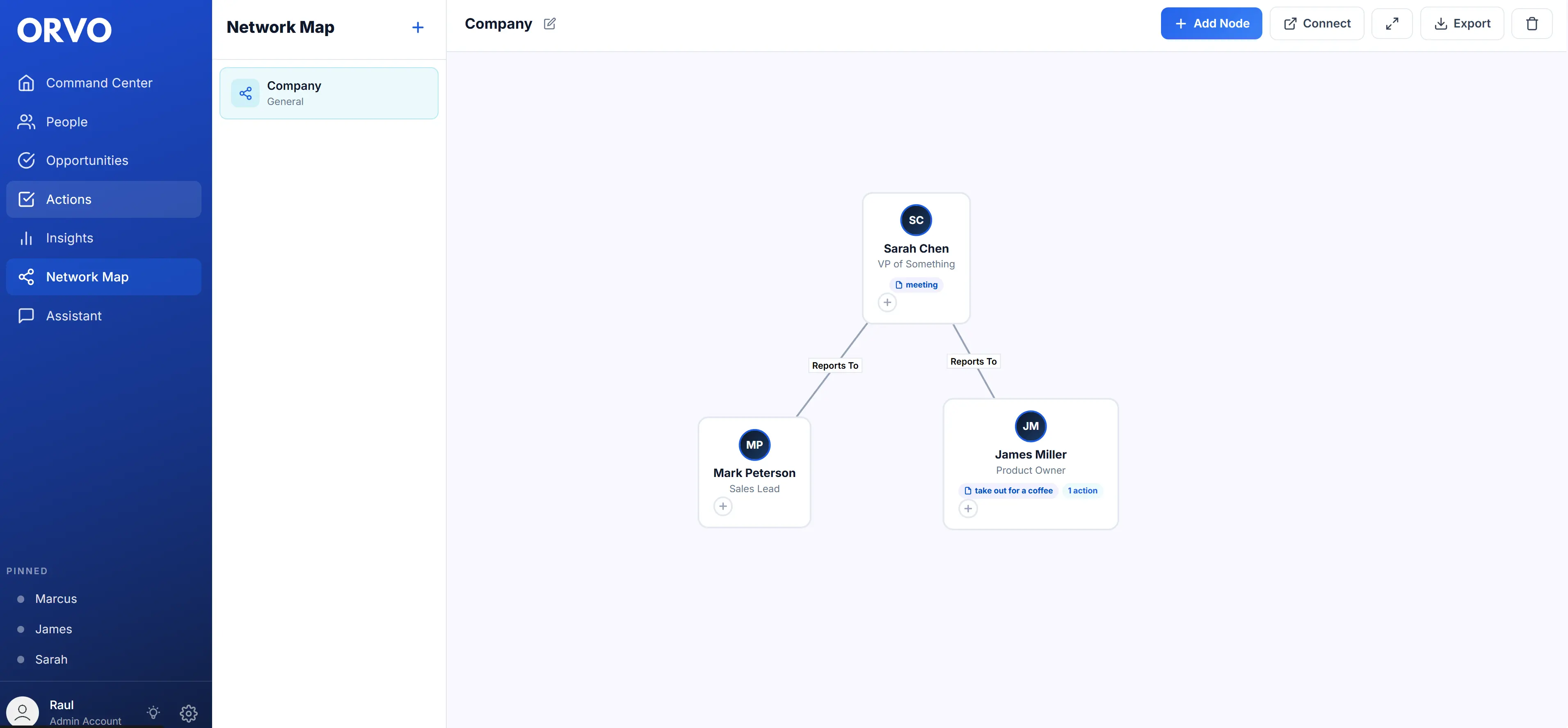
Track every alliance in Orvo. Note each peer's priorities, their team's challenges, and what they need from you. Review before cross-functional meetings. The ENTJ who walks into a meeting knowing what every stakeholder needs — and has already started addressing those needs — wins the room without a fight.
ENTJ communication: how to lead without alienating
ENTJs communicate to direct, decide, and drive action. This is effective in crisis situations and early-stage teams. It is counterproductive in mature organisations where people expect to be consulted, not commanded.
The ENTJ communication upgrade: Command → Collaborate → Commit.
Old pattern (Command): "We are going to do X. Here is the plan. Execute." New pattern (Collaborate → Commit): "I have been thinking about X. My current view is [proposal]. Before we commit, I want to hear your perspective on two things: [specific questions]. Let us align by Friday."
The outcome is often the same — you still do X. But the process includes people, which creates commitment rather than compliance. The 48-hour delay feels expensive to an ENTJ. It is actually an investment that prevents the 2-week delay of silent resistance and re-work.
In 1-on-1s with direct reports: Ask before telling. Start with "What is your read on this situation?" before sharing your view. If you always lead with your opinion, your team will stop thinking independently and just wait for your direction. This creates the dependency pattern that frustrates every ENTJ.
In executive presentations: ENTJs present with confidence and authority — a genuine strength. Add one element: acknowledge trade-offs. "The risk with this approach is Y. Here is how we mitigate it." Executives trust leaders who show they have considered the downsides, not just the upside. Unqualified confidence at the executive level reads as naivete.
In conflict situations: ENTJs confront conflict directly, which is usually the right instinct. The upgrade: separate the person from the problem. "I want to resolve this issue between our teams" not "You need to fix your team's process." Direct confrontation works when it is about the problem. It backfires when it feels like a personal attack.
With introverted or feeling-type colleagues: Slow down. Lower your volume (ENTJs tend to speak loudly and fast when passionate). Ask questions and wait for answers — genuinely wait, not the ENTJ "wait 3 seconds then answer your own question" pattern. Introverts and feelers have valuable input that you will never hear if your communication style overwhelms them.
| Situation | ENTJ Default | More Effective Version | Impact |
|---|---|---|---|
| Announcing a decision | "We're doing X. Execute." | "My view is X. Before we commit, I need your input on Y." | Commitment > compliance |
| 1-on-1 with report | "Here's what I think..." | "What's your read on this?" | Develops independence, reduces dependency |
| Executive presentation | Confident, no caveats | Confident + acknowledge trade-offs | Signals maturity, builds trust |
| Conflict | "You need to fix this" | "Let's resolve this issue between our teams" | Addresses problem without personal attack |
| With introverts | Fast, loud, dominant | Slow down, ask, genuinely wait | Surfaces input you would otherwise miss |
The ENTJ career path: where you thrive and where you derail
ENTJs thrive in roles that combine strategic thinking with execution authority. The ideal ENTJ role has clear goals, decision-making power, a team to lead, and a problem worth solving.
Roles where ENTJs thrive: General management, management consulting, corporate strategy, product leadership, entrepreneurship, operations leadership, programme management, and executive roles. These roles reward decisiveness, strategic thinking, and the ability to drive results through others.
Roles where ENTJs struggle: Individual contributor roles with no team (too isolating), highly collaborative consensus-driven cultures (too slow), research positions with no clear deliverable (too abstract), and support functions with no decision authority (too constraining). ENTJs who find themselves in these roles should either reshape the role to include more leadership scope or plan a strategic move.
The ENTJ derailment pattern. A Hogan Assessment study of 500+ executives found that the most common derailment factor for ENTJ-type leaders is "intimidation" — creating a climate of fear that suppresses dissent and honest feedback. When your team is afraid to tell you bad news, you make worse decisions because you are operating on incomplete information. The executive who says "I want honest feedback" but visibly bristles when they receive it has created an environment where honest feedback is dangerous. This is the single most common reason ENTJs stall at the VP level.
The ENTJ leadership evolution: Early career — lead by competence and drive. Mid-career — lead by vision and decision quality. Senior career — lead by trust, influence, and the ability to develop other leaders. The ENTJ who never evolves past "lead by drive" tops out, no matter how talented they are.
Famous ENTJ leaders: Steve Jobs, Margaret Thatcher, and Jack Welch are frequently typed as ENTJs. What they share is not warmth — it is vision, decisive action, and the ability to mobilise organisations around a clear direction. Notably, each of them learned (some more successfully than others) that raw command authority has limits. Jobs was fired from Apple at 30 because he could not build alliances; he returned at 42 having learned to collaborate. The ENTJ career arc often follows this pattern: early success through force of will, a setback caused by relationship damage, and then a breakthrough when drive is combined with genuine stakeholder investment.
| Career Stage | ENTJ Strength | ENTJ Derailment Risk | Priority Investment |
|---|---|---|---|
| Early (0-5 years) | Decisiveness, execution speed | Alienating peers by being too aggressive | Build peer alliances, practise listening |
| Mid (5-12 years) | Strategic vision, team leadership | Creating dependency — team cannot function without you | Develop team decision-making, delegate genuinely |
| Senior (12+ years) | Executive presence, organisational impact | Intimidation — suppressing honest feedback | Build psychological safety, reward dissent |
| Executive | Vision, transformation capability | Isolation — surrounded by yes-people | Seek diverse counsel, build a truth-telling inner circle |
The ENTJ and emotional intelligence: your biggest growth opportunity
ENTJs often dismiss emotional intelligence as soft or secondary. This is a strategic error. Research from TalentSmart shows that 90% of top-performing executives score high in emotional intelligence, and EQ is the single strongest predictor of leadership performance at the senior level — stronger than IQ, technical skill, or strategic ability.
For ENTJs, emotional intelligence is not about becoming emotional. It is about developing four specific capabilities:
1. Reading the room. ENTJs often miss emotional signals because they are focused on the content of a conversation rather than the dynamics. Practice noticing: who is tense, who is disengaged, who is holding back, who is excited. These signals tell you whether your message is landing, whether you have alignment, and whether people will actually execute after the meeting ends.
2. Timing your directness. ENTJs are direct, which is usually good. But the same message delivered at the wrong moment lands completely differently. Giving blunt feedback to someone who just had a bad day creates resentment. Waiting 24 hours and delivering the same feedback constructively creates growth. The content does not change — the timing does.
3. Asking before telling. This is the single hardest habit for ENTJs to develop and the highest-ROI one. Before sharing your view, ask: "What is your assessment?" or "How would you approach this?" The answer gives you data, makes the other person feel valued, and often reveals considerations you missed. The ENTJ who asks first and tells second makes better decisions and builds more trust simultaneously.
4. Celebrating others' contributions. ENTJs are generous with feedback about what needs to improve and stingy with recognition of what went well. Flip this ratio. For every piece of critical feedback, give three pieces of genuine recognition. This is not empty praise — it is strategic investment in team motivation and loyalty. People who feel recognised by their leader will run through walls for them. People who only hear criticism will do the minimum.
Orvo helps here by tracking your interactions with each team member and stakeholder. If your notes show five consecutive critical conversations with a direct report and zero positive ones, that is a signal to rebalance. Systematic relationship tracking makes invisible patterns visible.
The ENTJ EQ development plan:
Week 1-2: Practise reading the room. In every meeting this week, spend the first 2 minutes observing body language and energy levels before engaging. Note who seems tense, who is checked out, and who is leaning in. Log your observations in Orvo after each meeting.
Week 3-4: Practise asking before telling. In every 1-on-1, ask your direct report for their assessment before sharing yours. This will feel agonisingly slow. Do it anyway. Note which team members give better input when asked first versus told first.
Week 5-8: Practise the recognition ratio. For every piece of constructive feedback, give three pieces of genuine recognition. Not generic praise — specific acknowledgment of what someone did well and why it mattered. Track this ratio in your meeting notes.
Month 3+: Practise timing your directness. Before giving blunt feedback, ask yourself: is this the right moment? Is this person in a state to receive it? Would waiting 24 hours improve how it lands? The content does not change — the timing does. Most ENTJs report that this single practice transforms their leadership effectiveness more than any other EQ investment.
The research is unambiguous: EQ is trainable, and for ENTJs, it has the highest career ROI of any skill investment. You already have the strategic mind. EQ is the multiplier that turns it into executive-level influence.
ENTJ vs INTJ: the key difference at work
ENTJs and INTJs share strategic thinking and decisiveness but differ fundamentally in one dimension: how they deploy their energy.
INTJs build strategy and systems. ENTJs build strategy and mobilise people. The INTJ creates the plan. The ENTJ creates the plan and drives the organisation to execute it.
This difference shows up in career trajectories. INTJs gravitate toward architect and strategist roles — they design the system. ENTJs gravitate toward leadership roles — they run the system. Neither is better, but understanding the difference helps you choose the right path.
Where ENTJs outperform INTJs: Stakeholder mobilisation, team leadership, executive communication, organisational transformation, and any situation that requires driving alignment across large groups.
Where INTJs outperform ENTJs: Deep analytical work, system design, independent problem-solving, long-term strategic planning, and any situation that requires patience over speed.
The power pairing: In many organisations, the most effective leadership duo is an ENTJ-INTJ partnership. The ENTJ leads the people, sets the vision, and drives execution. The INTJ designs the strategy, identifies risks, and provides analytical depth. If you are an ENTJ, finding and partnering with a strong INTJ is one of the highest-leverage relationship investments you can make.
Track these complementary relationships in Orvo. Note who provides what kind of value — strategic thinking, emotional intelligence, execution capability, creative energy — and invest in the relationships that complement your natural strengths.
The ENTJ at home vs at work: managing the switch
ENTJs often hear that they need to "turn off" their leadership mode outside work. Partners, friends, and family members describe feeling managed rather than loved. This is not a character flaw — it is a communication pattern that does not translate well from boardrooms to living rooms.
Understanding this dynamic matters for your career because personal relationship strain directly affects professional performance. A 2024 study from the Harvard Business School found that executives who reported high relationship satisfaction at home performed 23% better on collaborative leadership measures at work. Your home relationships are not separate from your career — they are the foundation.
The ENTJ pattern at home: You see a problem (messy kitchen), you identify the solution (clean it now), and you direct the execution (tell your partner to clean it). In the office, this is leadership. At home, this is controlling. The difference: your team agreed to be managed. Your partner did not.
The switch that helps both domains:
1. Ask, do not direct. At home: "How do you want to handle the kitchen?" not "Can you clean the kitchen?" At work with peers (not direct reports): the same principle applies. Asking invites collaboration. Directing creates resistance.
2. Listen without solving. When your partner shares a problem, they often want empathy, not a solution. Practice saying "That sounds frustrating" before "Here is what you should do." This skill transfers directly to work — colleagues who feel heard before being advised are more receptive to your input.
3. Schedule downtime seriously. ENTJs treat rest as wasted time. It is not — it is recovery time that makes your work performance sustainable. Schedule personal time with the same rigour you schedule meetings. Block it on your calendar. Treat it as non-negotiable.
4. Apply stakeholder thinking to personal relationships. Your partner has priorities, communication preferences, and needs — just like any stakeholder. Log them. Review them. Adapt. The ENTJ who uses Orvo to track professional relationships but ignores the communication preferences of their spouse is optimising the wrong system.
The ENTJs who master the home-work switch report that it improves their leadership at work too. Learning to listen without solving, ask without directing, and support without managing makes you a more effective leader across every domain.
The ENTJ networking advantage (and how to avoid its trap)
ENTJs are natural networkers — they are comfortable approaching senior people, speaking at events, and building high-powered connections. This is a genuine career advantage. The trap is building a network that is wide but shallow.
The ENTJ networking trap: 500 LinkedIn connections, 50 people who recognise your name, and 5 people who would actually go out of their way to help you. Width without depth is a vanity metric. The ENTJ who has genuine trust-based relationships with 20-30 people outperforms the one with 500 contacts every time.
The ENTJ networking upgrade:
1. Follow up with substance. After meeting someone, send a personalised follow-up within 48 hours that references something specific from your conversation. Not a generic "great to meet you" — something that shows you were listening. This takes 2 minutes and puts you in the top 5% of networkers.
2. Give before you ask. ENTJs naturally approach relationships with an agenda — which people sense. Flip it: for the first three interactions with any new contact, offer value without asking for anything. Share an article, make an introduction, or offer a perspective on a challenge they mentioned. By the fourth interaction, the relationship has a foundation of generosity, and any request feels natural.
3. Invest downward. ENTJs network up instinctively. The highest-ROI networking investment is actually downward — mentoring junior professionals, supporting rising talent, and building relationships with people who are early in their careers. Today's junior analyst is tomorrow's VP. The ENTJ who invested in them early has a loyal ally for decades.
4. Maintain systematically. ENTJs start relationships with energy but often let them fade when a new priority emerges. Use Orvo to set quarterly relationship maintenance reminders for your top 30 contacts. A brief message — "Thinking of you, how is the new role going?" — keeps relationships warm without requiring the sustained social energy that ENTJs eventually redirect elsewhere.
The ENTJ networking advantage is real. The upgrade is turning it from a collection of contacts into a network of genuine alliances.
ENTJs lead naturally. Orvo makes that leadership smarter — track alliances, prepare for stakeholder meetings, and build the trust that turns natural authority into lasting influence. Start free →
Get Orvo FreePoints clés
- ✓ ENTJs are overrepresented in senior leadership by 4.5x — but the traits that drive rapid promotion become liabilities at the executive level without trust and alliances
- ✓ Five blind spots: bulldozing consensus, confusing speed with effectiveness, dismissing emotional data, creating team dependency, and networking only upward
- ✓ Build alliances horizontally (peers) and downward (team trust), not just upward. Cross-functional support determines whether your initiatives succeed.
- ✓ Communication upgrade: Command → Collaborate → Commit. Consult 2-3 stakeholders before deciding — it reduces decision reversals by 40%.
- ✓ Emotional intelligence is the ENTJ's highest-leverage growth area. 90% of top executives score high in EQ. It turns natural leadership into executive influence.
- ✓ The ENTJ derailment pattern is intimidation — creating a climate where honest feedback is suppressed. Build psychological safety.
- ✓ Track alliances and stakeholder dynamics systematically in Orvo. The ENTJ who knows what every stakeholder needs wins the room without a fight.